CLAT PG Exam > CLAT PG Notes > Criminal Law > Cheat Sheet: Offences Against the State
Cheat Sheet: Offences Against the State


1. Waging War Against Government (Section 121 IPC)
1.1 Essential Elements
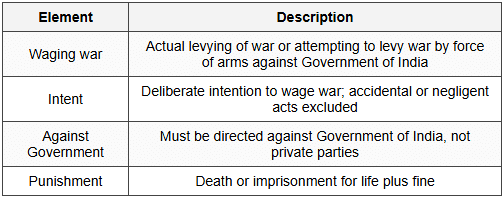
1.2 Key Judicial Interpretations
- War must involve use of force and violence with military operations
- Internal disturbances, riots or unlawful assemblies do not constitute waging war
- Actual commencement of war not necessary; attempts sufficient
- Must intend to overthrow or change government by force
- Isolated acts of violence against officials not waging war
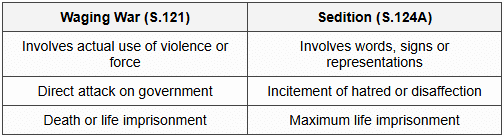
1.3 Distinguished From Sedition
2. Conspiracy to Wage War (Section 121A IPC)
2.1 Essential Elements
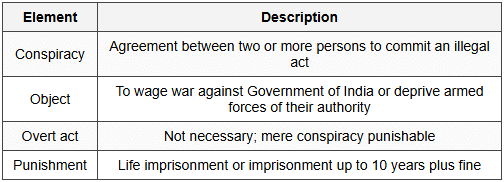
2.2 Key Features
- Added by Act 27 of 1870
- Preparatory stage itself made punishable
- Conspiracy continues until object achieved or abandoned
- All conspirators equally liable regardless of role
- Withdrawal from conspiracy must be explicit and communicated
3. Collecting Arms for Waging War (Section 122 IPC)
3.1 Scope
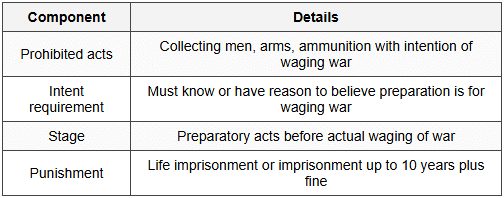
3.2 Distinction From S.121
- S.122 covers preparatory acts; S.121 covers actual waging of war
- Lesser punishment under S.122 (maximum life) vs S.121 (death or life)
- S.122 requires knowledge or reason to believe; S.121 requires actual intent
4. Concealing Design to Wage War (Section 123 IPC)
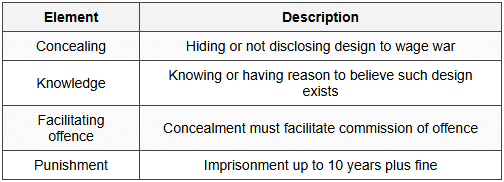
4.1 Essential Elements
4.2 Practical Application
- Applies to persons not directly involved in waging war
- Covers passive assistance through silence
- Knowledge or reason to believe sufficient; actual knowledge not required
- Duty to disclose implied when person aware of design
5. Assaulting President, Governor (Section 124 IPC)
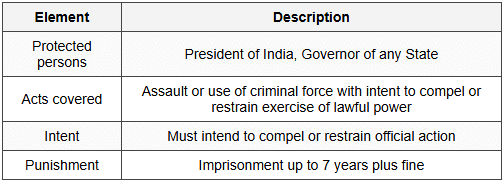
5.1 Offence Components
5.2 Key Aspects
- Protects dignity and independence of constitutional functionaries
- Assault must be connected to official functions
- Personal assault not related to official duty covered under general assault provisions
- Intent to compel or restrain must be proved
6. Sedition (Section 124A IPC)
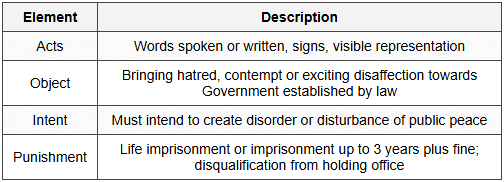
6.1 Essential Elements
6.2 Protected Expression
- Criticism of government measures or policies without exciting hatred
- Comments expressing disapprobation of administrative action
- Advocacy of change through lawful means
- Expression of views without incitement to violence or public disorder
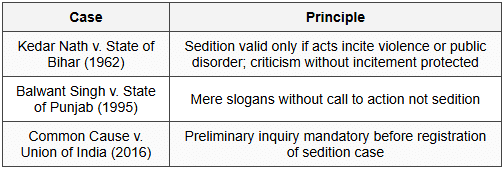
6.3 Landmark Cases
6.4 Constitutional Validity
- Upheld as constitutional in Kedar Nath case subject to narrow interpretation
- Must be read with Article 19(1)(a) freedom of speech
- Only acts inciting violence or public disorder punishable
- Strong dislike or enmity alone not sedition
- Supreme Court placed section in abeyance in 2022 pending reconsideration
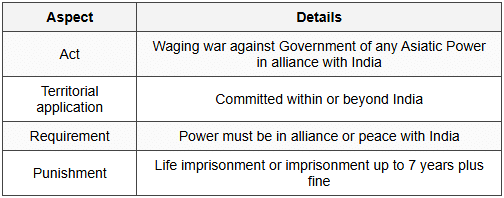
7. Waging War Against Asiatic Powers (Section 125 IPC)
7.1 Scope
7.2 Related Provisions
- Section 126: Committing depredation on territories of power at peace with India
- Section 127: Receiving property taken by war or depredation (imprisonment up to 7 years plus fine)
- All three sections protect India's foreign relations
8. Public Tranquility Offences
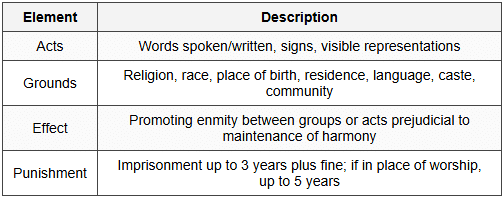
8.1 Promoting Enmity (Section 153A IPC)
8.2 Imputations Prejudicial to National Integration (Section 153B IPC)
- Making imputations that any class cannot bear true faith to Constitution
- Asserting superiority or inferiority based on identity grounds
- Imprisonment up to 3 years plus fine
- Added by Act 35 of 1969
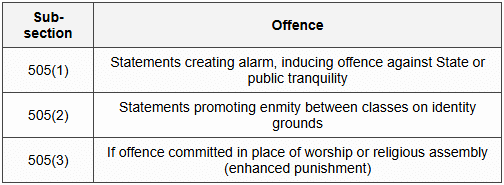
8.3 Public Mischief (Section 505 IPC)
9. Unlawful Assembly (Sections 141-145 IPC)
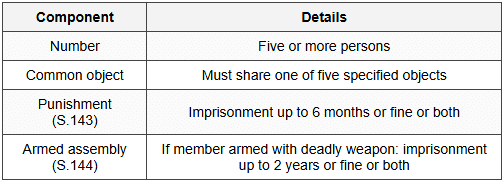
9.1 Definition and Elements
9.2 Five Common Objects (Section 141)
- Overawe Government or Parliament/State Legislature by criminal force or show of force
- Resist execution of any law or legal process
- Commit any mischief or criminal trespass
- Obtain possession of property by force or wrongfully retain it
- Compel any person to do illegal act or omit to do legal act
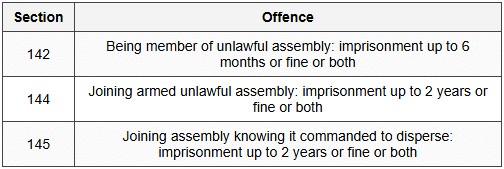
9.3 Joining Unlawful Assembly (Section 142-145)
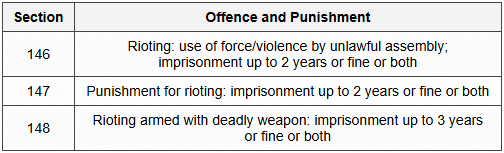
10. Rioting (Sections 146-158 IPC)
10.1 Basic Offence
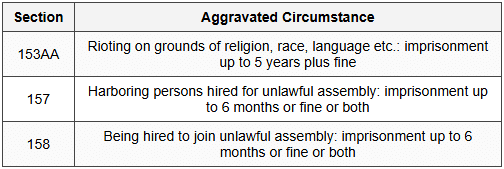
10.2 Aggravated Forms
10.3 Vicarious Liability
- Every member of unlawful assembly liable for offence committed in prosecution of common object
- Liability extends even if member did not commit actual offence
- Member must know offence likely to be committed
- Applies under Section 149 IPC
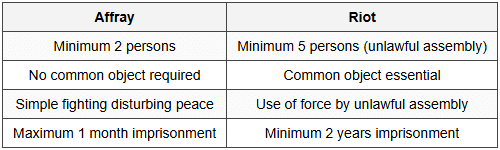
11. Affray (Section 159 IPC)
11.1 Elements
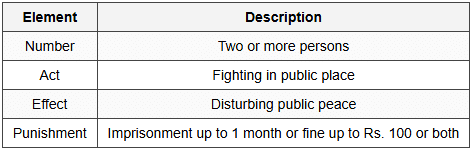
11.2 Distinction From Riot
12. Procedural Aspects
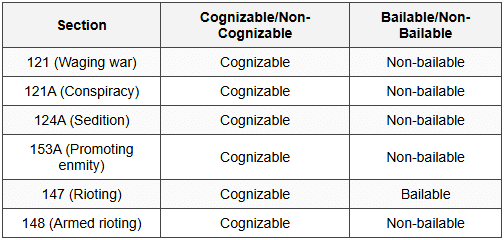
12.1 Cognizability and Bail
12.2 Trial Courts
- Sections 121, 121A, 122, 123: Court of Session
- Section 124A: Court of Session
- Sections 143-145, 147-148: Any Magistrate
- Sections 153A, 153B, 505: First Class Magistrate or higher
12.3 Special Provisions
- Government sanction required for prosecution under Section 124A (sedition)
- Preliminary inquiry mandatory before FIR in sedition cases (Common Cause judgment)
- Section 196 CrPC: Sanction required for prosecution under S.153A in certain cases
- Compoundable: None of these offences compoundable
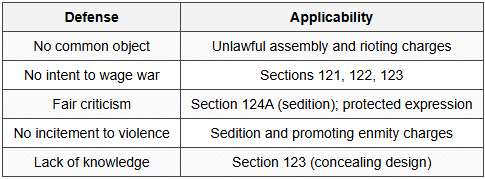
13. Defenses and Exceptions
13.1 General Defenses
13.2 Constitutional Protections
- Article 19(1)(a): Freedom of speech includes right to criticize government
- Article 19(2): Reasonable restrictions on speech in interest of sovereignty, integrity, security
- Article 21: Right to life includes right to dissent
- Balancing test: State interest vs. individual liberty
14. Recent Developments
14.1 Sedition Law Status
- Supreme Court in S.G. Vombatkere v. Union of India (2022) placed Section 124A in abeyance
- Pending cases under sedition stayed
- No fresh FIRs to be registered until reconsideration complete
- Government directed to review sedition law
- Kedar Nath principles continue to guide interpretation
14.2 Judicial Trends
- Stricter scrutiny of sedition charges
- Emphasis on preliminary inquiry before arrest
- Protection for peaceful protests and dissent
- Narrow interpretation of "public order" offences
- Enhanced protection for journalistic freedom
14.3 Amendments
- Section 153AA added by Act 31 of 2014: Rioting on identity grounds
- Enhanced punishment for offences in places of worship
- Stricter provisions for armed assemblies
The document Cheat Sheet: Offences Against the State is a part of the CLAT PG Course Criminal Law.
All you need of CLAT PG at this link: CLAT PG
About this Document

4.94/5 Rating

Apr 20, 2026 Last updated
Related Exams
Document Description: Cheat Sheet: Offences Against the State for CLAT PG 2026 is part of Criminal Law preparation. The notes and questions for Cheat Sheet: Offences Against the State have been prepared according to the CLAT PG exam syllabus. Information about Cheat Sheet: Offences Against the State covers topics like and Cheat Sheet: Offences Against the State Example, for CLAT PG 2026 Exam. Find important definitions, questions, notes, meanings, examples, exercises and tests below for Cheat Sheet: Offences Against the State.
Introduction of Cheat Sheet: Offences Against the State in English is available as part of our Criminal Law for CLAT PG & Cheat Sheet: Offences Against the State in Hindi for Criminal Law course. Download more important topics related with notes, lectures and mock test series for CLAT PG Exam by signing up for free. CLAT PG: Cheat Sheet: Offences Against the State
Description
Cheat Sheet: Offences Against the State of Criminal Law to help you remember important concepts with short tricks. Start learning for CLAT PG exam & improve retention with EduRev.
Information about Cheat Sheet: Offences Against the State
In this doc you can find the meaning of Cheat Sheet: Offences Against the State defined & explained in the simplest way possible. Besides explaining types of Cheat Sheet: Offences Against the State theory, EduRev gives you an ample number of questions to practice Cheat Sheet: Offences Against the State tests, examples and also practice CLAT PG tests



Related Searches
Exam, Cheat Sheet: Offences Against the State, Semester Notes, study material, past year papers, practice quizzes, Cheat Sheet: Offences Against the State, Viva Questions, Previous Year Questions with Solutions, pdf , video lectures, Cheat Sheet: Offences Against the State, Objective type Questions, ppt, Extra Questions, Important questions, shortcuts and tricks, Summary, Sample Paper, MCQs, Free, mock tests for examination;