Critical Thinking Questions: Equation of A Line

Statements Based Questions
Q1: Consider the line with the equation 2x - 3y = 6.
Statement 1: The slope of this line is 2/3.
Statement 2: The y-intercept of this line is -2.
Statement 3: This line is parallel to the line with the equation 3y = 2x + 12.
(a) Only 1
(b) Only 2
(c) Only 1 and 3
(d) All 1, 2 and 3
Q2: A line passes through the points (1, 2) and (-3, -2).
Statement 1: The slope of the line is -2.
Statement 2: An equation of the line in slope-intercept form is y = -2x + 4.
Statement 3: The line crosses the y-axis above the origin.
(a) Only 1
(b) Only 2
(c) Only 1 and 2
(d) All 1, 2 and 3
Q3: Given the line equation y = 7x - 35,
Statement 1: The slope of the line is 7.
Statement 2: The y-intercept of the line is -5.
Statement 3: The line passes through the point (5, 0).
(a) Only 1
(b) Only 2
(c) Only 1 and 3
(d) All 1, 2 and 3
Q4: Let L is perpendicular to the equation 3x - 4y = 12 and passes through the point (1, 4).
Statement 1: The slope of line L is 4/3.
Statement 2: An equation of line L is 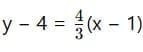 .
.
Statement 3: Line L intersects the y-axis at y = 8/3.
(a) Only 1
(b) Only 2
(c) Only 1 and 2
(d) None of the above
Q5: Consider the following statements regarding the line that passes through the point P (3, 2) and cuts the x-axis and the y-axis at ratios 3:4.
Statement 1: The x-intercept of the line is 4 units.
Statement 2: The y-intercept of the line is 3 units.
Statement 3: The equation of the line is 4x + 3y - 18 = 0.
(a) Only 1
(b) Only 2
(c) All 1, 2 and 3
(d) None of the above
Q6: For a rectangle with vertices A (-1, -1), B (4, -1), C (4, 2), and D (-1, 2), which of the following statements are true regarding its diagonals?
Statement 1: The slope of diagonal AC is 3/5.
Statement 2: The equation of diagonal BD is y = (3/5)x + 3.
Statement 3: The diagonals intersect at the point (1.5, 0.5).
(a) Only 1
(b) Only 2
(c) 1 and 3
(d) All 1, 2 and 3
Q7: If two lines with slopes (m₁) and (m₂) are perpendicular, which of the following statements must be true?
Statement 1: (m₁)(m₂) = -1
Statement 2: m₁ = -m₂
Statement 3: m₁ = 1/m₂
(a) Only 1
(b) Only 2
(c) Only 1 and 3
(d) All 1, 2 and 3
Q8: Which of the following are the correct steps to find the slope of a line perpendicular to the line (4x - 6y = 12)?
Statement 1: Convert the equation to slope-intercept form to find the slope (m₁).
Statement 2: Use the relationship (m₁)(m₂) = -1 to find the perpendicular slope (m₂).
Statement 3: Take the reciprocal of (m₁) to find (m₂).
(a) Only 1
(b) Only 1 and 2
(c) Only 2 and 3
(d) All 1, 2 and 3
Q9: Consider the equation of the line parallel to line AB, where AB joins points A (7, -1) and B (0, 3). Which of the following statements is true regarding the line parallel to AB?
Statement 1: The slope of the line parallel to AB is 4/7.
Statement 2: The y-intercept of the line parallel to AB and passing through C (1, 20) is 20.
Statement 3: The equation of the line parallel to AB passing through point P (4, 1) is 4x + 7y - 13 = 0.
(a) Only 1
(b) Only 2
(c) Only 1 and 3
(d) All 1, 2 and 3
Q10: For the line perpendicular to line AB that passes through point P (4, -1), which of the following statements is/are true?
Statement 1: The slope of the line perpendicular to AB is 1.
Statement 2: The x-intercept of the line perpendicular to AB is 3.
Statement 3: The equation of the line perpendicular to AB through P (4, -1) is x - y + 3 = 0.
(a) Only 1
(b) Only 2
(c) Only 1 and 3
(d) All 1, 2 and 3
FAQs on Critical Thinking Questions: Equation of A Line
| 1. What is the general equation of a straight line in a two-dimensional coordinate system? |  |
| 2. How can the slope of a line be determined from two points on the line? | |
| 3. What does the y-intercept of a line represent in its equation? | |
| 4. How can one convert the equation of a line from slope-intercept form to standard form? | |
| 5. What is the significance of parallel and perpendicular lines in the context of their slopes? | |