PIB Summary - 4th January 2026

Catalyzing India's Semiconductor Design Ecosystem
Why in News?
The Government of India, through the Ministry of Electronics and Information Technology, highlighted the progress of the Design Linked Incentive (DLI) Scheme under the Semicon India Programme, showcasing India's advances in semiconductor chip design, a high-value and strategic segment of the global electronics ecosystem.
The announcement underscores India's push towards Aatmanirbhar Bharat, technological sovereignty, and positioning India as a global fabless semiconductor design hub.
Relevance (UPSC GS-III)
Science & Technology: Semiconductors, Emerging Technologies
Infrastructure & Industry: Electronics manufacturing ecosystem
Economic Development: Industrial policy, Innovation, Startups
Internal & External Security: Defence electronics, critical tech autonomy
Static Background (Conceptual Linkage)
What are Semiconductors?
Semiconductors are materials (e.g., silicon) whose electrical conductivity lies between conductors and insulators. They form the backbone of:
Consumer electronics
Telecom & 5G
Defence & space systems
AI, IoT, EVs, medical devices
Global Semiconductor Value Chain
Design (Fabless) - IP cores, SoCs, chip architecture
Fabrication (Fabs) - Capital-intensive manufacturing
Assembly, Testing & Packaging (ATMP)
India's strength lies primarily in design, not fabrication.
Key Highlights from PIB (DLI Scheme)
1. Strategic Importance of Chip Design
Contributes up to 50% of value addition
Accounts for 20-50% of Bill of Materials (BoM) cost
Forms 30-35% of global semiconductor sales in the fabless segment
Inference: Design is the highest value-generating and least capital-intensive segment - ideal for India.
2. Design Linked Incentive (DLI) Scheme
Implemented by Ministry of Electronics and Information Technology
Part of Semicon India Programme
Objective: Build a self-reliant, globally competitive semiconductor design ecosystem
3. Project Coverage & Outcomes
24 semiconductor design projects supported
Strategic domains:
Video surveillance
Drone detection
Energy metering
Microprocessors
Satellite communication
IoT-based SoCs
Achievements so far:
16 tape-outs
6 ASIC chips
10 patents
1,000+ engineers engaged
3× private investment leverage
Who Can Apply? (Policy Design)
DPIIT-recognized Startups
MSMEs
Indian-owned domestic companies (as per FDI norms)
Promotes inclusive innovation beyond large corporates.
Financial Architecture (Static + Dynamic Integration)
Product Design Linked Incentive
Up to 50% reimbursement of eligible expenditure
Cap: ₹15 crore per application
Deployment Linked Incentive
6%-4% of net sales turnover for 5 years
Cap: ₹30 crore per application
Minimum sales:
₹1 crore (Startups/MSMEs)
₹5 crore (Others)
Static Link: Mirrors global best practices of outcome-based industrial incentives.
Design Infrastructure Support (Institutional Backbone)
Through C-DAC - ChipIN Centre:
National EDA Tool Grid (remote access)
IP Core Repository
MPW prototyping subsidies
Post-silicon validation facilities
Achievements & Ecosystem Impact
~1 lakh engineers enabled
~400 organisations onboarded
95 startups + 305 academic institutions
54 lakh+ EDA usage hours
140+ reusable semiconductor IP cores
Inference: Creation of a national shared design commons.
Strategic Significance (Mains-Ready)
Economic
Reduces import dependence on foreign semiconductor IPs
Strengthens electronics manufacturing value chain
Technological
Enables AI, telecom, EVs, defence & space applications
Promotes IP-led innovation over assembly-led growth
Geopolitical
Reduces vulnerability to global chip supply disruptions
Enhances strategic autonomy amid US-China tech decoupling
Startup & Innovation
Lowers entry barriers for deep-tech startups
Encourages fabless semiconductor entrepreneurship
Challenges & Watch-Points
Limited domestic fabrication capacity (design-manufacturing gap)
Long gestation period for commercial chip success
Talent retention amid global competition
Need for stronger industry-academia-defence linkage
Way Forward
Integrate DLI with upcoming semiconductor fabs & ATMP units
Expand DLI coverage to AI-specific & defence-grade chips
Strengthen global partnerships while retaining IP ownership
Align with Digital India, Make in India, and Startup India
Rah-Veer: Save a Life Without Fear - Good Samaritan Protections Ensure You Don't Need to Worry About Anything
Why in News?
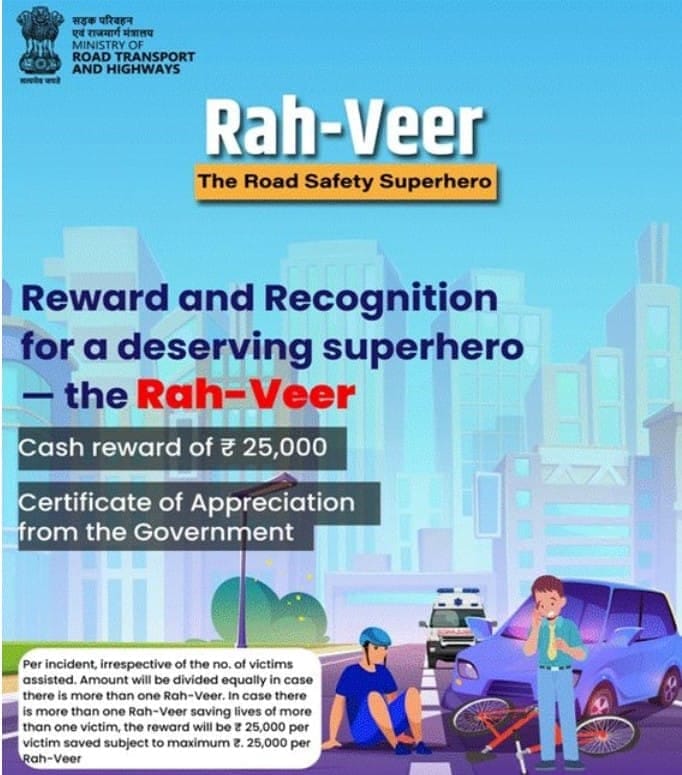
Rah-Veer: Save a Life Without Fear initiative highlighted by the Ministry of Road Transport & Highways through a PIB release (04 Jan 2026) to promote Good Samaritan protections for citizens who assist road-accident victims during the Golden Hour, backed by statutory immunity and monetary recognition.
Relevance
GS-II
Governance, Citizen-centric administration
Police reforms, access to justice
Rights of citizens, legal safeguards
GS-III
Road safety, transport sector reforms
Disaster & accident management
Public health (emergency response systems)
Essay / Ethics (GS-IV)
Moral courage, empathy, civic duty
Fear vs responsibility in public life
Background & Static Linkage
Legal basis: Section 134A, Motor Vehicles (Amendment) Act, 2019
Operationalised through Good Samaritan Rules, 2020
Anchored in the concept of "Golden Hour" - first hour after trauma when timely care can save lives
Aligns with:
National Road Safety Policy
WHO Decade of Action for Road Safety
SDG-3 (Good Health & Well-being) & SDG-11 (Safe transport systems)
Key Features of the Rah-Veer Framework
1. Legal Protections (Fear-Removal Architecture)
A Good Samaritan (Rah-Veer):
Cannot be compelled to reveal identity
Cannot be detained or harassed by police
Protected from civil & criminal liability when acting in good faith
Single voluntary statement only, at a time/place of choice
No obligation to bear medical costs or remain at hospital
Inference: Law shifts from procedural suspicion to presumption of good faith.
2. Myths vs Reality (Behavioural Nudge)
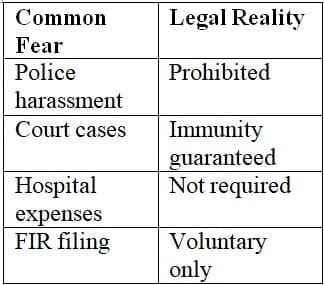
Static Angle: Addresses bystander effect - a known behavioural barrier in emergency response.
3. Golden Hour Significance
30-50% reduction in mortality possible with timely medical aid
Most road fatalities occur due to delay, not injury severity
India records among the highest road deaths globally
GS-III Link: Road safety is as much about institutional design as infrastructure.
Recognition & Incentive Structure
Under the Rah-Veer Scheme:
₹25,000 cash reward
Certificate of Appreciation
Recognition up to 5 times per year
Policy Logic:
Combination of moral appeal + economic incentive → sustained citizen participation.
Governance & Administrative Significance
Social Impact
Normalises helping behaviour in public spaces
Reduces hesitation driven by legal fear
Strengthens trust between citizens, police & hospitals
Economic Impact
Road accidents cost India ~3% of GDP
Faster response → lower long-term healthcare & productivity losses
Institutional Impact
Moves governance from punitive compliance to facilitative citizenship
Comparative & Static Perspective
Similar to Good Samaritan Laws in:
USA
Canada
UK
India's model stands out for:
Explicit anonymity rights
Cash incentives
Central legal backing
Ethics Angle (GS-IV Ready)
Reinforces constitutional morality beyond written law
Encourages:
Compassion over apathy
Duty over fear
Converts ethical action into state-supported behaviour
Gaps & Watch-Points
Low public awareness at grassroots level
Inconsistent police/hospital sensitisation
Reward process delays may dilute motivation
No real-time national dashboard on Rah-Veer cases
Way Forward
Mandatory training for police & emergency staff
Integration with 112 emergency system
Mass IEC campaigns (schools, driving licences, toll plazas)
Digital tracking & fast-track reward disbursal
Conclusion
Rah-Veer transforms road safety from a state-centric response to a citizen-powered rescue ecosystem, proving that governance succeeds when law empowers empathy rather than punishes humanity.
Ayush Export Promotion Council observes 4th Establishment Anniversary in New Delhi
Key Highlights
4th Anniversary Celebration
The Ayush Export Promotion Council (AYUSHEXCIL) marked its 4th establishment anniversary in New Delhi.
It was established to promote exports of traditional systems of medicine and wellness products.
Growth in AYUSH Exports
Exports of AYUSH and herbal products recorded a 6.11% increase in 2024-25 compared to 2023-24.
Export value rose from USD 649.2 million to USD 688.89 million.
Initiatives by AYUSHEXCIL
Focus on building exporter capacity.
Facilitating export procedures and compliance.
Organising B2B meetings, international exhibitions, seminars, and outreach programmes in key overseas markets.
Recognition in Trade Agreements
Traditional medicine systems (AYUSH) received formal acknowledgment in bilateral trade agreements such as:
India-Oman CEPA
India-New Zealand FTA
These include dedicated annexes on traditional medicine and health-related services.
Ayush Quality Mark Programme
AYUSHEXCIL has been assigned to anchor the Ayush Quality Mark programme by the Ministry of Ayush.
The programme was launched by the Hon'ble Prime Minister during the 2nd WHO Summit on Traditional Medicine (17-19 December 2025) to strengthen quality assurance and global recognition.
Future Goals for AYUSHEXCIL
Strengthen international cooperation.
Leverage Free Trade Agreements for better market access.
Promote certification frameworks and global acceptance of Indian traditional medicine systems.
About AYUSHEXCIL
Registered as a Section-8 Company on 4 January 2022.
Formally launched by Prime Minister Shri Narendra Modi on 20 April 2022 at the Global AYUSH Investment and Innovation Summit in Gandhinagar, Gujarat.
Designated as the Nodal Export Promotion Council for AYUSH by the Directorate General of Foreign Trade (DGFT) on 31 July 2023.
Operates in consultation with the Ministry of Ayush and supported by the Ministry of Commerce & Industry.
Key Takeaway
The press release highlights the progress of India's AYUSH exports - growing steadily under AYUSHEXCIL's initiatives - and emphasizes India's enhanced global outreach for traditional medicine products, backed by trade agreements, quality certification drives, and strategic international cooperation.
FAQs on PIB Summary - 4th January 2026
| 1. What is the significance of catalysing India's semiconductor design ecosystem? |  |
| 2. What are the potential challenges faced by India's semiconductor design ecosystem? | |
| 3. How do Good Samaritan protections relate to saving lives? | |
| 4. What role does the Ayush Export Promotion Council play in promoting health and wellness products? | |
| 5. How can individuals contribute to the semiconductor design ecosystem in India? | |




