CBSE Class 10 > Class 10 Notes > Mathematics (Maths) > Infographics: Surface Areas and Volumes
Infographics: Surface Areas and Volumes

The document Infographics: Surface Areas and Volumes is a part of the Class 10 Course Mathematics (Maths) Class 10.
All you need of Class 10 at this link: Class 10
FAQs on Infographics: Surface Areas and Volumes
| 1. What are the formulas for calculating the surface areas and volumes of common geometric shapes? |  |
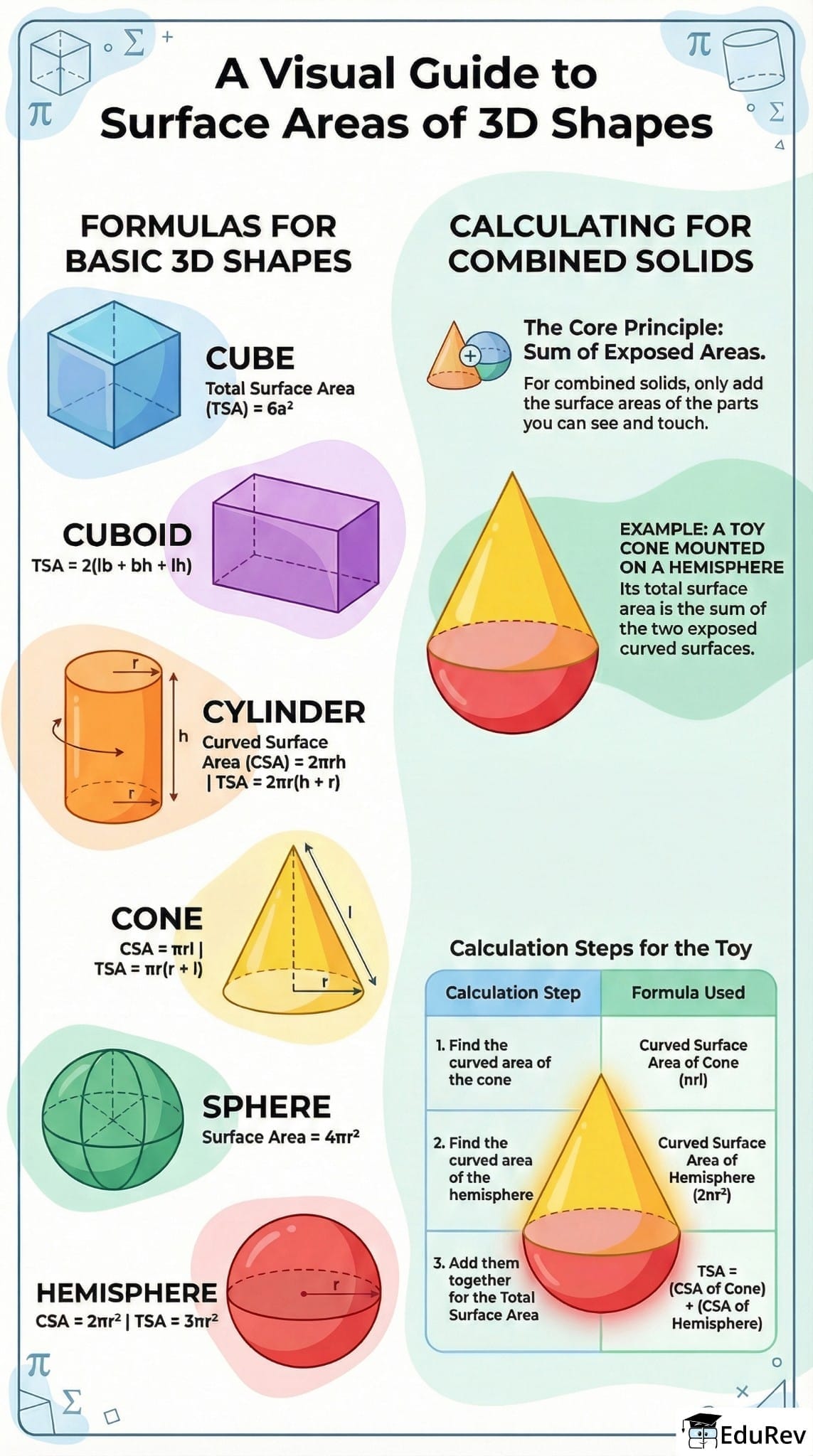
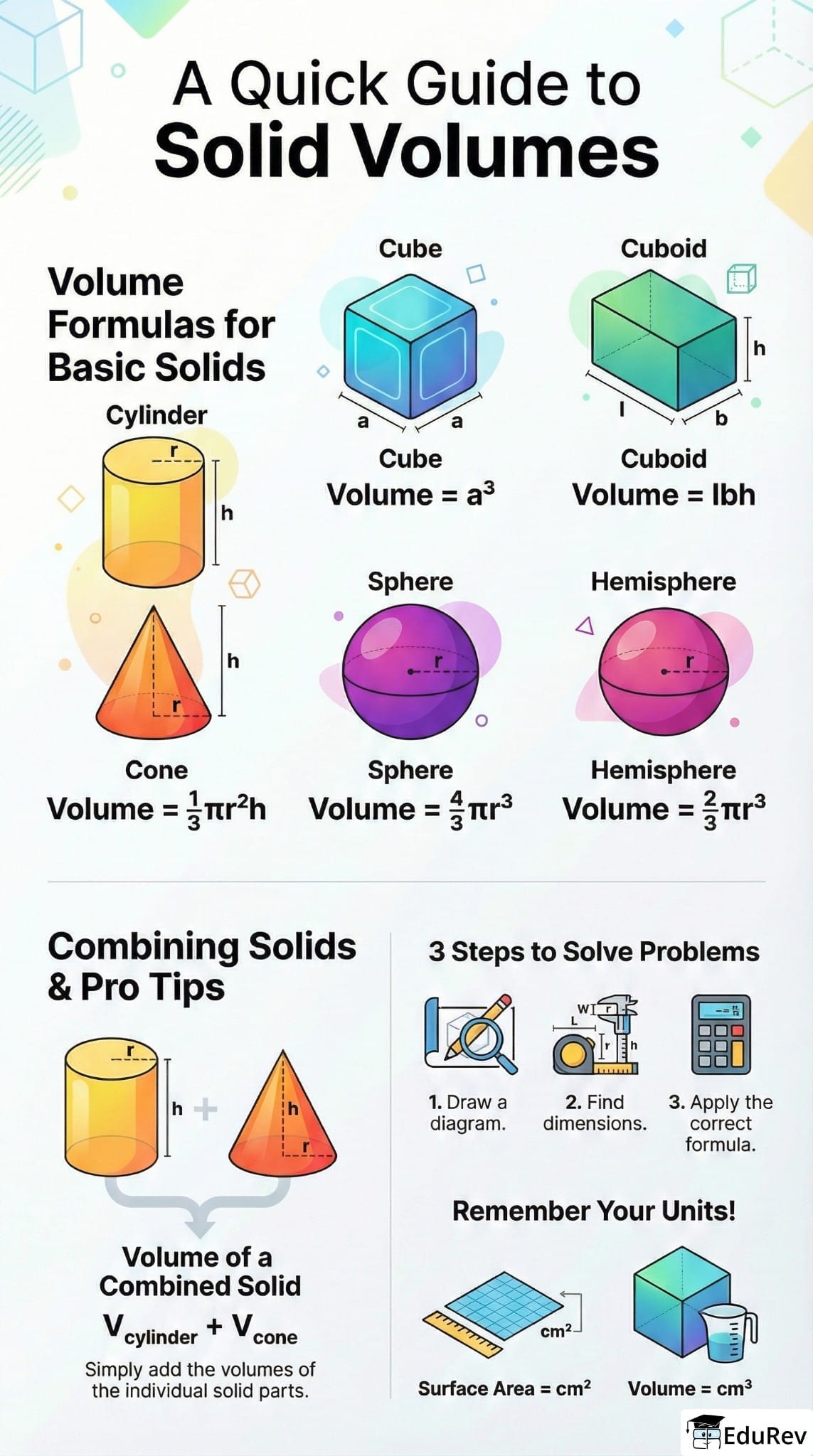
Ans. The formulas for calculating surface areas and volumes of common geometric shapes are as follows: - For a cube: Surface Area = 6a², Volume = a³ (where a is the length of a side). - For a cuboid: Surface Area = 2(lb + bh + hl), Volume = lbh (where l, b, and h are the length, breadth, and height, respectively). - For a cylinder: Surface Area = 2πr(r + h), Volume = πr²h (where r is the radius and h is the height). - For a sphere: Surface Area = 4πr², Volume = (4/3)πr³ (where r is the radius). - For a cone: Surface Area = πr(r + l), Volume = (1/3)πr²h (where r is the radius and l is the slant height).
| 2. How does one derive the volume of a cylinder? | |
Ans. The volume of a cylinder can be derived from the formula Volume = πr²h. Here, r is the radius of the circular base, and h is the height of the cylinder. This formula is based on the concept that the volume of the cylinder is equal to the area of the base (which is a circle) multiplied by the height. Since the area of a circle is given by A = πr², multiplying this by the height yields the volume of the cylinder.
| 3. What is the relationship between surface area and volume for geometric shapes? | |
Ans. The relationship between surface area and volume for geometric shapes can be understood as follows: while surface area measures the total area that the surface of a three-dimensional object occupies, volume measures the space that the object occupies. Generally, as the size of an object increases, its volume increases at a faster rate than its surface area. This means that larger shapes have a relatively smaller surface area-to-volume ratio, which is important in various applications, such as biology and material science.
| 4. How can one apply the concepts of surface area and volume in real-life situations? | |
Ans. The concepts of surface area and volume are widely applicable in real-life situations. For example, in packaging, understanding the volume helps in determining how much product can fit within a box, while surface area can assist in calculating the amount of material needed for packaging. In construction, these concepts help architects and engineers design spaces effectively, ensuring that buildings have adequate volume for occupancy while maintaining appropriate surface areas for insulation and aesthetics. Additionally, in cooking, understanding the volume of pots and pans can help in recipe scaling.
| 5. Why is it important to understand the surface area-to-volume ratio? | |
Ans. Understanding the surface area-to-volume ratio is important because it affects various physical and biological processes. For example, in biology, smaller cells have a higher surface area-to-volume ratio, allowing for more efficient exchange of materials such as nutrients and waste. In engineering, this ratio influences heat dissipation in electronic devices, as a higher ratio allows for better cooling. In ecological contexts, it affects how organisms interact with their environment, impacting metabolism and growth rates. Thus, this ratio is crucial for optimising design and functionality across different fields.
About this Document

4.67/5 Rating

Apr 20, 2026 Last updated
Document Description: Infographics: Surface Areas and Volumes for Class 10 2026 is part of Mathematics (Maths) Class 10 preparation. The notes and questions for Infographics: Surface Areas and Volumes have been prepared according to the Class 10 exam syllabus. Information about Infographics: Surface Areas and Volumes covers topics like and Infographics: Surface Areas and Volumes Example, for Class 10 2026 Exam. Find important definitions, questions, notes, meanings, examples, exercises and tests below for Infographics: Surface Areas and Volumes.
Introduction of Infographics: Surface Areas and Volumes in English is available as part of our Mathematics (Maths) Class 10 for Class 10 & Infographics: Surface Areas and Volumes in Hindi for Mathematics (Maths) Class 10 course. Download more important topics related with notes, lectures and mock test series for Class 10 Exam by signing up for free. Class 10: Infographics: Surface Areas and Volumes
Description
Infographics: Surface Areas & Volumes of Maths Class 10 provides you one-page visual summary of the chapter covering all the important topics. Download the PDF from EduRev.
Information about Infographics: Surface Areas and Volumes
In this doc you can find the meaning of Infographics: Surface Areas and Volumes defined & explained in the simplest way possible. Besides explaining types of Infographics: Surface Areas and Volumes theory, EduRev gives you an ample number of questions to practice Infographics: Surface Areas and Volumes tests, examples and also practice Class 10 tests



Related Searches
Free, Infographics: Surface Areas and Volumes, past year papers, Important questions, Infographics: Surface Areas and Volumes, Summary, Sample Paper, study material, Infographics: Surface Areas and Volumes, Extra Questions, ppt, pdf , Semester Notes, Objective type Questions, Exam, shortcuts and tricks, mock tests for examination, practice quizzes, video lectures, Previous Year Questions with Solutions, MCQs, Viva Questions;