CBSE Class 9 > Class 9 Notes > Science > Infographics: Structure of the Atom
Infographics: Structure of the Atom

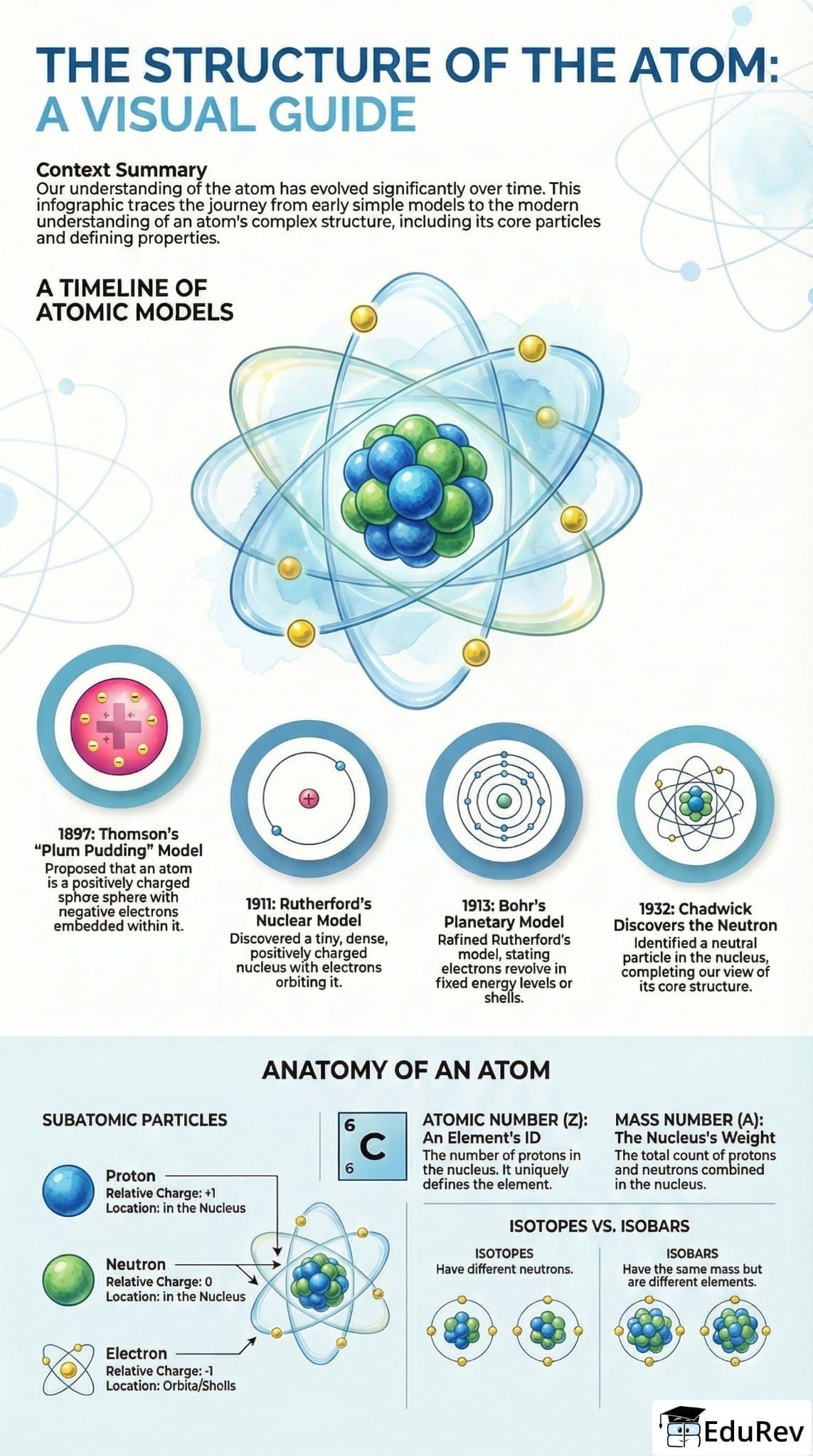
The document Infographics: Structure of the Atom is a part of the Class 9 Course Science Class 9.
All you need of Class 9 at this link: Class 9
FAQs on Infographics: Structure of the Atom
| 1. What are the main components of an atom? |  |
Ans. The main components of an atom are protons, neutrons, and electrons. Protons are positively charged particles located in the nucleus, neutrons are neutral particles also found in the nucleus, and electrons are negatively charged particles that orbit around the nucleus in various energy levels.
| 2. How do protons and neutrons contribute to the atomic mass? | |
Ans. Protons and neutrons contribute significantly to the atomic mass of an atom. Since electrons have negligible mass compared to protons and neutrons, the atomic mass is primarily determined by the total number of protons and neutrons in the nucleus. The sum of these particles is referred to as the mass number.
| 3. What is the charge of an atom, and how is it determined? | |
Ans. An atom is electrically neutral when it has an equal number of protons and electrons, balancing their opposite charges. If an atom gains or loses electrons, it becomes charged, forming ions; a loss of electrons results in a positive charge, while a gain of electrons results in a negative charge.
| 4. What is the significance of energy levels in an atom? | |
Ans. Energy levels in an atom represent the specific regions where electrons can exist. These levels are quantised, meaning electrons can only occupy certain energy states. The arrangement of electrons in these energy levels determines the chemical properties of an element and its reactivity.
| 5. How did the understanding of atomic structure evolve over time? | |
Ans. The understanding of atomic structure has evolved through various models, starting from Dalton's solid sphere model to Thomson's plum pudding model, then Rutherford's nuclear model, and finally Bohr's model introducing quantised energy levels. Each model improved the understanding of the atom's structure and behaviour, leading to the modern quantum mechanical model we use today.
About this Document

4.68/5 Rating

Apr 22, 2026 Last updated
Document Description: Infographics: Structure of the Atom for Class 9 2026 is part of Science Class 9 preparation. The notes and questions for Infographics: Structure of the Atom have been prepared according to the Class 9 exam syllabus. Information about Infographics: Structure of the Atom covers topics like and Infographics: Structure of the Atom Example, for Class 9 2026 Exam. Find important definitions, questions, notes, meanings, examples, exercises and tests below for Infographics: Structure of the Atom.
Introduction of Infographics: Structure of the Atom in English is available as part of our Science Class 9 for Class 9 & Infographics: Structure of the Atom in Hindi for Science Class 9 course. Download more important topics related with notes, lectures and mock test series for Class 9 Exam by signing up for free. Class 9: Infographics: Structure of the Atom
Description
Infographics: Structure of the Atom of Science Class 9 provides you one-page visual summary of the chapter covering all the important topics. Download the PDF from EduRev.
Information about Infographics: Structure of the Atom
In this doc you can find the meaning of Infographics: Structure of the Atom defined & explained in the simplest way possible. Besides explaining types of Infographics: Structure of the Atom theory, EduRev gives you an ample number of questions to practice Infographics: Structure of the Atom tests, examples and also practice Class 9 tests



Related Searches
MCQs, Infographics: Structure of the Atom, Free, ppt, Important questions, Summary, Objective type Questions, Sample Paper, pdf , Semester Notes, shortcuts and tricks, past year papers, video lectures, Exam, Extra Questions, Viva Questions, Infographics: Structure of the Atom, Previous Year Questions with Solutions, Infographics: Structure of the Atom, mock tests for examination, practice quizzes, study material;