Chapter Notes: The BAUDHĀYANA- Pythagoras Theorem


Introduction
Imagine you're an ancient Indian architect around 800 BCE, tasked with building a grand fire altar. You need to create a square platform that's exactly double the size of an existing square. How would you do it? Would you simply double each side? Let's find out!
This chapter takes us on a fascinating journey through one of mathematics' most beautiful and useful theorems, discovered by the Indian mathematician Baudhāyana around 800 BCE in his work called the Śulba-Sūtra.
Doubling a Square
Q: How can we construct a square that has double the area of a given square?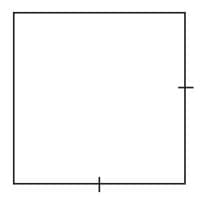
First Guess (The Wrong Way!)
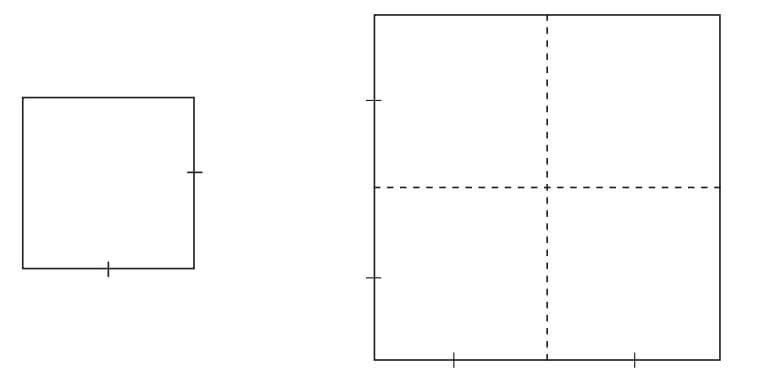
You might think: "Just double each side!" Let's check:
- Original square: side = 1 unit, area = 1 sq. unit
- New square: side = 2 units, area = $2 \times 2$ = 4 sq. units
Oh no! We got 4 times the area, not double!
Baudhāyana's Brilliant Solution
Baudhāyana's Discovery (Śulba-Sūtra, Verse 1.9):
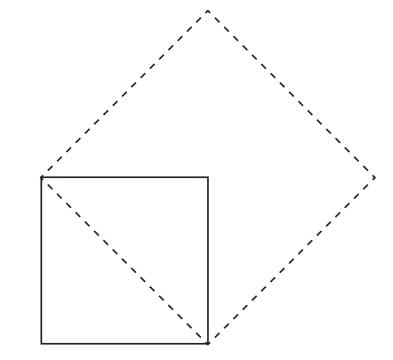
"The diagonal of a square produces a square of double the area of the original square."
What does this mean?
Simply draw a square using the diagonal of your original square as the side!
Why Does This Work?
Let's understand this step by step:
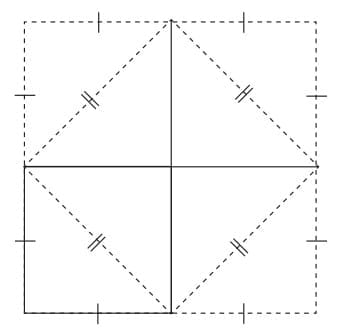
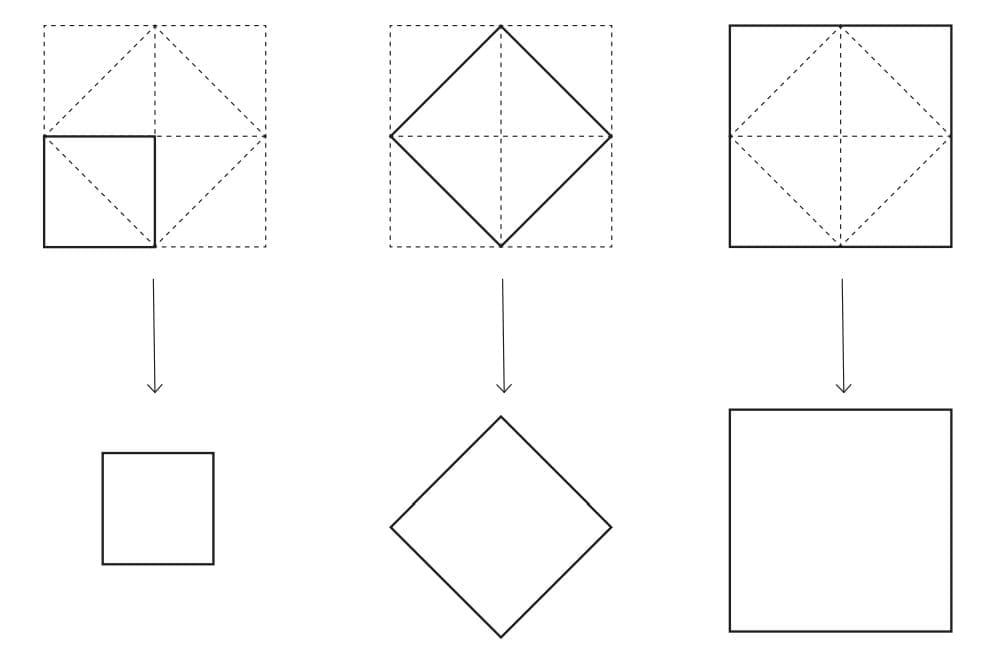
- Draw horizontal and vertical lines through the original square
- These lines will pass through the vertices (corners) of the new tilted square
- Both squares are composed of congruent right triangles; the original has 2 such triangles, while the new square has 4.
- Since 4 triangles = 2 × (2 triangles), the new square has double the area!
Creating a Sequence
We can keep going! Each new square has double the area of the previous one:
- First square: 2 triangles
- Second square: 4 triangles (double!)
- Third square: 8 triangles (double again!)
Activity: Doubling a Square Using Paper
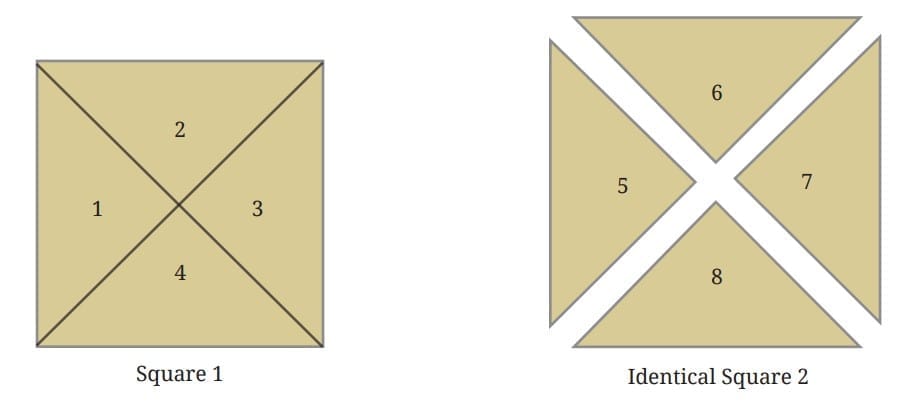
What you need: 2 identical square papers, scissors
Steps:
- Take Square 1 as it is
- Cut Square 2 into 4 identical triangular pieces (cut along both diagonals)
- Place these 4 pieces around Square 1
- You've created a square with double the area!
Halving a Square
The Problem
Now the opposite challenge: Given a square, how do we create a square with half the area?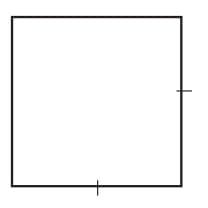
Sol: Simple! Just reverse what we did before:
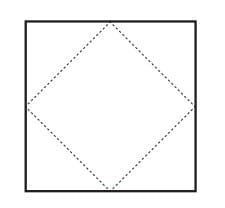
- Draw a smaller tilted square inside the larger square
- The corners of this tilted square touch the midpoints of the larger square's sides
Why Does This Work?
When we add horizontal and vertical lines:
- The larger square is divided into 4 triangles
- The smaller tilted square is made of 2 triangles
- Since 2 is half of 4, the inner square has half the area!
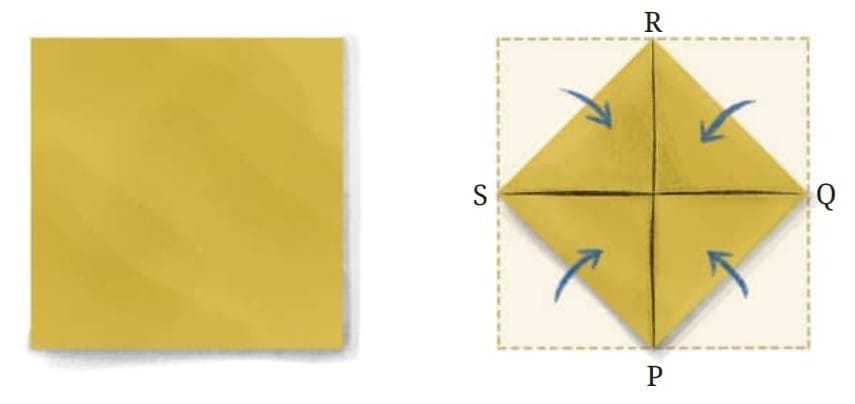
Activity: Halving a Square Using Paper
Steps:
- Cut out a square from paper
- Fold it so the crease lines pass through the midpoints of the sides
- The inner square PQRS has half the area!
Q: Will a square with half the side-length have half the area?
- No! If side = 2, area = 4
- Half side = 1, area = 1 (which is $\frac{1}{4}$, not $\frac{1}{2}$!)
Hypotenuse of an Isosceles Right Triangle
- Right Triangle: A triangle with one 90° angle
- Hypotenuse: The side opposite the right angle (the longest side)
- Isosceles Right Triangle: A right triangle where the two shorter sides are equal
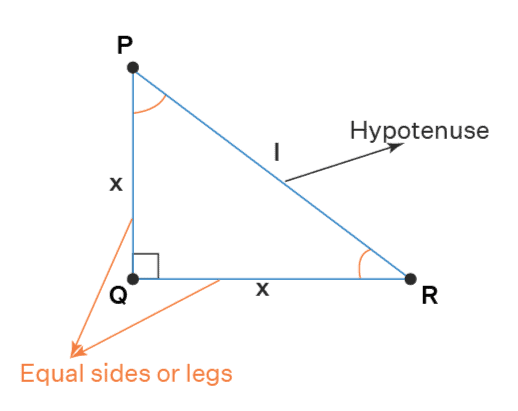
Finding the Hypotenuse
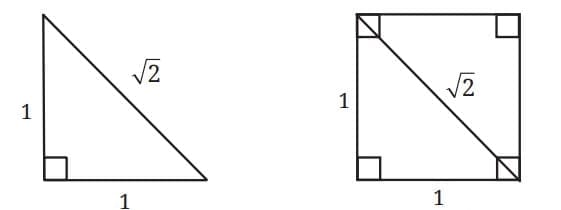
Q: Find the hypotenuse of an isosceles right triangle with equal sides of length 1 unit.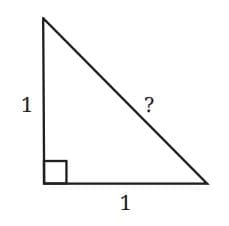
Sol:
- Two such triangles make a square of side 1 unit
- The square on the diagonal (hypotenuse) has double the area
- Area of small square = 1 sq. unit
- Area of square on hypotenuse = 2 sq. units
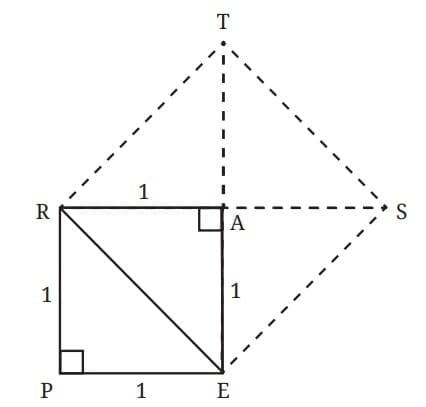
If hypotenuse = c, then:
- Area of square on hypotenuse = c²
- c² = 2
- Therefore, c = $\sqrt{2}$
Decimal Representation of $\sqrt{2}$
We want to find where the number $\sqrt{2}$ lies on the number line.
By definition, $\sqrt{2}$ is the number whose square is 2.
So,
$\sqrt{2}$ × $\sqrt{2}$ = 2
Step 1: Compare $\sqrt{2}$ with 1
Square of 1:
1² = 1
Square of $\sqrt{2}$:
($\sqrt{2}$)² = 2
Since 1 is less than 2, we get:
1² < ($\sqrt{2}$)²
So,
1 < $\sqrt{2}$
This means $\sqrt{2}$ is greater than 1.
Step 2: Compare $\sqrt{2}$ with 2
Square of 2:
2² = 4
Square of $\sqrt{2}$:
($\sqrt{2}$)² = 2
Since 2 is less than 4, we get:
($\sqrt{2}$)² < 2²
So,
$\sqrt{2}$ < 2
This means $\sqrt{2}$ is less than 2.
Step 3: Combine both results
We found:
1 < $\sqrt{2}$
and
$\sqrt{2}$ < 2
Therefore,
1 < $\sqrt{2}$ < 2
So $\sqrt{2}$ lies between 1 and 2.
Lower bound and Upper bound
A lower bound is a number smaller than $\sqrt{2}$.
An upper bound is a number larger than $\sqrt{2}$.
Here,
1 is the lower bound
2 is the upper bound
So $\sqrt{2}$ lies between 1 and 2.
Can $\sqrt{2}$ be written as a fraction?
We want to know whether $\sqrt{2}$ can be written as a fraction of two counting numbers, that is, in the form
m / n.
Let us assume that it is possible.
So, suppose: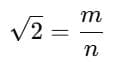
where m and n are counting numbers and have no common factor other than 1.
Squaring both sides: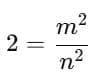
Multiplying both sides by n²: 2n2 = m2
Important fact about square numbers
In the prime factorisation of a square number, every prime factor appears an even number of times.
For example:
- 36 = 2² × 3²
- 100 = 2² × 5²
All exponents are even.
So, m² must have every prime factor an even number of times.
Now look at the equation 2n² = m²
The left side is 2 × n².
Since n² is a square, all its prime factors occur an even number of times.
Multiplying by 2 adds one extra factor of 2.
So on the left side, the prime factor 2 appears an odd number of times.
But on the right side, m² is a square number, so every prime factor (including 2) must appear an even number of times.
This is impossible because the same number cannot have an odd and an even number of factors of 2 at the same time.
Conclusion
Our assumption that $\sqrt{2}$ can be written as m / n is wrong.
Therefore,
$\sqrt{2}$ cannot be expressed as a fraction of two counting numbers.
So $\sqrt{2}$ is not a rational number.
It is an irrational number.
Its decimal form goes on forever without repeating: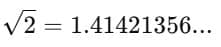
General Solution
The relation between the areas of a square and the square on its diagonal can be used to find a general relation between the hypotenuse and the other two sides of an isosceles right triangle.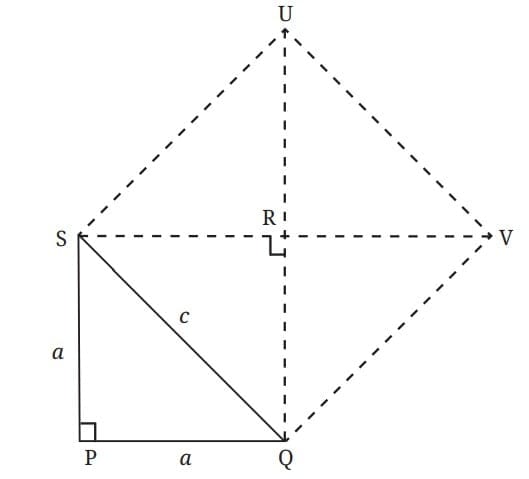
Let a be the length of the equal sides and c the length of the hypotenuse.
Area of SQVU = 2 × Area of PQRS
So, c2 = 2a2 .
This formula can be used to find c when a is known, or to find a when c is known.
Combining Two Different Squares
We learned to combine two identical squares.
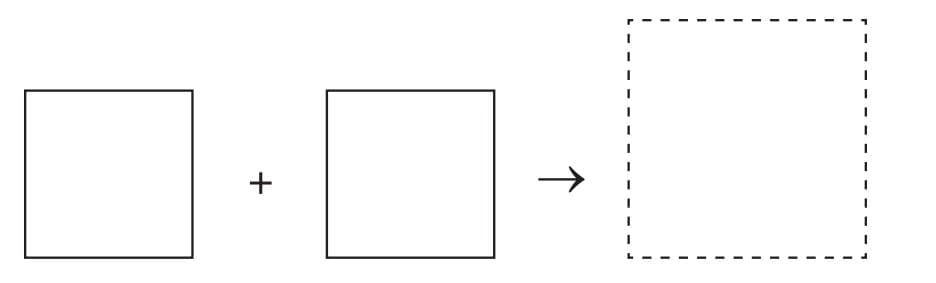
The sidelength of the larger square is the length of the diagonal of either of the smaller squares.
But what if we want to combine two different-sized squares?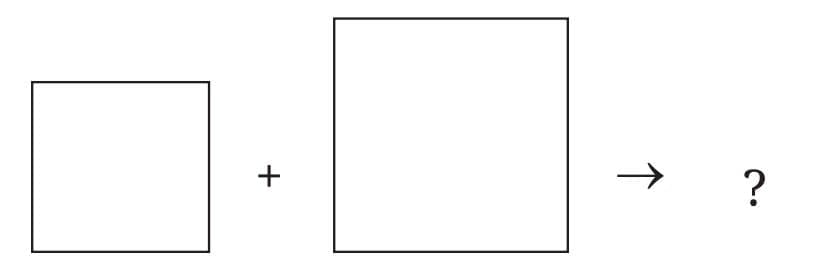
Baudhāyana's Remarkable Solution (Verse 1.12)
Baudhāyana's Discovery:
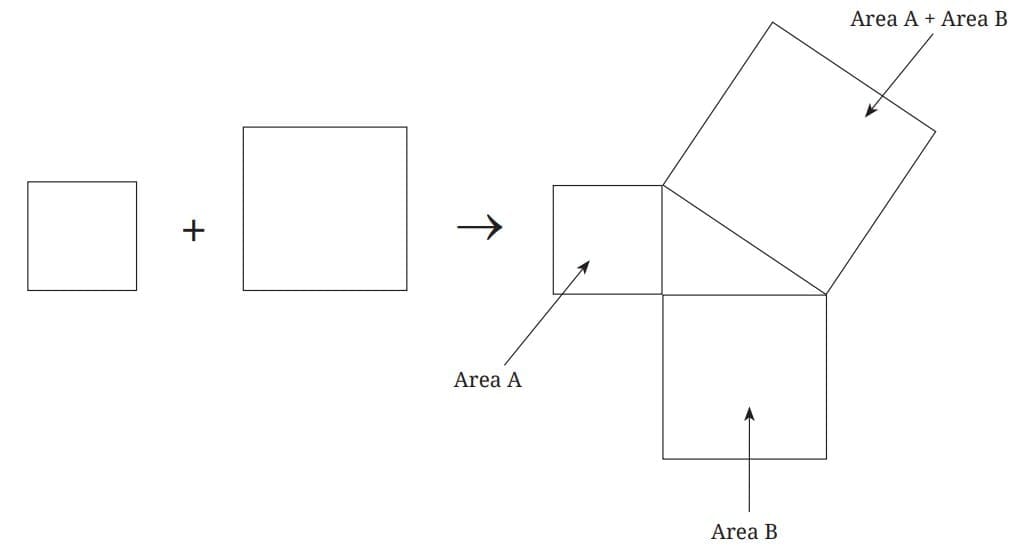
"The area of the square produced by the diagonal is the sum of the areas of the squares produced by the two sides."
In Simple Words:
- Make a right-angled triangle using the sides of both squares as the two shorter sides
- Draw a square on the hypotenuse
- This new square has area = sum of areas of both original squares!
Why Does Baudhāyana's Method Work?
Baudhāyana gave us another verse (Verse 2.1) to explain:
Step-by-Step Visual Proof:
Step 1: Join the two squares
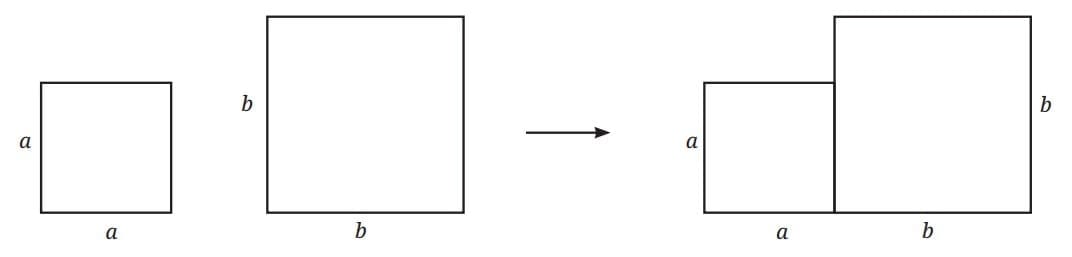
Step 2: Mark a rectangle in the larger square using the smaller square's side, then draw its diagonal.
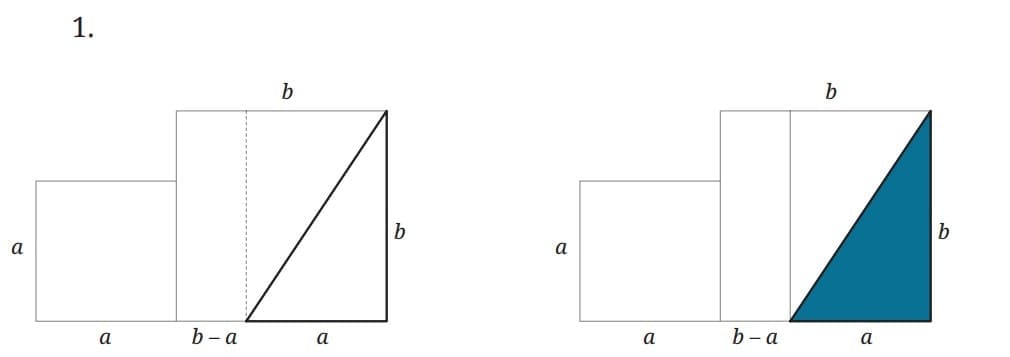
Step 3: Draw three more identical right triangles around this diagonal to form a 4-sided figure 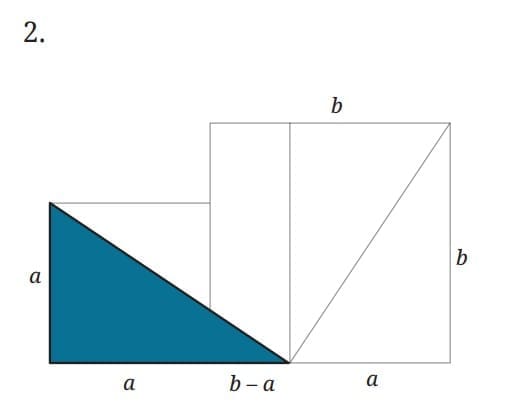
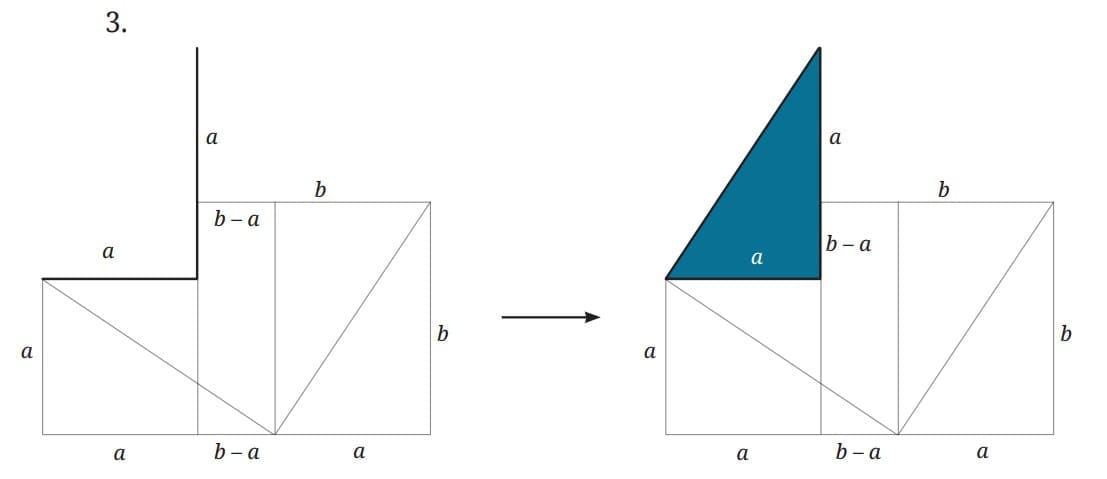
Step 4: This 4-sided figure is actually a square!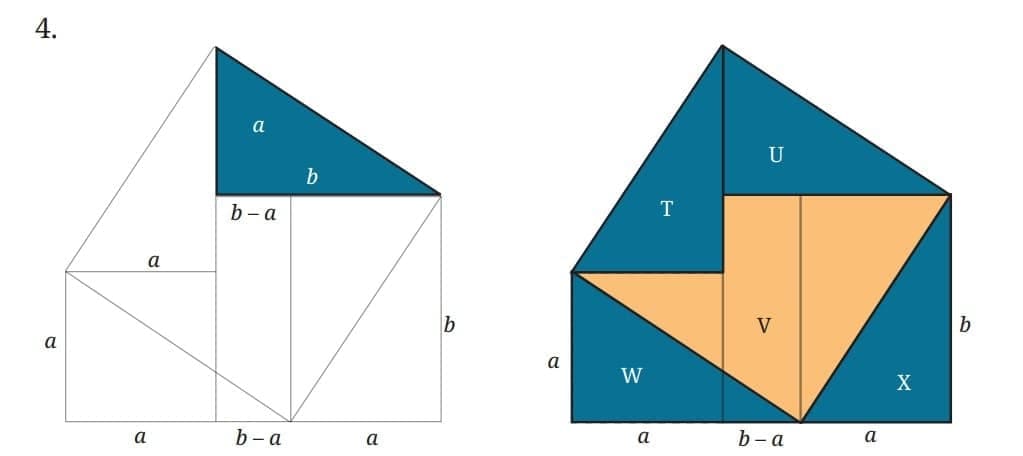
Why is it a square?
- All four sides are equal (they're all hypotenuses of congruent triangles)
- All four angles are 90° (because angles in the triangles add up correctly)
Why does it have the right area?
The new square consists of the same triangular pieces that made up our two original squares, just rearranged!
Combining Two Squares Using Paper
What you need: Two different-sized square papers, scissors
Steps:
- Place the two squares next to each other
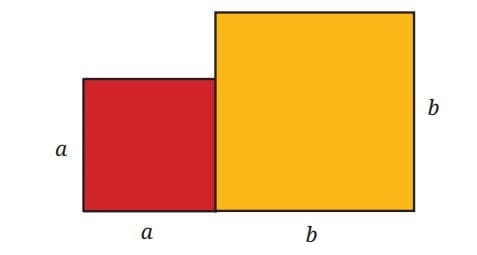
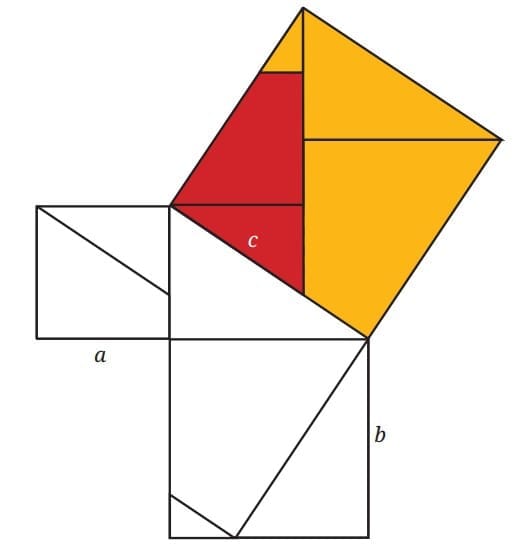
- Make two cuts to create three pieces
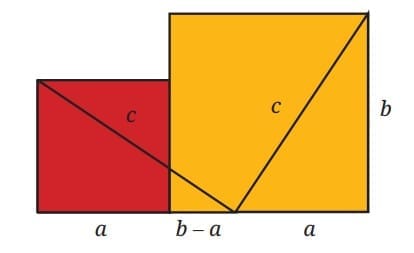
- Rearrange these three pieces into a larger square
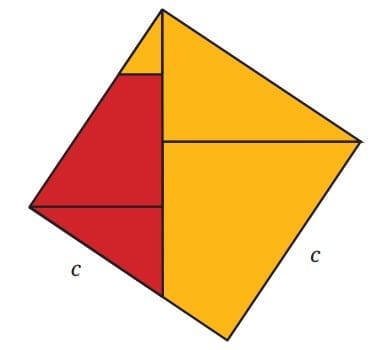
- Now make a right triangle using the two original squares' sides
- Draw a square on the hypotenuse
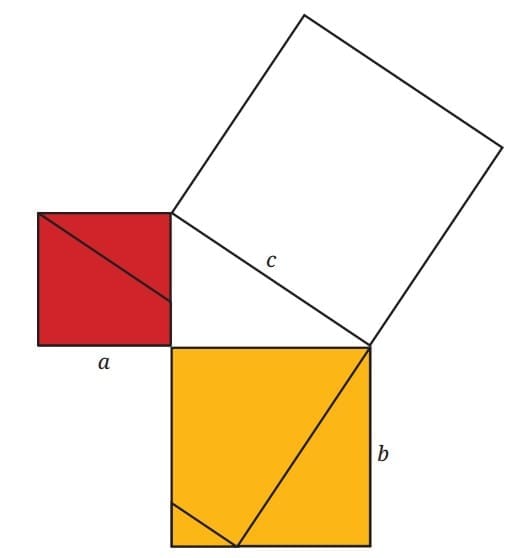
- Cover this square using your three pieces - perfect fit!
The Baudhāyana-Pythagoras Theorem
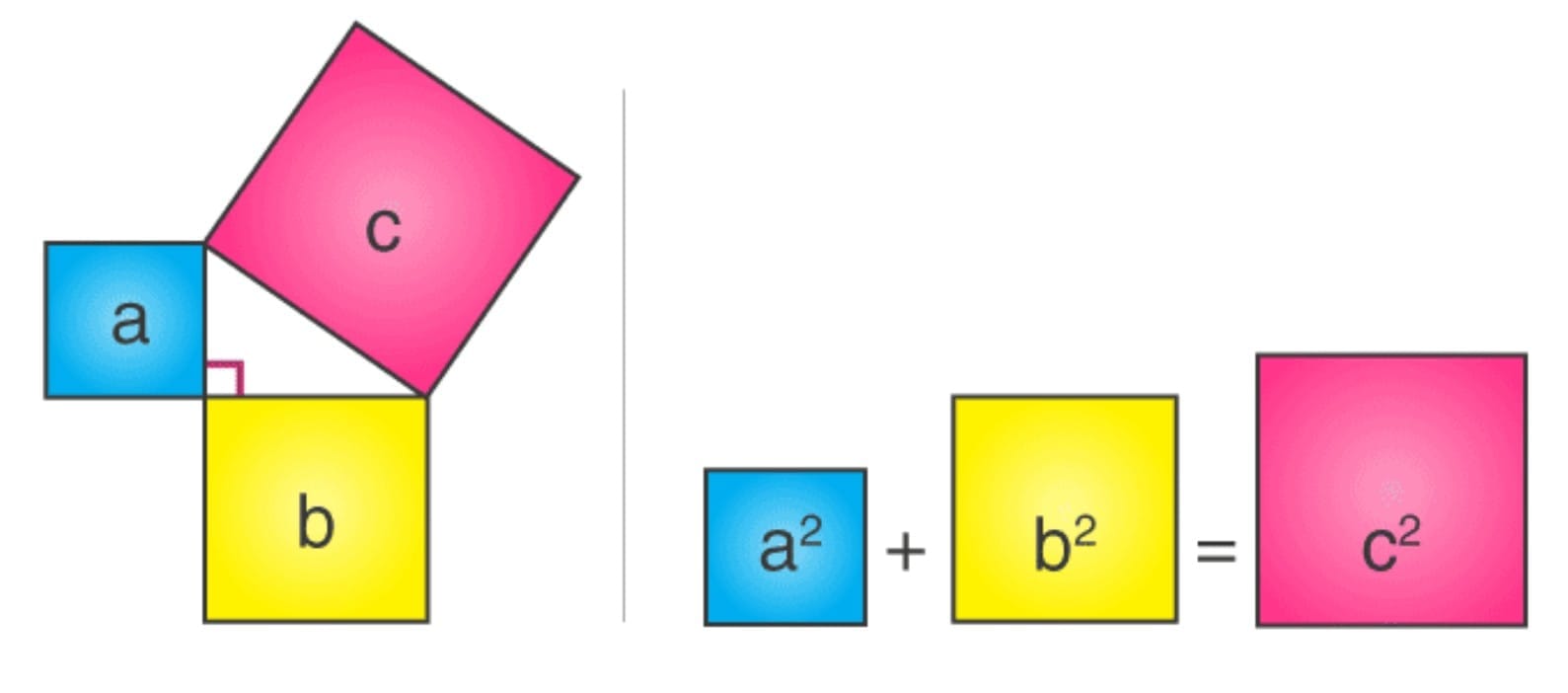
Baudhāyana's Theorem (c. 800 BCE):
For any right-angled triangle with sides a, b, and hypotenuse c:
a² + b² = c²
Historical Note
This theorem is also called:
- Baudhāyana's Theorem (first stated by Baudhāyana around 800 BCE)
- Pythagorean Theorem (after Pythagoras, Greek mathematician, c. 500 BCE)
- Baudhāyana-Pythagoras Theorem (the transitional name that honors both)
Baudhāyana was the first person in history to state this theorem in this general and modern form!
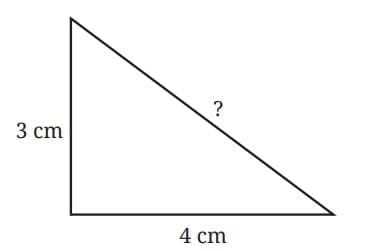
Q: Draw a right triangle with shorter sides 3 cm and 4 cm. What's the hypotenuse?
Sol:
- a = 3 cm, b = 4 cm
- a² + b² = c²
- 3² + 4² = c²
- 9 + 16 = c²
- 25 = c²
- c = 5 cm
Verify by measuring! Your hypotenuse should be exactly 5 cm!
Right Triangles with Integer Side-Lengths
Baudhāyana Triples
Definition: A set of three positive integers (a, b, c) that satisfy a² + b² = c² is called a Baudhāyana triple (also called Pythagorean triple).
Examples from Baudhāyana's Śulba-Sūtra (Verse 1.13)
Baudhāyana listed these integer triples:
- (3, 4, 5) → 9 + 16 = 25
- (5, 12, 13) → 25 + 144 = 169
- (8, 15, 17) → 64 + 225 = 289
- (7, 24, 25) → 49 + 576 = 625
- (12, 35, 37) → 144 + 1225 = 1369 ✓
- (15, 36, 39) → 225 + 1296 = 1521 ✓
Finding All Baudhāyana Triples ≤ 20
Let's list all triples where all numbers are ≤ 20:
- (3, 4, 5)
- (6, 8, 10)
- (9, 12, 15)
- (5, 12, 13)
- (12, 16, 20)
Notice a pattern? Some are just multiples of others!
Scaling Baudhāyana Triples
Discovery: If (a, b, c) is a Baudhāyana triple, then (ka, kb, kc) is also a Baudhāyana triple for any positive integer k.
Example:
- (3, 4, 5) is a triple
- (6, 8, 10) = 2×(3, 4, 5) is also a triple
- (30, 40, 50) = 10×(3, 4, 5) is also a triple
Proof:
- We know: a² + b² = c²
- Let's check: (ka)² + (kb)² = (kc)²
- (ka)² + (kb)² = k²a² + k²b² = k²(a² + b²) = k²c² = (kc)²
Conclusion: There are infinitely many Baudhāyana triples!
Primitive vs Non-Primitive Triples
Primitive Triple: A Baudhāyana triple where the three numbers have no common factor greater than 1.
Examples:
- (3, 4, 5) → Primitive (no common factor)
- (6, 8, 10) → Non-primitive (common factor = 2)
- (5, 12, 13) → Primitive
- (9, 12, 15) → Non-primitive (common factor = 3)
Key Idea: Find all primitive triples, then scale them to get all triples!
Generating Primitive Triples Using Odd Squares
Remember: Sum of first n odd numbers = n²
- 1 = 1²
- 1 + 3 = 2²
- 1 + 3 + 5 = 3²
Algebraically: 1 + 3 + 5 + ... + (2n - 1) = n²
Rearranging: (n - 1)² + (2n - 1) = n²
The Trick: If (2n - 1) is a perfect square, we get a Baudhāyana triple!
Example 1: Using 9 (odd square)
- 9 is the 5th odd number (9 = $2 \times 5$ - 1)
- So n = 5
- (5 - 1)² + 9 = 5²
- 4² + 3² = 5²
- Triple: (3, 4, 5) ✓
Example 2: Using 25 (odd square)
- 25 is the 13th odd number (25 = $2 \times 13$ - 1)
- So n = 13
- (13 - 1)² + 25 = 13²
- 12² + 5² = 13²
- Triple: (5, 12, 13) ✓
A Long-Standing Open Problem
Fermat's Last Theorem
The French mathematician Pierre de Fermat (17th century) was fascinated by Baudhāyana triples. He wondered:
Fermat's Question:
- We can find squares that are sums of two squares: a² + b² = c²
- Can we find cubes that are sums of two cubes? a³ + b³ = c³
- Can we find fourth powers that are sums of two fourth powers? a⁴ + b⁴ = c⁴
Fermat's Claim (Fermat's Last Theorem)
The equation xⁿ + yⁿ = zⁿ has NO solution in positive integers when n > 2.
The Famous Margin Note
Fermat wrote in the margin of a book:
"I have found a truly marvellous proof of this statement, but the margin is too small to contain it."
The Mystery: No one ever found Fermat's proof! Did he really have one?
The 300-Year Quest
After Fermat's death, mathematicians tried for over 300 years to prove this theorem. Many brilliant mathematicians failed!
Andrew Wiles: The Boy Who Solved It
1963: A 10-year-old boy named Andrew Wiles read a book about Fermat's Last Theorem
His Dream: Despite reading about centuries of failures, young Andrew decided he would prove it!
1994: After dedicating years to the problem, Andrew Wiles succeeded! He proved Fermat's Last Theorem at age 41.
[IMAGE: Timeline showing 1963-1994 with key points]
Lesson: Never give up on your dreams, no matter how impossible they seem!
Further Applications of the Baudhāyana-Pythagoras Theorem
The Baudhāyana-Pythagoras theorem is one of the most useful theorems in mathematics! Let's see some applications.
Bhāskarāchārya (Bhāskara II) was a great Indian mathematician who lived around 1150 CE. His book Līlāvatī contains many beautiful problems. Here's one:
The Lotus Problem:
"In a lake surrounded by chakra and krauñcha birds, there is a lotus flower peeping out of the water, with the tip of its stem 1 unit above the water. On being swayed by a gentle breeze, the tip touches the water 3 units away from its original position. Quickly tell the depth of the lake."
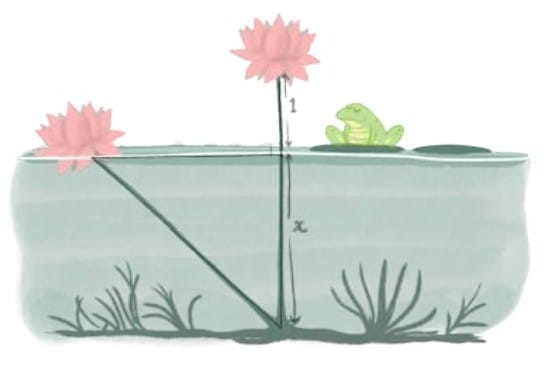
Step 1: Understand the Situation
- Lotus stem is perpendicular to water surface
- Tip is 1 unit above water
- When bent, tip touches water 3 units away
- Stem length doesn't change!
Step 2: Set Up Variables
- Let x = depth of lake (length of stem in water)
- Total stem length = x + 1 (includes the 1 unit above water)
Step 3: Form a Right Triangle When the lotus bends:
- One side = 3 units (horizontal distance)
- Another side = x units (depth)
- Hypotenuse = x + 1 units (stem length)
Step 4: Apply Baudhāyana's Theorem
- 3² + x² = (x + 1)²
- 9 + x² = x² + 2x + 1
- 9 = 2x + 1 (subtracting x² from both sides)
- 8 = 2x
- x = 4 units
Answer: The depth of the lake is 4 units!
FAQs on Chapter Notes: The BAUDHĀYANA- Pythagoras Theorem
| 1. What is the Baudhāyana-Pythagoras Theorem? |  |
| 2. How can a square be doubled according to the article? | |
| 3. What does it mean to halve a square? | |
| 4. What is the significance of the equation xⁿ + yⁿ = zⁿ when n > 2? | |
| 5. How are right triangles with integer side lengths related to the Baudhāyana-Pythagoras Theorem? | |