Chapter Notes: Continents and Oceans

What is Earth Made Of?
Our Earth is like a big ball with land and water. The large pieces of land are called continents, and the huge bodies of water are called oceans. If you look at a globe or world map, you can see both the brown/green land areas and the blue water areas.
The Seven Continents
There are 7 continents on Earth. Think of them as seven big islands, though they are much, much bigger than regular islands!
1. Asia: This is the biggest continent of all. It is where India, China, Japan, and many other countries are located. We live in Asia! It has the highest mountain in the world called Mount Everest. Asia has deserts, forests, mountains, and plains.
2. Africa: This is the second largest continent. Africa is known for its hot deserts like the Sahara Desert (the biggest desert in the world), wild animals like lions, elephants, and giraffes, and the longest river called the Nile River. Egypt and Kenya are in Africa.
3. North America: This continent includes countries like the United States, Canada, and Mexico. It has different types of land including mountains, plains, and forests. It's the third largest continent.
4. South America: This continent is below North America. It has the Amazon Rainforest, which is the largest rainforest in the world with many plants and animals. Brazil and Argentina are in South America.
5. Antarctica: This is the coldest continent on Earth! It is covered with ice and snow all year round. Very few people live here, but penguins and seals do! It is at the bottom of the Earth (South Pole).
6. Europe: This continent has many countries like the United Kingdom, France, Germany, and Italy. It is connected to Asia, so sometimes people call it Eurasia. Europe has many old and beautiful buildings and cities.
7. Australia: This is the smallest continent. It is also called an island continent because water surrounds it completely. Kangaroos and koalas live here! Australia is known for its unique animals.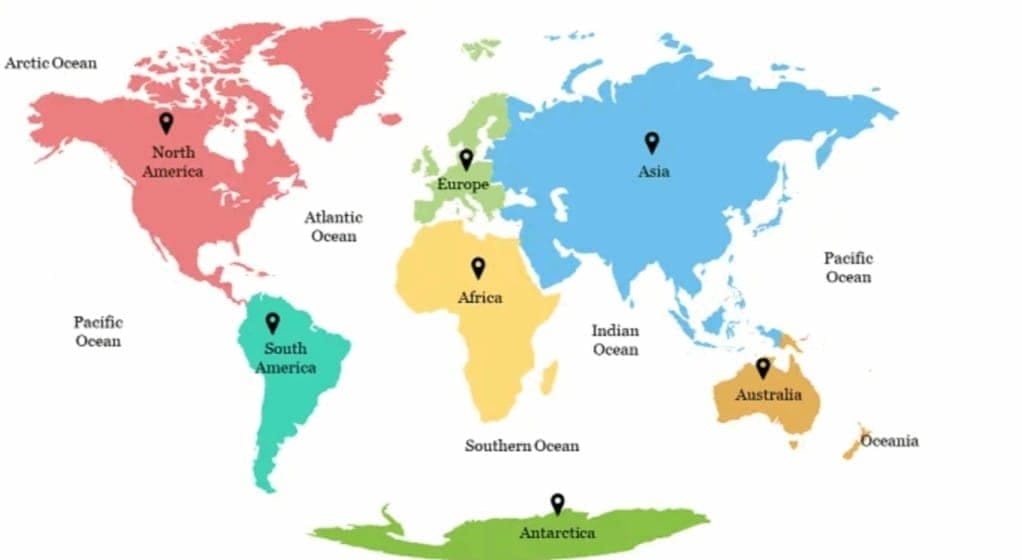 Seven Continents and Five Oceans
The Five Oceans
Oceans are huge bodies of salt water. They are much bigger than rivers, lakes, or seas. There are 5 oceans on Earth.
1. Pacific Ocean: This is the largest and deepest ocean in the world. It is so big that it covers more space than all the land on Earth put together! It is located between Asia and North America on one side and South America and Australia on the other side.
2. Atlantic Ocean: This is the second largest ocean. It separates the Americas (North and South America) from Europe and Africa. Many ships travel across the Atlantic Ocean.
3. Indian Ocean: This ocean is near India, which is why it is called the Indian Ocean! It is the third largest ocean and is warm. It touches Asia, Africa, and Australia.
4. Southern Ocean (or Antarctic Ocean): This ocean surrounds Antarctica. It is very cold and has icebergs (big chunks of floating ice). It connects the Pacific, Atlantic, and Indian Oceans.
5. Arctic Ocean: This is the smallest ocean and it is at the top of the Earth (North Pole). It is very cold and mostly covered with ice. Polar bears live in the areas around the Arctic Ocean.
Important Things to Remember
- Water covers more of Earth than land. About 71% (more than two-thirds) of Earth is covered with water, and only 29% is land.
- All oceans are connected to each other. You can sail from one ocean to another.
- Continents have different climates. Some are hot (like Africa), some are cold (like Antarctica), and some have different seasons (like Asia and Europe).
- People, plants, and animals are different on different continents because of the different weather and land.
FAQs on Chapter Notes: Continents and Oceans
| 1. What are the seven continents of the Earth? |  |
| 2. What are the five oceans of the world? | |
| 3. Why is it important to study continents and oceans? | |
| 4. How do continents and oceans affect weather patterns? | |
| 5. What are some key characteristics of each continent? | |