CBSE Class 8 > Class 8 Notes > Science > Infographics: Nature of Matter: Elements, Compounds, and Mixtures
Infographics: Nature of Matter: Elements, Compounds, and Mixtures

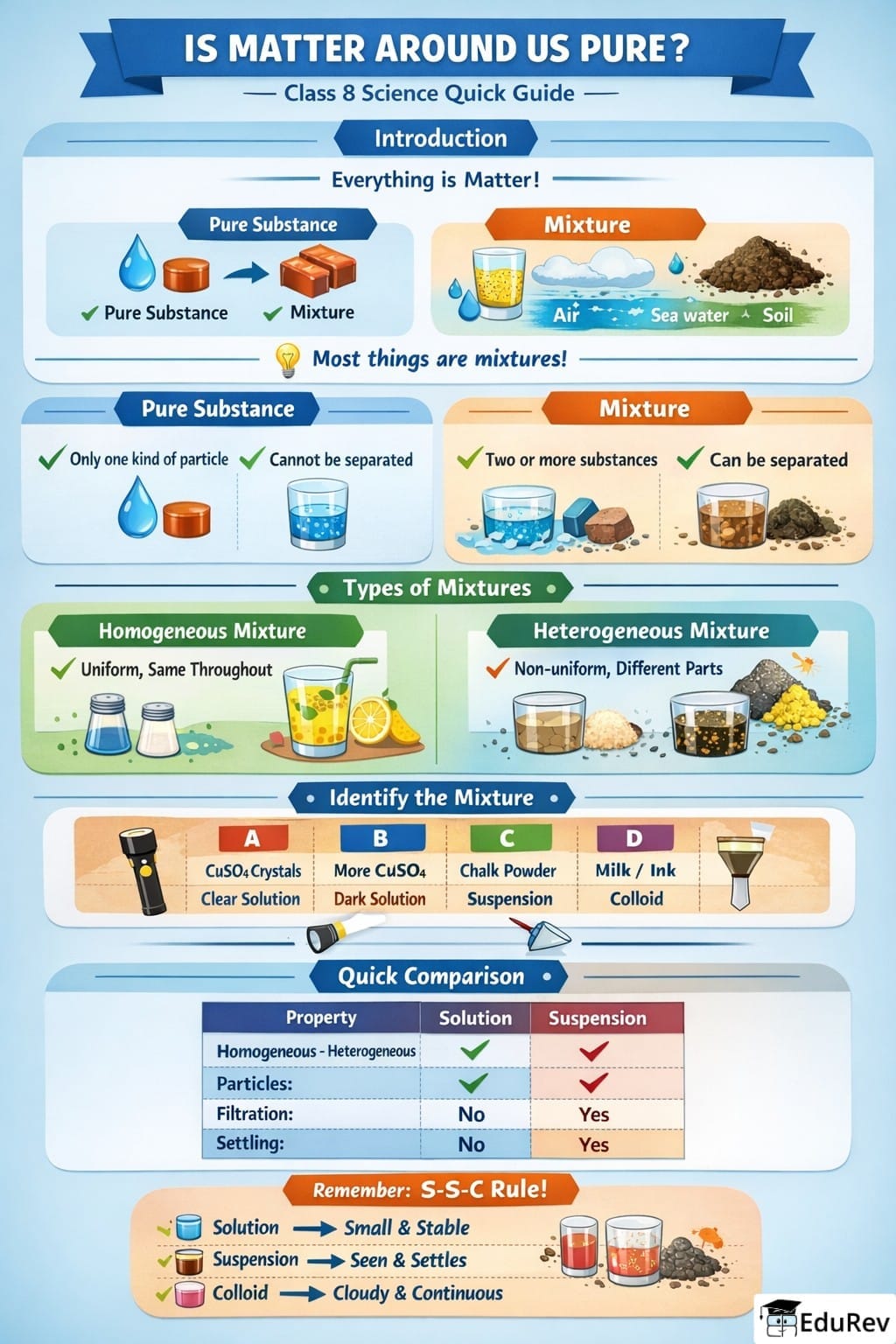
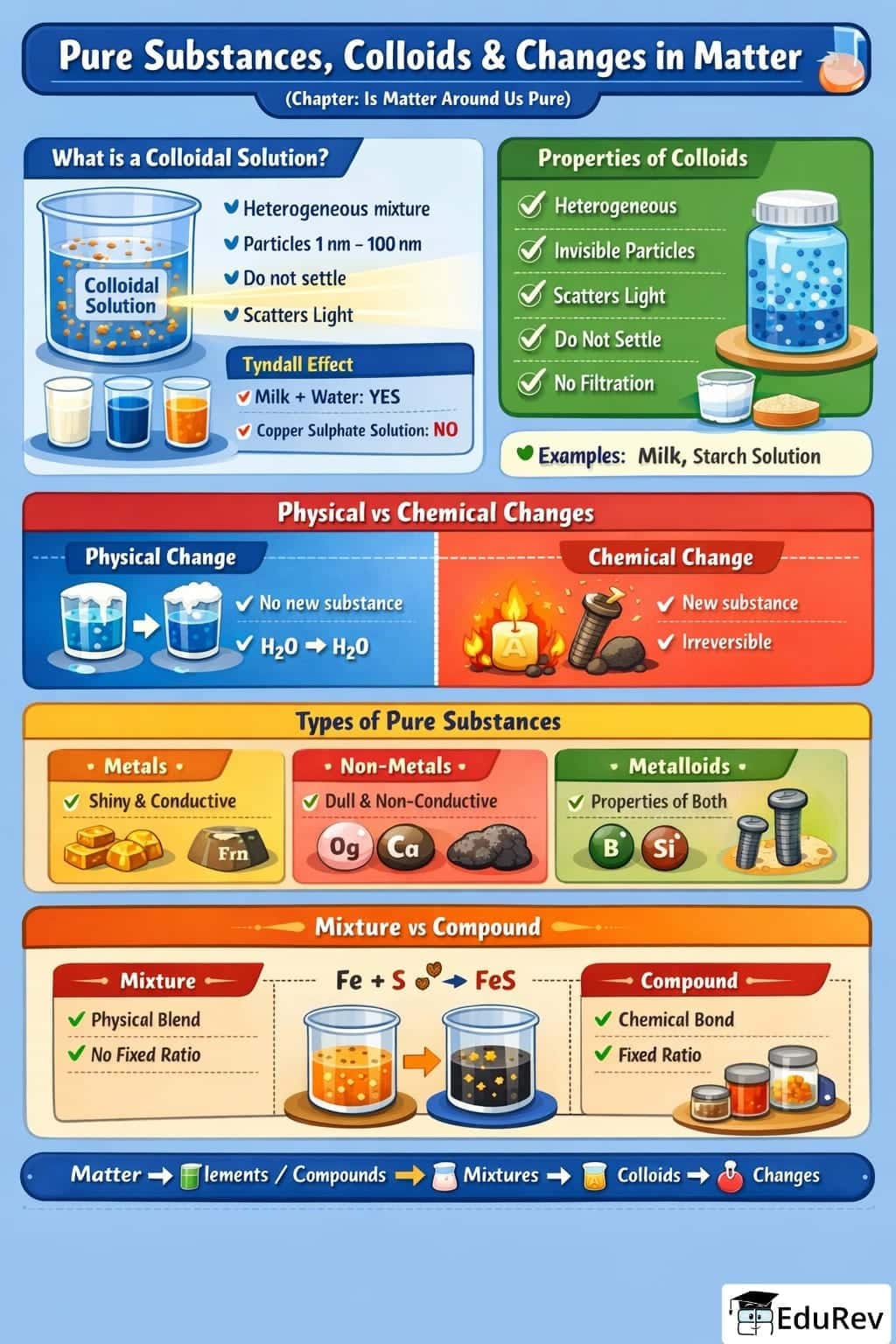
The document Infographics: Nature of Matter: Elements, Compounds, and Mixtures is a part of the Class 8 Course Science Class 8.
All you need of Class 8 at this link: Class 8
FAQs on Infographics: Nature of Matter: Elements, Compounds, and Mixtures
| 1. What are the basic building blocks of matter? |  |
Ans. The basic building blocks of matter are atoms. An atom is the smallest unit of an element and consists of a nucleus containing protons and neutrons, surrounded by electrons in various energy levels. Atoms combine to form molecules, which are the foundation of compounds and mixtures.
| 2. How do elements differ from compounds? | |
Ans. Elements are pure substances that consist of only one type of atom, while compounds are substances formed when two or more different elements chemically combine in a fixed ratio. For example, oxygen (O) is an element, while water (H₂O) is a compound made up of hydrogen and oxygen atoms.
| 3. What is the difference between a homogeneous mixture and a heterogeneous mixture? | |
Ans. A homogeneous mixture has a uniform composition throughout, meaning that its components are evenly distributed and not distinguishable, such as saltwater. In contrast, a heterogeneous mixture consists of visibly different substances or phases, such as a salad or sand and iron filings, where the individual components can be seen and separated easily.
| 4. Can mixtures be separated? If so, how? | |
Ans. Yes, mixtures can be separated using physical methods based on differences in their physical properties. Common techniques include filtration (for separating solids from liquids), distillation (for separating liquids with different boiling points), and chromatography (for separating substances based on their movement through a medium).
| 5. Why are compounds considered to have different properties than their constituent elements? | |
Ans. Compounds have different properties from their constituent elements because the chemical bonding and arrangement of atoms in a compound result in new characteristics. For example, sodium (Na) is a highly reactive metal and chlorine (Cl) is a poisonous gas, but when they combine to form sodium chloride (NaCl), commonly known as table salt, it is safe and essential for human consumption.
About this Document

4.67/5 Rating

Apr 22, 2026 Last updated
Document Description: Infographics: Nature of Matter: Elements, Compounds, and Mixtures for Class 8 2026 is part of Science Class 8 preparation. The notes and questions for Infographics: Nature of Matter: Elements, Compounds, and Mixtures have been prepared according to the Class 8 exam syllabus. Information about Infographics: Nature of Matter: Elements, Compounds, and Mixtures covers topics like and Infographics: Nature of Matter: Elements, Compounds, and Mixtures Example, for Class 8 2026 Exam. Find important definitions, questions, notes, meanings, examples, exercises and tests below for Infographics: Nature of Matter: Elements, Compounds, and Mixtures.
Introduction of Infographics: Nature of Matter: Elements, Compounds, and Mixtures in English is available as part of our Science Class 8 for Class 8 & Infographics: Nature of Matter: Elements, Compounds, and Mixtures in Hindi for Science Class 8 course. Download more important topics related with notes, lectures and mock test series for Class 8 Exam by signing up for free. Class 8: Infographics: Nature of Matter: Elements, Compounds, and Mixtures
Description
Infographics: Nature of Matter: Elements, Compounds, & Mixtures of Science Class 8 provides you one-page visual summary of the chapter covering all the important topics. Download the PDF from EduRev.
Information about Infographics: Nature of Matter: Elements, Compounds, and Mixtures
In this doc you can find the meaning of Infographics: Nature of Matter: Elements, Compounds, and Mixtures defined & explained in the simplest way possible. Besides explaining types of Infographics: Nature of Matter: Elements, Compounds, and Mixtures theory, EduRev gives you an ample number of questions to practice Infographics: Nature of Matter: Elements, Compounds, and Mixtures tests, examples and also practice Class 8 tests



Related Searches
Objective type Questions, past year papers, Compounds, Infographics: Nature of Matter: Elements, Sample Paper, Infographics: Nature of Matter: Elements, study material, practice quizzes, Important questions, Previous Year Questions with Solutions, Summary, video lectures, and Mixtures, Exam, ppt, Infographics: Nature of Matter: Elements, shortcuts and tricks, Free, and Mixtures, Compounds, pdf , Extra Questions, Viva Questions, Compounds, Semester Notes, MCQs, and Mixtures, mock tests for examination;