NCERT Solutions: Proportional Reasoning - 2

Page No. 60
Figure it Out
Q1: A cricket coach schedules practice sessions that include different activities in a specific ratio - time for warm-up/cool-down : time for batting : time for bowling : time for fielding :: 3 : 4 : 3 : 5. If each session is 150 minutes long, how much time is spent on each activity?
Ans: Given, time for warm-up/cool-down : time for batting : Time for bowling : time for fielding :: 3 : 4 : 3 : 5
Total number of ratio parts = 3 + 4 + 3 + 5 = 15
Total time of each session = 150 minutes
So, time for warm-up/cool-down = \( \frac{3}{15} \times 150 = 30 \) minutes
Time for batting = \( \frac{4}{15} \times 150 = 40 \) minutes
Time for bowling = \( \frac{3}{15} \times 150 = 30 \) minutes
Time for fielding = \( \frac{5}{15} \times 150 = 50 \) minutes
Verification: 30 + 40 + 30 + 50 = 150 minutes
Q2: A school library has books in different languages in the following ratio - no. of Odiya books : no. of Hindi books : no. of English books :: 3 : 2 : 1. If the library has 288 Odiya books, how many Hindi and English books does it have?
Ans: Books Ratio
Given, No. of Odiya books : No. of Hindi books : No. of English books :: 3 : 2 : 1
Let x be the total number of books.
No. of Odiya books = \( \frac{3}{6} \times x \)
⇒ 288 = \( \frac{3}{6} \times x \)
⇒ x = 576
∴ No. of Hindi books = \( \frac{2}{6} \times 576 = 192 \)
and no. of English books = \( \frac{1}{6} \times 576 = 96 \)
Q3: I have 100 coins in the ratio - no. of ₹10 coins : no. of ₹5 coins : no. of ₹2 coins : no. of ₹1 coins :: 4 : 3 : 2 : 1. How much money do I have in coins?
Ans: Coins Ratio
Given no. of ₹ 10 coins : no. of ₹ 5 coins : no. of ₹ 2 coins : no. of ₹ 1 coins :: 4 : 3 : 2 : 1.
Total number of coins = 100
Total number of ratio parts = 4 + 3 + 2 + 1 = 10
no. of ₹ 10 coins = \( \frac{4}{10} \times 100 = 40 \)
no. of ₹ 5 coins = \( \frac{3}{10} \times 100 = 30 \)
no. of ₹ 2 coins = \( \frac{3}{10} \times 100 = 30 \)
no. of ₹ 1 coins = \( \frac{1}{10} \times 100 = 10 \)
Total money = 40 × 10 + 30 × 5 + 2 × 20 + 1 × 10
= 400 + 150 + 40 + 10
= ₹ 600
Math Talk
Q4: Construct a triangle with sidelengths in the ratio 3 : 4 : 5. Will all the triangles drawn with this ratio of sidelengths be congruent to each other? Why or why not?
Ans: We can construct triangles with sides in the ratio 3 : 4 : 5.
They will not be congruent to each other.
Reason:
Triangle 1: Let sides 3 cm, 4 cm, 5 cm
Triangle 2: Let sides 6 cm, 8 cm, 10 cm
Triangle 3: Let sides = 9 cm, 12 cm, 15 cm
Though all these triangles have the same ratio (3 : 4 : 5), their actual sizes are different.
Congruent triangles must have the same shape and size.
These triangles have the same shape (they are similar) but different sizes.
Hence, they are not congruent.
Q5: Can you construct a triangle with sidelengths in the ratio 1 : 3 : 5? Why or why not?
Ans: For a triangle to exist, it must satisfy the triangle inequality theorem, which states:
The sum of any two sides of a triangle must be greater than the third side.
Let's take
Side 1 = 1 cm
Side 2 = 3 cm
Side 3 = 5 cm
1. 1 + 3 < 5 ⇒ 4 > 5 (No)
2. 1 + 5 > 3 ⇒ 6 > 3 (Yes)
3. 3 + 5 > 1 ⇒ 8 > 1 (Yes)
Since the first condition fails (1 + 3 = 4 < 5)
We can't construct a triangle with these sidelengths.
Page No. 62-63
Figure it Out
Q1: A group of 360 people were asked to vote for their favourite season from the three seasons - rainy, winter and summer. 90 liked the summer season, 120 liked the rainy season, and the rest liked the winter. Draw a pie chart to show this information.
Ans: Given, total people = 360
90 people liked the summer season.
120 people liked the rainy season.
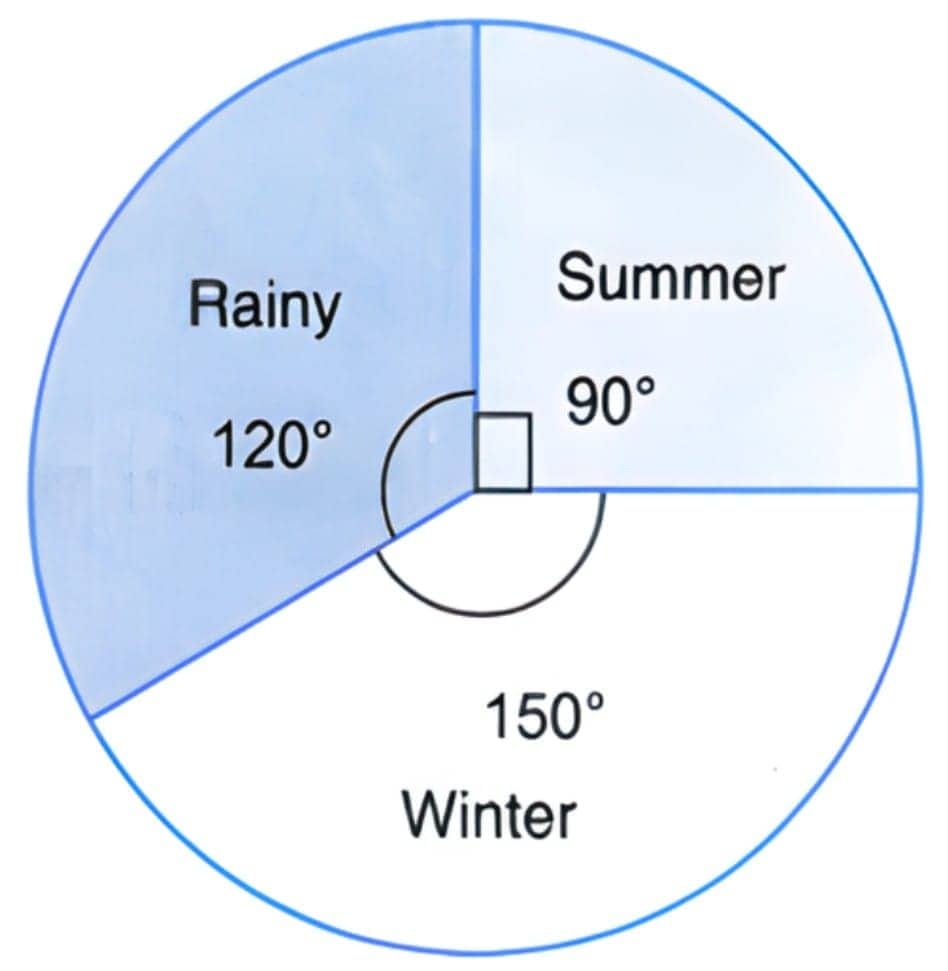
∴ People liked winter season = 360 - (120 + 90) = 150
So, angle for summer season = \( \frac{90}{360} \times 360^\circ = 90^\circ \)
Angle for rainy season = \( \frac{120}{360} \times 360^\circ = 120^\circ \)
Angle for winter season = \( \frac{150}{360} \times 360^\circ = 150^\circ \)
Verification: 90 + 120 + 150 = 360°
Q2: Draw a pie chart based on the following information about viewers' favourite type of TV channel: Entertainment - 50%, Sports - 25%, News - 15%, Information - 10%.
Ans: Given, Entertainment = 50%
Sports = 25%
News = 15%
Information = 10%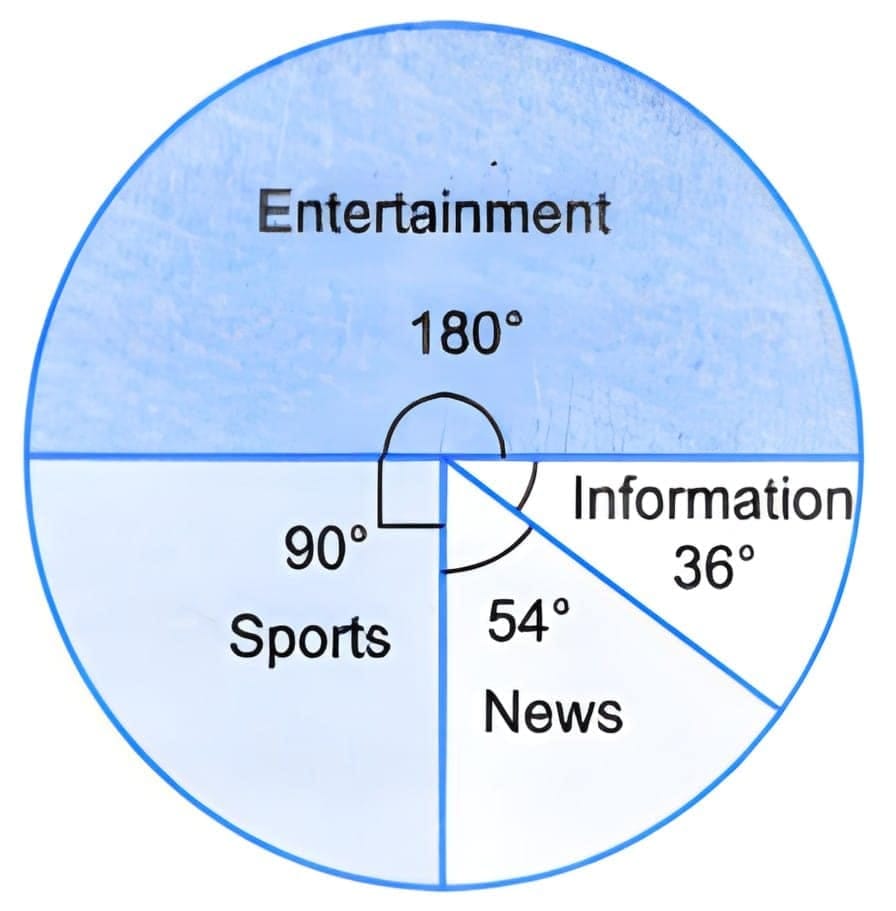
Angle for entertainment = 50% of 360°
= \( \frac{50}{100} \times 360^\circ \)
= 180°
Angle for sports = 25% of 360°
= \( \frac{25}{100} \times 360^\circ \)
= 90°
Angle for news = 15% of 360°
= \( \frac{15}{100} \times 360^\circ \)
= 54°
Angle for information = 10% of 360°
= \( \frac{10}{100} \times 360^\circ \)
= 36°
Verification: 180° + 90° + 54° + 36° = 360°
Q3: Prepare a pie chart that shows the favourite subjects of the students in your class.
 Ans:
Ans: 
Total number of students = 4 + 6 + 9 + 3 + 10 + 12 + 16 = 60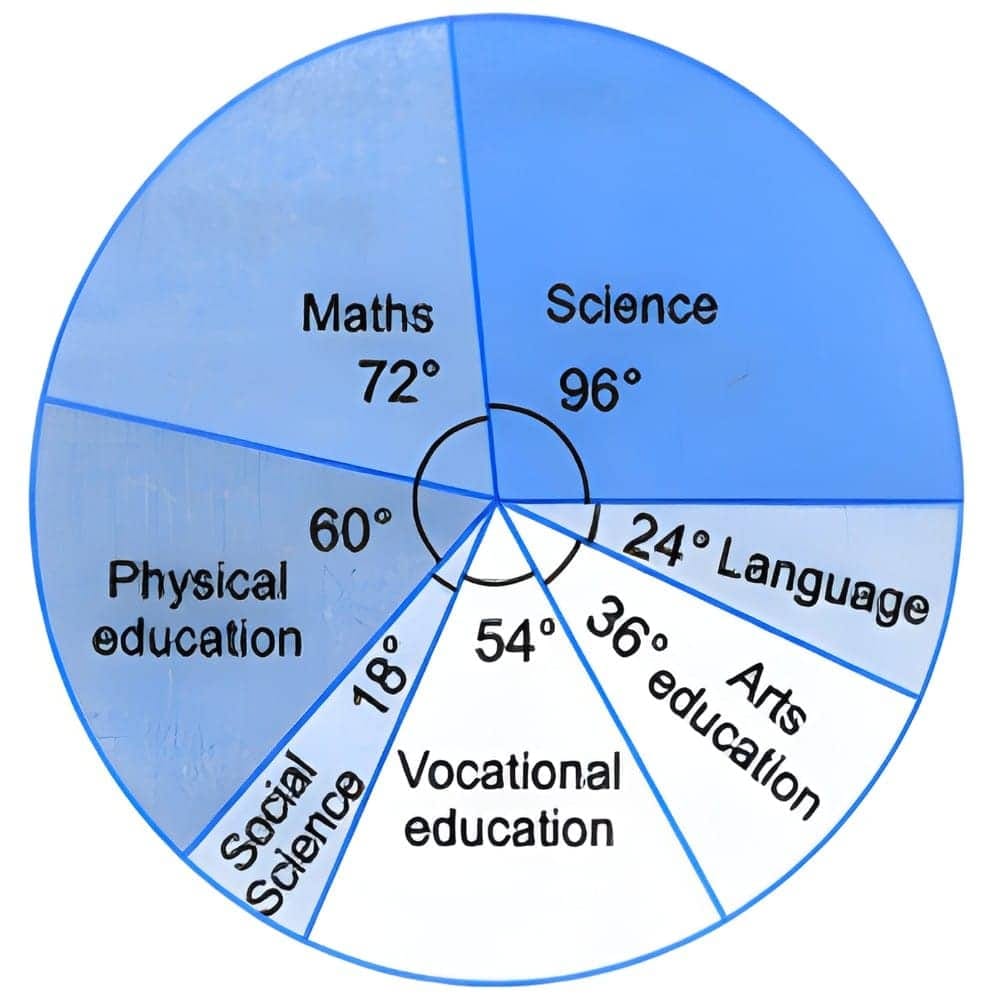
Angle for Language = \( \frac{4}{60} \times 360^\circ = 24^\circ \)
Angle for Arts Education = \( \frac{6}{60} \times 360^\circ = 36^\circ \)
Angle for Vocational Education = \( \frac{9}{60} \times 360^\circ = 54^\circ \)
Angle for Social Science = \( \frac{3}{60} \times 360^\circ = 18^\circ \)
Angle for Physical Education = \( \frac{10}{60} \times 360^\circ = 60^\circ \)
Angle for Maths = \( \frac{12}{60} \times 360^\circ = 72^\circ \)
Angle for Science = \( \frac{16}{60} \times 360^\circ = 96^\circ \)
Page No. 65
Figure it Out
Q1: Which of these are in inverse proportion?
(i) 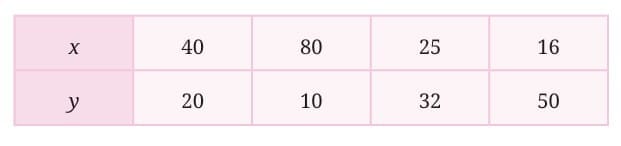
Ans: x1 = 40, x2 = 80, x3 = 25, x4 = 16
y1 = 20, y2 = 10, y3 = 32, y4 = 50
x1y1 = 40 × 20 = 800
x2y2 = 80 × 10 = 800
x3y3 = 25 × 32 = 800
x4y4 = 16 × 50 = 800
So, x1y1 = x2y2 = x3y3 = x4y4 = 800
∴ x and y are in inverse proportion
(ii) 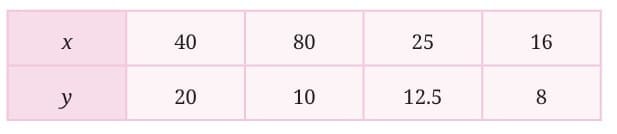
Ans: x1 = 40, x2 = 80, x3 = 25, x4 = 16
y1 = 20, y2 = 10, y3 = 12.5, y4 = 8
x1y1 = 40 × 20 = 800
x2y2 = 80 × 10 = 800
x3y3 = 25 × 12.5 = 312.5
x4y4 = 16 × 8 = 128
So, x1y1 = x2y2 ≠ x3y3 ≠ x4y4
∴ x and y are not in inverse proportion.
(iii) 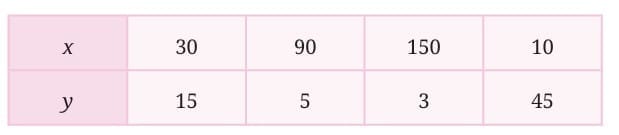
Ans: x1 = 30, x2 = 90, x3 = 150, x4 = 10
y1 = 15, y2 = 5, y3 = 3, y4 = 45
x1y1 = 30 × 15 = 450
x2y2 = 90 × 5 = 450
x3y3 = 150 × 3 = 450
x4y4 = 10 × 45 = 450
So, x1y1 = x2y2 = x3y3 = x4y4 = 450
∴ x and y are in inverse proportion.
Q2: Fill in the empty cells if x and y are in inverse proportion.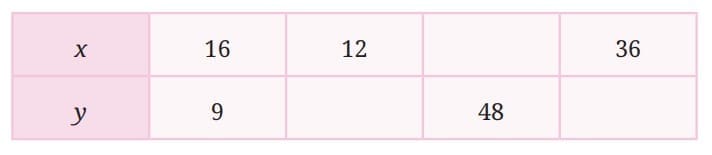
Ans: 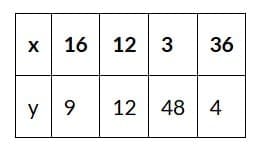
\(\therefore\; x \text{ and } y \text{ are in } \textbf{inverse proportion.}\)
\(\therefore\; 16 \times 9 = 12 \times y_2\)
\(\Rightarrow\; y_2 = \frac{16 \times 9}{12} = 12\)
\(\therefore\; 16 \times 9 = x_3 \times 48\)
\(\Rightarrow\; x_3 = \frac{16 \times 9}{48} = 3\)
And
\(16 \times 9 = 36 \times y_4\)
\(\Rightarrow\; y_4 = \frac{16 \times 9}{36} = 4 \Rightarrow y_4 = 4\)
Page No. 67
Figure it Out
Q1: Which of the following pairs of quantities are in inverse proportion?
(i) The number of taps filling a water tank and the time taken to fill it.
Ans: More taps → Less time to fill the tank
Fewer taps → More time to fill the tank
The quantities change in opposite directions by the same factor.
If we double the no. of taps, the time taken becomes half.
Hence, they are in inverse proportion.
(ii) The number of painters hired and the days needed to paint a wall of fixed size.
Ans: More painters → Fewer days needed
Fewer painters → More days needed.
If we double the no. of painters, the work gets done in half the time.
Hence, they are in inverse proportion.
(iii) The distance a car can travel and the amount of petrol in the tank.
Ans: Petrol → It decreases
Distance → It increases
When distance increases, then petrol decreases, so they are in inverse proportion.
(iv) The speed of a cyclist and the time taken to cover a fixed route.
Ans: Higher speed → Less time taken
Lower speed → More time taken
For a fixed distance, if speed doubles, time becomes half.
Hence, they are in inverse proportion.
(v) The length of cloth bought and the price paid at a fixed rate per metre.
Ans: More cloth → More price to pay
Less cloth → Less price to pay
Both quantities decrease together and increase together, so they are in direct proportion.
(vi) The number of pages in a book and the time required to read it at a fixed reading speed.
Ans: More pages → More time to read
Fewer pages → Less time to read
Both quantities decrease together and increase together, so they are in direct proportion.
Q2: If 24 pencils cost ₹120, how much will 20 such pencils cost?
Ans: The number of pencils and the cost of pencils are in direct proportion.
If x is the required cost, then
\( \frac{24}{20} = \frac{₹120}{x} \)
⇒ x × 24 = ₹ 120 × 20
⇒ x = ₹ 100
So, the cost of 20 such pencils is ₹ 100.
Q3: A tank on a building has enough water to supply 20 families living there for 6 days. If 10 more families move in there, how long will the water last? What assumptions do you need to make to work out this problem?
Ans: The number of families and the number of days are in inverse proportion.
Assumptions needed
(i) All families use the same amount of water.
(ii) Water usage per family per day is constant.
(iii) No additional water is added to the tank.
Let the water last for x days.
So, 20 × 6 = 30 × x
⇒ x = 4
So, the water will last for 4 days.
Q4: Fill in the average number of hours each living being sleeps in a day by looking at the charts. Select the appropriate hours from this list: 15, 2.5, 20, 8, 3.5, 13, 10.5, 18.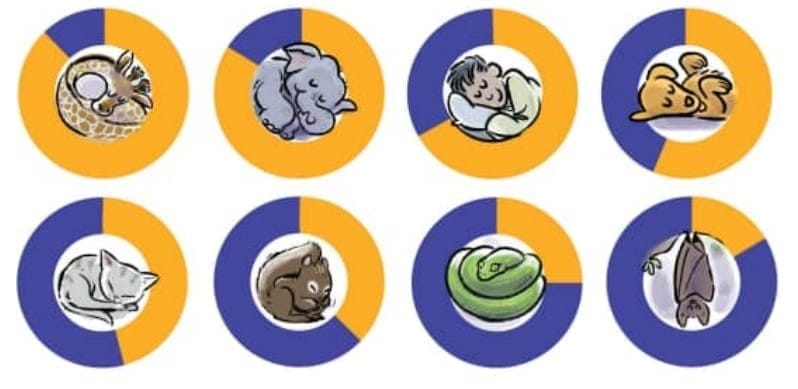
Ans: Common Sleep Patterns:
Average no. of hours a giraffe sleeps = 2.5 hours
Average no. of hours an elephant sleeps = 3.5 hours
Average no. of hours a boy sleeps = 8 hours
Average no. of hours a dog sleeps = 10.5 hours
Average no. of hours a cat sleeps = 13 hours
Average no. of hours a squirrel sleeps = 15 hours
Average no. of hours a snake sleeps = 18 hours
Average no. of hours a bat sleeps = 20 hours
Page No. 68
Q5: The pie chart shows the result of a survey carried out to find the modes of transport used by children to go to school. Study the pie chart and answer the following questions.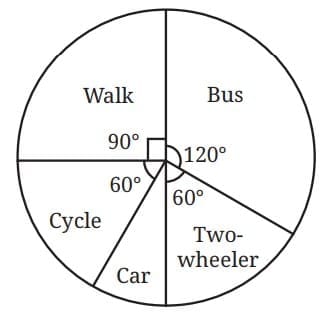
(i) What is the most common mode of transport?
(ii) What fraction of children travel by car?
(iii) If 18 children travel by car, how many children took part in the survey? How many children use taxis to travel to school?
(iv) By which two modes of transport are equal numbers of children travelling?
Ans: (i) The largest angle is 120°, which corresponds to the Bus.
(ii) The fraction of children who travel by car
\( \frac{30}{360} = \frac{1}{12} \)
(iii) Let x be the total number of children who took part in the survey.
Then 18 = \( \frac{1}{12} \times x \)
⇒ x = 18 × 12 = 216
The number of children using taxis is 0, as taxis are not a category in this chart.
(iv) Cycle and two-wheeler (60°)
Q6: Three workers can paint a fence in 4 days. If one more worker joins the team, how many days will it take them to finish the work? What are the assumptions you need to make?
Ans: When the number of workers increases, the number of days needed to paint the fence decreases.
Assumptions Needed
(i) All workers work at the same speed/rate.
(ii) The work is uniformly distributed among all workers.
(iii) All workers work for the same number of hours each day.
So, the number of workers and the number of days are in inverse proportion.
Let x be the no. of days taken.
3 × 4 = 4 × x
⇒ x = 3
So, they will take 3 days to finish the work.
Q7: It takes 6 hours to fill 2 tanks of the same size with a pump. How long will it take to fill 5 such tanks with the same pump?
Ans: No. of hours and no. of tanks are in direct proportion.
Let 5 such tanks take x hours.
\( \frac{6}{2} = \frac{x}{5} \)
⇒ x = 15
So, 5 tanks will take 15 hours.
Q8: A given set of chairs are arranged in 25 rows, with 12 chairs in each row. If the chairs are rearranged with 20 chairs in each row, how many rows does this new arrangement have?
Ans: No. of rows and no. of chairs in each row are in inverse proportion.
Let the new arrangement have x rows.
25 × 12 = x × 20
⇒ x = 15
So, the new arrangement has 15 rows.
Q9: A school has 8 periods a day, each of 45 minutes duration. How long is each period, if the school has 9 periods a day, assuming that the number of school hours per day stays the same?
Ans: No. of periods and the duration of each period are in inverse proportion.
Let each period be of x minutes.
8 × 45 = 9 × x
⇒ x = 40
So, each period is 40 minutes
Q10: A small pump can fill a tank in 3 hours, while a large pump can fill the same tank in 2 hours. If both pumps are used together, how long will the tank take to fill?
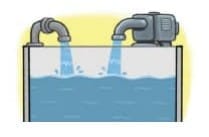
Ans: Let x litres be the capacity of the tank.
Then, water filled by small tank in one hour = \( \frac{x}{3} \) litre
Water filled by large tank in one hour = \( \frac{x}{2} \) litre
So, total water filled by both pumps in one hour = \( \left(\frac{x}{3} + \frac{x}{2}\right) \) litre = \( \frac{5x}{6} \) litre
∴ Time taken by both pumps used together to fill the tank = \( \left(1 \div \frac{5x}{6}\right) \times x \)
= \( 1 \times \frac{6}{5x} \times x \)
= \( \frac{6}{5} \) hour
= \( 1 \frac{1}{5} \) hour
Q11: A factory requires 42 machines to produce a given number of toys in 63 days. How many machines are required to produce the same number of toys in 54 days?
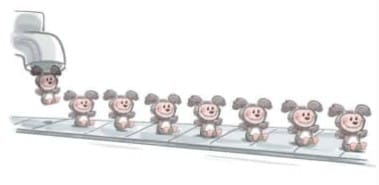
Ans: No. of machines and no. of days are in inverse proportion.
42 × 63 = x × 54
⇒ x = 49
So, 49 machines are required.
Q12: A car takes 2 hours to reach a destination, travelling at a speed of 60 km/h. How long will the car take if it travels at a speed of 80 km/h?
Ans: Let the car take t hours.
The speed of the car and the time taken are in inverse proportion.
So, 2 × 60 = t × 80
⇒ t = 1.5 hour
So, the car will take 1.5 hours.
FAQs on NCERT Solutions: Proportional Reasoning - 2
| 1. What is proportional reasoning? |  |
| 2. How can proportional reasoning be applied in real-life situations? | |
| 3. What are some common examples of ratios used in proportional reasoning? | |
| 4. What strategies can be used to solve problems involving proportional reasoning? | |
| 5. Why is it important for students to master proportional reasoning in mathematics? | |