Checklists & Templates for Study Abroad Planning


Planning to study abroad requires careful organization and preparation. Checklists and templates are essential tools that help students systematically manage the complex process of applying to foreign universities. These resources ensure that no important step is missed, deadlines are tracked properly, and all necessary documents are prepared on time. For students seeking scholarships and financial aid, having structured planning tools becomes even more critical as financial applications have strict deadlines and specific requirements.
1. Purpose and Importance of Planning Tools
Using checklists and templates makes study abroad planning more manageable and less stressful. These tools serve multiple important functions.
- Organization: Helps keep all application materials, documents, and deadlines in one place. Students can track multiple university applications simultaneously without confusion.
- Time Management: Study abroad applications require 12-18 months of preparation. Checklists break this long process into smaller, manageable tasks with specific timelines.
- Error Prevention: Reduces chances of missing important requirements like essays, recommendation letters, or financial documents. Even one missing document can lead to application rejection.
- Financial Planning: Templates help calculate total costs, compare scholarship options, and plan budget systematically. This prevents unexpected financial surprises later.
- Progress Tracking: Allows students and parents to monitor what has been completed and what still needs attention. This reduces last-minute panic.
1.1 Types of Planning Tools Needed
Different stages of study abroad preparation require different planning tools. Students should use a combination of these resources.
- Timeline Checklist: Month-by-month breakdown of tasks from initial research to final departure
- Application Tracker: Spreadsheet or table listing all universities, their deadlines, requirements, and application status
- Document Checklist: List of all required documents with completion status for each university
- Financial Planning Template: Budget calculator showing tuition fees, living costs, scholarship amounts, and funding gaps
- Scholarship Tracker: Record of all scholarship applications with deadlines, eligibility criteria, and submission status
2. Master Timeline Checklist
A comprehensive timeline ensures students start preparation early and complete tasks in proper sequence. The typical study abroad preparation timeline spans 12-18 months before the intended start date.
2.1 Early Preparation Phase (12-18 Months Before)
- Self-Assessment: Identify academic interests, career goals, preferred countries, and courses. List strengths and areas needing improvement.
- Academic Preparation: Focus on improving Class 9 and early Class 10 grades. Strong academic performance is essential for scholarships.
- English Language Tests: Begin preparing for IELTS, TOEFL, or other required language proficiency tests. Most universities require minimum scores.
- Research Phase: Create initial list of 15-20 universities and courses that match academic profile and financial capacity.
- Financial Planning Start: Calculate available family funds, explore scholarship options, and estimate total costs including tuition and living expenses.
2.2 Application Preparation Phase (10-12 Months Before)
- Shortlist Finalization: Narrow down to 6-8 universities based on detailed research about admission requirements, costs, and scholarship availability.
- Standardized Tests: Complete SAT, ACT, or other entrance tests if required by chosen universities. Register well in advance as test dates fill quickly.
- Document Collection: Gather academic transcripts, mark sheets from Class 9 and 10, birth certificate, passport-size photographs, and identity proofs.
- Statement of Purpose (SOP) Draft: Begin writing personal statement or essay explaining academic goals, reasons for studying abroad, and career plans.
- Recommendation Letters: Approach teachers, principal, or mentors early to request recommendation letters. Provide them sufficient time (minimum 4-6 weeks).
2.3 Application Submission Phase (6-9 Months Before)
- Application Forms: Complete online application forms carefully. Double-check all entered information before submission.
- Application Fee Payment: Arrange payment for application fees (typically $50-100 per university). Some universities offer fee waivers for financial need.
- Scholarship Applications: Submit separate scholarship applications with required essays, financial statements, and supporting documents before deadlines.
- Document Submission: Upload or mail all required documents including transcripts, test scores, SOP, and recommendation letters as per university instructions.
- Portfolio Preparation: For creative courses (art, design, music), prepare and submit portfolio showcasing previous work and achievements.
2.4 Post-Application Phase (3-6 Months Before)
- Application Tracking: Regularly check application portals for updates. Respond promptly to any university requests for additional information.
- Interview Preparation: Some universities conduct interviews. Prepare answers for common questions about academic interests and future goals.
- Financial Aid Follow-up: Track scholarship application status. Submit any additional documents requested by scholarship committees.
- Acceptance Decision: Compare admission offers based on program quality, location, total costs, and scholarship amounts received.
- Enrollment Confirmation: Accept admission offer by paying enrollment deposit (usually $200-500) before the deadline mentioned in offer letter.
2.5 Pre-Departure Phase (1-3 Months Before)
- Student Visa Application: Apply for student visa immediately after receiving admission letter. Process can take 4-8 weeks depending on country.
- Accommodation Booking: Arrange housing either in university dormitory or private accommodation. Apply early as campus housing has limited availability.
- Financial Arrangements: Open international bank account if needed. Arrange foreign exchange for initial expenses. Understand how to transfer funds from India.
- Health Requirements: Complete medical examination, get required vaccinations, and arrange health insurance as mandated by university or country.
- Travel Booking: Book flight tickets after visa approval. Look for student discounts. Arrange airport pickup if university offers this service.
- Packing Preparation: Create packing list including essential documents, clothing suitable for destination climate, study materials, and personal items.
3. University Application Tracker Template
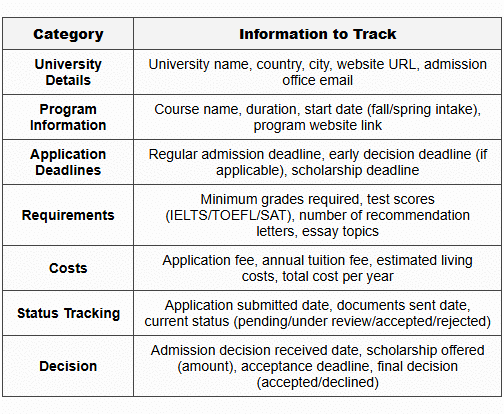
An application tracker is a structured table or spreadsheet that records key information about each university application. This prevents confusion when applying to multiple universities simultaneously.
3.1 Essential Columns in Application Tracker
A comprehensive application tracker should include the following information categories:
3.2 Color-Coding System
Using colors in the tracker helps quickly identify application status at a glance.
- Red: Urgent tasks or approaching deadlines within 2 weeks
- Yellow: In-progress applications or pending document submissions
- Green: Completed applications or received admission offers
- Blue: Universities offering scholarships or financial aid
- Gray: Rejected applications or declined offers
3.3 Priority Classification
Assign priority levels to universities based on preference and likelihood of admission.
- Reach Schools (15-20%): Dream universities where admission chances are lower due to high competition or strict requirements
- Target Schools (50-60%): Universities where academic profile matches requirements and admission is reasonably likely
- Safety Schools (20-30%): Universities where admission is highly probable based on strong matching of qualifications
4. Document Checklist Template
A document checklist ensures all required papers are prepared, verified, and submitted correctly. Missing even one document can delay or reject an application.
4.1 Academic Documents
- Class 9 Mark Sheets: Certified copies showing all subjects and grades for both terms. Some universities require official school seal on each page.
- Class 10 Mark Sheets: Final examination results with all subjects. If applying before Class 10 results, submit predicted scores from school.
- School Transcripts: Official grade reports prepared on school letterhead, signed by principal, and stamped with school seal.
- Academic Certificates: Any awards, merit certificates, or academic honors received during school years.
- Grading Scale Explanation: Document explaining Indian grading system (percentage or CGPA) as foreign universities may not understand it.
4.2 Test Score Documents
- English Proficiency Scores: Official IELTS, TOEFL, or PTE score reports sent directly from testing agency to universities.
- Standardized Test Scores: SAT, ACT, or other entrance test results if required. Scores must be sent through official channels.
- Test Registration Receipts: Proof of test registration and payment for record-keeping purposes.
4.3 Personal Documents
- Passport: Valid passport with at least 6 months validity beyond intended study period. Apply early as passport processing takes 2-4 weeks.
- Birth Certificate: Official certificate showing date of birth, required for visa applications in many countries.
- Photographs: Recent passport-size photos meeting specific size and background requirements of each country (typically 10-15 copies).
- Identity Proof: Aadhaar card, PAN card, or other government-issued ID documents as backup identification.
4.4 Written Components
- Statement of Purpose (SOP): Personal essay (500-1000 words) explaining academic interests, reasons for studying abroad, career goals, and why chosen university is suitable.
- Essays: Answers to specific essay questions asked by universities. Each university may have different essay topics.
- Resume/CV: Summary of academic achievements, extracurricular activities, volunteer work, internships, and skills.
- Recommendation Letters: Usually 2-3 letters from teachers or principal describing academic abilities, character, and potential for success abroad.
4.5 Financial Documents
- Bank Statements: Last 6 months statements showing sufficient funds to cover first year expenses (tuition plus living costs).
- Scholarship Certificates: Award letters from scholarships already received, showing amount and duration of funding.
- Sponsorship Letters: If parents or relatives are sponsoring, formal letter stating commitment to fund education with their financial documents.
- Income Proof: Parent's salary slips, income tax returns, or business income documents showing financial capability.
- Property Documents: If showing property as financial proof, ownership documents and current valuation certificates.
4.6 Document Preparation Guidelines
- Certification: Get all academic documents attested by school principal with official seal. Some countries require notarization from government authorities.
- Translation: If any document is in regional language, get official English translation from certified translator.
- Copies: Make 5-6 copies of each document. Keep original, certified copy, and regular copies separately.
- Digital Versions: Scan all documents in high-quality PDF format (minimum 300 DPI). Universities often require electronic uploads.
- Organization: Store documents in labeled folders (physical and digital) for each university to avoid confusion during submission.
5. Financial Planning Template
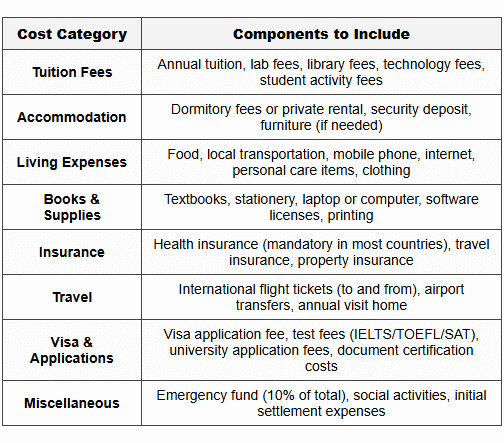
A financial planning template helps calculate total study abroad costs, identify funding sources, and plan budget systematically. This prevents financial difficulties during studies.
5.1 Cost Estimation Components
Total cost of studying abroad includes both direct academic expenses and living costs. Students must budget for all categories.
5.2 Funding Sources Template
List all potential sources of funding and calculate total available amount. This helps identify funding gap that needs additional scholarships or loans.
- Family Contribution: Amount parents can provide from savings, investments, or regular income
- Personal Savings: Student's own savings from pocket money, gifts, or part-time work
- University Scholarships: Merit-based or need-based scholarships offered by universities
- Government Scholarships: Programs like National Overseas Scholarship or state government schemes
- Private Scholarships: Awards from foundations, corporations, or NGOs supporting education
- Education Loans: Bank loans for education (calculate interest and repayment terms)
- Part-Time Work: Expected earnings from on-campus or off-campus jobs allowed on student visa
5.3 Budget Calculation Formula
Use this systematic approach to calculate complete financial plan:
Total Cost = Tuition Fees + Accommodation + Living Expenses + Books + Insurance + Travel + Miscellaneous
Total Available Funds = Family Contribution + Personal Savings + Scholarships + Loans + Expected Earnings
Funding Gap = Total Cost - Total Available Funds
If Funding Gap is positive, student needs additional scholarships or loans. If negative, there is surplus for emergencies.
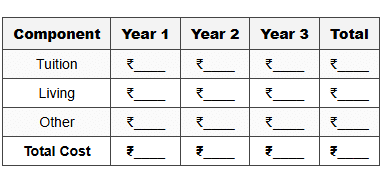
5.4 Year-wise Budget Planning
Break down costs and funding for each year of study. This helps plan better as some costs may increase over time.
5.5 Scholarship Comparison Template
When evaluating multiple scholarship offers, compare them systematically using key parameters.
- Scholarship Amount: Total value (one-time or annual) and what percentage of total costs it covers
- Duration: Number of years scholarship continues (some are only for first year)
- Conditions: Requirements to maintain scholarship like minimum GPA or full-time enrollment
- Coverage: What expenses are included (tuition only, or tuition plus living costs)
- Renewal Process: Whether scholarship automatically renews or requires reapplication each year
- Additional Benefits: Other perks like travel allowance, book allowance, health insurance, or internship support
6. Scholarship Application Tracker
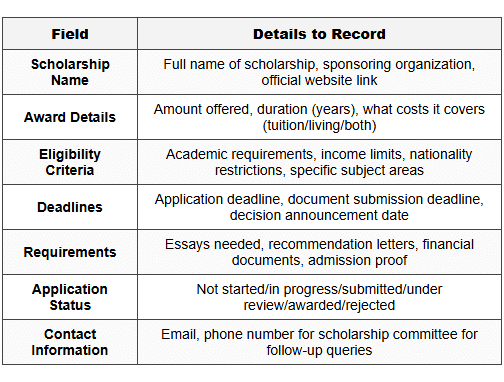
A scholarship tracker is essential because students typically apply to 10-15 different scholarships to maximize financial aid chances. Each scholarship has different requirements and deadlines.
6.1 Key Information to Track
6.2 Priority Ranking for Scholarships
Not all scholarships have equal value. Rank them based on strategic importance.
- High Priority: Large amount scholarships covering full tuition or more, with high probability of success based on eligibility match
- Medium Priority: Partial scholarships covering 25-50% of costs, moderate competition level
- Low Priority: Small amount scholarships (covering less than 25%) or very competitive ones with low success probability
6.3 Scholarship Essay Tracking
Different scholarships require different essays. Track essay requirements separately to avoid confusion.
- Essay Topic: Exact question or prompt given by scholarship committee
- Word Limit: Maximum word count or page limit specified
- Draft Status: First draft/revision stage/final draft/submitted
- Review Date: When teacher or mentor reviewed and provided feedback
- Unique Requirements: Special instructions like double spacing, specific font, or particular focus areas
7. Task Priority Management
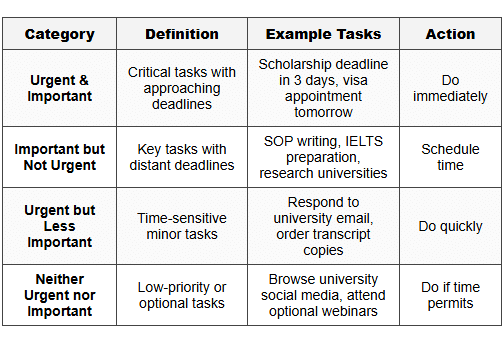
With multiple deadlines and tasks, students need system to prioritize work effectively. Priority management ensures urgent and important tasks are completed first.
7.1 Urgency-Importance Matrix
Classify all study abroad tasks into four categories based on urgency (deadline proximity) and importance (impact on admission).
7.2 Weekly Planning Template
Break long-term goals into weekly action plans. This makes large projects manageable.
- Week's Main Goals: List 3-5 major tasks to complete during the week
- Daily Task Breakdown: Assign specific tasks to each day based on time available and complexity
- Time Allocation: Estimate hours needed for each task to plan realistically
- Progress Check: Review at week end what was completed and what needs to carry forward
- Adjustment: Modify next week's plan based on current week's actual progress
8. Digital Tools and Resources
While paper-based checklists work well, digital tools offer additional benefits like automatic reminders, cloud backup, and easy sharing with parents or counselors.
8.1 Spreadsheet Applications
- Microsoft Excel or Google Sheets: Best for creating detailed trackers with multiple columns, formulas for calculations, and filtering options. Google Sheets allows parents to view progress in real-time.
- Benefits: Can create dropdown lists for status tracking, use conditional formatting for color-coding deadlines, and automatically calculate total costs.
- Templates Available: Many education websites offer free downloadable Excel templates specifically designed for study abroad planning.
8.2 Calendar Applications
- Google Calendar or Outlook: Set reminders for all deadlines. Create different colored calendars for applications, scholarships, tests, and visa appointments.
- Reminder Settings: Set multiple reminders for critical deadlines (e.g., 2 weeks before, 1 week before, 3 days before, 1 day before).
- Sharing Feature: Share calendar with parents so they can track progress and provide timely support.
8.3 Document Management
- Cloud Storage: Use Google Drive, Dropbox, or OneDrive to store all scanned documents. Organize in clearly labeled folders for each university.
- Backup Strategy: Keep documents in three places-original physical copies, home computer, and cloud storage. This prevents loss due to damage or technical failure.
- File Naming Convention: Use clear names like "StudentName_Class10_MarkSheet.pdf" or "StudentName_SOP_UniversityName.docx" for easy identification.
8.4 Note-Taking Applications
- Evernote or OneNote: Maintain detailed notes about each university, scholarship requirements, contact information, and communication history.
- Research Documentation: While researching universities, save important information with source links for future reference.
- Question Bank: Note down questions to ask university admission office or scholarship committees during follow-up.
9. Review and Update System
Checklists and templates are only effective if reviewed and updated regularly. Static tools quickly become outdated and misleading.
9.1 Regular Review Schedule
- Weekly Review: Every Sunday evening, review all trackers. Update completed tasks, check upcoming deadlines, and plan next week's priorities.
- Monthly Comprehensive Review: First day of each month, assess overall progress. Compare with original timeline to identify delays.
- After Major Milestones: Update immediately after submitting application, receiving admission decision, or getting scholarship results.
- Deadline Approaching: Review daily when major deadline is within 1 week to ensure nothing is missed.
9.2 Updating Best Practices
- Real-Time Updates: Update tracker immediately when task is completed or status changes. Don't rely on memory to update later.
- Change Tracking: Note when requirements change (universities sometimes modify essay topics or deadlines).
- Communication Log: Record all important communications with universities or scholarship committees with date and key points discussed.
- Lessons Learned: Note what worked well and what didn't for future applications or to help others.
9.3 Collaboration with Parents and Counselors
- Shared Access: Give parents view-only or edit access to trackers so they can monitor progress and provide timely help.
- Weekly Discussion: Have 30-minute meeting with parents every week to discuss progress, challenges, and next steps.
- School Counselor Input: Show trackers to school counselor monthly. They can provide guidance on priorities and warn about potential issues.
- Accountability: When others review progress regularly, students are more likely to stay on track and meet deadlines.
10. Emergency Backup Plans
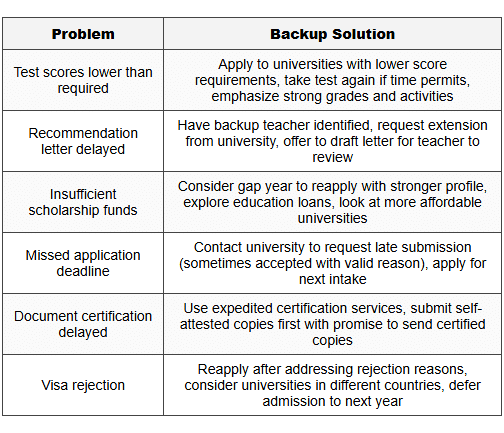
Even with perfect planning, unexpected situations arise. Having backup plans prevents panic and ensures applications continue smoothly.
10.1 Common Problems and Solutions
10.2 Financial Contingency Planning
- Cost Overrun Buffer: Plan for expenses to be 15-20% higher than estimated. Living costs often exceed initial estimates.
- Alternative Funding: Identify 2-3 backup scholarship options or loan providers if primary funding falls through.
- Cheaper Alternatives: Keep list of affordable universities as backup if first-choice universities don't offer sufficient financial aid.
- Gap Year Option: Be mentally prepared to defer by one year if financial arrangements are not satisfactory. Better than starting with insufficient funds.
Effective use of checklists and templates transforms study abroad planning from overwhelming to manageable. These tools provide structure, ensure nothing important is missed, and give confidence that preparation is on track. Students who systematically use planning tools have significantly higher success rates in securing admissions and scholarships compared to those who approach process casually. The key is not just creating these tools but updating them regularly and actually following the planned schedule. With disciplined use of these resources, studying abroad becomes a well-organized journey rather than a stressful race against deadlines.
