CBSE PYQs: Money and Banking

CBSE Previous Year Questions 2025
Q1. "Irfaan (a student) borrows ₹ 80,000 to finance his college fee. He plans to begin repaying the loan six months after his graduation, making payments over a span of ten years."
Based on above text, identify the indicated function of money. (1 Mark)
(A) Medium of Exchange
(B) Unit of Account
(C) Standard of Deferred Payments
(D) Store of Value
Answer: (C)
Solution: Money serves as a standard of deferred payments because it allows for economic transactions that are not settled immediately but involve payments to be made in the future. In this case, Irfaan is taking a loan now and agreeing to pay it back over a period of ten years starting in the future, which is made possible by money's ability to act as a stable measure for future obligations.
Q2. As the Banker to the Bank, Reserve Bank of India performs all functions except _________. (1 Mark)
(A) Purchase and sale of securities on behalf of general public
(B) Maintaining current account for Commercial Banks
(C) Clearing and settlement of Interbank transactions
(D) Facilitating governmental transactions
Answer: (A)
Solution: The Reserve Bank of India (RBI) acts as a banker to the commercial banks by maintaining their current accounts and clearing interbank transactions, and as a banker to the government by facilitating its transactions. However, the RBI does not deal directly with the general public for the purchase and sale of securities; its open market operations are conducted through the banking system and institutional investors.
Q3. State the formula to compute Credit Multiplier. (1 Mark)
Answer:The formula for the Credit Multiplier (also known as the Money Multiplier) is:
Where the Reserve Ratio is the percentage of deposits that banks are legally required to keep as cash reserves.
Q4. _____________ releases data of money supply in India. (1 Mark)
(A) Corporation Bank
(B) Reserve Bank of India
(C) Commercial Banks
(D) State Bank of India
Answer: (B)
Solution: The Reserve Bank of India (RBI) is the monetary authority of the country and is responsible for regulating and publishing the alternative measures of money supply (M1, M2, M3, and M4) in the economy.
Q5. Read the following statements carefully: (1 Mark)
Statement 1: Open Market Operations refers to purchase/sale of Government Securities (G-Sec) by the Central Bank.
Statement 2: To decrease money supply, Central Bank will sell the Government Securities to commercial banks. .
(A) Statement 1 is true and Statement 2 is false.
(B) Statement 1 is false and Statement 2 is true.
(C) Both statements 1 and 2 are true.
(D) Both statements 1 and 2 are false.
Answer: (C)
Solution: Statement 1 is true because Open Market Operations (OMO) involve the buying and selling of government bonds by the Central Bank. Statement 2 is true because selling securities reduces the cash reserves of commercial banks, thereby decreasing the money supply and aggregate demand to curb an inflationary gap.
Q6. Read the following text carefully: (2 Mark)
"This function of money provides different items to be evaluated against a common standard. It allows comparison of prices and keeping financial records."
(i) On the basis of the given text, identify the indicated function of money.
(ii) List any other two functions of money.
Answer: (i) Unit of Account: The text describes money as a common standard that allows the value of all goods and services to be expressed in monetary units, enabling price comparisons.
(ii) Other Functions:
- Medium of Exchange: Money facilitates the exchange of goods and services, overcoming the problem of double coincidence of wants in a barter system.
- Store of Value: Money can be held as an asset to transfer purchasing power from the present to the future because it is not perishable and has low storage costs.
Q7. Suppose in an economy, primary deposits are ₹ 500, if the Reserve Ratio is 25%. Estimate the total deposits created and the total lending by the banking system. (4 Marks)
Answer:
- Total Deposits Created: ₹ 2,000
- Total Lending: ₹ 1,500.
Solution:
- Money Multiplier calculation:The money multiplier is the reciprocal of the Reserve Ratio.
- Money Multiplier = 1 / Reserve Ratio
= 1 / 0.25 = 4
- Total Deposits Created:Total deposits are calculated by multiplying the primary deposit by the money multiplier.
- Total Deposits = Primary Deposit × Money Multiplier
= ₹500 × 4 = ₹2,000
- Total Lending:Total lending is the difference between total deposits and the required reserves.
- Required Reserves = 25% of ₹2,000 = ₹500
- Total Lending = Total Deposits - Required Reserves
= ₹2,000 - ₹500 = ₹1,500
Q8. Elaborate the process of Credit Creation using a suitable numerical example. (4 Marks)
Answer: Credit Creation is the process by which commercial banks create new money (deposits) through the lending of a portion of their primary deposits.
Process:
- Banks assume that not all depositors will withdraw their money at the same time.
- The Central Bank mandates a Legal Reserve Ratio (LRR), which is the minimum percentage of deposits banks must keep as reserves.
- Banks lend the "excess reserves" to borrowers. These loans are not given in cash but are credited as new deposits in the borrowers' accounts.
- Since every loan creates a new deposit, the total money supply in the economy increases.
Numerical Example:
- Suppose an initial primary deposit of ₹ 1,000 is made in a bank, and the LRR is 20%.
- Round 1: The bank keeps ₹ 200 (20% of 1,000) as reserves and lends ₹ 800. This ₹ 800 eventually returns to the banking system as a new deposit.
- Round 2: The bank keeps ₹ 160 (20% of 800) as reserves and lends ₹ 640.
- This process continues until total reserves equal the initial deposit.
- Total Deposits Created = Initial Deposit × (1 / LRR)
= ₹1,000 × (1 / 0.20)
= ₹5,000
The process of credit creation is limited by the legal reserve ratio fixed by the central bank, which determines how much banks can lend.
Q9. Justify the following statements with valid arguments: (4 Marks)
(i) Money supply in an economy is an example of a stock variable.
(ii) The Central Bank provides several Banking services to the government.
Answer:
(i) Money supply is a stock variable because it refers to the total stock of money in circulation among the public at a particular point of time. Unlike flow variables, which are measured over a period of time, money supply is a snapshot of the monetary resources available in the economy at a specific moment.
(ii) The Central Bank acts as a banker to the government by performing the following services:
- It maintains the current accounts of the government.
- It carries out government transactions, such as accepting receipts and making payments.
- It manages the public debt and acts as an agent and adviser to the government on economic and monetary matters.
Q10. "In the 1990s, on the advice of Reserve Bank of India (RBI), the Government of India took a decision of hypothecation of gold reserves to different nations."
In the light of above statement, discuss briefly the role of Central Bank as Banker, Agent and Adviser to the Government. (4 Marks)
Answer: The Reserve Bank of India (RBI) performs three critical roles for the Government of India:
- As a Banker: The RBI maintains the banking accounts of the government, accepts deposits, and carries out financial transactions on its behalf.
- As an Agent: The RBI manages the public debt for the government and acts as its representative in various financial markets, including the purchase and sale of government securities.
- As an Adviser: The RBI advises the government on monetary, financial, and economic matters, especially relating to banking, credit, and currency management.
CBSE Previous Year Questions 2024
Q1. Identify the incorrect feature(s) of money supply (M1) from the following: (1 Mark)
(i) It is measured at a point of time.
(ii) It does not include stock of money held by the government.
(iii) It is always the currency in the hands of the Central Bank of a nation.
Alternatives:
(A) (i) and (ii)
(B) (ii) and (iii)
(C) (ii) only
(D) (iii) only
Answer: (D)
Solution: M1 is a stock variable, meaning it is measured at a specific point in time and includes only the money held by the public (currency and demand deposits), not the money held by the issuing authority like the Central Bank or the government.
(NCERT Reference: 3.4.1 Supply of Money (Measures of Money Supply))
Q2. Find the missing figures and choose the correct alternative: (1 Mark)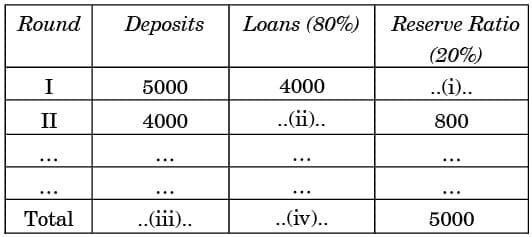 (A) 1000, 800, 20000, 25000
(B) 5000, 3200, 25000, 20000
(C) 1000, 3200, 25000, 20000
(D) 1000, 800, 20000, 25000
Answer: (C)
Solution:(i) Reserve in Round I = $0.2 \times 5000 = 1000$
(ii) Loans in Round II = $0.8 \times 4000 = 3200$
(iii) Total Deposits = $\dfrac{5000}{0.2} = 25000$
(iv) Total Loans = $25000 - 5000 = 20000$
Correct Option: (C)
Q3. Read the following statements carefully:
Statement 1: Money is a commodity which is generally accepted as a medium of exchange.
Statement 2: Money solved the problem of double coincidence of wants.
In the light of the given statements, choose the correct alternative from the following. (1 Mark)
(A) Statement 1 is true and statement 2 is false.
(B) Statement 1 is false and statement 2 is true.
(C) Both statements 1 and 2 are true.
(D) Both statements 1 and 2 are false.
Answer: (C)
Solution: Money is defined by its role as a commonly accepted medium of exchange, which facilitates transactions and eliminates the primary drawback of the barter system, which is the rare "double coincidence of wants".
(NCERT Reference: 3.1 Functions of Money)
Q4. Identify the incorrect statement with reference to Cash Reserve Ratio (CRR):
(A) It is a certain percentage of demand and time deposit liabilities that every bank must keep as cash reserves with the Central Bank.
(B) It is fixed by the Central Bank.
(C) It is not binding on the commercial banks.
(D) It is a tool used by the Central Bank to control the credit creation in the economy. (1 Mark)
Answer: (C)
Solution: The CRR is a legal requirement set by the RBI; it is strictly binding on all commercial banks to ensure they do not over-lend and to maintain stability in the banking system.
(NCERT Reference: 3.3.2 Limits to Credit Creation and Money Multiplier)
Q5. The Central Bank can reduce the Money Supply in the economy by ______ the ______. (1 Mark)
Answer: increasing the Bank Rate / Reserve Ratio.Solution
By increasing quantitative tools like the Bank Rate, the cost of borrowing for commercial banks rises, which leads to higher interest rates for the public, discouraged borrowing, and a subsequent reduction in money supply.
(NCERT Reference: 3.4 Policy Tools to Control Money Supply)
Q6. "Mr. Sahotra borrowed funds from bank for purchasing a new house".
From the above statement, identify the indicated function of money: (1 Mark)
(A) Medium of exchange
(B) Store of value
(C) Unit of account
(D) Standard of deferred payments.
Answer: (D)
Solution: Borrowing involves a contract to repay the principal and interest in the future. This is made possible because money serves as a standard for deferred (future) payments, allowing value to be settled over time.
(NCERT Reference: 3.1 Functions of Money)
Q7. If in an economy the initial deposits are ₹ 4,000 crore and Reserve Ratio (RR) is 10%. The value of total deposit created would be ₹ ______ crore. (1 Mark)
(A) 4,000
(B) 40,000
(C) 2,000
(D) 20,000
Answer: (B)
Solution: The money multiplier is calculated as $1 / \text{Reserve Ratio}$. Here, $1 / 0.10 = 10$. Total deposits created = $\text{Initial Deposits} \times \text{Multiplier} = 4,000 \times 10 = 40,000$.
Q8. Identify the incorrect feature(s) of the Money Supply in an economy, from the following:
(i) It is measured during a period of time.
(ii) It includes stock of money held by the government of a nation.
(iii) It always represents the currency held with Central Bank of the Nation. (1 Mark)
(A) (i) only
(B) (ii) and (iii)
(C) (i) and (ii)
(D) (i), (ii) and (iii)
Answer: (D)
Solution: Money supply is a stock variable (measured at a point in time, not a period), it excludes money held by the government/Central Bank, and it represents the stock of money held by the public.
Q9. The Central Bank is the sole currency issuing authority of an economy. Justify. (2 Marks)
Answer: In a modern economy like India, the Reserve Bank of India (RBI) is the sole authority for issuing currency notes, which are considered fiat money because they derive their value from the government's guarantee rather than intrinsic worth. This function allows the Central Bank to control the monetary base (high-powered money), which acts as the foundation for credit creation within the entire banking system.
(NCERT Reference: 3.2.2 Supply of Money - Central Bank)
Q10. Money serves as a measure of standard of deferred payments. Justify. (2 Marks)
Answer: Money acts as a standard for deferred payments because it is not perishable, has relatively low storage costs, and maintains universal acceptability over time. These characteristics allow individuals to store wealth and settle debts or obligations at a future date with confidence that the value can be expressed in stable monetary units.
(NCERT Reference: 3.1 Functions of Money)
Q11. Read the following text carefully from 'The Economic Times' dated 8th June, 2023:
"The Reserve Bank of India's (RBI's) rate setting panel unanimously decided to keep the benchmark lending rate unchanged at 6-5%. The committee voted to remain focused on the withdrawal of accommodating monetary policy."
On the basis of given text and common understanding, answer the following questions: (4 Marks)
(a) Identify and discuss the economic issue indicated in the above text.
Answer: The economic issue indicated in the text is monetary policy decision related to interest rates.
The Reserve Bank of India, through its rate-setting panel, regulates money supply and credit conditions in the economy by changing policy rates. Keeping the benchmark rate unchanged indicates a cautious monetary stance aimed at controlling inflation while supporting economic stability.
(b) Discuss the likely consequence on money supply if the rate setting panel would have decreased the said rate.
Answer: If the rate-setting panel (Central Bank) decreases the Bank Rate or Repo Rate, the cost of borrowing funds for commercial banks from the Central Bank decreases. This leads to an increase in the reserves held by commercial banks, encouraging them to lend more, which ultimately results in an increase in the money supply in the economy.
(NCERT Reference: 3.4 Policy Tools to Control Money Supply)
Q12. Reserve Bank of India undertakes the important function of managing the government's banking transactions.
Discuss the above stated function. (4 Marks)
Answer: As the banker to the government, the Reserve Bank of India performs all banking transactions of the Central and State Governments. It maintains their current accounts and receives and makes payments on their behalf. The RBI also acts as an agent of the government by managing public debt. It issues government bonds and treasury bills, services existing loans, and handles repayment on maturity. Further, it facilitates the transfer of government funds between different accounts and departments, ensuring smooth day-to-day financial operations. Through these functions, the RBI enables the government to conduct its financial transactions efficiently and systematically.
Q13. Elaborate the 'Banker's Bank and Supervisor' function of the Reserve Bank of India. (4 Marks)
Answer: In this role, the RBI acts as the head of the banking structure:
- Custodian of Reserves: Commercial banks are required to keep a portion of their deposits (reserves) with the RBI.
- Lender of Last Resort: When commercial banks face a liquidity crunch and cannot find funds elsewhere, they can approach the RBI for loans.
- Supervision: The RBI regulates the banking system through tools like the reserve ratio, bank rate, and moral suasion to ensure banks follow monetary policy and maintain financial health.
- Central Clearing: It facilitates the settlement of inter-bank claims.
(NCERT Reference: 3.2.2 Supply of Money - Central Bank)
Q14. Open market operations by Reserve Bank of India (RBI) help in regulating money supply in the economy. Justify the given statement with valid arguments. (4 Marks)
Answer: Open Market Operations (OMO) refer to the buying and selling of government bonds by the Central Bank.
- Increasing Money Supply: When the RBI buys bonds, it pays with a cheque, which increases the total reserves of commercial banks, thereby expanding their ability to create credit and increasing the overall money supply.
- Decreasing Money Supply: Conversely, when the RBI sells bonds, it withdraws money from the system, reducing bank reserves and the money supply.
- Nature of Operations: These can be outright (permanent) or repo (short-term repurchase agreements).
Q15: Justify the following statements with valid arguments : (4 Marks)
(a) Money serves as a store of value in an economy. Justify.
Answer: Money serves as a store of value because wealth can be saved in monetary form for future use, benefiting from the fact that money is not perishable and is universally acceptable. While other assets like land or gold can also store value, money is unique because it is the most liquid asset, easily convertible into other commodities at any time.
(b) The Central Bank acts as 'Government's Bank' in an economy.
Answer: Banker to the government.
The Central Bank manages the government's banking transactions, acting as an agent and adviser to the government. It undertakes the responsibility of managing the public debt and maintains the accounts of the government, similar to how commercial banks serve the public.
FAQs on CBSE PYQs: Money and Banking
| 1. What is National Income Accounting? |  |
| 2. What are the key components of National Income? | |
| 3. How is Gross Domestic Product (GDP) calculated? | |
| 4. What is the difference between GNP and GDP? | |
| 5. Why is National Income important for a country? | |