CBSE Class 6 > Class 6 Notes > Science > Mnemonics: Methods of Separation in Everyday Life
Mnemonics: Methods of Separation in Everyday Life

Main Separation Methods
These are the standard methods you'll see in your science textbook for separating components of a mixture.
"Happy Teachers Will See Every Day From Children Making Smiles"
"Happy Teachers Will See Every Day From Children Making Smiles"
- Happy = Handpicking
- Teachers = Threshing
- Will = Winnowing
- See = Sieving
- Every = Evaporation
- Day = Decantation
- From = Filtration
- Children = Churning
- Making = Magnetic separation
- Smiles = Sedimentation
What does each method do?
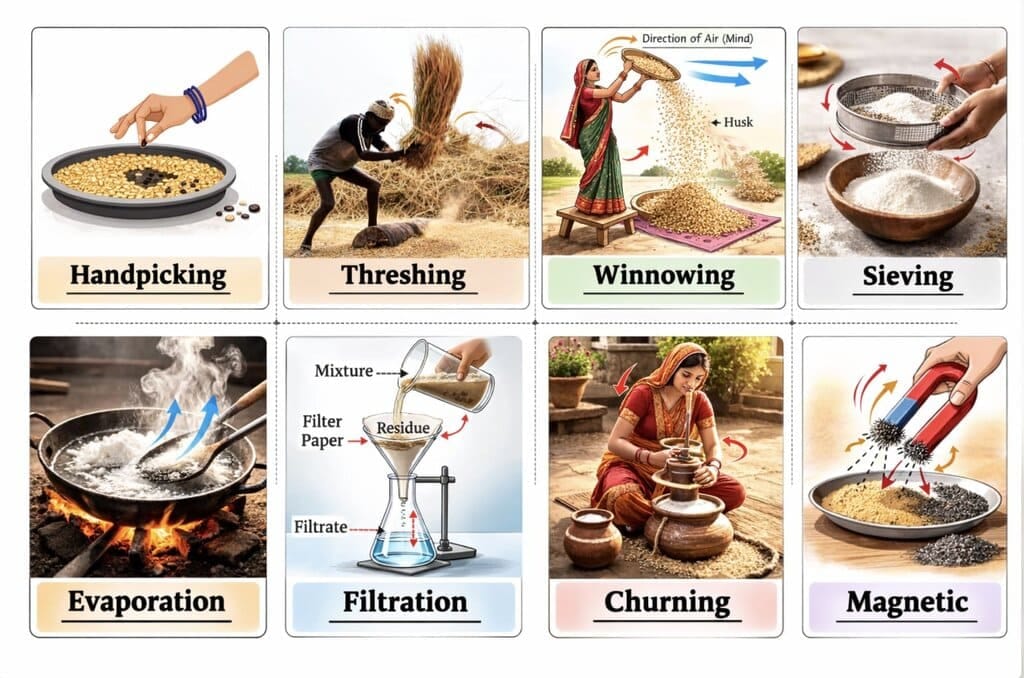
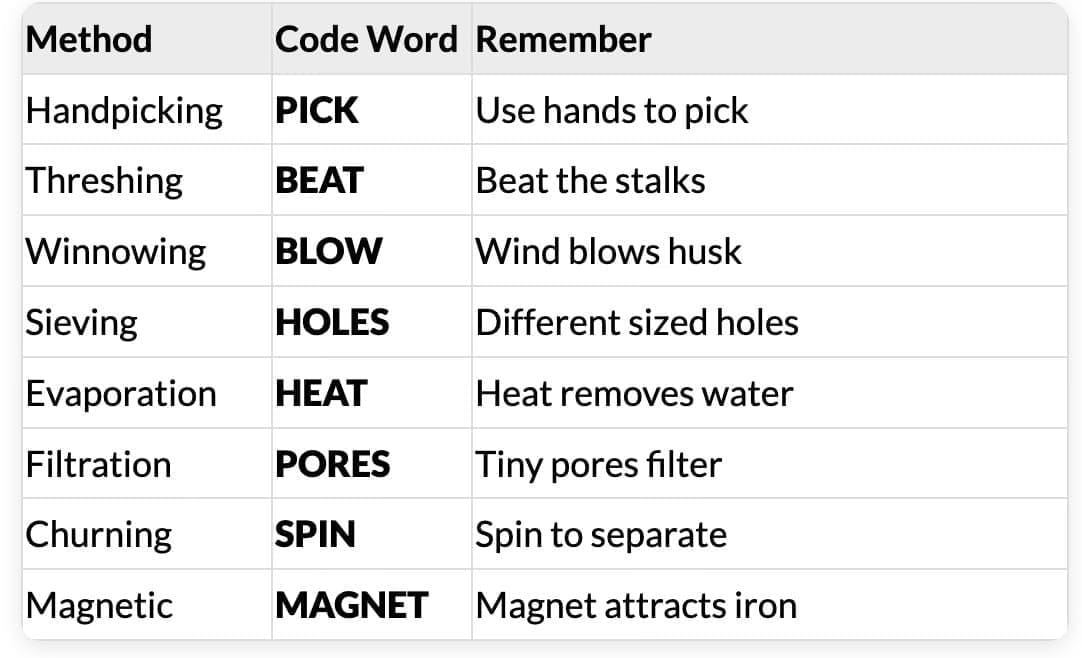
When to Use What Method ?
To separate
1. Solid-Solid mixtures: Hot Spicy Maggie
- Hot : Handpicking
- Spicy : Sieving
- Maggie: Magnetic separation
2. Solid-Liquid mixtures: FED
- Filtration
- Evaporation
- Decantation (with Sedimentation)
3. Special methods: World Cup
- World : Winnowing (uses wind/air)
- Cup: Churning (for cream/butter)
Quick Recall Stories
- The Farmer's Day
Mnemonic: "First he THRESHES (beats stalks), then he WINNOWS (wind blows away husk)"
Remember: BEAT then BLOW!
- How To Make Tea
Mnemonic: "Tea leaves SETTLE (sedimentation), then POUR (decantation), then STRAIN (filtration)"
Remember: SIT, TIP, DRIP!
- How To Get Salt from Sea
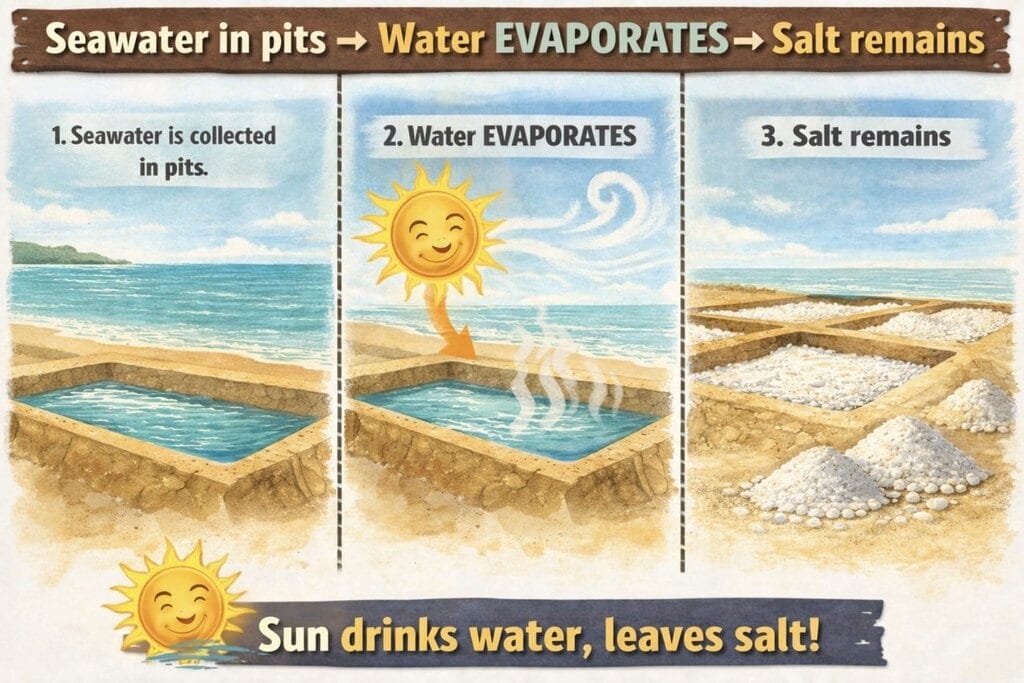 Mnemonic: "Seawater in pits → Water EVAPORATES → Salt remains"
Remember: Sun drinks water, leaves salt!
The document Mnemonics: Methods of Separation in Everyday Life is a part of the Class 6 Course Science for Class 6.
All you need of Class 6 at this link: Class 6
FAQs on Mnemonics: Methods of Separation in Everyday Life
| 1. What are the main separation methods used in everyday life? |  |
Ans. The main separation methods used in everyday life include filtration, evaporation, distillation, chromatography, and magnetic separation. Each method is chosen based on the physical and chemical properties of the substances involved.
| 2. How does filtration work as a separation method? | |
Ans. Filtration works by passing a mixture through a filter, which allows smaller particles or liquids to pass through while retaining larger particles or solids. It is commonly used to separate solids from liquids, such as in the process of making tea or purifying water.
| 3. When is evaporation used to separate substances? | |
Ans. Evaporation is used to separate a soluble solid from a liquid, where the liquid is heated until it turns into vapour, leaving the solid behind. This method is often applied in processes like obtaining salt from seawater.
| 4. What is the principle behind distillation? | |
Ans. Distillation is based on the difference in boiling points of substances. It involves heating a liquid to create vapour and then cooling the vapour to obtain a liquid. This method is effective for separating mixtures of liquids, such as in the production of alcoholic beverages.
| 5. Can you explain how chromatography separates mixtures? | |
Ans. Chromatography separates mixtures based on the movement of different components through a medium. The mixture is placed on a stationary phase and a solvent moves through it, carrying different components at varying rates, resulting in separation. It is commonly used in laboratories for analysing chemical substances.
About this Document

4.78/5 Rating

Apr 29, 2026 Last updated
Related Exams
Document Description: Mnemonics: Methods of Separation in Everyday Life for Class 6 2026 is part of Science for Class 6 preparation. The notes and questions for Mnemonics: Methods of Separation in Everyday Life have been prepared according to the Class 6 exam syllabus. Information about Mnemonics: Methods of Separation in Everyday Life covers topics like and Mnemonics: Methods of Separation in Everyday Life Example, for Class 6 2026 Exam. Find important definitions, questions, notes, meanings, examples, exercises and tests below for Mnemonics: Methods of Separation in Everyday Life.
Introduction of Mnemonics: Methods of Separation in Everyday Life in English is available as part of our Science for Class 6 for Class 6 & Mnemonics: Methods of Separation in Everyday Life in Hindi for Science for Class 6 course. Download more important topics related with notes, lectures and mock test series for Class 6 Exam by signing up for free. Class 6: Mnemonics: Methods of Separation in Everyday Life
Description
Mnemonics: Methods of Separation in Everyday Life of Science to help you remember important concepts with short tricks. Start learning for Class 6 exam & improve retention with EduRev.
Information about Mnemonics: Methods of Separation in Everyday Life
In this doc you can find the meaning of Mnemonics: Methods of Separation in Everyday Life defined & explained in the simplest way possible. Besides explaining types of Mnemonics: Methods of Separation in Everyday Life theory, EduRev gives you an ample number of questions to practice Mnemonics: Methods of Separation in Everyday Life tests, examples and also practice Class 6 tests



Related Searches
mock tests for examination, Free, study material, Exam, Important questions, Previous Year Questions with Solutions, Extra Questions, Mnemonics: Methods of Separation in Everyday Life, pdf , Viva Questions, past year papers, Sample Paper, video lectures, MCQs, Objective type Questions, Summary, Mnemonics: Methods of Separation in Everyday Life, shortcuts and tricks, Semester Notes, ppt, Mnemonics: Methods of Separation in Everyday Life, practice quizzes;