Short Answer Questions: Filling and Lifting

Q1: A jug fills 6 identical glasses. Another jug fills 9 of the same glasses. Which jug has greater capacity? How much greater is it in terms of glasses?
Ans: Jug B has greater capacity. It holds the amount of 3 more glasses than Jug A.
| Jug | Number of Glasses Filled |
|---|---|
| Jug A | 6 |
| Jug B | 9 |
Q2: Look at the balance and answer. Which object is heavier and why? 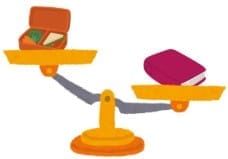 Ans: The book is heavier because its side of the balance goes down.
Q3: Three children use different glasses to drink milk. After pouring each glass into the same measuring cup, the amounts are equal. What does this show about the glasses?
Ans: This shows that even though the glasses look different, they all have the same capacity.
Q4: Look at the table and answer: Which vessel has the least capacity?
| Vessel | Number of Ladles Needed |
|---|---|
| Jug | 14 |
| Bowl | 7 |
| Glass | 4 |
Ans: The glass has the least capacity because it needs the fewest ladles.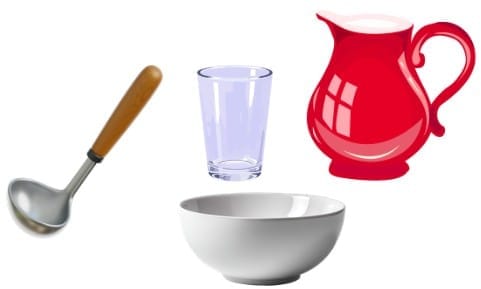
Q5: A container holds exactly 1 litre of water. Which of the following must be true: a mug that fills it twice or a mug that fills it four times? Explain.
Ans: If a mug fills the container four times, the mug has a smaller capacity. If it fills it twice, the mug has larger capacity. So, the mug that fills it four times is smaller.
Q6: A bucket is filled using two different mugs. Mug A fills it in 8 pours. Mug B fills it in 12 pours. Which mug has greater capacity? Give a reason.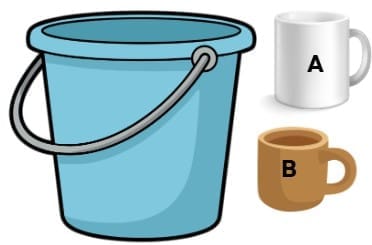 Ans: Mug A has a greater capacity because fewer pours are needed to fill the bucket.
Q7: A bowl fills 4 glasses. A bottle fills 2 bowls. How many glasses will the bottle fill?
Ans: Total glasses = 2 × 4 = 8 glasses.
| Relation | Value |
|---|---|
| 1 bowl = glasses | 4 |
| 1 bottle = bowls | 2 |
Q8: An object balances with 6 identical coins. Another object balances with 9 of the same coins. Which object is heavier? How do you know?
Ans: The object that balances with 9 coins is heavier because it needs more coins to balance.
Q9: Arrange the objects from lightest to heaviest.
| Object | Number of Erasers Used to Balance |
|---|---|
| Sharpener | 2 |
| Pencil box | 5 |
| School bag | 11 |
Ans: Sharpener → Pencil box → School bag.
Q10: A shopkeeper uses a 1-litre measuring cup. He pours water into a vessel and needs the cup exactly 3 times. What is the capacity of the vessel? Write the answer with unit.
Ans: The capacity of the vessel is 3 litres.
FAQs on Short Answer Questions: Filling and Lifting
| 1. What is the principle behind filling and lifting in engineering? |  |
| 2. What types of machines are commonly used for lifting tasks? | |
| 3. How does hydraulic lifting work? | |
| 4. What safety measures should be taken when using lifting equipment? | |
| 5. Why is understanding load distribution important in lifting operations? | |