UPSC Daily Current Affairs: 2026-01-25


GS1/Society; GS2/Governance
National Girl Child Day
Why in News?
National Girl Child Day was observed on January 24, 2026, with Prime Minister Narendra Modi reaffirming the nation's commitment to the dignity, opportunity, and empowerment of every girl child, highlighting progress under schemes like Beti Bachao Beti Padhao.
Key Takeaways (2026 Updates)
- Observed annually since 2008 by Ministry of Women and Child Development (MWCD) to raise awareness on girls' rights, education, health, nutrition, and safety.
- 2026 theme emphasis: "Educate, grow and empower daughters" - govt statement notes India advancing towards an equitable society through sustained interventions.
- PM Modi message: Nation recommits to ensuring equal opportunities and protection for girls, building on improved sex ratios and enrolment metrics.
Challenges Faced by Girls in India
- Cultural Preference for Sons: Preference due to family lineage, religious rites, and old-age support; daughters seen as financial burden due to dowry.
- Gender Discrimination: Neglect in nutrition, education, and healthcare leading to higher female mortality.
- Female Infanticide & Sex-Selective Abortion: Historical killing/abandonment and misuse of ultrasound technology.
- Economic & Social Factors: Son preference in agrarian societies, limited education access (especially rural), safety concerns, child marriage, and rigid gender norms.
Government Initiatives & Achievements
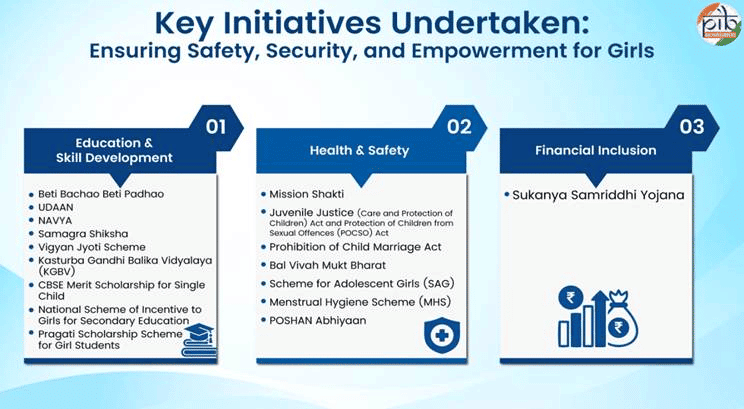
- Improved Sex Ratio: Sex Ratio at Birth (SRB) rose from ~918 (2014-15) to 930 (2023-24) under Beti Bachao Beti Padhao (BBBP); continued monitoring in 2026.
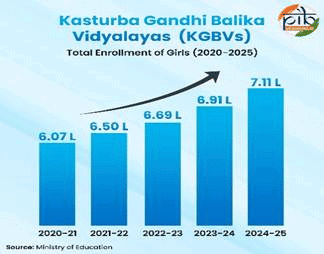
- Education Progress: Gross Enrolment Ratio (GER) for girls at secondary level reached 80.2% (2024-25); 97.5% schools have girls' toilets (UDISE data).
- Prevention of Child Marriage: As of January 2026, 2,153 child marriages prevented; 60,262 Child Marriage Prohibition Officers appointed.
- Sukanya Samriddhi Yojana (SSY): Over 4.2 crore accounts opened by 2024; scheme continues to gain traction in 2026 for financial security.
Way Forward
- Community Awareness: Intensify campaigns like BBBP to challenge biases and dowry; involve local leaders in 2026 events.
- Health & Education Access: Strengthen rural healthcare, nutrition, and girl-centric education programs.
- Social Change: Engage men and families in gender equality discussions; promote inclusive norms.
- Data & Monitoring: Robust real-time tracking of sex ratio, enrolment, and scheme outcomes for evidence-based policy.
GS2/Government Policies; GS3/Banking & Energy
India's Power Sector Milestones 2025 - Year-End Review 2026
Why in News?
In January 2026, the Ministry of Power released its year-end review highlighting 2025 as a landmark year with record peak demand handling (242.49 GW), capacity crossing 509 GW, historic renewable additions, transmission milestone of 5 lakh ckm, and early achievement of 50% non-fossil capacity NDC target.
Key Achievements (Updated with 2026 Review)
- Record Demand & Reliability: Peak demand met at 242.49 GW in FY 2025-26; national energy shortage slashed to 0.03% (from 4.2% in 2013-14); rural/urban availability ~22.6/23.4 hours.
- Capacity Expansion: Total installed capacity crossed 509 GW (Nov 2025); 55.57 GW added in 2025 (highest-ever in a year); 104.4% growth since 2014. Renewables added 178 GW since 2014 (130 GW solar, 33 GW wind); 2025 marked highest-ever RE expansion.
- Thermal & Coal: 13.32 GW new coal capacity awarded; total coal capacity 226.23 GW; robust stocks via revised SHAKTI Policy.
- Storage & Transmission: Targets of 57 GW Pumped Storage by 2031-32 and 43,220 MWh BESS; national transmission network crossed 5 lakh circuit km milestone in 2025.
- Distribution Reforms: RDSS sanctioned 19.79 crore smart meters; AT&C losses down to 16.16%; ACS-ARR gap Rs 0.11/kWh.
- Energy Efficiency & Carbon Market: Carbon Credit Trading Scheme launched; Standards & Labelling expanded to 41 appliances; ADEETIE scheme for MSMEs.
- NDC Achievement: 50% non-fossil capacity reached in June 2025 (from 32% in 2014), five years ahead of target; share at 51% by late 2025.
Conclusion
In 2025, India's power sector achieved transformative milestones in reliability, capacity (~509 GW+), renewables (~178 GW since 2014), transmission expansion, and reforms, dramatically reducing deficits and solidifying sustainable energy security as confirmed in the January 2026 year-end review.
GS3/Science and Technology
Reusable Launch Vehicle (RLV) Technology
Why in News?
Reusable Launch Vehicles are disrupting the space industry by reducing launch costs 5-20 times, enabling frequent, sustainable access as the market heads toward USD 1 trillion by 2030.
Key Facts
- About: RLVs recover and reuse stages (unlike expendable rockets), shifting to an aviation-like model.
- Goal: Reduce cost via reusability; addresses Tsiolkovsky equation inefficiency (90%+ mass is propellant).
- Mechanism: Launch → Stage separation → Re-entry control → Deceleration (drag/retro-propulsion) → Vertical/horizontal landing → Refurbishment.
- Limitations: Thermal stress during re-entry, high refurbishment costs, risk management challenges.
GS3/Economy
One District One Product (ODOP) Initiative - 8 Years
Context
- Launched in 2018; completed 8 years promoting district-specific traditional products for balanced growth.
About
- Spearheaded by DPIIT; 1,243 products identified from 775 districts (textiles, agri, handicrafts, etc.).
- Product selection by States/UTs based on local ecosystem.
Government Initiatives
- GeM-ODOP Bazaar & Unity Malls: Online/offline platforms for wider reach.
- Global Outreach: Promoted via 80+ Indian Missions, G20 gifting, stores in Singapore & Kuwait.
- District as Export Hub: Identifies export-potential products per district.
Significance
- Balanced regional development, artisan empowerment, heritage preservation, inclusive growth, global recognition.
Concluding Remarks
ODOP transforms local skills into engines of economic growth, national pride, and global opportunity for millions.
GS1/Ancient History; GS2/Government Policies
INSV Kaundinya Reached Oman
Why in News?
INSV Kaundinya, India's first stitched ship using ancient Tankai method, completed its maiden 17-day wind-powered voyage from Porbandar (Gujarat) to Muscat's Port Sultan Qaboos (Oman) on January 14, 2026, receiving a ceremonial water salute and highlighting shared India-Oman maritime heritage.
Key Details (January 2026 Updates)
- Voyage Highlights: Departed Porbandar on December 29, 2025; completed ~17-day journey (some reports say 18 days) entirely without engines; 16-member crew led by Commander Vikas Sheoran.
- Arrival & Reception: Arrived January 14, 2026; honored with grand water salute; vessel to remain in Oman for ~20 days for maintenance and inspections before return voyage to India.
- About: 20m wooden sailing vessel built using ancient stitched (Tankai) method with coir ropes and no metal fasteners; flexible, rust-proof design; modeled on 5th-century Ajanta cave paintings and Yuktikalpataru text (9th century CE by King Bhoja).
- Tankai Method: Ancient Indian hull-first technique using coir ropes for stitching planks, dammar resin and animal fat for waterproofing; revives 2,000-year-old indigenous shipbuilding tradition.
- Construction & Support: Built starting September 2023 under tripartite agreement (Ministry of Culture and others); Eutelsat OneWeb constellation provided high-speed satellite connectivity throughout the ocean voyage via 600+ satellites.
- Historical Significance: Named after legendary 1st-century Indian mariner Kaundinya, credited with sailing to Mekong Delta and influencing early Southeast Asian kingdoms; symbolizes revival of India's ancient maritime legacy and blue economy potential.
GS3/Science and Technology
Sexual Dimorphism and Spider Silk Quality
Why in News?
A 2025 study (published late 2025) revealed that only large adult female Darwin's bark spiders (Caerostris darwini) produce the toughest silk ever recorded (~1.6 GPa tensile strength, ~3× stronger than iron), driven by extreme sexual size dimorphism and ecological pressures.
Key Takeaways
- Females 3-5× larger than males; only large adult females produce exceptionally tough, stiff silk rich in proline (amino acid for elasticity/toughness).
- Males and juvenile females produce weaker, more stretchable silk; females build sparser but stronger webs over rivers/lakes to capture large prey.
- Silk elasticity remains genetically conserved across all; extreme toughness evolves only when high survival advantage exists (metabolically expensive production).
Additional Details
- Study Findings: Dragline (major ampullate) silk from adult females shows higher initial stiffness and toughness; juveniles/males lack this due to lower energy investment and different web needs (denser webs with cheaper silk).
- Evolutionary Context: Extreme female-biased size dimorphism in orb-weavers like bark spiders creates sex-specific selection; females face greater demands for giant webs spanning rivers (up to 25m), requiring superior silk to absorb high-impact prey energy.
- Implications: Demonstrates how evolution optimizes costly traits like silk production based on body size, sex roles, and habitat; highlights metabolic trade-offs in material science inspiration from nature.
GS3/Conservation
Dulhasti Stage-II & Dugong Conservation Centre Concerns
Why in News?
In mid-January 2026, the Expert Appraisal Committee (EAC) of MoEFCC reiterated the need for major eco-friendly redesign of the proposed International Dugong Conservation Centre in Manora (Thanjavur, Tamil Nadu) due to severe risks in CRZ zones; Dulhasti Stage-II (260 MW) received clearance amid broader hydro concerns.
Dugong Conservation Centre Issues (Jan 2026 Update)
- Project Details: Proposed centre covers ~28,000 sq m at ₹40.94 crore; aims to promote awareness, research, rescue, and protection of dugongs and seagrass ecosystems in Palk Bay.
- EAC Concerns & Recommendations (Jan 16, 2026): Site overlaps CRZ-I (ecologically sensitive mangroves, seagrass meadows) and CRZ-III No Development Zone; construction could cause irreversible habitat damage. Tamil Nadu directed to revise plan for minimal impact, prioritize eco-friendly design, and recognize dugong's role as critically endangered "ecosystem engineer" that maintains seagrass health through grazing.
- Broader Context: Move aligns with India's dugong conservation push; emphasizes avoiding coastal degradation while advancing research/education goals.
About Dugong
- Features: Large marine mammal (up to 10 ft, 420 kg), dolphin-like tail, strictly herbivorous ("sea cows"/"farmers of the sea"); feed exclusively on seagrass, aiding ecosystem health by preventing overgrowth.
- Habitat & Distribution in India: Shallow warm coastal waters (<10m) with dense seagrass meadows; found in Gulf of Kutch, Gulf of Mannar-Palk Bay, Andaman & Nicobar Islands.
- Latest Status (2026): IUCN lists as Vulnerable; long-term survival uncertain in key habitats (Gulf of Kutch/Andamans) due to habitat loss, bycatch, pollution; urgent action needed as per recent assessments.
- Conservation: Schedule I (Wildlife Protection Act, 1972); Appendix I (CITES, bans trade); slow reproduction (maturity 9-10 yrs, birth every 3-5 yrs); India to host First South Asia Dugong Conservation Workshop for regional cooperation (India, Pakistan, Sri Lanka, Bangladesh).
- Threats: Habitat degradation (seagrass loss from trawling/pollution), fishing nets entanglement, boat strikes; community-led efforts (e.g., women in conservation linking livelihoods to protection) gaining momentum.
FAQs on UPSC Daily Current Affairs: 2026-01-25
| 1. What is National Girl Child Day and its significance in India? |  |
| 2. What are the key milestones of India's power sector planned for the near future? | |
| 3. What is the antimicrobial resistance crisis in India, particularly concerning antibiotics? | |
| 4. What is the Reusable Launch Vehicle (RLV) technology and its potential benefits? | |
| 5. What does the One District One Product (ODOP) initiative aim to achieve in India? | |




