Q1: Where can we use a computer to watch cartoons and play games? (a) Hospital (b) Home (c) Bank (d) Airport
Solution:
Ans: (b) Explanation: At home, computers help us watch cartoons and movies, play games, do homework, listen to music, and connect with friends and family.
Q2: What do computers help teachers make in school? (a) Food and snacks (b) Toys and dolls (c) Timetables and test papers (d) Clothes and shoes
Solution:
Ans: (c) Explanation: In schools, computers help teachers create timetables, test papers, and report cards. They also help store information about teachers and students.
Q3: What do computers in shops help to make? (a) Books and toys (b) Bills and price lists (c) Clothes and bags (d) Food and drinks
Solution:
Ans: (b) Explanation: In shops and departmental stores, computers create bills and price lists. They also print bills and maintain records of goods and customers.
Q4: Which movie was made using computers? (a) Spider-Man (b) A storybook (c) A newspaper (d) A song
Solution:
Ans: (a) Explanation: Movies like Jurassic Park, Spider-Man, and My Friend Ganesha were created using computers. Computers are also used to produce cartoon films.
Q5: What do computers help us do at home on the Internet? (a) Cook food (b) Clean the house (c) Book tickets and shop online (d) Wash clothes
Solution:
Ans: (c) Explanation: At home, computers help us connect with friends and family using the Internet, book flight and train tickets online, and shop online.
Fill in the Blanks
Q1: Computers help us send and receive _____ at home and in offices.
Solution:
Ans: emails
Q2: In hospitals, computers store _____ records.
Solution:
Ans: patient
Q3: Computers make learning _____ and interesting for students.
Solution:
Ans: fun
Q4: In banks, computers maintain records of _____ and their accounts.
Solution:
Ans: customers
Q5: Computers help teachers present lessons using audio and _____ aids.
Solution:
Ans: visual
True or False
Q1: Computers help us draw and color at home.
Solution:
Ans: True Explanation: At home, computers help us with many activities including listening to music, drawing, and coloring.
Q2: In schools, computers are used to cook food for students.
Solution:
Ans: False Explanation: In schools, computers help teachers teach students, store information, keep library records, and conduct experiments, not cook food.
Q3: Computers in offices help to type letters and reports.
Solution:
Ans: True Explanation: In offices, computers are used to send emails, maintain records, type letters and reports, and print documents.
Q4: Computers at airports store information about passengers and tickets.
Solution:
Ans: True Explanation: At airports and railway stations, computers store information about passengers, tickets, and the arrival and departure of flights and trains.
Q5: Computers cannot help in making cartoon films.
Solution:
Ans: False Explanation: Computers are used to produce cartoon films and create movies. They also help design advertisements seen on television.
Match the Following
Solution:
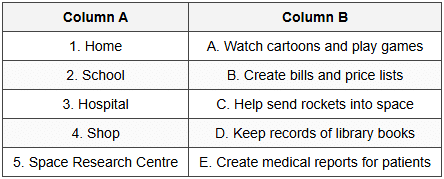
Ans:
1 - A: At home, computers help us watch cartoons and movies, play games, do homework, listen to music, draw and color.
2 - D: In schools, computers help teachers teach, store information about teachers and students, keep records of library books, and create timetables.
3 - E: In hospitals, computers store patient records and create medical reports for patients to help doctors treat them better.
4 - B: In shops and departmental stores, computers create bills and price lists, print bills, and maintain records of goods and customers.
5 - C: Space research centres use computers to gather information about space, help send rockets into space, and design security weapons.
Short Answer Questions
Q1: How do computers help us at home?
Solution:
Ans: Computers help us at home in many ways. We can do homework and play games. We can watch cartoons and movies. We can listen to music, draw, and color. Computers help us connect with friends and family using the Internet. We can book tickets, shop online, and pay bills.
Q2: What do computers do in schools?
Solution:
Ans: In schools, computers help teachers teach students in class. They store information about teachers and students. Computers keep records of library books. They help conduct experiments in labs. Computers create timetables, test papers, and report cards. They make learning fun and interesting for students.
Q3: How do computers help in hospitals?
Solution:
Ans: In hospitals, computers store patient records safely. They create medical reports for patients. Computers help doctors keep track of all patient information. This helps doctors treat patients better. Computers make hospital work easier and faster. They help save important information about patients and their treatment.
Q4: What do computers do in banks?
Solution:
Ans: In banks, computers maintain records of customers and their accounts. They keep all the details related to ATMs. Computers help bank workers manage money and accounts safely. They store important information about customers. This helps banks work faster and keep customer information safe and organized.
Q5: How does the Internet help teachers and students?
Solution:
Ans: The Internet provides students and teachers with lots of information. It allows teachers to connect with students from far away. Teachers can conduct online tests for students. The Internet offers teaching resources like activities, quizzes, worksheets, puzzles, and crosswords. This makes learning easier and more interesting.
FAQs on Worksheet with Solutions: Role of Computer
1. What is the role of a computer in education?
Ans. A computer serves as a vital tool in education by providing access to information, facilitating research, enabling interactive learning through educational software, and allowing for communication and collaboration among students and teachers.
2. How can computers help in everyday tasks?
Ans. Computers assist in everyday tasks by enabling users to perform functions such as word processing, managing finances, creating presentations, and accessing the internet for information and services, thus enhancing productivity and efficiency.
3. What are some common uses of computers in homes?
Ans. In homes, computers are commonly used for online shopping, streaming videos, managing household budgets, communicating via email and social media, and supporting educational activities for children.
4. Why is it important for children to learn about computers?
Ans. It is important for children to learn about computers as it equips them with essential digital skills necessary for their future education and career opportunities, enhances their ability to navigate technology, and fosters critical thinking and problem-solving abilities.
5. What safety precautions should be taken when using computers?
Ans. Safety precautions when using computers include protecting personal information online, using strong passwords, avoiding sharing sensitive data, ensuring parental supervision for younger users, and taking regular breaks to prevent strain on eyes and posture.
Exam, ppt, Worksheet with Solutions: Role of Computer, Objective type Questions, pdf , MCQs, Previous Year Questions with Solutions, Semester Notes, shortcuts and tricks, Worksheet with Solutions: Role of Computer, Extra Questions, Worksheet with Solutions: Role of Computer, Viva Questions, study material, Important questions, Summary, past year papers, video lectures, Free, Sample Paper, practice quizzes, mock tests for examination;