Q1: What is the process by which living organisms make new individuals of their own kind called? (a) Germination (b) Reproduction (c) Dispersal (d) Pollination
Solution:
Ans: (b) Explanation: Reproduction is the process where living organisms produce new individuals of their own kind to keep their species alive. This is a fundamental biological process.
Q2: In binary fission, how does the parent cell divide? (a) The nucleus splits into two parts and the cell splits across the middle (b) A bud forms on the parent cell (c) The cell breaks into multiple fragments (d) Spores are released from the cell
Solution:
Ans: (a) Explanation: Binary fission involves the nucleus splitting into two parts, then the cell divides across the middle to form two identical daughter cells.
Q3: Which part of the flower contains the ovules that will become seeds after fertilisation? (a) Anther (b) Stigma (c) Ovary (d) Petal
Solution:
Ans: (c) Explanation: The ovary is the swollen bottom part of the carpel that contains ovules. These ovules turn into seeds after fertilisation takes place.
Q4: What type of pollination occurs when pollen grains from one plant are transferred to the stigma of a flower on a different plant of the same species? (a) Self-pollination (b) Cross-pollination (c) Artificial pollination (d) Water pollination
Solution:
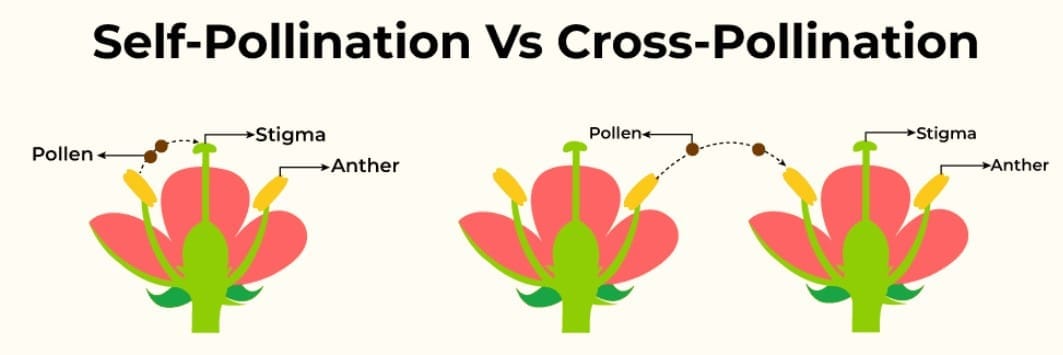
Ans: (b) Explanation: Cross-pollination happens when pollen moves from the anther of a flower on one plant to the stigma of a flower on another plant.
Q5: Which vegetative part of the potato plant contains buds called "eyes" that can grow into new plants? (a) Leaf (b) Root (c) Modified stem (tuber) (d) Flower
Solution:
Ans: (c) Explanation: Potato is a modified stem that bears buds called "eyes." Each part with an eye can be separated and grown into a new plant.
Fill in the Blanks
Q1: In yeast, the parent cell produces a small outgrowth called a _____ which grows and detaches to become independent.
Solution:
Ans: bud
Q2: The transfer of pollen grains from the anther to the stigma is called _____.
Solution:
Ans: pollination
Q3: The green, leaf-like parts that form the outermost layer of a flower are called _____.
Solution:
Ans: sepals
Q4: The fusion of male and female cells after the pollen tube reaches the ovule is called _____.
Solution:
Ans: fertilisation
Q5: Ginger is an example of a modified _____ with nodes and internodes.
Solution:
Ans: stem
True or False
Q1: Binary fission is a method of asexual reproduction common in bacteria.
Solution:
Ans: True Explanation: Lower plants like bacteria reproduce asexually through binary fission where the nucleus splits into two parts forming daughter cells.
Q2: Flowers that have only male parts or only female parts are called bisexual flowers.
Solution:
Ans: False Explanation: Flowers with only male or only female parts are called unisexual flowers. Bisexual flowers have both male and female parts.
Q3: Insect-pollinated flowers produce sticky pollen grains so the pollen can stick to the insect's body.
Solution:
Ans: True Explanation: Insect-pollinated flowers have special features including sticky pollen grains that help the pollen attach to insects visiting the flowers.
Q4: Vegetative reproduction takes a longer time compared to reproduction from seeds.
Solution:
Ans: False Explanation: Reproduction by vegetative parts takes place in a shorter time, which is one of the advantages of this method.
Q5: Wind-pollinated flowers are usually large and have bright colors to attract wind.
Solution:
Ans: False Explanation: Wind-pollinated flowers are usually small with dull colors because they do not need to attract pollinators like insects or birds.
Match the Following
Solution:
Ans:
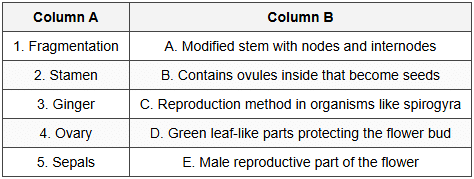
1 - C: Fragmentation occurs in organisms like spirogyra where filaments break into fragments that grow into individual organisms.
2 - E: Stamens are the male reproductive parts of flowers with filaments and anthers that produce pollen grains.
3 - A: Ginger is a modified stem that has nodes and internodes along with scaly leaves and axillary buds.
4 - B: The ovary is the swollen bottom part of the carpel that contains ovules which become seeds after fertilisation.
5 - D: Sepals are green leaf-like structures forming the outermost layer of flowers that protect the flower when budding.
Short Answer Questions
Q1: Explain the method of budding in yeast as a form of asexual reproduction.
Solution:
Ans: Budding is common in yeast where asexual reproduction occurs. In this method, the parent cell produces a small outgrowth called a bud. The bud gradually grows larger over time. Eventually, the bud gets detached from the parent body. After detachment, it becomes an independent living organism capable of reproducing further.
Q2: Describe the structure and function of a carpel in a flower.
Solution:
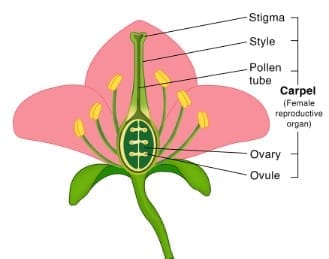
Ans: Carpels are the female reproductive parts of flowers, also called pistils. Each carpel has three distinct parts. The ovary is the swollen part at the bottom containing ovules. The style is a thin thread-like structure in the middle. The stigma is flat and sticky at the top. The carpel receives pollen during pollination for reproduction.
Q3: What are the advantages of vegetative reproduction for farmers?
Solution:
Ans: Vegetative reproduction has several advantages for farmers. It takes place in a shorter time compared to seed reproduction. New plants produced spread very fast in a small area. It is a surer method with guaranteed results. All good characters of the mother plant are retained by daughter plants, ensuring quality crop production.
Q4: Explain how wind-pollinated flowers are specially adapted for pollination.
Solution:
Ans: Wind-pollinated flowers have special adaptations for their pollination method. They are usually small with dull colors since they don't need to attract insects. They have long anthers sticking out of flowers so pollen can be blown off easily. They make light pollen grains easily carried by wind and produce large quantities of pollen.
Q5: Describe the process of fertilisation in flowering plants after pollination occurs.
Solution:
Ans: After pollination, pollen grains reaching the stigma start growing a tube called the pollen tube. This tube grows through the style and reaches the ovule inside the ovary. Male cells in the pollen grain move through the pollen tube. These male cells fuse with the ovule, and this fusion is called fertilisation.
Long Answer Questions
Q1: Analyze the differences between self-pollination and cross-pollination. Justify why cross-pollination is generally more beneficial for plant species than self-pollination.
Solution:
Ans: Self-pollination occurs when pollen grains from anthers fall on the stigma of the same flower or another flower on the same plant. Cross-pollination happens when pollen transfers from one plant to the stigma of a flower on a different plant of the same species. Cross-pollination is generally more beneficial because it introduces genetic variation in offspring, making plants stronger and more resistant to diseases. Self-pollination produces identical plants which may all be affected simultaneously by diseases. Cross-pollination requires agents like insects, wind, or water for pollen transfer.
Q2: Compare and contrast asexual reproduction and sexual reproduction in plants. Evaluate the circumstances under which each method would be more advantageous.
Solution:
Ans: Asexual reproduction produces new plants from vegetative parts or through methods like binary fission, budding, fragmentation, and spore formation without involving flowers or seeds. Sexual reproduction involves flowers, pollination, fertilisation, and seed formation. Asexual reproduction is faster, surer, and retains all parent characteristics, making it advantageous for farmers wanting quick, uniform crops. However, all plants are identical and vulnerable to diseases. Sexual reproduction produces genetic variation, creating stronger species adapted to changing environments. It is advantageous when diversity and disease resistance are needed despite taking longer time.
Q3: Describe the various methods of artificial vegetative propagation used by farmers. Analyze how these methods help in producing better quality crops.
Solution:
Ans: Artificial vegetative propagation includes cutting, layering, grafting, and tissue culture. Cutting involves planting stem pieces with axillary buds in moist soil. Layering bends a branch to soil until roots develop, then separates it. Grafting fixes a desired variety shoot onto another plant's stem. Tissue culture grows plantlets from explants in nutrient medium forming callus. These methods help farmers produce crops quickly with desired characteristics like better fruit quality, disease resistance, or higher yields. They ensure uniformity and retain superior parent plant traits, improving agricultural productivity significantly.
The document Worksheet with Solutions: Reproduction in Plants is a part of the Class 8 Course Biology Class 8 ICSE.
FAQs on Worksheet with Solutions: Reproduction in Plants
1. What are the two main types of reproduction in plants?
Ans. The two main types of reproduction in plants are asexual reproduction and sexual reproduction. Asexual reproduction involves the production of new plants from vegetative parts such as roots, stems, and leaves, while sexual reproduction involves the formation of seeds through the fertilisation of ovules by pollen.
2. How do flowering plants reproduce sexually?
Ans. Flowering plants reproduce sexually through the process of pollination, where pollen grains from the male anther are transferred to the female stigma. After pollination, fertilisation occurs when a sperm cell from the pollen merges with an ovule, leading to the formation of seeds within the ovary.
3. What is the role of seeds in plant reproduction?
Ans. Seeds play a crucial role in plant reproduction as they contain the embryo of the plant and provide a protective outer covering. They also serve as a means of dispersal, allowing the plant to spread its offspring over a wide area, and contain stored nutrients that support the seedling's growth after germination.
4. What are some examples of asexual reproduction in plants?
Ans. Examples of asexual reproduction in plants include vegetative propagation methods such as cuttings, where a piece of the stem or leaf is planted to grow a new plant, and layering, where branches are bent to the ground to develop roots while still attached to the parent plant. Other methods include division and budding.
5. Why is pollination essential for seed formation?
Ans. Pollination is essential for seed formation because it facilitates the transfer of male gametes from the pollen to the ovule in the ovary of a flower. This fertilisation process leads to the development of seeds, which are necessary for the continuation of a plant's genetic lineage and for producing new plants.
Worksheet with Solutions: Reproduction in Plants, Worksheet with Solutions: Reproduction in Plants, Previous Year Questions with Solutions, Semester Notes, practice quizzes, shortcuts and tricks, Worksheet with Solutions: Reproduction in Plants, Viva Questions, mock tests for examination, past year papers, Exam, ppt, study material, Free, MCQs, pdf , Summary, video lectures, Extra Questions, Important questions, Objective type Questions, Sample Paper;