Q1: Which ancient Indian astronomer was among the first to propose that Earth is spherical? (a) Brahmagupta (b) Aryabhatta (c) Varahamihira (d) Bhaskara
Solution:
Ans: (b) Explanation: Aryabhatta was the Indian astronomer who, along with Pythagoras and Aristotle in Europe, first proposed that Earth is spherical, challenging ancient beliefs.
Q2: What percentage of Earth's surface is covered by water?(a) 50% (b) 65% (c) 71% (d) 85%
Solution:
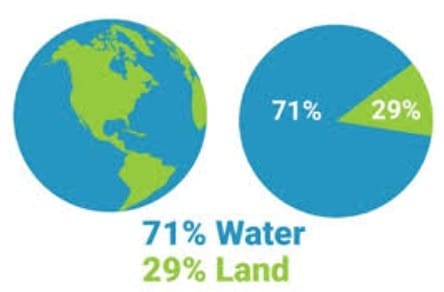
Ans: (c) Explanation: Approximately 71% of Earth's surface is covered by water, which is why it is called the "Blue Planet" or "Watery Planet".
Q3: What is Earth's shape more accurately described as? (a) Perfect sphere (b) Oblate spheroid (c) Ellipse (d) Cylinder
Solution:
Ans: (b) Explanation: Earth is an oblate spheroid or geoid, meaning it bulges at the equator and is flattened at the poles, rather than being a perfect sphere.
Q4: What percentage of nitrogen is present in Earth's atmosphere? (a) 21% (b) 50% (c) 78% (d) 90%
Solution:
Ans: (c) Explanation: Earth's atmosphere contains 78% nitrogen and 21% oxygen, which together support life by providing essential gases for breathing and other processes.
Q5: Who made the historic journey of circumnavigation that confirmed Earth's spherical shape? (a) Christopher Columbus (b) Ferdinand Magellan (c) Vasco da Gama (d) James Cook
Solution:
Ans: (b) Explanation: Ferdinand Magellan's journey around the world, traveling west and returning to the starting point without encountering an edge, confirmed Earth's spherical shape.
Fill in the Blanks
Q1: The term "_____" means "Earth-shaped" and refers to Earth's actual shape.
Solution:
Ans: Geoid
Q2: Earth is located _____ million km from the Sun.
Solution:
Ans: 150
Q3: The _____ layer in Earth's atmosphere protects life by absorbing harmful ultraviolet rays.
Solution:
Ans: Ozone
Q4: The _____ is Earth's only natural satellite.
Solution:
Ans: Moon
Q5: Earth's rocky surface is called the _____.
Solution:
Ans: Lithosphere
True or False
Q1: In ancient times, people believed Earth was spherical.
Solution:
Ans: False Explanation: In ancient times, people believed Earth was flat, not spherical. This belief was later disproved by scientific observations.
Q2: Earth is the fifth largest planet in the Solar System.
Solution:
Ans: True Explanation: Earth is indeed the fifth largest planet in the Solar System, with an average diameter of approximately 12,735 kilometres.
Q3: During a lunar eclipse, Earth's shadow on the Moon appears square-shaped.
Solution:
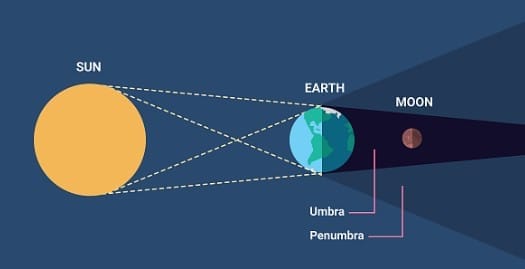
Ans: False Explanation: During a lunar eclipse, Earth's shadow on the Moon is consistently oval , indicating Earth's spherical shape, not square.
Q4: The Pole Star appears directly overhead at the North Pole.
Solution:
Ans: True Explanation: The Pole Star appears directly overhead at the North Pole, but its angle of elevation decreases as one moves southward.
Q5: If Earth were flat, all places would experience sunrise and sunset at different times.
Solution:
Ans: False Explanation: If Earth were flat, all places would experience sunrise and sunset simultaneously, not at different times as they currently do.
Match the Following
Solution:
Ans:
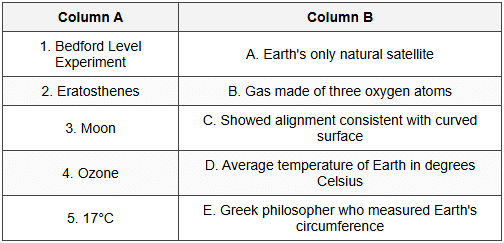
1 - C: The Bedford Level Experiment used three poles placed 5 km apart to show alignment consistent with a curved surface.
2 - E: Eratosthenes was the Greek philosopher who made an early attempt to measure Earth's circumference using scientific methods.
3 - A: The Moon is Earth's only natural satellite, orbiting around Earth and influencing tides and other natural phenomena.
4 - B: Ozone is a gas made of three oxygen atoms that protects Earth by absorbing harmful ultraviolet radiation from sunlight.
5 - D: Earth's average temperature is 17°C, which is ideal for supporting life, being neither too hot nor too cold.
Short Answer Questions
Q1: Explain how the sighting of a ship approaching the shore proves that Earth is spherical.
Solution:
Ans: When a ship approaches the shore, it becomes visible gradually from the top down rather than all at once. First, the mast and upper parts appear, followed by the hull. This phenomenon occurs because Earth's surface is curved. If Earth were flat, the entire ship would be visible simultaneously from a distance. This gradual appearance confirms the curved nature of Earth's surface.
Q2: Why is Earth called the "Blue Planet" and what makes it unique in the Solar System?
Solution:
Ans: Earth is called the "Blue Planet" because approximately 71% of its surface is covered by water, giving it a blue appearance from space. This abundant water presence makes Earth unique in the Solar System. Combined with its thick atmosphere containing oxygen and nitrogen, protective ozone layer, ideal distance from the Sun, and rocky lithosphere, Earth is the only known planet capable of supporting human life.
Q3: Describe how the position of the Pole Star provides evidence that Earth is spherical.
Solution:
Ans: The Pole Star appears directly overhead at the North Pole, positioned at 90 degrees elevation. However, as one moves southward from the North Pole, the angle of elevation of the Pole Star gradually decreases. This changing angle of the Pole Star with latitude is only possible on a spherical surface. On a flat Earth, the Pole Star would maintain the same angle of elevation regardless of location.
Q4: What is an oblate spheroid and why does Earth have this shape?
Solution:
Ans: An oblate spheroid is a sphere that is slightly flattened at the poles and bulging at the equator, similar to an orange. Earth has this shape rather than being a perfect sphere. This specific shape is also referred to as a "Geoid," meaning "Earth-shaped." Earth's rotation causes the equatorial bulge and polar flattening. The average diameter of Earth is approximately 12,735 kilometres, making it the fifth largest planet.
Q5: How does the lunar eclipse provide evidence for Earth's spherical shape?
Solution:
Ans: During a lunar eclipse, Earth passes between the Sun and Moon, casting a shadow on the Moon's surface. This shadow is consistently oval or circular in shape, indicating that Earth itself is spherical. The shadow remains consistent as Earth rotates during the eclipse. If Earth were any other shape, such as flat or cylindrical, the shadow would change shape or appear different, but it always remains circular.
Long Answer Questions
Q1: Analyse how varying time zones and the differences in sunrise and sunset timings across different locations prove Earth's spherical shape. Justify your answer with examples.
Solution:
Ans: Varying time zones and different sunrise and sunset timings across locations strongly prove Earth's spherical shape. The time of sunrise and sunset differs across locations because Earth's curved surface causes different parts to receive sunlight at different times. If Earth were flat, all places would experience sunrise and sunset simultaneously since sunlight would reach every location at once. Different regions experience different times of day due to uneven sunlight distribution on a curved surface. For example, when it is morning in India, it is night in America. This phenomenon of varying time zones is only possible on a spherical Earth, confirming its curved nature convincingly.
Q2: Evaluate the unique features of Earth that make it capable of supporting life. Compare these features with what would be required for a planet to be habitable.
Solution:
Ans: Earth possesses several unique features making it the only known planet supporting life. Its optimum distance of 150 million km from the Sun provides an ideal average temperature of 17°C, neither too hot nor too cold. Earth's thick atmosphere contains 21% oxygen and 75% nitrogen, essential for breathing and life processes. The ozone layer protects life by absorbing harmful ultraviolet radiation. Approximately 71% water coverage provides the necessary liquid for life. The lithosphere offers rocky surface with soil for plant growth and mineral resources. The Moon as a natural satellite influences tides. These combined features create perfect habitable conditions unmatched by other planets.
Q3: Compare and contrast the different scientific proofs that establish Earth's spherical shape. Which proof do you consider most convincing and why?
Solution:
Ans: Multiple scientific proofs establish Earth's spherical shape through different approaches. Observable proofs include ship sightings showing gradual appearance, circular horizon expansion at altitude, and varying star constellations. Experimental proofs include the Bedford Level Experiment demonstrating curved alignment and shadows cast by sticks varying in length. Astronomical proofs include changing Pole Star elevation, lunar eclipse shadows, and satellite photographs. Historical proof comes from Magellan's circumnavigation. While all proofs are valid, satellite photographs from space provide the most convincing direct visual evidence, showing Earth's curved surface clearly. However, combining multiple proofs from different scientific disciplines creates the strongest cumulative evidence for Earth's spherical shape.
FAQs on Worksheet with Solutions: Earth as a Planet
1. What are the key characteristics of Earth as a planet?
Ans. Earth is the third planet from the Sun, characterised by its ability to support life due to the presence of water in all three states (solid, liquid, gas), a suitable atmosphere, and a diverse range of ecosystems. It has a unique magnetic field and a relatively stable climate, which contribute to its habitability.
2. How does Earth's rotation affect its day and night cycle?
Ans. Earth's rotation on its axis takes approximately 24 hours, leading to the alternation of day and night. As the Earth rotates, different parts of its surface face the Sun, experiencing daylight, while the opposite side experiences darkness. This continuous movement results in the cyclical nature of day and night.
3. What role does the atmosphere play in supporting life on Earth?
Ans. The atmosphere is crucial for supporting life as it contains essential gases such as oxygen and carbon dioxide. It protects living organisms from harmful solar radiation and maintains the planet's temperature through the greenhouse effect, allowing for a stable environment conducive to life.
4. What are the major layers of the Earth, and what are their characteristics?
Ans. The Earth is composed of several layers: the crust (the thin outer layer), the mantle (a semi-solid layer beneath the crust), and the core (divided into a liquid outer core and a solid inner core). Each layer has distinct physical and chemical properties, contributing to geological activity such as earthquakes and volcanic eruptions.
5. How does Earth's position in the solar system influence its climate?
Ans. Earth's position in the solar system, particularly its distance from the Sun and its axial tilt, significantly influences its climate. The tilt affects the intensity and distribution of sunlight received, leading to seasonal variations. Additionally, the planet's orbit affects the length of days and nights, impacting overall climate patterns.
Extra Questions, past year papers, shortcuts and tricks, Previous Year Questions with Solutions, ppt, Sample Paper, Objective type Questions, video lectures, Semester Notes, Free, Exam, mock tests for examination, Summary, Viva Questions, practice quizzes, Worksheet with Solutions: Earth as a Planet, pdf , Important questions, Worksheet with Solutions: Earth as a Planet, MCQs, study material, Worksheet with Solutions: Earth as a Planet;