Q1: What is the outermost layer of the Earth where we live called? (a) Mantle (b) Core (c) Crust (d) Hydrosphere
Solution:
Ans: (c) Explanation: The Crust is the outer solid part of Earth where we live, forming the topmost layer of the planet's structure.
Q2: How much does Earth's temperature increase for every 32 metres of depth? (a) 0.5°C (b) 1°C (c) 2°C (d) 5°C
Solution:
Ans: (b) Explanation: Earth's temperature rises with depth, increasing by 1°C for every 32 metres, demonstrating the internal temperature gradient of our planet.
Q3: What is the name of the boundary between the Crust and Mantle? (a) Gutenberg Discontinuity (b) Mohorovicic Discontinuity (c) Biosphere (d) Lithosphere
Solution:
Ans: (b) Explanation: The Mohorovicic Discontinuity is the transition zone marking the boundary between Earth's Crust and Mantle, where earthquake wave speeds change.
Q4: What is the density of SIAL in gm/cm³? (a) 2.0 (b) 2.7 (c) 3.0 (d) 3.5
Solution:
Ans: (b) Explanation: SIAL has a density of 2.7 gm/cm³, which is less dense than SIMA, allowing it to float on the denser layer.
Q5: Which method is used to study the Earth's interior by analysing waves? (a) Studying meteorites (b) Studying Earth's shape (c) Studying earthquake waves (d) Studying ocean currents
Solution:
Ans: (c) Explanation: Studying earthquake waves helps scientists understand Earth's layers by observing how these waves travel through different materials at varying speeds.
Fill in the Blanks
Q1: The liquid layer of Earth made of water is called the _____.
Solution:
Ans: Hydrosphere
Q2: The zone in the atmosphere that holds living creatures is called the _____.
Solution:
Ans: Biosphere
Q3: The boundary between Mantle and Core is called _____ Discontinuity.
Solution:
Ans: Gutenberg
Q4: The solid layer of Earth made of rocks is called the _____.
Solution:
Ans: Lithosphere
Q5: The density of SIMA is _____ gm/cm³.
Solution:
Ans: 3.0
True or False
Q1: The Core is the deepest part of the Earth and is very hot and dense.
Solution:
Ans: True Explanation: The Core is indeed the deepest layer of Earth, characterised by extremely high temperatures and density compared to other layers.
Q2: Discontinuities are areas where earthquake waves maintain constant speed.
Solution:
Ans: False Explanation: Discontinuities are transition zones between layers where the speed of earthquake waves changes, not where they remain constant.
Q3: SIAL is denser than SIMA.
Solution:
Ans: False Explanation: SIAL is less dense at 2.7 gm/cm³ compared to SIMA at 3.0 gm/cm³, allowing SIAL to float on SIMA.
Q4: Earth has three main realms: Lithosphere, Hydrosphere, and Atmosphere.
Solution:
Ans: True Explanation: Earth consists of three main realms including the solid Lithosphere, liquid Hydrosphere, and gaseous Atmosphere surrounding the planet.
Q5: Meteorites are studied to learn about the shape of Earth.
Solution:
Ans: False Explanation: Meteorites are studied to understand Earth's composition, not its shape. Earth's shape is studied through different methods.
Match the Following
Solution:
Ans:
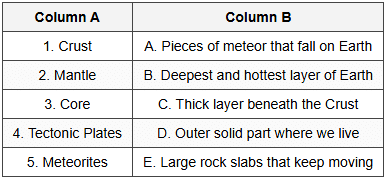
1 - D: The Crust is the outer solid part of Earth where we live, forming the topmost layer of the planet.
2 - C: The Mantle is a thick layer situated beneath the Crust, between the outer layer and the Core.
3 - B: The Core is the deepest part of Earth, characterised by extremely high temperatures and density.
4 - E: Tectonic Plates are large and small rock slabs that form Earth's crust and continuously move over time.
5 - A: Meteorites are pieces of a meteor that fall on Earth and are not burned up during entry.
Short Answer Questions
Q1: Describe the three main layers that make up the Earth's structure.
Solution:
Ans: Earth consists of three major concentric layers. The Crust is the outer solid part where we live. The Mantle is a thick layer beneath the Crust. The Core is the deepest part of Earth, which is very hot and dense. These layers have unique features and help scientists understand Earth's structure and behaviour.
Q2: Explain how SIAL and SIMA differ in terms of density.
Solution:
Ans: SIAL and SIMA are layers with different densities. SIAL has a density of 2.7 gm/cm³, making it less dense. SIMA has a density of 3.0 gm/cm³, making it denser. Because SIAL is less dense than SIMA, the lighter SIAL floats on the denser SIMA layer beneath it.
Q3: What are discontinuities and name the two main discontinuities in Earth's structure?
Solution:
Ans: Discontinuities are transition zones between Earth's layers where the speed of earthquake waves changes. The two main discontinuities are the Mohorovicic Discontinuity and Gutenberg Discontinuity. The Mohorovicic Discontinuity marks the boundary between Crust and Mantle. The Gutenberg Discontinuity marks the boundary between Mantle and Core.
Q4: Describe the three main realms of Earth.
Solution:
Ans: Earth has three main realms with distinct characteristics. The Lithosphere is the solid layer made of rocks. The Hydrosphere is the liquid layer made of water covering parts of Earth. The Atmosphere is the gas layer that surrounds Earth, holding living creatures in a zone called the Biosphere.
Q5: What are the three methods used to obtain knowledge about Earth's interior?
Solution:
Ans: Knowledge of Earth's interior is obtained through three main methods. First, studying earthquake waves helps understand Earth's layers by analysing wave behaviour. Second, studying meteorites provides information about Earth's composition. Third, studying Earth's shape, size, and density reveals details about its internal structure and characteristics.
Long Answer Questions
Q1: Analyse how the study of earthquake waves helps scientists understand Earth's internal structure and explain the significance of discontinuities.
Solution:
Ans: Scientists study earthquake waves to understand Earth's interior because these waves travel through different layers at varying speeds. When earthquake waves pass through discontinuities, which are transition zones between layers, their speed changes significantly. The Mohorovicic Discontinuity marks the boundary between Crust and Mantle, whilst the Gutenberg Discontinuity marks the boundary between Mantle and Core. By analysing these changes in wave speed, scientists can identify the different layers and determine their properties. This method has been crucial in revealing Earth's three major concentric layers: Crust, Mantle, and Core.
Q2: Compare the properties of SIAL and SIMA layers and justify why SIAL floats on SIMA.
Solution:
Ans: SIAL and SIMA are two distinct layers with different densities that influence their arrangement. SIAL has a density of 2.7 gm/cm³, whilst SIMA has a density of 3.0 gm/cm³, making SIMA the denser layer. The lighter SIAL floats on the denser SIMA because materials with lower density naturally float on materials with higher density. This principle is similar to how ice floats on water. The difference in density of 0.3 gm/cm³ between these layers is significant enough to maintain this floating arrangement, affecting the structure and behaviour of Earth's crust.
Q3: Evaluate the three methods used to study Earth's interior and explain how each method contributes to our understanding of Earth's structure.
Solution:
Ans: Scientists use three complementary methods to study Earth's interior. Studying earthquake waves reveals the layered structure by showing how waves change speed at discontinuities between Crust, Mantle, and Core. Studying meteorites provides direct information about Earth's composition since these space rocks contain similar materials to Earth's interior. Studying Earth's shape, size, and density offers calculations about the planet's overall structure and mass distribution. Each method provides unique information that, when combined, creates a comprehensive understanding of Earth's internal structure, temperature gradient, and the characteristics of different layers.
FAQs on Worksheet with Solutions: Earth’s Structure
1. What are the main layers of the Earth's structure?
Ans. The Earth's structure is primarily divided into three main layers: the crust, the mantle, and the core. The crust is the outermost layer, the mantle lies beneath it, and the core is the innermost layer, which is further divided into the outer core and inner core.
2. How do tectonic plates affect the Earth's surface?
Ans. Tectonic plates are large sections of the Earth's lithosphere that move and interact at their boundaries, leading to geological events such as earthquakes, volcanic eruptions, and the formation of mountains. Their movement can cause significant changes to the Earth's surface over time.
3. What is the significance of the mantle in Earth's structure?
Ans. The mantle is significant as it is composed of semi-solid rock that flows slowly, allowing tectonic plates to move. It also plays a crucial role in the Earth's geological processes, including mantle convection, which drives plate tectonics and influences volcanic activity.
4. Describe the characteristics of the Earth's core.
Ans. The Earth's core is divided into two parts: the outer core, which is liquid and composed mainly of iron and nickel, and the inner core, which is solid due to immense pressure. The movement of the outer core generates the Earth's magnetic field.
5. What is the importance of studying Earth's structure?
Ans. Studying the Earth's structure is important for understanding geological processes, predicting natural disasters, exploring natural resources, and comprehending the Earth's history and evolution. It helps scientists gain insights into the mechanisms that shape our planet.
study material, Objective type Questions, Worksheet with Solutions: Earth’s Structure, Worksheet with Solutions: Earth’s Structure, past year papers, Worksheet with Solutions: Earth’s Structure, Viva Questions, MCQs, Extra Questions, video lectures, shortcuts and tricks, Summary, mock tests for examination, Important questions, Semester Notes, Exam, practice quizzes, pdf , Sample Paper, Free, ppt, Previous Year Questions with Solutions;