Q1: Which process is responsible for the formation of igneous rocks? (a) Weathering and erosion of existing rocks (b) Cooling and solidification of molten magma (c) Compression of plant and animal remains (d) Transformation under heat and pressure
Solution:
Ans: (b) Explanation: Igneous rocks are formed by the cooling, solidification, and crystallization of molten magma, making them primary rocks that form the basis for other rock types.
Q2: What percentage of Earth's surface is covered by sedimentary rocks? (a) 25% (b) 50% (c) 75% (d) 90%
Solution:
Ans: (c) Explanation: Sedimentary rocks cover 75% of Earth's surface. They are formed from fragments of igneous rocks that are weathered, transported, and deposited by various agents.
Q3: Which type of metamorphism affects only a small area and transforms sandstone to quartzite? (a) Regional metamorphism (b) Dynamic metamorphism (c) Thermal metamorphism (d) Local or contact metamorphism
Solution:
Ans: (d) Explanation: Local or contact metamorphism affects a small area and is responsible for transforming sandstone into quartzite through localized heat and pressure conditions near magma intrusions.
Q4: Which igneous rock type is commonly found in the Deccan Plateau in India? (a) Granite (b) Dolomite (c) Basalt (d) Marble
Solution:
Ans: (c) Explanation: Basalt is an extrusive igneous rock that is commonly found in volcanic regions like the Deccan Plateau in India, formed by rapid cooling of lava.
Q5: What are batholiths in igneous rock formations? (a) Vertical structures formed in cracks and fissures (b) Dome-shaped structures formed by magma cooling below the surface (c) Horizontal layers between rock layers (d) Solidified magma in extinct volcano passages
Solution:
Ans: (b) Explanation: Batholiths are dome-shaped intrusive igneous structures formed when magma cools slowly beneath Earth's surface and later becomes exposed through erosion processes.
Fill in the Blanks
Q1: Rocks are essential for soil formation through weathering and _____.
Solution:
Ans: decomposition
Q2: The process of turning loose sediments into solid rocks is called _____.
Solution:
Ans: lithification
Q3: Acid igneous rocks contain between 65% to 85% of _____.
Solution:
Ans: silica
Q4: Igneous rocks mainly contain alumino-silicate minerals like quartz and _____.
Solution:
Ans: feldspar
Q5: When limestone is subjected to high heat and pressure, it transforms into _____, a metamorphic rock.
Solution:
Ans: marble
True or False
Q1: Minerals have a definite chemical composition whereas rocks lack a definite chemical composition.
Solution:
Ans: True Explanation: Rocks lack a definite chemical composition, while minerals have a specific chemical composition, which is one of the key differences between them.
Q2: Extrusive igneous rocks have coarse texture with large crystals due to slow cooling.
Solution:
Ans: False Explanation: Extrusive igneous rocks are smooth, crystalline, and fine-grained due to rapid cooling on Earth's surface, not slow cooling with large crystals.
Q3: Sedimentary rocks may contain plant and animal remains between their layers.
Solution:
Ans: True Explanation: Sedimentary rocks may contain plant and animal remains between layers, which can form fossils and provide important clues about ancient life.
Q4: Igneous rocks are known as secondary rocks formed from sediments of other rocks.
Solution:
Ans: False Explanation: Igneous rocks are known as primary rocks, not secondary rocks. Sedimentary rocks are known as secondary rocks formed from sediments of other rocks.
Q5: The rock cycle is the continuous transformation of rocks from one type to another.
Solution:
Ans: True Explanation: The rock cycle describes the continuous transformation process where rocks change from one type to another through various geological processes.
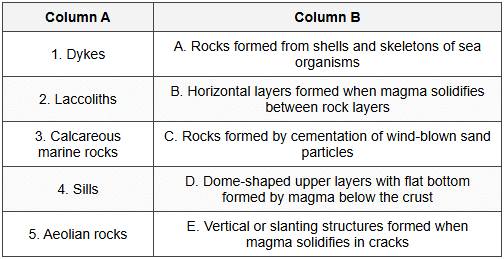
Match the Following
Solution:
Ans:
1 - E: Dykes are vertical or slanting igneous structures formed when molten magma solidifies in cracks and fissures beneath the Earth's surface.
2 - D: Laccoliths form when magma solidifies just below the crust, creating distinctive dome-shaped upper layers with a flat bottom surface underneath.
3 - A: Calcareous marine rocks are sedimentary rocks formed from the shells and skeletons of sea organisms deposited on the ocean floor.
4 - B: Sills are intrusive igneous structures forming horizontal layers when magma solidifies between existing rock layers deep within the Earth's crust.
5 - C: Aeolian rocks are sedimentary rocks formed through the cementation of sand particles that have been transported and deposited by wind action.
Short Answer Questions
Q1: Distinguish between extrusive and intrusive igneous rocks based on their formation and characteristics.
Solution:
Ans: Extrusive igneous rocks form when molten magma cools on Earth's surface through volcanic eruptions or fissures. They are smooth, crystalline, and fine-grained due to rapid cooling. Intrusive igneous rocks form when magma cools beneath Earth's surface. They have coarse texture with large crystals due to slow cooling, allowing more time for crystal formation.
Q2: Explain the process of lithification and its importance in sedimentary rock formation.
Solution:
Ans: Lithification is the process that turns loose sediments into solid rocks. It involves compaction, where loose sediments harden under pressure from overlying and underlying rocks, and cementation, where compacted sediments bind together with natural materials like silica or iron. This process is essential for converting weathered rock fragments into stable sedimentary rocks like sandstone.
Q3: What is the significance of fossils found in sedimentary rocks?
Solution:
Ans: Fossils found in sedimentary rocks are plant and animal remains preserved between layers. They serve as important clues to ancient environments and processes, helping scientists understand Earth's history. Sedimentary rocks contain these fossils, which are a significant energy source. The preservation of organic remains between sedimentary layers provides valuable information about past life forms.
Q4: Describe the rock cycle and explain how igneous rocks transform into sedimentary rocks.
Solution:
Ans: The rock cycle is the continuous transformation of rocks from one type to another. Hot lava cools to form igneous rocks. These igneous rocks undergo weathering, breaking into small particles which are transported by water, wind, or glaciers. The particles are then deposited in layers and undergo lithification to form sedimentary rocks, completing this transformation process.
Q5: Why are igneous rocks more resistant to chemical weathering compared to other rock types?
Solution:
Ans: Igneous rocks are hard and resistant to erosion due to their crystalline structure formed from cooling magma. Water seeps through cracks and joints in these rocks, making them less affected by chemical weathering. However, they are subject to mechanical weathering. Their compact nature and alumino-silicate mineral composition, mainly quartz and feldspar, contribute to their resistance.
Long Answer Questions
Q1: Analyze the different types of metamorphism and explain how each process transforms existing rocks. Provide specific examples.
Solution:
Ans: Metamorphism transforms existing rocks through heat and pressure. Thermal metamorphism occurs due to extreme heat from magma or friction, forming slate from clay. Dynamic metamorphism happens during large-scale crustal movements, converting shale to hornfels. Regional metamorphism occurs during mountain building, affecting large areas and forming new rocks from buried igneous or sedimentary rocks. Local or contact metamorphism affects small areas, transforming sandstone to quartzite. Each type involves different geological conditions and produces distinct metamorphic rocks with altered mineral structures and textures.
Q2: Evaluate the economic importance of rocks in human civilization, from ancient times to modern industries. Justify your answer with examples.
Solution:
Ans: Rocks have been crucial for human civilization throughout history. Early humans used quartzite to make tools, demonstrating their initial importance. In construction, red sandstone was used in Red Fort and white marble in Taj Mahal, showing architectural value. Granite serves in building construction for its durability. Economically, rocks contain valuable minerals like coal, petroleum, iron, gold, and aluminium essential for industries. Sedimentary rocks contain fossils that serve as significant energy sources. Small stones are even used in games, showing rocks' diverse applications from survival to culture.
Q3: Compare the characteristics and formation processes of the three main types of rocks. How does understanding these differences help in identifying rocks?
Solution:
Ans: Igneous rocks are primary rocks formed by cooling magma, characterized by hard, crystalline structure with alumino-silicate minerals. Sedimentary rocks are secondary rocks formed from weathered fragments, covering 75% of Earth's surface, characterized by soft, layered structure containing fossils. Metamorphic rocks form from existing rocks transformed by heat and pressure. Understanding these differences helps identify rocks through texture, hardness, layering, and mineral composition. Igneous rocks show crystalline structure, sedimentary rocks display layers, and metamorphic rocks exhibit recrystallized minerals, making identification systematic.
Ans. The three main types of rocks are igneous, sedimentary, and metamorphic rocks. Igneous rocks form from the solidification of molten material, sedimentary rocks are formed through the accumulation of sediments, and metamorphic rocks arise from the transformation of existing rocks due to heat and pressure.
2. How are sedimentary rocks formed?
Ans. Sedimentary rocks are formed through a process that includes the accumulation and compaction of sediments, which can be fragments of other rocks, minerals, or organic materials. These sediments are often deposited in layers and may undergo lithification to become solid rock.
3. What is the rock cycle?
Ans. The rock cycle is a continuous process that describes the transformations between the three main types of rocks: igneous, sedimentary, and metamorphic. It illustrates how rocks can change from one type to another over geological time due to processes such as melting, cooling, erosion, and pressure.
4. What is the significance of metamorphic rocks?
Ans. Metamorphic rocks are significant because they provide insights into the conditions and processes that occur deep within the Earth. They often contain valuable minerals and can indicate past geological events, such as tectonic activity and heat transfer.
5. How do igneous rocks differ from sedimentary rocks?
Ans. Igneous rocks differ from sedimentary rocks in their formation process; they form from the cooling and solidification of molten magma or lava, whereas sedimentary rocks are formed from the accumulation and compaction of sediments. Additionally, igneous rocks typically have a crystalline texture, while sedimentary rocks often display layered structures.
Extra Questions, MCQs, video lectures, Worksheet with Solutions: Rocks, Worksheet with Solutions: Rocks, Important questions, Summary, past year papers, Free, Viva Questions, ppt, Sample Paper, Objective type Questions, pdf , shortcuts and tricks, Exam, practice quizzes, mock tests for examination, Previous Year Questions with Solutions, study material, Semester Notes, Worksheet with Solutions: Rocks;