Q1: What is humidity? (a) The total amount of water on Earth (b) The amount of water vapor present in a given volume of air at any time (c) The process of water turning into ice (d) The measurement of rainfall in centimeters
Solution:
Ans: (b) Explanation: Humidity refers specifically to the amount of water vapor present in a given volume of air at any time, which determines how humid the weather feels.
Q2: Which factor does NOT increase the rate of evaporation? (a) High humidity in the air (b) Higher temperatures (c) Strong, dry winds (d) Greater heat supply
Solution:
Ans: (a) Explanation: High humidity actually slows down evaporation, while dry air with low humidity speeds it up. Higher temperatures, strong winds, and heat supply increase evaporation rates.
Q3: At what height are high clouds typically located? (a) Below 2 km above sea level (b) Between 2 km and 4 km (c) Between 2 km and 6 km (d) Above 6 km above sea level
Solution:
Ans: (d) Explanation: High clouds are located above 6 km above sea level and are made of ice crystals. An example of such clouds is Cirrostratus.
Q4: Which type of rainfall is common in the Amazon river basin? (a) Orographic rainfall (b) Cyclonic rainfall (c) Convectional rainfall (d) Frontal rainfall
Solution:
Ans: (c) Explanation: The Amazon river basin experiences daily rain due to convectional rainfall, which is common in equatorial regions with high temperatures causing rapid evaporation.
Q5: Why does Mumbai receive more rainfall than Pune? (a) Mumbai is located on the leeward side of mountains (b) Pune has stronger winds than Mumbai (c) Mumbai is on the windward side of the Western Ghats (d) Pune is closer to the ocean
Solution:
Ans: (c) Explanation: Mumbai is located on the windward side of the Western Ghats, which receives heavy orographic rainfall, while Pune on the leeward side receives scanty rain.
Fill in the Blanks
Q1: Relative humidity is expressed as a _____ showing how close the air is to being fully saturated.
Solution:
Ans: percentage
Q2: _____ is the hidden energy that changes water's state without changing temperature.
Solution:
Ans: Latent heat
Q3: Condensation occurs when air temperature falls below the _____.
Solution:
Ans: dew point
Q4: Rainfall is measured using an instrument called a _____.
Solution:
Ans: rain gauge
Q5: _____ is a mixture of fog, smoke, and dust commonly found in industrial areas.
Solution:
Ans: Smog
True or False
Q1: Relative humidity accounts for mist, clouds, and fog present in the air.
Solution:
Ans: False Explanation: Relative humidity only accounts for invisible water vapor and excludes mist, clouds, fog, or water aerosols from its measurement.
Q2: Strong, dry winds accelerate the process of evaporation.
Solution:
Ans: True Explanation: Strong, dry winds increase the rate of evaporation, which is why clothes dry faster on windy days than calm days.
Q3: Clouds are formed when billions of tiny water droplets or ice crystals combine together.
Solution:
Ans: True Explanation: Clouds form when warm air rises, cools, and condenses around dust particles, creating billions of water droplets that combine together.
Q4: The leeward side of mountains receives more rainfall than the windward side.
Solution:
Ans: False Explanation: The windward side receives more rain as moisture-bearing winds rise and condense, while the leeward side gets less rain.
Q5: Cyclonic rainfall lasts for several days continuously.
Solution:
Ans: False Explanation: Cyclonic rainfall typically lasts only a few hours and often occurs during tropical cyclones when warm and cold air masses meet.
Match the Following
Solution:
Ans:
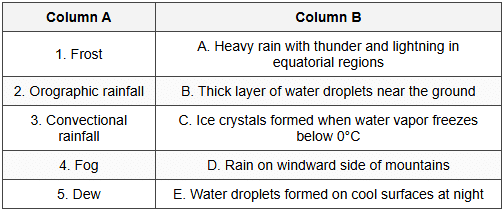
1 - C: Frost forms as ice crystals when water vapor freezes on surfaces like leaves or rocks at temperatures below 0°C.
2 - D: Orographic rainfall occurs when mountains force moisture-bearing winds to rise, causing rain on the windward side of the mountains.
3 - A: Convectional rainfall is characterized by heavy rain with thunder and lightning, common in equatorial regions due to high temperatures.
4 - B: Fog appears as a thick layer of water droplets or mist that forms near the ground level.
5 - E: Dew forms as water droplets on cool surfaces during night or early morning hours due to the condensation process.
Short Answer Questions
Q1: Explain the three conditions required for condensation to occur in the atmosphere.
Solution:
Ans: Condensation requires three specific conditions to occur. First, there must be a high amount of water vapor in the atmosphere. Second, tiny particles like dust, salt, or smoke must be present for water vapor to condense around. Third, the air temperature must fall below the dew point, causing the water vapor to turn into tiny water droplets or ice.
Q2: What is latent heat and how does it affect the state of water?
Solution:
Ans: Latent heat is the hidden energy that changes water's state from solid to liquid or liquid to vapor without changing its temperature. When ice melts into water, it absorbs latent heat but does not get warmer until it is fully melted. This energy is essential for water to transform between different states during the water cycle.
Q3: Describe how clouds are formed in the atmosphere.
Solution:
Ans: Clouds are formed when warm air rises and cools in the atmosphere. As the air cools, water vapor condenses around tiny dust particles, creating microscopic water droplets. Billions of these tiny droplets combine together to form visible clouds. These clouds are masses of water droplets or ice crystals that float in the atmosphere at various heights.
Q4: How do lightning and thunderstorms occur during heavy rainfall?
Solution:
Ans: Lightning occurs when raindrops move due to convectional air currents, forming ice particles within clouds. These ice particles rub together, creating electric charges with positive ions at the cloud's top and negative ions at the bottom. The attraction between these opposite charges causes lightning flashes. This phenomenon accompanies heavy rainfall during thunderstorms with loud thunder sounds.
Q5: Why do coastal areas receive more rainfall than inland regions?
Solution:
Ans: Coastal areas receive more rainfall than inland regions due to land and sea contrast. Winds blowing from oceans to land carry abundant moisture, bringing more rain to coastal areas. In contrast, winds blowing from inland regions are drier and carry less moisture. Additionally, the direction of winds plays a crucial role in determining rainfall patterns in different areas.
Long Answer Questions
Q1: Analyze the three types of rainfall and explain how geographical features influence each type.
Solution:
Ans: The three types of rainfall are convectional, orographic, and cyclonic. Convectional rainfall occurs in equatorial regions due to high temperatures causing rapid evaporation, where hot air rises, cools, and forms cumulonimbus clouds with heavy rain. Orographic rainfall happens when mountains force moisture-bearing winds to rise, causing condensation and rain on the windward side, while the leeward side remains dry. Cyclonic rainfall occurs when warm and cold air masses meet, causing the lighter warm air to rise over cold air, leading to heavy rainfall lasting a few hours during tropical cyclones.
Q2: Compare and contrast the different forms of precipitation and justify how temperature affects their formation.
Solution:
Ans: Precipitation occurs in various forms depending on temperature conditions. Rain forms when water droplets fall from clouds at normal temperatures. Frost develops when water vapor freezes on surfaces below 0°C, creating ice crystals. Dew forms as water droplets on cool surfaces through condensation at night. Mist and fog are suspended water droplets near ground level, with fog being denser. Hail consists of solid ice pieces, while sleet is a mixture of rain and ice. Temperature critically determines which form develops, with freezing temperatures producing frost and hail, while warmer conditions create rain and dew.
Q3: Evaluate how the factors affecting rainfall distribution create different climate patterns across the world.
Solution:
Ans: Rainfall distribution is influenced by land and sea contrast, wind direction, and mountain presence, creating diverse climate patterns globally. Equatorial regions of Africa, South America, and Southeast Asia receive over 200 cm rainfall annually due to convectional patterns. Mediterranean countries experience winter rainfall, while sub-tropical regions get summer rain. Coastal areas receive more precipitation than inland regions due to moisture-bearing ocean winds. Mountains create contrasting patterns, with windward sides receiving heavy rain and leeward sides remaining dry. Polar regions and tropical deserts receive less than 25 cm, creating arid conditions due to their geographical positions.
Ans. Humidity refers to the amount of water vapour present in the air. It is an important factor in weather and climate, affecting temperature and precipitation levels.
2. What are the different types of humidity?
Ans. The two main types of humidity are absolute humidity, which measures the actual amount of water vapour in the air, and relative humidity, which is the percentage of water vapour present in the air compared to the maximum amount the air can hold at a given temperature.
3. How does temperature affect humidity levels?
Ans. Temperature has a significant impact on humidity levels. Warmer air can hold more moisture than cooler air; therefore, as temperature increases, relative humidity may decrease if moisture levels remain constant.
4. Why is relative humidity important in weather reports?
Ans. Relative humidity is important in weather reports because it helps indicate how comfortable or uncomfortable the weather may feel. High relative humidity can make temperatures feel hotter, while low relative humidity can make temperatures feel cooler.
5. What are the implications of high humidity on health?
Ans. High humidity can lead to discomfort, increased perspiration, and heat-related illnesses. It can also exacerbate respiratory problems and promote the growth of mould and dust mites, which can affect indoor air quality and overall health.
Free, shortcuts and tricks, Previous Year Questions with Solutions, Objective type Questions, Exam, mock tests for examination, Worksheet with Solutions: Humidity, video lectures, past year papers, MCQs, practice quizzes, Sample Paper, study material, Summary, pdf , Viva Questions, Worksheet with Solutions: Humidity, Important questions, Worksheet with Solutions: Humidity, Semester Notes, Extra Questions, ppt;