Q1: Which of the following is an example of a source correction method to reduce air pollution? (a) Using electrostatic precipitators (b) Replacing coal with compressed natural gas (c) Installing cyclone separators (d) Using gravitational settling chambers
Solution:
Ans: (b) Explanation: Replacing coal with compressed natural gas is a source correction method as it reduces pollution at its origin by using cleaner fuel with lower emissions.
Q2: What is the primary function of a scrubber in controlling air pollution? (a) Trapping particulate matter through cloth bags (b) Capturing water-soluble gases by spraying water (c) Removing fly ash using charged particles (d) Separating dust using gravitational force
Solution:
Ans: (b) Explanation: A scrubber sprays water downward through nozzles to trap water-soluble gases like sulfur dioxide, nitrogen oxide, and ammonia by collision with polluted gases.
Q3: Which wastewater treatment stage specifically removes nutrients like nitrogen and phosphorus? (a) Primary treatment (b) Secondary treatment (c) Tertiary treatment (d) Chlorination stage
Solution:
Ans: (c) Explanation: Tertiary treatment removes nutrients like nitrogen and phosphorus from wastewater, making the water suitable for reuse in various purposes including agriculture and industry.
Q4: Which pollution control device can remove over 99% of impurities from polluted air? (a) Filters (b) Cyclone separator (c) Electrostatic precipitator (d) Gravitational settling chamber
Solution:
Ans: (c) Explanation: The electrostatic precipitator is highly efficient and can remove over 99% of impurities by charging particles negatively and attracting them to positive electrode plates.
Q5: What is a major disadvantage of the open dumping method of waste disposal? (a) It requires high temperatures for operation (b) It produces nutrient-rich humus (c) It leads to breeding of mosquitoes and flies (d) It needs expensive pollution control devices
Solution:
Ans: (c) Explanation: Open dumping is unsafe as it leads to breeding of mosquitoes and flies, and burning wastes causes air pollution while rainwater carries pollutants to water bodies.
Fill in the Blanks
Q1: To reduce hydrocarbon and carbon monoxide emissions from vehicles, _____ should be installed.
Solution:
Ans: catalytic converters
Q2: In a gravitational settling chamber, particulates settle due to _____ force.
Solution:
Ans: gravity
Q3: The process of composting produces _____, which enhances soil fertility.
Solution:
Ans: humus
Q4: During secondary wastewater treatment, organic matter is broken down by _____.
Solution:
Ans: microorganisms
Q5: Nuclear devices should be tested deep _____ to minimise radioactive pollution.
Solution:
Ans: underground
True or False
Q1: Using fuels with low sulfur content helps to reduce air pollution.
Solution:
Ans: True Explanation: Low sulfur content fuels produce fewer sulfur dioxide emissions, which reduces air pollution and helps prevent acid rain formation.
Q2: Primary wastewater treatment completely removes all dissolved organic matter from water.
Solution:
Ans: False Explanation: Primary treatment involves screens and sedimentation tanks, but dissolved organic matter like salts remains untreated and requires further treatment stages.
Q3: Incineration is an inexpensive method of waste disposal.
Solution:
Ans: False Explanation: Incineration is expensive because it requires air pollution control devices to manage fly ash and sulfur dioxide produced during high-temperature burning.
Q4: Nitrogen-fixing plants help reduce the need for chemical fertilisers.
Solution:
Ans: True Explanation: Nitrogen-fixing plants naturally add nitrogen to soil, reducing dependency on chemical fertilisers and preventing excess nitrates from contaminating water bodies.
Q5: Radioactive wastes should be stored in open containers above ground for safe decay.
Solution:
Ans: False Explanation: Radioactive wastes must be stored in shielded, corrosion-proof containers buried deep underground to prevent environmental contamination and ensure safe decay.
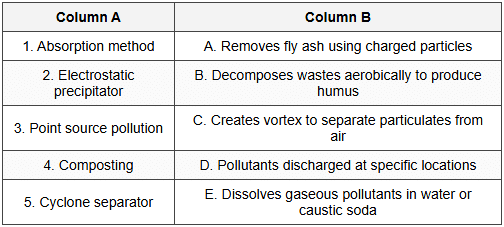
Match the Following
Solution:
Ans:
1 - E: Absorption removes gaseous pollutants like sulfur dioxide and nitrogen oxides by dissolving them in water or caustic soda solution.
2 - A: Electrostatic precipitators charge particles negatively and attract them to positive plates, efficiently removing fly ash from combustion processes.
3 - D: Point source pollution occurs when pollutants are discharged at specific locations, such as factory effluents being released directly into rivers.
4 - B: Composting uses aerobic microorganisms to decompose household and municipal wastes, producing nutrient-rich humus that improves soil fertility.
5 - C: Cyclone separators create a high-speed vortex that forces particulate matter to fall while clean gas exits upward from the device.
Short Answer Questions
Q1: Explain how a gravitational settling chamber helps control air pollution.
Solution:
Ans: A gravitational settling chamber is a rectangular chamber with horizontal trays where polluted gas moves slowly at low velocity. This allows particulates to settle due to gravitational force. High-density pollutants accumulate at the bottom of the chamber, where they can be removed easily. This device is particularly effective for capturing heavy dust particles from exhaust gases before they are released into the atmosphere.
Q2: What are the main steps involved in secondary wastewater treatment?
Solution:
Ans: During secondary treatment, water enters a tank containing microorganisms, and air is supplied through diffusers to provide oxygen. The microorganisms break down organic matter in the presence of oxygen through biological degradation. Impurities settle at the bottom of the tank and are removed. Finally, the water is treated with chlorine gas to eliminate any remaining harmful organisms, making it safer for further treatment or discharge.
Q3: Describe how sanitary landfills help prevent soil pollution.
Solution:
Ans: In sanitary landfills, wastes are disposed of in layers, compacted firmly, and covered with soil to facilitate bacterial decomposition. This method prevents attack by rodents and insects, reducing health hazards. The soil cover also prevents rainwater from directly contacting waste, minimising leachate formation. However, landfills should not be located in areas with high groundwater levels to avoid contamination of underground water sources through seepage.
Q4: How can farmers reduce non-point source water pollution from agricultural activities?
Solution:
Ans: Farmers can reduce non-point source pollution by planting nitrogen-fixing plants to decrease chemical fertiliser requirements. They should use agrochemicals and pesticides carefully to avoid contamination of nearby water bodies. Preventing manure runoff into water sources is essential. Additionally, using biofertilisers and biopesticides instead of chemical alternatives helps reduce the quantity of harmful substances that can wash into rivers and lakes during rainfall or irrigation.
Q5: What safety measures should be taken to control radioactive pollution?
Solution:
Ans: To control radioactive pollution, the use of X-rays should be minimised and nuclear reactors regularly inspected for safety. Nuclear devices must be tested deep underground to prevent radiation release. Production of radioisotopes should be reduced, and wet drilling with underground drainage should be used in nuclear mines. Radioactive wastes must be handled carefully and stored in shielded, corrosion-proof containers buried deep underground. Radiation-resistant walls should be built near nuclear reactors.
Long Answer Questions
Q1: Analyse the effectiveness of source correction methods compared to pollution control equipment in reducing air pollution. Justify your answer with appropriate examples.
Solution:
Ans: Source correction methods are more effective than pollution control equipment as they prevent pollution at its origin rather than treating it afterwards. Changing raw materials, such as replacing coal with compressed natural gas or liquefied petroleum gas, directly reduces harmful emissions like sulfur dioxide. Installing catalytic converters prevents hydrocarbon and carbon monoxide release. Modifying processes through absorption removes gaseous pollutants before release. While pollution control equipment like electrostatic precipitators and scrubbers are highly efficient, they require additional investment and maintenance. Source correction is economically sustainable long-term as it reduces pollutant generation, whereas control equipment only manages existing pollution.
Q2: Compare the three stages of wastewater treatment and evaluate which stage is most critical for protecting water quality. Provide reasons for your answer.
Solution:
Ans: Primary treatment removes large particles through screens and sedimentation, but dissolved organic matter remains untreated. Secondary treatment uses microorganisms to biologically degrade organic matter in the presence of oxygen, removing most contaminants. Tertiary treatment removes nutrients like nitrogen and phosphorus, making water reusable. Secondary treatment is most critical as it removes harmful organic pollutants that cause oxygen depletion and aquatic life damage. Without secondary treatment, dissolved organic matter would remain, rendering water unsafe. Primary treatment alone is insufficient, while tertiary treatment enhances quality but is not always essential for basic safety requirements.
Q3: Evaluate the different methods of controlling soil pollution and justify which method is most sustainable for managing municipal waste in developing countries.
Solution:
Ans: Methods include open dumping, sanitary landfills, composting, incineration, and segregation. Open dumping is unsafe and environmentally harmful. Incineration is expensive and causes air pollution. Sanitary landfills require land and careful site selection. Composting is most sustainable for developing countries as it converts household and municipal wastes into nutrient-rich humus aerobically. It is cost-effective, requires minimal infrastructure, and produces valuable soil enhancer for agriculture. Coupled with segregation for recycling materials like paper, glass, and metals, composting reduces waste volume significantly. This combined approach suits developing nations with limited resources while providing environmental and economic benefits.
FAQs on Worksheet with Solutions: Preventive Measures
1. What are preventive measures in health?
Ans. Preventive measures in health are strategies and actions aimed at reducing the risk of diseases and maintaining overall well-being. These measures can include vaccinations, regular health check-ups, proper hygiene practices, and healthy lifestyle choices such as balanced nutrition and exercise.
2. How can vaccinations contribute to preventive health?
Ans. Vaccinations are a critical aspect of preventive health as they immunise individuals against specific infectious diseases. By stimulating the immune system to recognise and combat pathogens, vaccinations help in preventing outbreaks and protecting vulnerable populations from severe illnesses.
3. What role does hygiene play in preventing diseases?
Ans. Hygiene plays a vital role in preventing diseases by reducing the transmission of pathogens. Good hygiene practices, such as regular hand washing, maintaining clean environments, and safe food handling, can significantly lower the risk of infections and promote better health outcomes.
4. Can you explain the importance of regular health check-ups?
Ans. Regular health check-ups are essential for early detection and prevention of potential health issues. They allow healthcare professionals to monitor individuals' health, identify risk factors, and provide timely interventions, thus enhancing the chances of successful treatment and long-term health maintenance.
5. What lifestyle changes can individuals adopt for better preventive health?
Ans. Individuals can adopt several lifestyle changes for better preventive health, including engaging in regular physical activity, consuming a balanced diet rich in fruits and vegetables, managing stress effectively, avoiding tobacco and excessive alcohol use, and ensuring adequate sleep to strengthen their immune system and overall health.
Viva Questions, Important questions, Extra Questions, Worksheet with Solutions: Preventive Measures, pdf , video lectures, Free, Worksheet with Solutions: Preventive Measures, Worksheet with Solutions: Preventive Measures, study material, Previous Year Questions with Solutions, Semester Notes, Summary, Sample Paper, MCQs, practice quizzes, past year papers, ppt, Exam, shortcuts and tricks, mock tests for examination, Objective type Questions;