Q1: What type of receptor is responsible for detecting taste on the tongue? (a) Mechanoreceptors (b) Chemoreceptors (c) Photoreceptors (d) Thermoreceptors
Solution:
Ans: (b) Explanation: Chemoreceptors are responsible for taste on the tongue and smell in the nose, both of which respond to chemical influences.
Q2: Which layer of the eyeball is rich in blood vessels and provides nourishment? (a) Sclerotic layer (b) Retina (c) Choroid layer (d) Cornea
Solution:
Ans: (c) Explanation: The choroid layer is the middle layer of the eyeball that is rich in blood vessels providing essential nourishment to the eye.
Q3: Which cells in the retina are sensitive to bright light and responsible for colour vision? (a) Rod cells (b) Cone cells (c) Sensory cells (d) Epithelial cells
Solution:
Ans: (b) Explanation: Cone cells are sensitive to bright light and are responsible for colour vision, whereas rod cells detect dim light without colour.
Q4: Which part of the inner ear contains the organ of Corti responsible for hearing? (a) Semicircular canals (b) Vestibule (c) Cochlea (d) Ampulla
Solution:
Ans: (c) Explanation: The cochlea is divided into three parallel canals, with the middle canal housing the organ of Corti, which is responsible for hearing.
Q5: What is the correct term for shortsightedness where near objects are seen clearly? (a) Hyperopia (b) Presbyopia (c) Myopia (d) Astigmatism
Solution:
Ans: (c) Explanation: Myopia, or shortsightedness, is a condition where near objects are seen clearly but distant objects appear blurred due to excessive lens curvature.
Fill in the Blanks
Q1: The transparent membrane covering the entire front part of the eye is called the _____.
Solution:
Ans: conjunctiva
Q2: The three small bones in the middle ear are collectively called ear _____.
Solution:
Ans: ossicles
Q3: The lens is held in position by a _____ ligament that attaches it to the ciliary body.
Solution:
Ans: suspensory
Q4: Night blindness is caused by the non-formation of _____ in rod cells of the retina.
Solution:
Ans: rhodopsin
Q5: The sensory cells in the utriculus and sacculus maintain _____ equilibrium when the body is stationary.
Solution:
Ans: static
True or False
Q1: Rod cells in the retina are sensitive to bright light and detect colour.
Solution:
Ans: False Explanation: Rod cells are sensitive to dim light and do not detect colour, whereas cone cells detect bright light and colour.
Q2: The eustachian tube connects the middle ear to the throat.
Solution:
Ans: True Explanation: The middle ear contains the eustachian tube, which connects the middle ear to the throat, equalising air pressure.
Q3: The image formed on the retina is both real and upright.
Solution:
Ans: False Explanation: The image formed on the retina is both real and inverted, not upright. The brain interprets this inverted image correctly.
Q4: Each eye contains between 6 to 12 tear glands.
Solution:
Ans: True Explanation: There are between 6 to 12 tear glands in each eye which lubricate the eye surface and wash away dust.
Q5: Myopia can be corrected using suitable convex lenses.
Solution:
Ans: False Explanation: Myopia is corrected with suitable concave lenses, not convex lenses, because the lens is too curved in myopia.
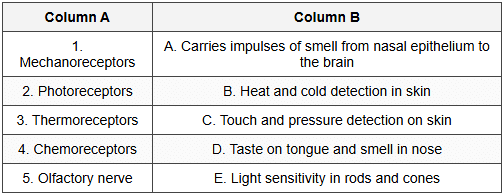
Match the Following
Solution:
Ans:
1 - C: Mechanoreceptors detect pressure on the skin due to mechanical changes, making them receptors for touch and pressure.
2 - E: Photoreceptors are sensitive to light and are found in the rods and cones of the retina in the eyes.
3 - B: Thermoreceptors are heat and cold receptors in the skin that respond to changes in temperature and detect thermal stimuli.
4 - D: Chemoreceptors are responsible for taste on the tongue and smell in the nose, responding to chemical influences in the environment.
5 - A: The olfactory nerve carries impulses from smell cells in the epithelial layer of the nasal chamber to the brain for processing.
Short Answer Questions
Q1: Describe the functions of tear glands in the eyes.
Solution:
Ans: The tear glands, numbering between 6 to 12 in each eye, perform two important functions. Firstly, they lubricate the surface of the eye, keeping it moist and preventing dryness. Secondly, they wash away dust particles and other foreign materials that may enter the eye, thus protecting it from potential damage and infection.
Q2: Explain the process of accommodation for near vision.
Solution:
Ans: For near vision, the lens changes to a more convex and rounded shape. This occurs when the ciliary muscles contract, pulling the ciliary body forward. As a result, the tension on the suspensory ligaments is reduced, allowing the lens to become thicker and more rounded. This adjustment enables the eye to focus clearly on close objects.
Q3: What is stereoscopic vision and which organisms possess this ability?
Solution:
Ans: Stereoscopic vision is the ability to perceive depth or the relative distance of objects. This ability is found in humans, monkeys, and apes. It results from the simultaneous focusing of an object with both eyes. The images from each eye overlap, creating a three-dimensional effect and allowing for accurate depth perception and distance judgment.
Q4: Describe the four major steps involved in seeing an object.
Solution:
Ans: Light rays reflected from an object pass through transparent parts of the eye. The cornea converges the light rays to some extent, and the lens further converges them. The image formed on the retina is real and inverted. Light energy causes chemical changes in the rods and cones, generating nerve impulses that travel through the optic nerve to the cerebrum, which interprets them correctly.
Q5: Explain how the semicircular canals help maintain body balance.
Solution:
Ans: The semicircular canals are three fluid-filled tubes oriented at right angles to each other, detecting rotational movements of the head. The ends of these canals widen to form an ampulla containing sensory cells. When the head moves, the fluid in the canals shifts, stimulating these sensory cells which send impulses to the brain, helping maintain body balance.
Long Answer Questions
Q1: Analyse the structure of the eyeball by describing the three concentric layers and their specific functions.
Solution:
Ans: The eyeball wall consists of three concentric layers. The outer sclerotic layer includes the sclera, the white visible part, and the cornea covering the coloured part. The middle choroid layer is rich in blood vessels providing nourishment and expands to form the ciliary body and iris, which regulates light entry through the pupil. The inner retina contains rods and cones, sensory cells for light detection. Rods are sensitive to dim light without colour detection, while cones detect bright light and colours, enabling complete vision.
Q2: Compare and contrast myopia and hyperopia in terms of their causes and correction methods.
Solution:
Ans: Myopia, or shortsightedness, occurs when the lens is too curved, causing near objects to be seen clearly but distant objects appear blurred. It is corrected using suitable concave lenses. In contrast, hyperopia, or long-sightedness, happens when the lens is too flat, leading to difficulty in seeing nearby objects clearly while distant objects remain clear. Hyperopia requires convex lenses for correction. Both conditions result from abnormal lens curvature but affect vision at opposite distances and require different corrective lens types.
Q3: Evaluate the dual functions of the ear by explaining the mechanisms of hearing and maintaining body balance.
Solution:
Ans: The ear performs two critical functions: hearing and balance. In hearing, sound waves collected by the pinna travel through the auditory canal to vibrate the eardrum. Ear ossicles amplify these vibrations, transmitting them through the oval window to the cochlea, where sensory cells convert them into electrical signals sent to the brain via the auditory nerve. For balance, the semicircular canals detect rotational movements, while the utriculus and sacculus in the vestibule maintain static equilibrium by detecting linear acceleration and head position relative to gravity.
1. What are the main types of sense organs in humans?
Ans. The main types of sense organs in humans include the eyes (vision), ears (hearing), nose (smell), tongue (taste), and skin (touch). Each organ is specialised to detect specific stimuli from the environment.
2. How do the sense organs work together to perceive the environment?
Ans. Sense organs work together to provide a comprehensive understanding of the environment. For instance, sight and sound can combine to enhance the perception of a scene, while smell and taste work together to identify flavours in food. The brain processes inputs from all sense organs to create a coherent experience.
3. What role do receptors play in the functioning of sense organs?
Ans. Receptors are specialised cells located in sense organs that detect specific stimuli such as light, sound, chemicals, or pressure. They convert these stimuli into electrical signals that are transmitted to the brain for interpretation, allowing us to perceive our surroundings.
4. What is the significance of the eye's structure in vision?
Ans. The structure of the eye is crucial for vision. Key components include the cornea, lens, retina, and optic nerve. The cornea and lens focus light onto the retina, where photoreceptor cells convert light into electrical signals. These signals travel via the optic nerve to the brain, where they are processed into images.
5. How does the sense of taste differ from the sense of smell?
Ans. The sense of taste involves the detection of flavours through taste buds on the tongue, which respond to five basic tastes: sweet, sour, salty, bitter, and umami. In contrast, the sense of smell detects airborne chemical molecules through olfactory receptors in the nose, which can identify a wider range of scents and significantly influences the perception of flavour.
practice quizzes, Extra Questions, mock tests for examination, Important questions, Semester Notes, ppt, Exam, Objective type Questions, Sample Paper, past year papers, Worksheet with Solutions: Sense Organs, Viva Questions, study material, video lectures, MCQs, Free, pdf , Previous Year Questions with Solutions, Worksheet with Solutions: Sense Organs, Worksheet with Solutions: Sense Organs, Summary, shortcuts and tricks;