RS Aggarwal Summary: logarithms


Introduction
Logarithms form a critical component of quantitative aptitude sections in competitive examinations. This chapter is frequently tested through direct formula-based questions, simplification problems, and complex numerical reasoning. Understanding logarithmic properties and their applications is essential for solving problems quickly and accurately. Questions from this chapter typically carry significant weightage and test both conceptual clarity and computational speed.
1. Definition of Logarithm
If \(a\) is a positive real number, other than 1, and \(a^m = x\), then we write:
\[m = \log_a x\]
This reads as "the logarithm of \(x\) to the base \(a\) is \(m\)."
Examples:
- \(10^3 = 1000 \Rightarrow \log_{10} 1000 = 3\)
- \(3^4 = 81 \Rightarrow \log_3 81 = 4\)
- \(2^{-3} = \frac{1}{8} \Rightarrow \log_2\left(\frac{1}{8}\right) = -3\)
- \((0.1)^2 = 0.01 \Rightarrow \log_{0.1}(0.01) = 2\)
\[\log_3 27 = \log_3 3^3 = 3 \log_3 3 = 3 \quad [\because \log_3 3 = 1]\]
2. Properties of Logarithms
Basic Properties:
- Product Rule: \(\log_a(xy) = \log_a x \log_a y\)
- Quotient Rule: \(\log_a\left(\frac{x}{y}\right) = \log_a x - \log_a y\)
- Identity: \(\log_x x = 1\)
- Logarithm of 1: \(\log_a 1 = 0\)
- Power Rule: \(\log_a(x^p) = p(\log_a x)\)
- Reciprocal Rule: \(\log_a\left(\frac{1}{x}\right) = -\log_a x\)
- Change of Base Formula: \(\log_a x = \frac{\log_b x}{\log_b a}\)
- Exponential Identity: \(a^{\log_a x} = x\)
- Inverse Property: \(\log_a(x^y) = y \log_a x\)
- Fractional Power: \(\log_{a^{p/q}} x = \frac{p}{q} \log_a x\)
Note: When base is not mentioned, it is taken as 10.
We know that \(a^{\log_a x} = x\)
\[36^{\log_6 4} = 6^{2 \log_6 4} = 6^{\log_6 4^2} = 6^{\log_6 16} = 16\]
$ \log_5 3 \times \log_{27} 25 = \frac{\log 3}{\log 5} \times \frac{\log 25}{\log 27}= \frac{\log 3}{\log 5} \times \frac{\log 5^2}{\log 3^3} = \frac{\log 3}{\log 5} \times \frac{2 \log 5}{3 \log 3} = \frac{2}{3} \ $
3. Common Logarithms
Logarithms to the base 10 are known as common logarithms. When no base is mentioned, base 10 is assumed.
$ \log_{10} 50 = \log_{10}\left(\frac{100}{2}\right) = \log_{10} 100 - \log_{10} 2\\ = 2 - 0.30103 = 1.69897 $
4. Characteristic and Mantissa
The logarithm of a number contains two parts:
- Characteristic: The integral part
- Mantissa: The decimal part
Characteristic Rules:
Case I: When the number is greater than 1
Characteristic = (Number of digits to the left of decimal point) - 1
Case II: When the number is less than 1
Characteristic = -(Number of zeros between decimal point and first significant digit) - 1
Written as \(\bar{1}, \bar{2}, \bar{3}\) (bar notation) instead of -1, -2, -3
Examples Table:
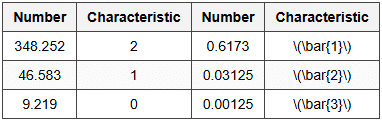
\[\log(2^{56}) = 56 \log 2 = 56 \times 0.30103 = 16.85768\] Its characteristic is 16. Hence, the number of digits in \(2^{56}\) is 17.
5. Solving Logarithmic Equations
$ \log_2[\log_3(\log_2 x)] = 1 \Rightarrow \log_3(\log_2 x) = 2^1 = 2 \Rightarrow \log_2 x =3^2 = 9 \Rightarrow x = 2^9 = 512 $
$ \log_{10}(x^2 - 6x 45) = 2\Rightarrow x^2 - 6x 45 = 10^2 = 100 \Rightarrow x^2 - 6x - 55 = 0 \Rightarrow x^2 - 11x 5x - 55 = 0 \Rightarrow x(x - 11) 5(x - 11)= 0 \Rightarrow (x - 11)(x 5) = 0 \Rightarrow x = 11 \text{ or } x = -5 \ $
6. Simplification Using Logarithmic Properties
$ \log\left(\frac{75}{16}\right) - \log\left(\frac{5}{9}\right)^2 \log\left(\frac{32}{243}\right) $ = $ \log\left(\frac{75}{16}\right) -\log\left(\frac{25}{81}\right) \log\left(\frac{32}{243}\right) $ = $ \log\left[\frac{75}{16} \times \frac{32}{243} \times \frac{81}{25}\right]$= $ \log 2 $
$ \log_{10} 3 \log_{10}(4x 1) = \log_{10}(x 1) 1 \Leftrightarrow \log_{10} 3 \log_{10}(4x 1) = \log_{10}(x 1) \log_{10} 10 \Leftrightarrow \log_{10}[3(4x 1)]= \log_{10}[10(x 1)] \Leftrightarrow 3(4x 1) = 10(x 1) \Leftrightarrow 12x 3 = 10x 10 \Leftrightarrow 2x = 7 \Leftrightarrow x = \frac{7}{2} $
7. Advanced Applications
$ \log_{xyz}(xy) \log_{xyz}(yz) \log_{xyz}(zx) = \log_{xyz}(xy \times yz \times zx) = \log_{xyz}(xyz)^2 = 2 \log_{xyz}(xyz) = 2 \times 1 = 2 $
$ \log_a b = \frac{1}{2}, \quad \log_b c = \frac{1}{3}, \quad \log_c a = \frac{1}{k} \Rightarrow \frac{\log b}{\log a} = \frac{1}{2}, \quad \frac{\log c}{\log b} = \frac{1}{3}, \quad \frac{\log a}{\log c} = \frac{1}{k} \Rightarrow \frac{\log b}{\log a} \times \frac{\log c}{\log b} \times \frac{\log a}{\log c} = \frac{1}{2} \times \frac{1}{3} \times \frac{1}{k} \Rightarrow 1 = \frac{1}{k} \Rightarrow k = 30 $
Complete Chapter Practice Examples
$ \log_{10}(8^x) = \frac{1}{3} \Leftrightarrow 8^x = 10^{1/3}\Leftrightarrow (2^3)^x = 10^{1/3} \Leftrightarrow 2^{3x} = 10^{1/3} \ $
Let \(\log_9 27 = n\). Then \(9^n = 27 \Leftrightarrow 3^{2n} = 3^3 \Leftrightarrow 2n = 3 \Leftrightarrow n = \frac{3}{2}\)
Let \(\log_{27} 9 = m\). Then \(27^m = 9 \Leftrightarrow 3^{3m} = 3^2 \Leftrightarrow 3m = 2 \Leftrightarrow m = \frac{2}{3}\)
\[\therefore \log_9 27 - \log_{27} 9 = (n - m) = \left(\frac{3}{2} - \frac{2}{3}\right) = \frac{5}{6}\]
$ \log 25 = \log\left(\frac{100}{4}\right) = \log 100 - \log 4 = 2 - 2 \log 2 = 2 - 2 \times 0.3010 = 1.398 $
$ \log 4.5 = \log\left(\frac{9}{2}\right) = \log 9 - \log 2 = 2 \log 3 - \log 2 = 2 \times 0.4771 - 0.3010 = 0.6532 \ $
$ \log_{10}\left(\frac{8^x}{3}\right) = 1\Rightarrow \frac{8^x}{3} = 10^1 = 10 \Rightarrow 8^x = 30 \Rightarrow (2^3)^x = 30 \Rightarrow 2^{3x} = 30 \Rightarrow x = \frac{\log_2 30}{3} \ $
Key Points to Remember
- ✓ Always check if base is mentioned; assume base 10 if not specified
- ✓ \(\log_a 1 = 0\) and \(\log_a a = 1\) are fundamental identities
- ✓ Use change of base formula when bases differ in multiplication/division
- ✓ Characteristic determines the number of digits in a number
- ✓ Practice converting between exponential and logarithmic forms
- ✓ Master product, quotient, and power rules for quick simplification
FAQs on RS Aggarwal Summary: logarithms
| 1. What is the definition of a logarithm? |  |
| 2. What are the key properties of logarithms? | |
| 3. What are common logarithms and how are they used? | |
| 4. What is the difference between characteristic and mantissa in logarithms? | |
| 5. How can one simplify logarithmic expressions using properties of logarithms? | |