Half Yearly Exam Class 10 Set 2 (Solutions)

Maximum Marks: 80
Time: 3 Hours
General Instructions
- This question paper contains 38 questions. All questions are compulsory.
- The question paper is divided into five sections A, B, C, D and E.
- Section A consists of Question Numbers 1 to 18, which are Multiple Choice Questions (MCQs), and Question Numbers 19 and 20, which are Assertion-Reason based questions. Each question carries 1 mark.
- Section B consists of Question Numbers 21 to 25, which are Very Short Answer (VSA) type questions. Each question carries 2 marks.
- Section C consists of Question Numbers 26 to 31, which are Short Answer (SA) type questions. Each question carries 3 marks.
- Section D consists of Question Numbers 32 to 35, which are Long Answer (LA) type questions. Each question carries 5 marks.
- Section E consists of Question Numbers 36 to 38, which are Case Study based questions. Each question carries 4 marks with sub-parts of 1, 1 and 2 marks respectively.
- There is no overall choice. However, an internal choice has been provided in two questions of Section B, two questions of Section C and two questions of Section D. An internal choice has been provided in all questions of Section E.
- Draw neat and clean figures wherever required.
- Take the value of π as 22/7 wherever required, unless stated otherwise.
- Use of calculators is not permitted.
SECTION - A (1 Mark Each)
Q1. The exponent of 2 in the prime factorisation of 144 is:
a) 2
b) 3
c) 4
d) 5
Ans: c) 4. In 144 = 2⁴ × 3², the power of 2 is 4.
Q2. If the zeroes of the quadratic polynomial x² + (a + 1)x + b are 2 and -3, then:
a) a = -7, b = -1
b) a = 5, b = -1
c) a = 2, b = -6
d) a = 0, b = -6
Ans: d) a = 0, b = -6.
Sum of zeroes is -1 and product is -6.
Q3. A pair of linear equations a₁x + b₁y + c₁ = 0 and a₂x + b₂y + c₂ = 0 is inconsistent if:
a) a₁/a₂ ≠ b₁/b₂
b) a₁/a₂ = b₁/b₂ = c₁/c₂
c) a₁/a₂ = b₁/b₂ ≠ c₁/c₂
d) a₁/a₂ ≠ c₁/c₂
Ans: c) a₁/a₂ = b₁/b₂ ≠ c₁/c₂.
The lines are parallel and do not intersect.
Q4. The roots of the quadratic equation x² - 3x - 10 = 0 are:
a) 2, -5
b) -2, 5
c) 2, 5
d) 3, 10
Ans: b) -2, 5.
The equation factorises as (x - 5)(x + 2) = 0.
Q5. In an AP, if d = -4, n = 7 and aₙ = 4, then a is:
a) 6
b) 7
c) 20
d) 28
Ans: d) 28.
Using aₙ = a + (n - 1)d.
Q6. If △ABC ∼ △PQR, then which of the following is true?
a) AB/PQ = BC/QR = AC/PR
b) ∠A = ∠P
c) Both (a) and (b)
d) None of these
Ans: c) Both (a) and (b).
Similar triangles have equal angles and proportional sides.
Q7. The distance between the points (0, 5) and (-5, 0) is:
a) 5
b) 5√2
c) 10
d) 50
Ans: b) 5√2.
Distance is obtained using the distance formula.
Q8. Which of the following is an irrational number?
a) 3.14
b) √4
c) 5 - √3
d) 2/3
Ans: c) 5 - √3.
A rational minus an irrational number is irrational.
Q9. The sum of the first n terms of an AP is given by:
a) Sₙ = n/2 (a + l)
b) Sₙ = n/2 [2a + (n - 1)d]
c) Both (a) and (b)
d) Sₙ = a + (n - 1)d
Ans: c) Both (a) and (b).
Each formula is valid in different situations.
Q10. If a line is drawn parallel to one side of a triangle to intersect the other two sides in the same ratio, the theorem used is:
a) Pythagoras Theorem
b) Basic Proportionality Theorem
c) Mid-point Theorem
d) AAA Criterion
Ans: b) Basic Proportionality Theorem.
Q11. The coordinates of a point on the x-axis are of the form:
a) (0, y)
b) (x, 0)
c) (x, y)
d) (a, a)
Ans: b) (x, 0).
The y-coordinate is zero on the x-axis.
Q12. The discriminant of the quadratic equation x² + x + 1 = 0 is:
a) 1
b) -3
c) 4
d) 0
Ans: b) -3.
The value of b² - 4ac is negative.
Q13. How many polynomials can have zeroes -2 and 5?
a) 1
b) 2
c) 3
d) Infinitely many
Ans: d) Infinitely many.
A constant multiple of a polynomial has the same zeroes.
Q14. The HCF of two numbers is 9 and their LCM is 459. If one number is 27, the other number is:
a) 153
b) 150
c) 459
d) 81
Ans: a) 153.
Other number = (HCF × LCM) / given number.
Q15. In △ABC, DE ∥ BC. If AD = 1.5 cm, DB = 3 cm and AE = 1 cm, then EC is:
a) 1 cm
b) 2 cm
c) 3 cm
d) 4 cm
Ans: b) 2 cm.
Using the Basic Proportionality Theorem.
Q16. The midpoint of the line segment joining (2, -2) and (-2, 2) is:
a) (2, 2)
b) (0, 0)
c) (1, 1)
d) (-2, -2)
Ans: b) (0, 0).
Found using the midpoint formula.
Q17. Which term of the AP 3, 8, 13, 18, ... is 78?
a) 12th
b) 13th
c) 15th
d) 16th
Ans: d) 16th. Solving a + (n - 1)d = 78.
Q18. The number of zeroes a cubic polynomial can have is:
a) Exactly 3
b) At most 3
c) Exactly 1
d) Exactly 2
Ans: b) At most 3. A polynomial has at most as many zeroes as its degree.
Q19.
ASSERTION (A): The HCF of 6 and 20 is 2.
REASON (R): HCF(a, b) × LCM(a, b) = a × b.
a) Both A and R are true and R is the correct explanation
b) Both A and R are true but R is not the correct explanation
c) A is true and R is false
d) A is false and R is true
Ans: b). Both statements are true, but the reason does not explain the assertion.
Q20.
ASSERTION (A): The point (0, 4) lies on the y-axis.
REASON (R): The x-coordinate of any point on the y-axis is zero.
a) Both A and R are true and R is the correct explanation
b) Both A and R are true but R is not the correct explanation
c) A is true and R is false
d) A is false and R is true
Ans: a). A point with x-coordinate zero always lies on the y-axis.
SECTION - B (2 Marks Each)
Q21. Explain why 7 × 11 × 13 + 13 is a composite number.
Ans: 7 × 11 × 13 + 13 can be written as 13(7 × 11 + 1) 13(77 + 1) 13 × 78
Since the given number has factors other than 1 and itself, it is a composite number.
Q22. Find the zeroes of the quadratic polynomial 6x² - 3 - 7x.
Ans: Rewriting the polynomial as 6x² - 7x - 3
Splitting the middle term:
6x² - 9x + 2x - 3
Grouping the terms:
3x(2x - 3) + 1(2x - 3)
(3x + 1)(2x - 3) = 0
Hence, the zeroes are -1/3 and 3/2.
Q23. (Choice A): Solve the pair of linear equations by elimination method: 2x + 3y = 8 and 4x + 6y = 7.
Ans: Multiplying the first equation by 2: 4x + 6y = 16
Subtracting the second equation:
(4x + 6y) - (4x + 6y) = 16 - 7 0 = 9
This is a false statement.
Hence, the given pair of equations has no solution.
OR
Q23. (Choice B): Find the distance between the points (a, b) and (-a, -b).
Ans: Using the distance formula:
d = √[ (-a - a)² + (-b - b)² ]
d = √[ (-2a)² + (-2b)² ]
d = √[ 4a² + 4b² ]
d = 2√(a² + b²)
Q24. Find the discriminant and state the nature of roots of the quadratic equation 3x² - 4√3 x + 4 = 0.
Ans: Here, a = 3, b = -4√3 and c = 4
Discriminant,
D = b² - 4ac
D = (-4√3)² - 4(3)(4)
D = 48 - 48
D = 0
Since the discriminant is zero, the roots are real and equal.
Q25. (Choice A): Is the sequence 1, 1, 1, 2, 2, 2, ... an AP? Justify.
Ans: Difference between first and second terms:
a₂ - a₁ = 1 - 1 = 0
Difference between fourth and third terms:
a₄ - a₃ = 2 - 1 = 1
Since the difference between consecutive terms is not constant, the given sequence is not an AP.
OR
Q25. (Choice B): State the SSS similarity criterion.
Ans: If the corresponding sides of one triangle are proportional to the corresponding sides of another triangle, then the two triangles are similar.
SECTION - C (3 Marks Each)
Q26. Prove that √5 is irrational.
Ans:
Assume that √5 is a rational number.
Then √5 = a/b, where a and b are co-prime integers and b ≠ 0.
Squaring both sides, we get 5b² = a².
This implies that a² is divisible by 5, so a is divisible by 5.
Let a = 5c, where c is an integer.
Substituting, we get 5b² = 25c².
So, b² = 5c², which implies that b is also divisible by 5.
Thus, both a and b are divisible by 5, which contradicts the assumption that they are co-prime.
Hence, √5 is irrational.
Q27. Verify the relationship between zeroes and coefficients of the polynomial 4s² - 4s + 1.
Ans:
Given polynomial: 4s² - 4s + 1
Factorising:
4s² - 4s + 1 = (2s - 1)²
Hence, the zeroes are:
s = 1/2 and s = 1/2
Sum of zeroes = 1/2 + 1/2 = 1
According to the formula:
-b/a = -(-4)/4 = 1
Thus, the sum of zeroes is verified.
Product of zeroes = 1/2 × 1/2 = 1/4
According to the formula:
c/a = 1/4
Thus, the product of zeroes is also verified.
Q28.
(Choice A): Solve the pair of linear equations using substitution method:
0.2x + 0.3y = 1.3 and 0.4x + 0.5y = 2.3.
Ans:
From the first equation:
0.2x = 1.3 - 0.3y
x = 6.5 - 1.5y
Substituting this value of x in the second equation:
0.4(6.5 - 1.5y) + 0.5y = 2.3
2.6 - 0.6y + 0.5y = 2.3
-0.1y = -0.3
y = 3
Substituting y = 3 in x = 6.5 - 1.5y:
x = 2
Hence, the solution is x = 2 and y = 3.
OR
Q28.
(Choice B): How many multiples of 4 lie between 10 and 250?
Ans:
The multiples of 4 between 10 and 250 form an AP:
12, 16, 20, ... , 248
Here, first term a = 12 and common difference d = 4.
Let the number of terms be n.
Using the formula aₙ = a + (n - 1)d:
248 = 12 + (n - 1)4
236 = 4(n - 1)
n - 1 = 59
n = 60
Hence, there are 60 multiples of 4 between 10 and 250.
Q29. Find the coordinates of the point on the x-axis which is equidistant from the points (2, -5) and (-2, 9).
Ans:
Let the required point on the x-axis be P(x, 0).
Since P is equidistant from both points, PA² = PB².
So, (x - 2)² + (0 + 5)² = (x + 2)² + (0 - 9)².
x² - 4x + 4 + 25 = x² + 4x + 4 + 81.
Simplifying, -8x = 56.
x = -7.
Hence, the required point is (-7, 0).

Q30.
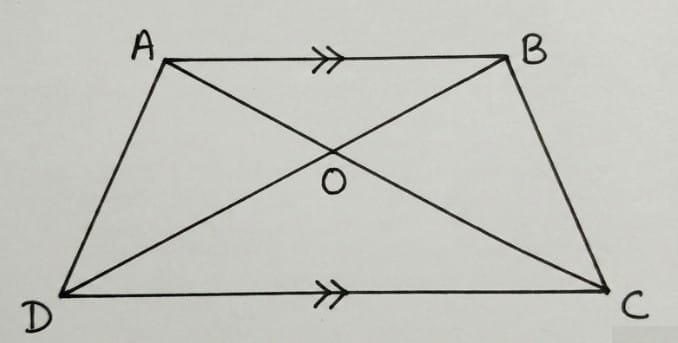
(Choice A): In a trapezium ABCD, AB ∥ DC and diagonals intersect at O. Prove that AO/BO = CO/DO.
Ans:
In trapezium ABCD, AB ∥ DC and diagonals AC and BD intersect at O.
Consider triangles △AOB and △COD.
∠AOB = ∠COD (vertically opposite angles).
∠ABO = ∠CDO (alternate interior angles as AB ∥ DC).
Therefore, △AOB ∼ △COD by AA similarity criterion.
Hence, corresponding sides are proportional.
So, AO/CO = BO/DO.
Rearranging, AO/BO = CO/DO.
OR
Q30.
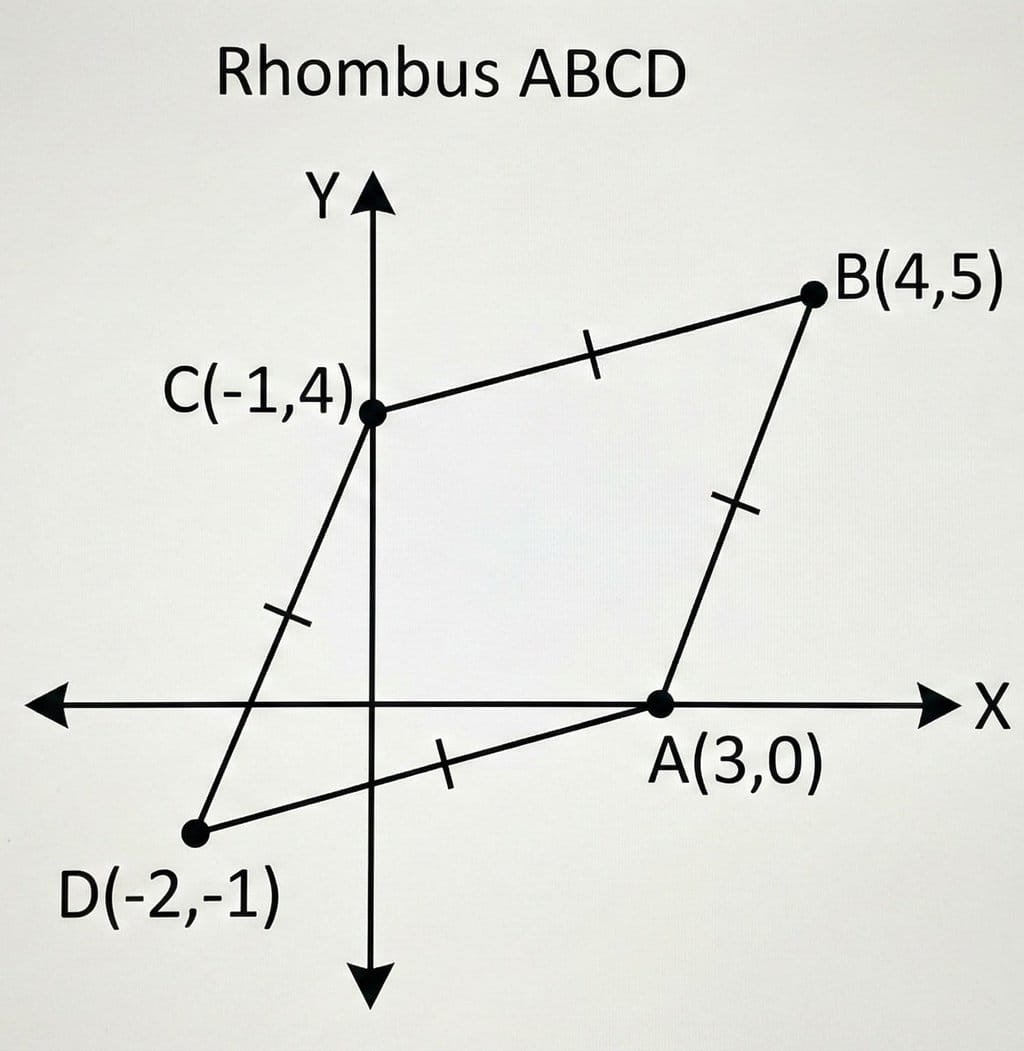
(Choice B): Find the area of a rhombus whose vertices are (3,0), (4,5), (-1,4) and (-2,-1).
Ans:
Let the vertices be A(3,0), B(4,5), C(-1,4) and D(-2,-1).
Length of diagonal AC:
= √[(-1 - 3)² + (4 - 0)²]
= √(16 + 16) = 4√2.
Length of diagonal BD:
= √[(-2 - 4)² + (-1 - 5)²]
= √(36 + 36) = 6√2.
Area of rhombus = 1/2 × d₁ × d₂.
= 1/2 × 4√2 × 6√2
= 1/2 × 48 = 24 square units.
Q31. Find two numbers whose sum is 27 and whose product is 182.
Ans:
Let the two numbers be x and (27 - x).
According to the given condition:
x(27 - x) = 182.
x² - 27x + 182 = 0.
Splitting the middle term:
x² - 13x - 14x + 182 = 0.
(x - 13)(x - 14) = 0.
Thus, x = 13 or x = 14.
Hence, the required numbers are 13 and 14.
SECTION - D (5 Marks Each)
Q32.
(Choice A): Prove Theorem 6.4 (SSS Similarity Criterion): If the corresponding sides of two triangles are proportional, then their corresponding angles are equal and the triangles are similar.
Ans:
Given two triangles △ABC and △DEF such that:AB/DE = BC/EF = AC/DF.
On side DE, take a point P such that DP = AB.
On side DF, take a point Q such that DQ = AC.
Join PQ.
Now, DP/DE = DQ/DF.
By the Converse of the Basic Proportionality Theorem, PQ ∥ EF.
Therefore, ∠DPQ = ∠DEF and ∠DQP = ∠DFE (corresponding angles).
Hence, △DPQ ∼ △DEF by AA similarity criterion.
Also, DP = AB and DQ = AC, and PQ = BC.
Therefore, △ABC ≅ △DPQ by SSS congruence criterion.
Since △DPQ ∼ △DEF and △ABC ≅ △DPQ,
we get △ABC ∼ △DEF.
Hence, the SSS similarity criterion is proved.
Q33.
(Choice A): A two-digit number is four times the sum of its digits. If 18 is added to the number, the digits are reversed. Find the number.
Ans:
Let the tens digit be x and the units digit be y.
Then the number is (10x + y).
According to the given condition:
10x + y = 4(x + y).
10x + y = 4x + 4y.
6x = 3y.
2x = y ... (1)
After adding 18, the digits are reversed:
10x + y + 18 = 10y + x.
9y - 9x = 18.
y - x = 2 ... (2)
Substituting y = 2x from (1) into (2):
2x - x = 2.
x = 2.
Then y = 2x = 4.
Hence, the required number is 24.
OR
Q33.
(Choice B): A train travels 480 km at a uniform speed. If the speed were 8 km/h less, it would take 3 hours more to cover the same distance. Find the speed of the train.
Ans:
Let the speed of the train be x km/h.
Then time taken = 480/x hours.
If the speed were (x - 8) km/h,
then time taken = 480/(x - 8) hours.
According to the given condition:
480/(x - 8) - 480/x = 3.
Simplifying:
(480x - 480(x - 8)) / x(x - 8) = 3.
3840 = 3x(x - 8).
x² - 8x - 1280 = 0.
(x - 40)(x + 32) = 0.
Since speed cannot be negative, x = 40.
Hence, the speed of the train is 40 km/h.
Q34. A manufacturer of television sets produced 600 sets in the 3rd year and 700 sets in the 7th year. Find the production in the 1st year, 10th year and the total production in the first 7 years.
Ans:
Let the production in the first year be a and the annual increase be d.
Production in the 3rd year:
a + 2d = 600 ... (1)
Production in the 7th year:
a + 6d = 700 ... (2)
Subtracting (1) from (2):
4d = 100.
d = 25.
Substituting d = 25 in (1):
a + 50 = 600.
a = 550.
Production in the 1st year = 550 sets.
Production in the 10th year:
a₁₀ = a + 9d = 550 + 225 = 775 sets.
Total production in 7 years:
S₇ = 7/2 [2a + 6d].
S₇ = 7/2 [1100 + 150].
S₇ = 4375 sets.
Q35. A pole is erected on the boundary of a circular park of diameter 13 m such that the difference of its distances from two opposite gates A and B is 7 m. Find the distances from the two gates.
Ans:
Let the distance of the pole from gate A be x metres.
Then the distance from gate B is (x + 7) metres.
Since AB is the diameter of the circular park,
∠APB = 90°.
Using Pythagoras theorem:
x² + (x + 7)² = 13².
x² + x² + 14x + 49 = 169.
2x² + 14x - 120 = 0.
x² + 7x - 60 = 0.
(x + 12)(x - 5) = 0.
x = 5 (distance cannot be negative).
Hence, the distances of the pole from the two gates are 5 m and 12 m.
SECTION - E (4 Marks Each)
Q36. Case Study: Revenue from a Cricket Match
A total of 50,000 people attended a cricket match. The cost of an adult ticket was ₹1000 and that of a child ticket was ₹200. The total revenue collected was ₹4,20,00,000.
(i) Form the equations. (1 Mark)
(ii) Find the number of children. (1 Mark)
(iii) Find the number of adults. (2 Marks)
Ans:
Let the number of adults be x and the number of children be y.
Total number of people:
x + y = 50,000 ... (1)
Total revenue collected:
1000x + 200y = 4,20,00,000
Dividing by 200:
5x + y = 2,10,000 ... (2)
Subtracting equation (1) from equation (2):
4x = 1,60,000
x = 40,000
Substituting x = 40,000 in equation (1):
y = 10,000
Hence, the number of children is 10,000 and the number of adults is 40,000.
Q37. Case Study: Ladder Rungs
The lengths of the rungs of a ladder decrease uniformly from 45 cm to 25 cm. The distance between the top and bottom rungs is 250 cm and the rungs are placed 25 cm apart.
(i) Find the total number of rungs. (1 Mark)
(ii) Do the lengths of the rungs form an AP? Give reason. (1 Mark)
(iii) Find the total length of wood required for all the rungs. (2 Marks)
Ans:
Distance between the top and bottom rungs = 250 cm.
Distance between consecutive rungs = 25 cm.
Number of gaps = 250 ÷ 25 = 10.
Total number of rungs = 10 + 1 = 11.
The rung lengths are 45 cm, 43 cm, 41 cm, ... , 25 cm.
The difference between consecutive lengths is constant.
Hence, the lengths of the rungs form an AP.
First term a = 45 cm and last term l = 25 cm.
Number of terms n = 11.
Total length of wood required:
S₁₁ = n/2 (a + l)
S₁₁ = 11/2 (45 + 25)
S₁₁ = 11/2 × 70 = 385 cm.
Q38. Case Study: Office Carpooling
Three employees live at points A(4,5), B(6,2) and C(2,6). The office is located at O(0,0).
(i) Find the distance between B and C. (1 Mark)
(ii) Find the coordinates of the midpoint of BC. (1 Mark)
(iii) Find who lives farthest from the office. (2 Marks)
Ans:
Distance between B(6,2) and C(2,6):
= √[(2 - 6)² + (6 - 2)²]
= √(16 + 16)
= √32 = 4√2 units.
Midpoint of BC:
= [(6 + 2)/2 , (2 + 6)/2]
= (4, 4).
Distance of A from office:
OA = √(4² + 5²) = √41.
Distance of B from office:
OB = √(6² + 2²) = √40.
Distance of C from office:
OC = √(2² + 6²) = √40.
Since √41 is greatest,
Amar, who lives at point A, is farthest from the office.
FAQs on Half Yearly Exam Class 10 Set 2 (Solutions)
| 1. What is the structure of the Half Yearly Exam for Class 10? |  |
| 2. How can students prepare effectively for the Half Yearly Exam? | |
| 3. What types of questions can be expected in Section D of the exam? | |
| 4. Are there any specific strategies to tackle the 3-mark questions in Section C? | |
| 5. What should students do if they encounter difficult questions during the exam? | |




