Final Exam Class 6 Mathematics Set 1

Maximum Marks: 80
Time: 3 Hours
General Instructions:
(i) All questions are compulsory.
(ii) Marks for each question are indicated against it.
(iii) Section A consists of 12 MCQs carrying 1 mark each.
(iv) Section B consists of 12 questions carrying 2 marks each.
(v) Section C consists of 8 questions carrying 3 marks each.
(vi) Section D consists of 5 questions carrying 4 marks each.
(vii) Use of calculators is not allowed.
Syllabus: The Final Examination is based on Chapters 6 to 10, namely Perimeter and Area, Fractions, Playing with Constructions, Symmetry, and The Other Side of Zero (Integers).
SECTION - A (12 × 1 = 12 Marks)
Q1. What is the perimeter of a square photo frame if one of its sides is 1 m?
a) 1 m
b) 2 m
c) 4 m
d) 8 m
Q2. Which fraction is the smallest?
a) 1/2
b) 1/5
c) 1/9
d) 1/100
Q3. The point about which an object is rotated in rotational symmetry is called:
a) Axis
b) Centre of rotation
c) Radius
d) Midpoint
Q4. On Floor +2 of Bela's building, if you press the "-" button 3 times, you reach:
a) Floor +5
b) Floor 0
c) Floor -1
d) Floor -5
Q5. A fraction whose numerator and denominator have no common factor except 1 is in:
a) Highest terms
b) Mixed form
c) Lowest terms
d) Equivalent form
Q6. How many lines of symmetry does a regular hexagon have?
a) 3
b) 4
c) 6
d) 1
Q7. What is the distance between the centre of a circle and any point on its rim called?
a) Diameter
b) Radius
c) Chord
d) Arc
Q8. Which integer is greater than -3?
a) -4
b) -5
c) -2
d) -10
Q9. What is the area of a square flower bed of side 4 m?
a) 8 sq m
b) 16 sq m
c) 12 sq m
d) 20 sq m
Q10. The additive inverse of +9 is:
a) 0
b) 9
c) -9
d) 1
Q11. In the fraction 5/6, the number 6 is the:
a) Numerator
b) Whole part
c) Denominator
d) Factor
Q12. Every diameter of a circle is also a:
a) Centre of rotation
b) Line of symmetry
c) Fractional unit
d) Radius
SECTION - B (12 × 2 = 24 Marks)
Q13. Find the missing term: Perimeter of a rectangle = 14 cm; breadth = 2 cm; length = ?
Q14. Express 16/20 in its simplest form.
Q15. Find the sum of (+1) and (+4) using the "Building of Fun" logic.
Q16. Draw a line of length 4 cm from a point P in three different directions.
Q17. Define a regular polygon and give one example.
Q18. Write the mixed fraction 2 3/11 as an improper fraction.
Q19. Identify the line of symmetry for a vertical fold of a square paper.
Q20. Evaluate: (-7) - (-5).
Q21. How many fractional units of 1/6 make 1/2?
Q22. Compare -10 and -12 using < or >.
Q23. In the "Wavy Wave" construction, the central line AB is 8 cm long. What radius should be taken to draw a half-circle on this line?
Q24. Find the sum of 2/7 + 5/7 + 6/7.
SECTION - C (8 × 3 = 24 Marks)
Q25. What is the cost of fencing a rectangular park of length 150 m and breadth 120 m at the rate of Rs. 40 per metre?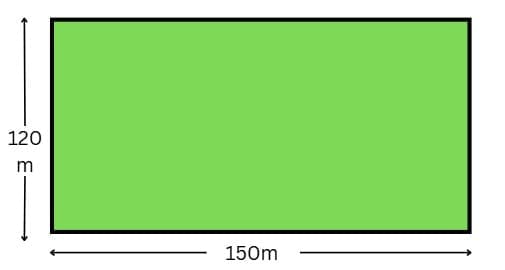
Q26. Add the fractions 3/4 and 1/3 using Brahmagupta's method.
Q27. Recreate the "House" figure with a border length of 5 cm. Briefly explain the steps.
Q28. A bank account starts with Rs. 0. It has credits of Rs. 30, 40 and 50, and debits of Rs. 40, 50 and 60. Find the final balance.
Q29. Find the area of a floor 5 m long and 4 m wide that is not covered by a square carpet of side 3 m.
Q30. Compare 4/9 and 3/7 and justify your answer.
Q31. Determine the angles of rotational symmetry for a figure with 3 radial arms separated by 120°.
Q32. Find the length of the third side of a triangle with perimeter 55 cm and two sides measuring 20 cm and 14 cm.
SECTION - D (5 × 4 = 20 Marks)
Q33. Using the "Building of Fun" plan, find the missing measurements for Charan's house:
(i) Find the area of the hall if its dimensions are 20 ft × 12 ft. (1 Mark)
(ii) Find the dimensions of the small bedroom if its area is 180 sq ft and one side is 15 ft. (1 Mark)
(iii) Find the total area of the house if its dimensions are 35 ft × 30 ft. (2 Marks)
Q34. Evaluate the following integer expressions using an unmarked number line:
(a) -125 + (-30)
(b) +105 - (-55)
Q35. A string is 36 cm long. Find the length of each side if the string is used to form:
(a) A square
(b) An equilateral triangle
(c) A regular hexagon
Q36. Explain Brahmagupta's method for adding fractions with different denominators using 2/3 and 1/5.
Q37. Identify the order of rotational symmetry and the number of lines of symmetry for a square.
You can find solutions to this Final Exam here.
FAQs on Final Exam Class 6 Mathematics Set 1
| 1. What is the structure of the final exam for Class 6 Mathematics? |  |
| 2. How are marks distributed across the different sections of the exam? | |
| 3. What types of questions can students expect in each section of the exam? | |
| 4. How should students prepare for the final exam based on its structure? | |
| 5. What is the importance of understanding the exam pattern for Class 6 Mathematics? | |