Chapter Notes: Swami Sahajanand Saraswati


Swami Sahajanand Saraswati was a prominent peasant leader, freedom fighter, and socialist thinker in colonial India. He founded the All India Kisan Sabha in 1936 and dedicated his life to fighting against zamindari exploitation and landlordism. His political thought combined anti-imperialism with agrarian socialism, making him a key figure in India's peasant movement during the 1920s-1940s.
1. Life and Background
1.1 Early Life and Transformation
- Birth Name: Nauranglal Sharma, born on 22 February 1889 in Ghazipur district, United Provinces (now Uttar Pradesh)
- Caste Background: Born in a Jijhautia Brahmin family; personally experienced caste discrimination and economic hardships
- Religious Conversion: Took Sanyasa (renunciation) in 1907 and adopted the name Swami Sahajanand Saraswati
- Education: Studied Sanskrit, Vedanta, and Hindu scriptures; gained deep knowledge of religious texts
- Shift to Politics: Moved from purely religious work to peasant politics in the 1920s after witnessing agrarian distress
1.2 Entry into Peasant Movement
- Bihar Peasant Movement (1920s): Started organizing peasants in Bihar against zamindari exploitation
- Congress Association: Initially worked within the Indian National Congress framework during Non-Cooperation Movement
- Independent Peasant Organization: Realized Congress did not adequately address peasant issues; focused on creating separate peasant organizations
- Key Inspiration: Deeply influenced by the plight of tenants suffering under the Zamindari System in Bihar and United Provinces
2. Founding of All India Kisan Sabha
2.1 Formation and Leadership
- Year of Formation: 1936 at Lucknow session
- Founding President: Swami Sahajanand Saraswati served as the first President
- Objective: United platform for peasants across India to fight against landlordism, high rent, and oppressive agrarian conditions
- Support Base: Drew members from various castes and communities, creating a broad peasant coalition
- Organizational Structure: Established state-level and district-level Kisan Sabhas across provinces
2.2 Key Demands and Programs
- Abolition of Zamindari: Central demand was to end the zamindari system without compensation to zamindars
- Land to the Tiller: Advocated for redistribution of land to actual cultivators
- Rent Reduction: Demanded reduction in exorbitant land revenue and rent charged by landlords
- Debt Relief: Called for cancellation of peasant debts and protection from moneylenders
- Security of Tenure: Demanded legal security for tenants against arbitrary eviction
- Abolition of Begar: Forced labor without payment imposed by landlords must be abolished
3. Political Ideology and Thought
3.1 Agrarian Socialism
- Class Analysis: Applied Marxist class analysis to Indian agrarian society; identified zamindars and landlords as exploiting class
- Peasant-Worker Alliance: Advocated unity between peasants and industrial workers for anti-capitalist struggle
- Socialist Vision: Envisioned a socialist society where land ownership would be collective or vested in the state
- Anti-Feudalism: Considered feudal landlordism the primary obstacle to peasant liberation and agricultural development
- Economic Equality: Emphasized equal distribution of agricultural produce and elimination of parasitic intermediaries
3.2 Anti-Imperialism and Nationalism
- Colonial Exploitation Theory: Argued that British imperialism sustained zamindari system to extract revenue and maintain social control
- Complete Independence: Supported Purna Swaraj (complete independence) and opposed dominion status proposals
- Link Between Imperialism and Landlordism: Believed true freedom required both political independence and economic liberation of peasants
- Critique of Congress: Criticized Congress for representing upper-class and landlord interests; demanded it take clear stand on peasant issues
3.3 Secularism and Social Reform
- Opposition to Communalism: Strongly opposed communal politics; worked for Hindu-Muslim unity among peasants
- Caste Critique: Though a Brahmin sanyasi, criticized caste-based oppression and hierarchies
- Religious Reform: Interpreted Hindu scriptures to support social equality and justice
- Peasant Unity Across Communities: Built Kisan Sabha as a platform uniting peasants irrespective of religion or caste
4. Major Movements and Struggles Led
4.1 Bihar Peasant Movements
- Saran Satyagraha (1930s): Led peasant resistance in Saran district against unjust enhancement of rent by zamindars
- Bakasht Land Movement: Organized peasants to reclaim Bakasht lands (land taken back by landlords from tenants for self-cultivation)
- Anti-Rent Campaign: Mobilized peasants to withhold rent payments to pressure for rent reduction
- Mass Mobilization: Conducted large peasant rallies and demonstrations across Bihar countryside
4.2 All-India Peasant Campaigns
- Kisan Manifesto (1936): Drafted comprehensive charter of peasant demands presented to Congress and government
- Linkage with Quit India (1942): Kisan Sabha participated in anti-British agitations, though with focus on agrarian demands
- Post-War Agitations (1945-46): Intensified peasant movements as World War II ended and food shortages worsened
- Coordination with Provincial Governments: Negotiated with Congress ministries in provinces (1937-39) for pro-peasant legislation
5. Relationship with Indian National Congress
5.1 Initial Cooperation Phase
- Congress Membership: Joined Congress during Non-Cooperation Movement; believed in Congress-led national struggle
- Overlapping Goals: Saw peasant liberation and national independence as interconnected objectives
- Support to Civil Disobedience: Mobilized peasants for Congress-led movements in 1920s and early 1930s
5.2 Growing Conflict and Critique
- Class Composition Critique: Criticized Congress for being dominated by landlords, industrialists, and upper-middle classes
- Congress Ministries (1937-39): Expressed disappointment that Congress provincial governments did not implement radical land reforms
- Faizpur Session Controversy (1936): Congress refused to endorse Kisan Sabha's radical demands for zamindari abolition without compensation
- Demand for Autonomy: Insisted that Kisan Sabha must maintain organizational independence from Congress
- Left-Wing Alliance: Increasingly aligned with Communist and Socialist members within and outside Congress
5.3 Final Break
- Post-Independence Disillusionment: Criticized Congress after 1947 for slow pace of land reforms and protecting landlord interests
- Advocacy for Militant Action: Supported more aggressive peasant struggles, which Congress leadership opposed
- Distance from Mainstream Politics: Moved away from Congress-dominated political mainstream after independence
6. Major Writings and Intellectual Contributions
6.1 Key Works
- "Mera Jeevan Sangharsh" (My Life Struggle): Autobiography detailing his transformation from sanyasi to peasant leader
- "Kisan Sabha Ke Sansmaran": Account of Kisan Sabha activities and peasant movement history
- Numerous Articles and Pamphlets: Wrote extensively in Hindi on agrarian issues, socialism, and anti-imperialism
- Religious-Political Synthesis: Tried to reconcile Hindu spiritualism with socialist politics in his writings
6.2 Theoretical Contributions
- Agrarian Class Structure: Provided detailed analysis of landlord-tenant relations in North Indian plains
- Colonial Agrarian Policy Critique: Exposed how British revenue settlements perpetuated feudal exploitation
- Peasant Consciousness: Emphasized need to develop class consciousness among peasants for effective political action
- Anti-Colonial Economy: Argued that colonial drain of wealth primarily affected peasants through revenue extraction
7. Legacy and Historical Significance
7.1 Impact on Peasant Movement
- Organizational Foundation: All India Kisan Sabha became the largest peasant organization in pre-independence India
- Political Mobilization: Brought millions of peasants into active political participation
- Influence on Land Reforms: Kisan Sabha's sustained campaign created political pressure for post-independence zamindari abolition
- Ideological Tradition: Established tradition of left-wing agrarian politics in India
7.2 Contribution to Indian Political Thought
- Class-Based Politics: Pioneered class-based political mobilization in agrarian context
- Synthesis of Nationalism and Socialism: Showed how anti-imperialism could be combined with socialist transformation
- Critique of Elite Nationalism: Challenged Congress's claim to represent all classes; exposed class interests within nationalist movement
- Secularism in Practice: Demonstrated secular politics through cross-community peasant unity
- Democratic Mass Politics: Promoted participatory democracy through grassroots peasant organizations
7.3 Limitations and Criticisms
- Limited Success in Land Reforms: Despite struggles, immediate tangible gains for peasants were limited during colonial period
- Regional Concentration: Movement remained strongest in Bihar and United Provinces; weaker in other regions
- Communist Influence Debate: Critics argued Kisan Sabha increasingly came under Communist Party control, diluting its independence
- Post-Independence Marginalization: Kisan Sabha's political influence declined after independence as Congress consolidated power
8. Key Concepts in Swami Sahajanand's Thought
8.1 Zamindari System
- Definition: Intermediary system where zamindars (landlords) collected revenue from cultivators and paid fixed amount to British government
- Exploitation Mechanism: Zamindars charged tenants much higher rent than what they paid as revenue, extracting surplus
- Legal Protection: British laws gave zamindars ownership rights and power to evict tenants
- Central Target: Abolition of this system was the primary goal of Swami Sahajanand's movement
8.2 Land to the Tiller
- Core Principle: Only the actual cultivator should own and control agricultural land
- Elimination of Intermediaries: All intermediary rent-collecting classes between state and cultivator must be removed
- Redistributive Justice: Land should be redistributed from large landlords to landless and land-poor peasants
- State Role: State should facilitate this redistribution without providing compensation to dispossessed landlords
8.3 Peasant-Worker Unity
- Class Alliance: Agricultural workers and industrial workers share common interest against exploiting classes
- Anti-Capitalist Struggle: Both groups must unite to challenge capitalist and feudal exploitation
- Political Strategy: Joint struggles would strengthen overall progressive movement
- Practical Application: Kisan Sabha coordinated with trade unions on several occasions
9. Comparison: Swami Sahajanand vs Mahatma Gandhi on Peasant Issues
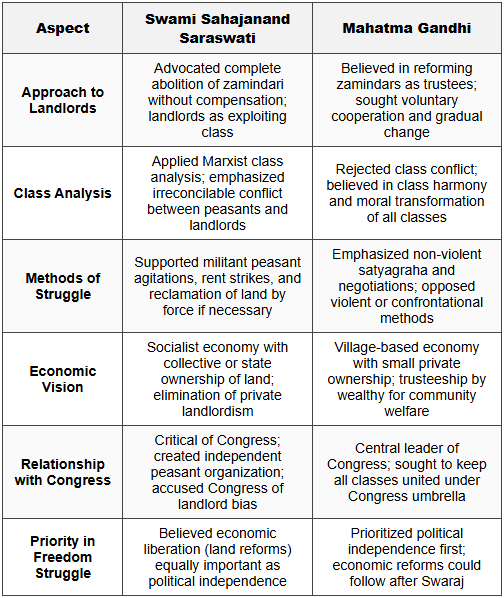
9.1 Common Student Confusion
- Trap Alert: Students often assume all peasant leaders worked within Gandhi's framework. Swami Sahajanand explicitly rejected Gandhian trusteeship and class harmony theories.
- Trap Alert: Do not confuse Swami Sahajanand's religious identity (sanyasi) with conservative politics. He used his religious status to mobilize peasants but advocated radical socialist transformation.
- Trap Alert: All India Kisan Sabha was founded in 1936, not during the 1920s peasant movements. Earlier movements were localized; 1936 marked all-India organization.
10. Relevance to Indian Political Thought
10.1 Contribution to Socialist Tradition
- Indigenous Socialism: Developed socialist thought rooted in Indian agrarian reality rather than mere European transplant
- Agrarian Focus: Shifted socialist discourse from industrial workers to peasants, relevant for predominantly agricultural India
- Practical Organization: Showed how socialist ideas could be translated into mass peasant organization
10.2 Critique of Liberal Nationalism
- Class Critique of Nationalism: Exposed how nationalist movement could serve elite interests while marginalizing peasants
- Economic Content of Freedom: Argued that political freedom without economic transformation is incomplete
- Democratic Participation: Insisted that peasants must have independent political voice, not just follow elite leadership
10.3 Influence on Post-Independence Politics
- Land Reform Legislation: Zamindari Abolition Acts passed by states in 1950s reflected decades of Kisan Sabha agitation
- Left Peasant Politics: Created enduring tradition of left-wing agrarian movements in India
- Agrarian Question in Polity: Established that agrarian issues are central to Indian politics and development
- Organizational Model: Kisan Sabha provided organizational template for subsequent peasant movements
Swami Sahajanand Saraswati occupies a unique position in Indian political thought as a religious figure who became a radical socialist peasant leader. His synthesis of anti-imperialism, agrarian socialism, and mass mobilization created a distinct ideological tradition that challenged both colonial rule and feudal landlordism. His critique of Congress's elite nationalism and emphasis on independent peasant organization highlighted class contradictions within the freedom struggle. The All India Kisan Sabha under his leadership became the most significant peasant organization in pre-independence India, leaving a lasting impact on agrarian politics and land reform debates. His thought remains relevant for understanding rural distress, agrarian movements, and the relationship between economic and political liberation in Indian context.