Adjectives and Adverbs


Adjectives and adverbs are words that add detail and precision to your writing. They help you describe how, when, where, and to what extent something happens. In standardized tests, you'll face questions that ask you to choose the correct form of a modifier or identify errors in their usage. Understanding the difference between these two and knowing when to use each is crucial for scoring well.
1. What Are Adjectives?
An adjective is a word that modifies (describes or gives more information about) a noun or pronoun. Adjectives answer questions like: Which one? What kind? How many?
1.1 How Adjectives Work
- Position: Adjectives usually come before the noun they modify OR after a linking verb (is, am, are, was, were, become, seem, appear, feel, look, smell, taste, sound).
- Example 1: The blue car (adjective before noun)
- Example 2: The car is blue (adjective after linking verb)
- Example 3: She seems confident about the test (adjective after linking verb "seems")
1.2 Common Test Pattern
Questions often test whether you can choose an adjective or an adverb based on the verb type. Look for linking verbs-they require adjectives, not adverbs.
- CORRECT: The soup tastes delicious (adjective after linking verb "tastes")
- WRONG: The soup tastes deliciously (adverb incorrectly used)
- CORRECT: She felt bad about missing the meeting (adjective after linking verb "felt")
- WRONG: She felt badly (common error; "badly" means "in a bad manner")
2. What Are Adverbs?
An adverb is a word that modifies (describes) a verb, an adjective, or another adverb. Adverbs answer questions like: How? When? Where? To what extent?
2.1 How Adverbs Work
- Modifying Verbs: Most adverbs modify verbs and tell you how an action is performed.
- Example 1: She ran quickly to catch the bus (adverb modifies verb "ran")
- Example 2: He speaks clearly during presentations (adverb modifies verb "speaks")
- Modifying Adjectives: Adverbs can also modify adjectives to show intensity or degree.
- Example 3: The test was extremely difficult (adverb modifies adjective "difficult")
- Modifying Other Adverbs: Adverbs can modify other adverbs.
- Example 4: She answered very quickly (adverb "very" modifies adverb "quickly")
2.2 Forming Adverbs
Most adverbs are formed by adding -ly to an adjective. However, not all words ending in -ly are adverbs, and not all adverbs end in -ly.
- Pattern: Adjective + -ly = Adverb
- Example: quick → quickly; careful → carefully; serious → seriously
- Irregular Adverbs: Some adverbs don't end in -ly: fast, hard, well, late, early, far
- Example 1: He works hard every day (NOT "hardly"-that means "barely")
- Example 2: She arrived late to class
3. Adjective vs. Adverb: The Core Distinction
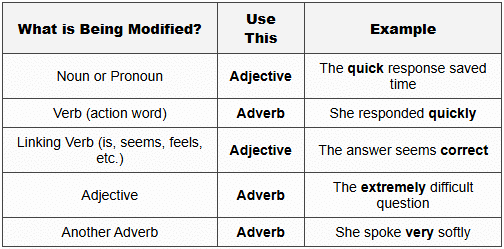
The most tested concept is choosing between an adjective and an adverb based on what word is being modified.
If modifying a noun/pronoun → use adjective
If modifying a verb/adjective/adverb → use adverb
If verb is linking → use adjective
3.1 Decision Framework
3.2 Common Test Traps
- Trap 1-Good vs. Well: "Good" is an adjective; "well" is usually an adverb (but can be an adjective when referring to health).
- CORRECT: She is a good singer (adjective modifying noun "singer")
- CORRECT: She sings well (adverb modifying verb "sings")
- CORRECT: I don't feel well today (adjective referring to health after linking verb)
- Trap 2-Bad vs. Badly: "Bad" is an adjective; "badly" is an adverb.
- CORRECT: The milk smells bad (adjective after linking verb "smells")
- WRONG: The milk smells badly (this would mean the milk's ability to smell is poor)
- Trap 3-Real vs. Really: "Real" is an adjective; "really" is an adverb.
- CORRECT: This is a real diamond (adjective modifying noun)
- CORRECT: She is really talented (adverb modifying adjective "talented")
- WRONG: She sings real good (should be "really well")
4. Linking Verbs: The Critical Concept
Understanding linking verbs is essential because they require adjectives, not adverbs. A linking verb connects the subject to a word that describes it.
4.1 Common Linking Verbs
- Forms of "be": is, am, are, was, were, been, being
- Sense verbs: look, smell, taste, sound, feel
- State verbs: seem, appear, become, remain, grow, turn, prove, stay
4.2 The Test: Action vs. Linking
Some verbs can be action verbs OR linking verbs depending on context. Use this simple test: Can you replace the verb with "is/are/was/were"? If yes, it's a linking verb and needs an adjective.
- Example 1 (Linking): The flowers smell sweet → The flowers are sweet ✓ (linking verb, use adjective)
- Example 2 (Action): The dog smells carefully → The dog is carefully ✗ (action verb, use adverb)
- Example 3 (Linking): The cake tastes delicious → The cake is delicious ✓ (linking verb, use adjective)
- Example 4 (Action): She tasted the soup cautiously → She is the soup cautiously ✗ (action verb, use adverb)
5. Comparative and Superlative Forms
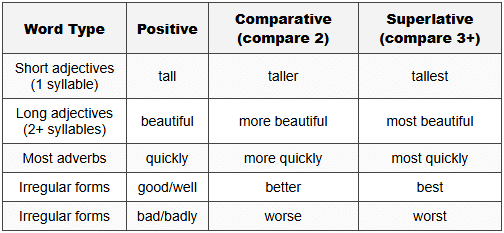
Both adjectives and adverbs have forms to show comparison. These are frequently tested.
5.1 Regular Patterns for Adjectives and Adverbs
5.2 Usage Rules
- Comparative: Use when comparing two things. Add -er or use more.
- Example 1: She is taller than her brother (comparing 2 people)
- Example 2: This test is more difficult than the last one
- Superlative: Use when comparing three or more things. Add -est or use most.
- Example 3: She is the tallest student in the class (comparing 3+ people)
- Example 4: This is the most interesting book I've read this year
5.3 Common Errors
- Double Comparatives/Superlatives: Never use both -er/-est AND more/most together.
- WRONG: more better, most fastest, more harder
- CORRECT: better, fastest, harder
- Using Superlative for Two: When comparing only two items, use comparative, not superlative.
- WRONG: Between the two sisters, she is the smartest
- CORRECT: Between the two sisters, she is the smarter
- Incomplete Comparisons: Make sure comparisons are logical and complete.
- WRONG: Her score was higher (than what? incomplete)
- CORRECT: Her score was higher than mine
6. Placement and Position of Modifiers
Where you place an adjective or adverb in a sentence affects meaning and clarity. Misplaced modifiers create confusion.
6.1 General Placement Rules
- Adjectives: Usually placed directly before the noun or after a linking verb.
- Example: The enthusiastic student / The student is enthusiastic
- Adverbs of Manner (how): Usually placed after the verb or at the end of the sentence.
- Example: She spoke confidently / She confidently spoke (both acceptable)
- Adverbs of Frequency (always, often, never): Usually placed before the main verb but after the verb "be".
- Example 1: She always studies before exams
- Example 2: She is always prepared
- Adverbs of Time and Place: Usually placed at the end of the sentence or at the beginning for emphasis.
- Example: We will meet tomorrow / Tomorrow, we will meet
6.2 Avoiding Misplaced Modifiers
Place modifiers as close as possible to the words they modify to avoid confusion.
- CONFUSING: She almost read the entire book (suggests she didn't actually finish the book)
- CLEAR: She read almost the entire book (she read most of it)
- CONFUSING: He only eats vegetables on Mondays (suggests Monday is the only day)
- CLEAR: He eats only vegetables on Mondays (vegetables are the only food)
7. Special Cases and Tricky Words
7.1 Words That Function as Both Adjectives and Adverbs
Some words have the same form whether used as adjectives or adverbs. Context determines their function.
- Fast: She is a fast runner (adjective) / She runs fast (adverb)
- Hard: This is a hard test (adjective) / He works hard (adverb)
- Late: The late train (adjective) / He arrived late (adverb)
- Early: The early morning (adjective) / Wake up early (adverb)
- Daily: My daily routine (adjective) / I exercise daily (adverb)
7.2 "Hardly" Does NOT Mean "In a Hard Manner"
This is a major trap. "Hardly" is an adverb that means "barely" or "scarcely", not the adverb form of "hard".
- CORRECT: He works hard (meaning: he puts in effort)
- CORRECT: He hardly works (meaning: he barely works, he doesn't work much)
- WRONG: He works hardly (doesn't make sense)
7.3 "Near" vs. "Nearly"
- Near: Can be an adjective, adverb, or preposition meaning "close".
- Example: She lives near the school (preposition)
- Nearly: Adverb meaning "almost".
- Example: She nearly finished the assignment (almost finished)
7.4 "Less" vs. "Fewer"
Though these modify nouns (so they function like adjectives), the distinction is tested frequently.
- Fewer: Use with countable nouns (things you can count).
- Example: There are fewer students in class today
- Less: Use with uncountable nouns (things you cannot count individually).
- Example: There is less water in the bottle
8. Test-Taking Strategy: Quick Decision Tree
When you encounter an adjective/adverb question on test day, follow this logic:
8.1 Step-by-Step Approach
- Identify what word is being modified: Is it a noun/pronoun, verb, adjective, or adverb?
- Check for linking verbs: If the verb is a linking verb (be, seem, feel, taste, etc.), use an adjective.
- Apply the replacement test: Can you replace the verb with "is/are"? If yes, linking verb = use adjective.
- Use adjective for nouns/pronouns: If modifying a noun or pronoun, always use an adjective.
- Use adverb for verbs, adjectives, other adverbs: If modifying anything else, use an adverb.
- Check comparisons: Two items = comparative (-er/more); three or more = superlative (-est/most).
- Avoid double forms: Never use "more better" or "most fastest".
8.2 Common Question Patterns
- Pattern 1: Choose between adjective/adverb forms (quick/quickly, good/well, bad/badly)
- Pattern 2: Identify errors in comparative/superlative usage
- Pattern 3: Correct misplaced modifiers or ambiguous placement
- Pattern 4: Recognize incorrect usage after linking verbs
9. Practice Examples with Explanations
9.1 Example Set 1: Adjective or Adverb?
- Sentence: She felt (nervous/nervously) before the presentation.
- Answer: nervous
- Reason: "Felt" is a linking verb here (describes her state). Use adjective.
- Sentence: The team performed (good/well) in the tournament.
- Answer: well
- Reason: "Performed" is an action verb. Use adverb "well" to modify it.
- Sentence: This solution seems (logical/logically) to me.
- Answer: logical
- Reason: "Seems" is a linking verb. Use adjective "logical".
9.2 Example Set 2: Comparatives and Superlatives
- Sentence: Of the three options, this is the (better/best) choice.
- Answer: best
- Reason: Comparing three items requires superlative form.
- Sentence: Her presentation was (more clearer/clearer) than his.
- Answer: clearer
- Reason: Never use double comparative. "Clearer" alone is correct.
- Sentence: Between you and me, who is (taller/tallest)?
- Answer: taller
- Reason: Comparing only two people requires comparative form.
9.3 Example Set 3: Special Cases
- Sentence: He works very (hard/hardly) to support his family.
- Answer: hard
- Reason: "Hard" means with effort. "Hardly" means barely.
- Sentence: There are (fewer/less) applicants this year.
- Answer: fewer
- Reason: "Applicants" are countable. Use "fewer".
- Sentence: She (almost/nearly) completed the entire project.
- Answer: nearly OR almost
- Reason: Both mean "close to finishing" and are acceptable here. Position matters more.
Practice identifying what word is being modified, and you'll confidently handle these questions. Remember: linking verbs take adjectives, action verbs take adverbs, and never double up on comparative/superlative forms. Keep these rules in mind, and you'll spot errors quickly and choose the right answers every time.
FAQs on Adjectives and Adverbs
| 1. What are adjectives and how do they function in a sentence? |  |
| 2. What are adverbs and what role do they play in a sentence? | |
| 3. What is the core distinction between adjectives and adverbs? | |
| 4. How do linking verbs relate to adjectives and adverbs? | |
| 5. What are comparative and superlative forms of adjectives and adverbs? | |