Chapter Notes: Physical and Physiological Aspects of Physical Education and Sports

LEARNING OBJECTIVES
After studying this chapter, students will be able to understand:
- Meaning of Growth and Development
- Difference between Growth and Development
- Factors Affecting Growth and Development
- Physical and Physiological Changes During Developmental Stages
- Physiological Aspects of Activities
- Warm-up, Conditioning and Cool-down
- Effects of Exercise on Various Body Systems
Growth and Development
Growth and development are two commonly used terms in physical education and psychology. Although they are related, they are not identical. Both are essential for understanding how an individual changes from birth to adulthood and throughout life.
Growth generally refers to increase in size, whereas development refers to overall improvement and transformation of abilities and functions.
Growth
Growth is a biological and quantitative process.
It refers to the increase in size, shape, height, weight, and mass of the body. Growth begins from the moment of conception and continues until physical maturity is achieved.
Characteristics of Growth:
- It is physical and measurable
- It relates to cell division
- It is limited to a certain age
- It is visible and tangible
- It includes increase in height, weight, and organ size
Development
Development is a qualitative as well as quantitative process.
It involves physical, mental, emotional, social, and psychological changes. Development continues throughout life and does not stop at physical maturity.
Characteristics of Development:
- It is lifelong
- It includes skills, behaviour, intelligence, emotions
- It is influenced largely by environmental factors
- It is difficult to measure precisely
- It represents overall personality growth
Difference Between Growth and Development
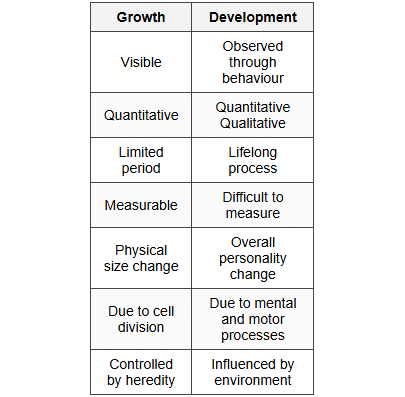
Factors Affecting Growth and Development
Growth and development are influenced by several biological, social, and environmental factors.
1. Heredity
- Transmission of traits from parents to children
- Influences height, weight, intelligence, temperament
- Traits are innate and present at birth
2. Environment
Environment includes physical, social, and psychological surroundings.
Types of Environment:
- Physical: climate, geography, shelter
- Social: culture, customs, institutions
- Psychological: emotions, affection, behaviour
Role of Heredity and Environment
- Heredity provides inborn traits
- Environment shapes mental and social traits
- Both work together like seed and soil
3. Gender
- Boys generally taller and heavier
- Girls show earlier growth spurts during adolescence
4. Nutrition
Adequate calories essential
- Malnutrition leads to poor structural and functional growth
5. Exercise
Improves muscle strength and circulation
- Promotes skeletal and muscular growth
- Lack of activity leads to atrophy
6. Hormones
Chemical messengers controlling growth
- Thyroxine affects skeletal growth
- Adrenaline controls heartbeat and blood pressure
- Gonads influence sexual development
7. Learning and Reinforcement
Learning includes habits, skills, and attitudes
- Reinforcement through repetition improves development
- "Learning by doing" principle
8. Pollution
- Air and indoor pollution affect respiratory organs
- Lead exposure damages brain development
9. Socio-Economic Status
Higher income → better nutrition and facilities
- Large family with limited income → poor growth rate
Physical and Physiological Changes During Developmental Stages
Early Childhood (0-8 Years)
Rapid growth in height and weight
- Development of motor skills
- Improvement in hand-eye coordination
- Cognitive and language growth
Middle Childhood
Growth becomes slow and steady
- Development of competence and self-esteem
- Puberty may begin toward the end of this stage
Adolescence (12-18 Years)
- Second period of rapid growth
- Height increases by 15-20 cm
- Weight increases by 8-10 kg
- Sexual maturation occurs
- Major cognitive and emotional changes
Physiological Aspects of Activities
Exercise affects multiple body systems including:
- Musculoskeletal
- Cardiovascular
- Respiratory
- Endocrine
- Immune systems
Before exercise, the body must be prepared through Warm-up, followed by Conditioning, and ended with Cool-down.
Warm-up
Warm-up is a short activity performed before intense exercise.
Objectives:
- Increase heart rate
- Increase body temperature
- Improve flexibility
- Prevent injuries
- Prepare psychologically
Types of Warm-up
1. General Warm-up
- Walking, jogging, skipping, aerobics
- Improves neuromuscular coordination
2. Specific Warm-up
Sport-related exercises, for example:
- Basketball: dribbling, lay-ups
- Cricket: batting, bowling
- Tennis: service practice
- Hockey: stick rotation
- Weightlifting: snatch squat
Methods of Warming Up
- Exercise
- Massage
- Hot water bath
- Hot beverages
Sports Conditioning
Sports conditioning enhances:
- Strength
- Speed
- Flexibility
- Balance
- Agility
- Power
- Anaerobic capacity
It prevents injuries and improves sport-specific performance.
Cool-down
Cool-down consists of light exercises after intense activity.
Benefits:
- Gradual heart rate recovery
- Prevents dizziness
- Removes lactic acid
- Prepares muscles for next session
Effects of Exercise on Body Systems
1. Cardiovascular System
- Increased heart rate
- Increased stroke volume
- Increased cardiac output
Cardiac Output = Heart Rate × Stroke Volume - Cardiac hypertrophy (athlete's heart)
- Increased blood volume and capillarisation
2. Respiratory System
- Increased tidal volume
- Increased respiratory rate
- Increased pulmonary ventilation
- Improved oxygen diffusion
- Hyperventilation during intense exercise
- Slight decrease in total lung capacity
- Increased vital capacity
3. Muscular System
Muscular Hypertrophy: Enlargement of muscles
Aerobic Changes: Better oxygen supply, fat utilisation
Anaerobic Changes: Lactic acid tolerance
Capillary Density: Improved blood supply
Performance: Increased strength, endurance, flexibility
4. Digestive System
- Improved blood flow
- Faster metabolism
- Prevention of constipation
- Strengthening of internal organs
- Prevention of digestive diseases
FAQs on Chapter Notes: Physical and Physiological Aspects of Physical Education and Sports
| 1. What are the key factors affecting growth and development in individuals? |  |
| 2. What are the physical and physiological changes that occur during different developmental stages? | |
| 3. How do physiological aspects influence activities in physical education and sports? | |
| 4. What is the importance of understanding growth and development in the context of physical education? | |
| 5. What role do environmental factors play in the growth and development of individuals? | |

