SBI Clerk Quantitative Aptitude Syllabus 2026: Topic-wise Weightage & Strategy

SBI Clerk Exam Pattern 2026
The SBI Clerk recruitment process is conducted by the State Bank of India to hire Junior Associates (Customer Support & Sales). It is a highly competitive national-level exam consisting of three primary phases: Preliminary Examination, Main Examination, and a Local Language Proficiency Test (LPT). Final selection is determined solely by your performance in the Mains exam, provided you pass the LPT. Both stages have strict sectional time limits; you cannot switch between sections or use remaining time from one section for another. Except for the English sections, all questions are available in both English and Hindi (and regional languages depending on the state applied for).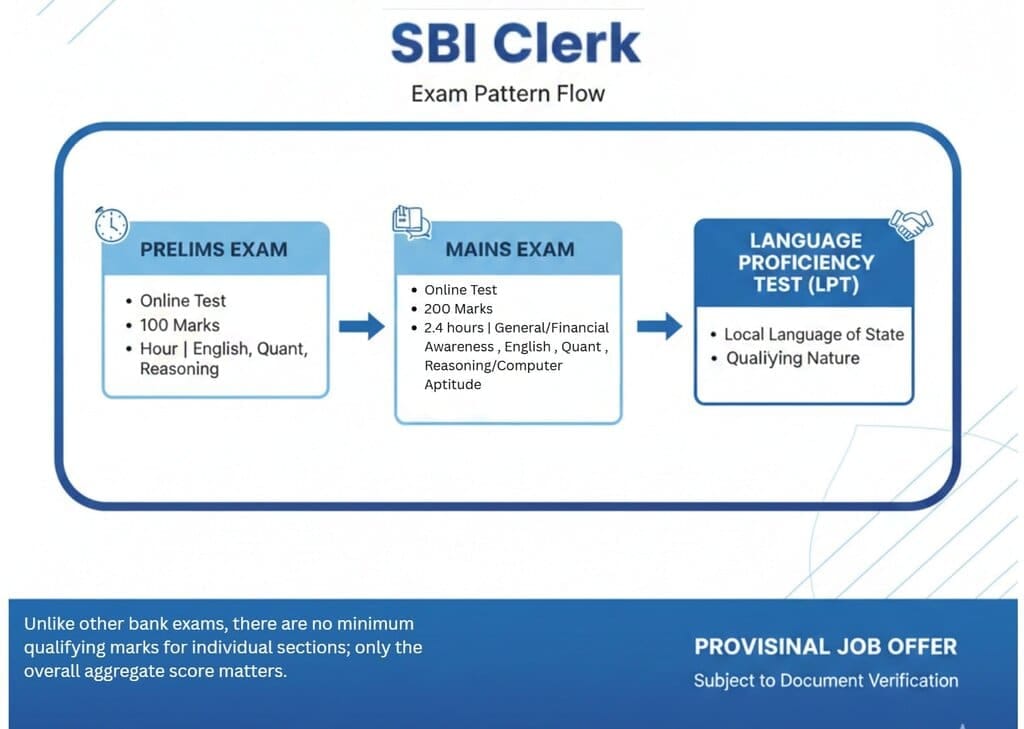
Stage 1: Preliminary Examination (Qualifying)
This is a screening stage conducted online to shortlist candidates for the Mains. The marks obtained here are not counted toward the final merit list.

SBI does not maintain minimum qualifying marks for individual sections; selection is based strictly on your aggregate score.
Stage 2: Main Examination (Merit Decider)
The Mains exam is the most critical phase. It is a more in-depth objective test where the difficulty level is significantly higher than the Prelims.
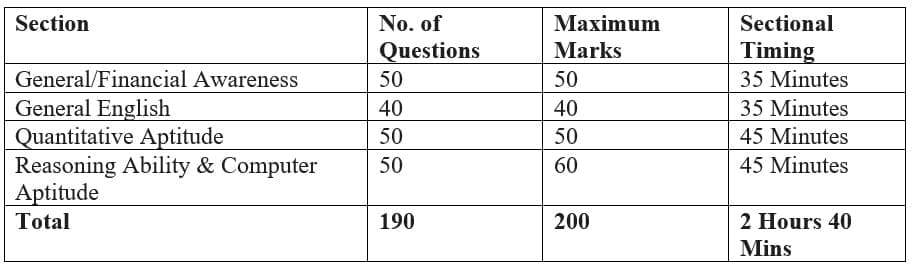
Negative Marking: A penalty of 0.25 (1/4th) of the marks assigned to a question is deducted for every wrong answer in both Prelims and Mains.
Stage 3: Local Language Proficiency Test (LPT)
After being provisionally selected based on Mains marks, candidates must undergo a test in the specified local language of the state they applied for.
- Exemption: If you have studied the specified local language in Class 10 or 12 and have a mark sheet as proof, you are exempt from this test.
- Consequence: Candidates who fail to demonstrate proficiency in reading, writing, and speaking the local language will be disqualified.
SBI Clerk Quantitative Aptitude Syllabus 2026
Stage 1: Numerical Ability (Preliminary Exam)
This stage focuses on calculation speed and basic mathematical concepts.
- Simplification & Approximation: BODMAS, Squares, Cubes, Square Roots, Indices, and Fractions.
- Number Series: Missing and Wrong Number Series patterns.
- Quadratic Equations: Comparing variables (x and y).
- Data Interpretation (DI): Tabular DI, Bar Graphs, and Line Graphs.
- Arithmetic Word Problems: Percentage, Profit & Loss, and Discount.
Ratio & Proportion, Average, and Ages.
Simple & Compound Interest.
Time & Work, Pipe & Cistern.
Speed, Time & Distance, and Boat & Stream.
Mensuration (2D/3D basic formulas).
Stage 2: Quantitative Aptitude (Main Exam)
The Mains syllabus includes all Preliminary topics with a significant shift toward Data Analysis and higher difficulty levels.
- Advanced Data Interpretation: Missing Data DI, Radar/Spider Graphs and Funnel Charts, Mixed DI (e.g., Pie Chart + Table).
- Arithmetic Data Sufficiency: 2-statement and 3-statement problems.
- Quantity Comparison (Q1 vs Q2): Solving two separate arithmetic statements to compare their final values.
- Advanced Arithmetic: Complex multi-step problems involving Probability, Permutation & Combination, and Partnership.
- Data Analysis: Interpretative questions where calculation is secondary to logical derivation.
SBI Clerk Quantitative Aptitude: Topic-Wise Weightage & Strategy
The Quantitative Aptitude section is designed to evaluate your numerical proficiency, mental calculation speed, and data interpretation skills.
In the Preliminary stage, this section is a high-speed "calculation sprint" where you must balance rapid-fire accuracy across 35 questions to meet the high clerk-level cut-offs. In the Main stage, the section transitions into a test of "Logical Stamina," focusing on complex, multi-variable data sets and advanced arithmetic applications.
Success in this section is not just about solving every problem; it is about the "Skip-Decision"-the ability to identify and bypass time-consuming traps to maximize your aggregate score. Since there are no minimum qualifying marks for individual sections in the SBI Clerk exam, your goal is to use Quantitative Aptitude to drive your overall total as high as possible.
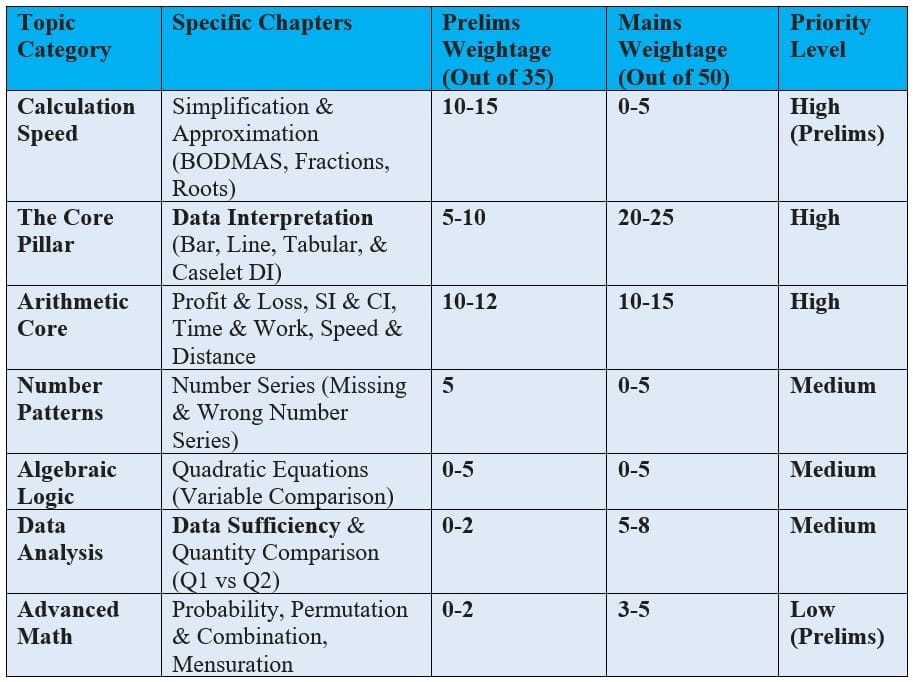
Edurev Tip : In prelims , aim to finish Simplification, Number Series, and Quadratic Equations within 7-8 minutes to leave enough time for Arithmetic and DI. In the Mains, don't get stuck on a 3-variable Caselet DI. If the data extraction takes more than 2 minutes without progress, skip it and secure marks in Arithmetic and Data Sufficiency first.
SBI Clerk Quantitative Aptitude- Success Strategy
Why Crack the SBI Clerk Exam?
Becoming a Junior Associate at the State Bank of India is more than just a job; it is a gateway to a secure and prestigious career in India's largest public sector bank.
- Best-in-Class Entry Salary: Starting gross salary is approximately ₹46,000 per month in metro cities, including two advance increments for graduates.
- Unrivaled Job Security: As a government-backed entity, SBI offers high job stability and a secure work environment even during economic downturns.
- Fast-Track Career Growth: Deserving Junior Associates can appear for internal exams to become Trainee Officers (TO) or Probationary Officers (PO) in as little as 3 years, leading to senior management roles.
- Comprehensive Perks: Includes medical insurance, concessional loans for housing/vehicles, dearness allowance, and travel concessions.
In the SBI Clerk exam, the Quantitative Aptitude section is often where candidates lose the most time. Your strategy must shift from solving everything to selective accuracy. In Prelims, you need high-speed execution; in Mains, you need deep conceptual clarity.
Phase I: Prelims Strategy (The 20-Minute Sprint)
The Goal: 30+/35 marks. Speed is your primary weapon.
Daily Commitment: 2 hours of focused calculation and arithmetic practice.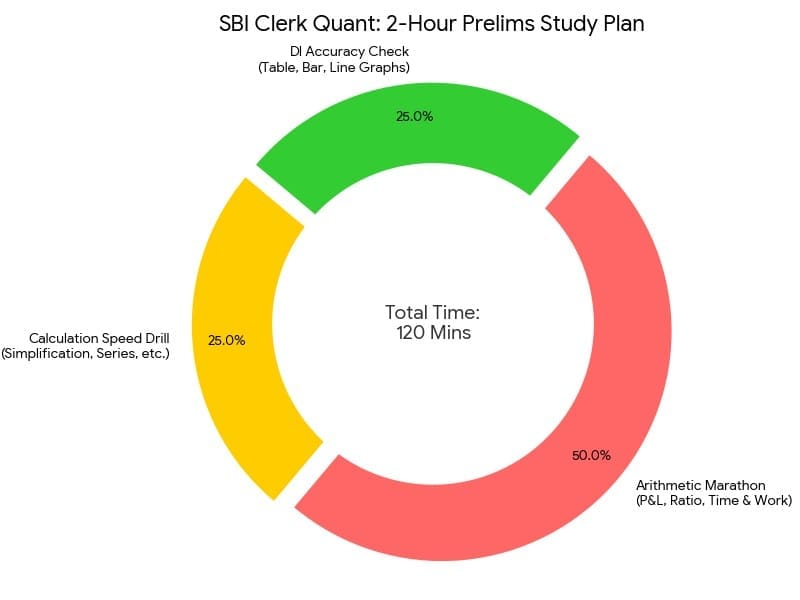
1. The Calculation Speed Drill (30 Minutes)
- Focus: Simplification, Approximation, Number Series, and Quadratic Equations.
- The Task: Solve 40 questions daily using a stopwatch.
- The Goal: Aim to clear these 15-20 marks in under 8 minutes. This creates a "time buffer" for the word problems.
2. The Arithmetic Marathon (60 Minutes)
- Focus: Percentage, Ratio, Profit & Loss, and Time & Work.
- The Technique: Instead of learning formulas, focus on Fraction-to-Percentage conversion and Ratio methods. These are universal shortcuts that apply to both Arithmetic and DI.
3. The DI Accuracy Check (30 Minutes)
- The Task: Solve 3 sets of Data Interpretation (Table, Bar, Line) daily.
- The Goal: Minimize "pen-work." Practice calculating averages and percentage shifts mentally to save precious seconds.
Phase II: Mains Strategy (The 45-Minute Logic Test)
The Goal: 35+ marks. Shift from pure speed to Data Analysis.
Daily Commitment: 3 hours of advanced practice (Post-Prelims).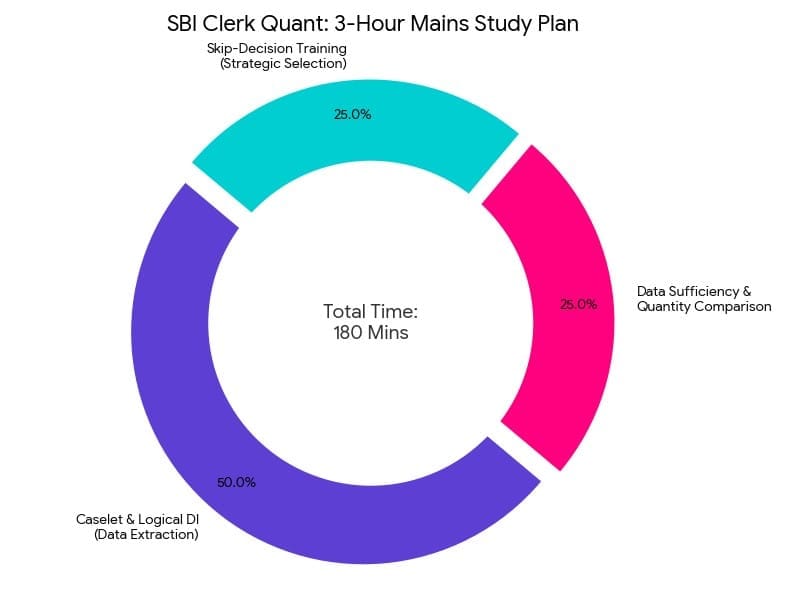
1. The Caselet & Logical DI Edge (90 Minutes)
- Focus: Paragraph-based DI (Caselets) and Missing Data DI.
- The Task: Tackle 4 high-level sets daily.
- The Goal: Practice "Data Extraction." The hardest part of Mains DI is converting the text into a workable table. Once the table is ready, the questions are usually simple.
2. Data Sufficiency & Quantity Comparison (45 Minutes)
The Goal: These are "hidden gems." You often don't need to find the final answer-only whether the answer can be found. This saves time compared to solving full arithmetic word problems.
3. The "Skip-Decision" Training (45 Minutes)
The Technique: During mock tests, if an Arithmetic problem takes more than 45 seconds to understand, skip it immediately. In Mains, choosing the right 35 questions to solve is better than attempting all 50 and getting half wrong.
Edurev Tip: To dominate the 2026 exam, your mental math must be "muscle memory." Memorize Squares up to 50, Cubes up to 30, and Tables up to 25. If you have to calculate 24x8 on paper, you've already lost 10 seconds to the competition.
The 30-Day Preparation Roadmap
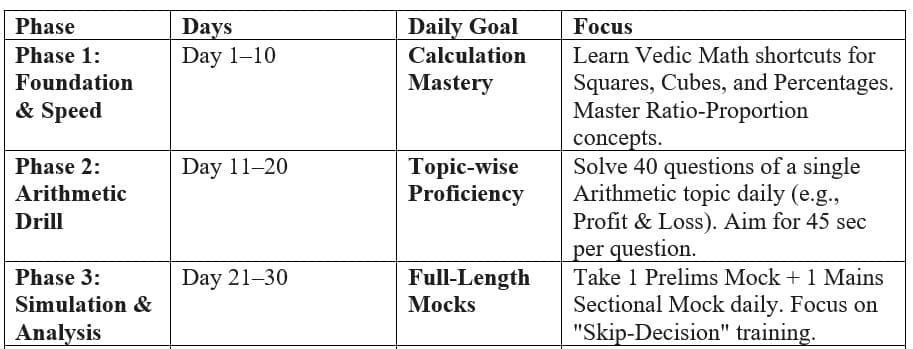
Custom Roadmap - Where do you stand?
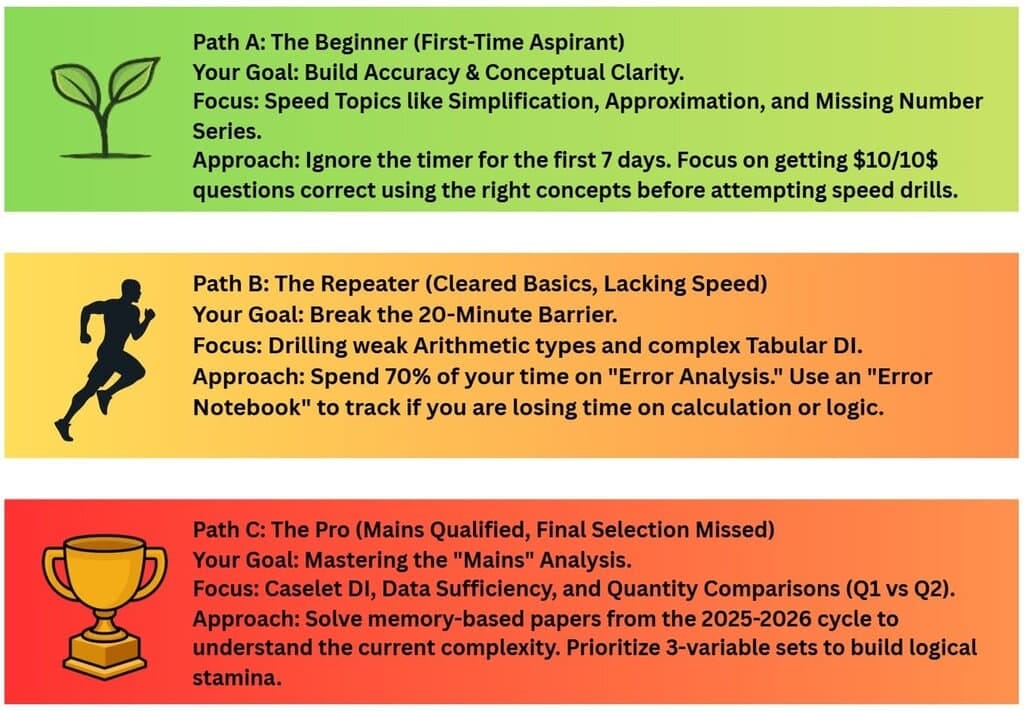
Choosing the right preparation path is essential for mastering the SBI Clerk 2026 Reasoning & Computer Aptitude section. The strategy for a first-time aspirant is vastly different from someone who has already cleared their basics or missed the final merit list.
Choose the path that matches your current level below:
"Harness these strategies, master your speed, and secure your future in the 2026 recruitment cycle-your journey to becoming a Junior Associate at the State Bank of India begins with a single, calculated step today."
FAQs on SBI Clerk Quantitative Aptitude Syllabus 2026: Topic-wise Weightage & Strategy
| 1. What is the exam pattern for the SBI Clerk examination? |  |
| 2. What topics are covered under the Quantitative Aptitude syllabus for the SBI Clerk exam? | |
| 3. How can candidates develop a successful strategy for the Quantitative Aptitude section of the SBI Clerk exam? | |
| 4. What is the topic-wise weightage in the Quantitative Aptitude section for the SBI Clerk exam? | |
| 5. What resources can candidates use to prepare for the Quantitative Aptitude section of the SBI Clerk exam? | |