Veena Bhargava Textbook Solutions: Climate of India

Multiple Choice Questions
Question 1The temperature decreases with increasing altitude at the rate of
- 2° C for every 140m
- 1° C for every 32m
- 6° C for every 500m
- 1° C for every 166m
Ans: (d)
Explanation: Temperature falls with height. In the context of this question the standard lapse rate given is 1° C for every 166 m, so option (d) is correct.
Question 2The SW monsoon blows in summer from
- SE to NW
- SW to NE
- NE to SW
- NW to SW
Ans: (b)
Explanation: The South-West monsoon moves from the ocean towards the land during summer; it advances in a south-west to north-east direction over India, so option (b) is correct.
Question 3Monsoon winds are
- Local winds
- Westerlies
- Periodic winds
- Easterlies
Ans: (c)
Explanation: Monsoon winds change direction seasonally - they blow from the sea to land in summer and from land to sea in winter - hence they are periodic (seasonal) winds. Option (c) is correct.
Question 4The local winds Kali Baisakhi are accompanied by heavy rainfall. It is good for
- wheat crop
- cotton crop
- tea crop
- coffee crop
Ans: (c)
Explanation: Kali Baisakhi are sudden thunderstorms over eastern India and Bengal that bring heavy rain and strong winds during the pre-monsoon period; this heavy, concentrated rainfall benefits tea gardens in those regions, so option (c) is correct.
Question 5SW monsoon winds pick up moisture from
- Bay of Bengal
- Arabian Sea
- Indian Ocean
- Mediterranean Sea
Ans: (b)
Explanation: The Arabian Sea branch of the South-West monsoon picks up large amounts of moisture while crossing the Arabian Sea before reaching the west coast and interior of India; therefore option (b) is the correct choice here.
Question 6The Retreating monsoon causes winter rain in
- Punjab
- Haryana
- Gujarat
- Tamil Nadu
Ans: (d)
Explanation: The retreating monsoon, or North-East monsoon, brings rainfall to the south-eastern coast of India, especially Tamil Nadu and parts of Andhra Pradesh, during October-December; option (d) is correct.
Question 7Cold season extends from
- June to September
- March to May
- October to November
- December to February
Ans: (d)
Explanation: The cold or winter season in India is generally from December to February, so option (d) is correct.
Question 8Loo, the hot dusty winds blow in the month of
- May
- December
- October
- January
Ans: (a)
Explanation: Loo are strong, hot, dry winds that blow over the north-western plains of India during late spring and early summer, especially in May; option (a) is correct.
Question 9North East Monsoon blows in the direction of
- Southwest to Northeast
- West to East
- Northeast to Southwest
- Northwest to Southeast
Ans: (c)
Explanation: The North-East monsoon blows from the land towards the sea, i.e., from north-east to south-west, bringing rains to the south-eastern coast; option (c) is correct.
Question 10Western disturbances originate in the
- Mediterranean Sea
Ans: (a)
Explanation: Western disturbances are temperate cyclones that originate over the Mediterranean region and travel eastwards, bringing winter rain and snow to north-western India; thus option (a) is correct.
Answer the following questions
Question 1Name the factors affecting the climate of a place.
Ans: The factors affecting the climate of a place are:
- Location - The climate of a place is influenced by its latitude and position relative to large water bodies; regions nearer the equator are generally warmer than those nearer the poles.
- Altitude - Temperature generally decreases with elevation; higher places tend to be cooler. A commonly used figure in this book is a fall of about 1°C for every 166 m of rise.
- Distance from the sea - Coastal areas usually have milder climates with smaller temperature ranges, while inland areas experience greater extremes of temperature.
- Physical features - Mountain ranges, plateaus and plains affect wind patterns and rainfall. For example, the Himalayas block cold winds and modify monsoon rainfall, and the Western Ghats produce heavy rain on their windward side.
Name the type of climate of India.
Ans: The climate of India is classified as the Tropical Monsoon Type, characterised by distinct wet and dry seasons driven by monsoon winds.
Question 3What is the chief characteristic feature of the tropical monsoon type of climate?
Ans: The chief characteristic is the alternation of seasons - a pronounced wet season (monsoon) and a dry season - caused by the seasonal reversal of wind direction.
Question 4What are onshore winds and offshore winds?
Ans: Onshore winds are winds that blow from the sea towards the land. Offshore winds blow from the land towards the sea.
Question 5State the importance of the Monsoon season in India.
Ans: The monsoon season is important because:
- Agriculture - It provides the main source of water for crops such as rice, sugarcane and pulses.
- Water resources - Monsoon rains refill rivers, lakes and reservoirs, supporting irrigation and drinking water supplies.
- Economy - Many sectors, including agriculture, fisheries and tourism, depend on monsoon rainfall; a good monsoon supports food production and rural incomes.
Name a few local winds that pass through India.
Ans: Some local winds in India include:
- Kali Baisakhi
- Loo
- Mango Showers
Which is the more important branch - the Arabian Sea Branch or the Bay of Bengal Branch? Why?
Ans: The Arabian Sea Branch is more important because:
- Its volume of moisture is nearly three times that of the Bay of Bengal Branch.
- It contributes rainfall to a larger area of peninsular and northern India, whereas the Bay of Bengal Branch mainly affects the north-eastern states and eastern coast.
Which is the first state to receive the monsoon winds and the last to see its retreat in India?
Ans: Kerala is the first state to receive the South-West monsoon and is also among the last to experience its retreat.
Question 9State two important characteristic features of the Indian monsoons.
Ans: Two key features are:
- They are erratic and variable, causing uneven distribution of rainfall from year to year.
- They are strongly influenced by orography; mountain ranges such as the Himalayas and Western Ghats modify rainfall patterns and intensities.
Name the different seasons of India, stating the months when they are experienced.
Ans: The seasons and months are:
- The Hot Dry Season - March to May
- The Rainy Season (South-West Monsoon) - June to September
- The Retreating South-West Monsoon Season - October to November
- The Cold Season (North-East Monsoon period) - December to February
What is the meaning of the word 'monsoon'?
Ans: The word Monsoon comes from the Arabic word 'Mausim', which means season.
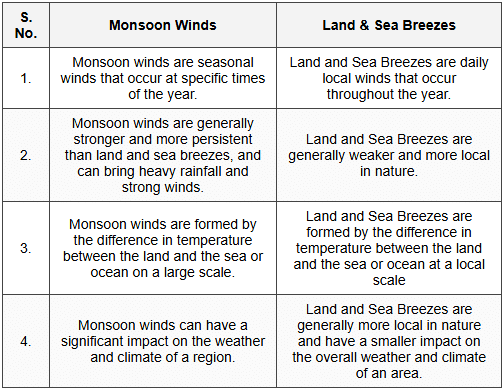
Question 12How are monsoon winds different from the land and sea breezes?
Ans: Monsoon winds are large-scale seasonal winds that reverse direction between summer and winter and affect the whole subcontinent. Land and sea breezes are local daily winds caused by temperature differences between land and sea and operate on a much smaller scale and on a daily cycle.
Why are there great variations in India's climate?
Ans: Major reasons for climatic variation in India include:
- Latitude and continentality: Areas north of the Tropic of Cancer experience more continental (extreme) climates, while areas to the south remain consistently warm (mean annual temperatures about 25-27°C).
- Coast vs interior: The long east-west coastline gives a maritime climate with a small annual temperature range (3-5°C), while the interior north shows a much larger annual range (up to about 20°C).
- Monsoon variability: The monsoon is variable, producing wide differences in annual rainfall-from over 1187 cm at Mawsynram to under 25 cm in the Thar Desert.
- Altitude: Higher elevations such as the Himalayas are much cooler than the plains.
- Himalayan influence: The Himalayas block cold Siberian winds and strongly affect rainfall distribution and wind patterns.
Give reasons to justify that the Himalayas act as a perfect climatic divide.
Ans: The Himalayas act as a climatic divide because:
- They block cold, dry winds from Siberia, preventing extreme cold from reaching the peninsular regions.
- They intercept the rain-bearing South-West monsoon winds, causing heavy rainfall on the windward side and influencing distribution of rainfall across the subcontinent.
Which winds are responsible for the rain experienced over the greater part of India?
Ans: The South-West Monsoon winds are responsible for the majority of rainfall over India.
Question 16During which part of the year is the rain experienced in India?
Ans: Rain in India is mainly experienced from June to September, during the South-West monsoon season.
Question 17How are the sources of rainfall in the north-west part of India different from the rain experienced on the eastern coastal areas in winter?
Ans: North-west India receives winter rainfall from temperate cyclones or western disturbances originating over the Mediterranean and travelling eastwards. Eastern coastal areas, especially Tamil Nadu, receive winter rain from the North-East monsoon winds that blow across the Bay of Bengal.
Question 18Why does Kanyakumari experience an equable climate?
Ans: Kanyakumari has an equable climate because it is surrounded by sea on three sides; the moderating influence of the ocean and regular land and sea breezes keep temperature variations small throughout the year.
Question 19Why does central Maharashtra receive scanty rainfall?
Ans: Central Maharashtra lies in the rain shadow region of the Western Ghats; the Ghats force moist winds to rise on the western side and lose most of their moisture, leaving little rain for the leeward interior.
Question 20Why is the western part of India a desert region?
Ans: The western region is arid because:
- The Aravalis run roughly parallel to the monsoon winds and are low, so they do not force the moisture-laden winds to rise and cause much rain.
- High temperatures in the desert increase the air's capacity to hold moisture so that winds passing over the region do not become saturated and cannot produce significant rainfall.
What are western disturbances?
Ans: Western disturbances are temperate cyclones or westerly depressions that originate over the Mediterranean Sea and move eastwards, bringing winter rain to Punjab, Haryana and western Uttar Pradesh and snowfall in the Himalayas.
Question 22Name one part of India that receives rainfall in winter and summer as well.
Ans: Northern India, especially the plains of Punjab, Haryana and Uttar Pradesh, receives rainfall both in summer (from the South-West monsoon) and in winter (from western disturbances).
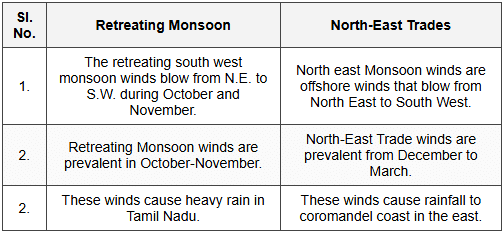
Question 23Explain how retreating monsoon winds are different from the north-east trades.
Ans:
Name a place in India which receives the heaviest rainfall. To which state does this place belong?
Ans: Mawsynram in Meghalaya receives the heaviest rainfall in India (and among the highest in the world).
Question 25Name the winds that are responsible for causing heaviest rainfall in the region.
Ans: The Bay of Bengal branch of the South-West monsoon is chiefly responsible for the very heavy rainfall in parts of north-east India, including Mawsynram.
Question 26What is meant by a 'rain shadow' area? Give an example and state the mountains responsible for the rain shadow area.
Ans: A rain shadow area is the leeward side of a mountain range that receives little rainfall because the winds have lost most of their moisture on the windward side. Example: Central Maharashtra is in the rain shadow of the Western Ghats.
Question 27Name the winds that bring rain to the Tamil Nadu coast.
Ans: The North-East Monsoon winds bring rain to the Tamil Nadu coast, usually during October-December.
Question 28Give reasons:
- In spite of the Aravalis, many parts of Rajasthan do not receive much rain.
- The Malabar coast has fewer rainy months but receives more rain than the Coromandel Coast.
- Punjab has three sources of rain.
- Mawsynram receives more rain than Shillong.
Ans:
- Although the Aravalis are an old mountain range, they run parallel to the incoming monsoon winds and are not sufficiently high to cause heavy orographic rainfall; hence Rajasthan remains dry.
- The Malabar coast gets heavy rainfall from the strong Arabian Sea branch of the South-West monsoon in a few months, while the Coromandel coast depends mainly on the weaker North-East monsoon, so overall Malabar receives more rain despite fewer rainy months.
- Punjab receives rain from the Arabian Sea branch (deflected), from the Bay of Bengal branch (later reaching parts of the north), and from western disturbances in winter - three distinct sources.
- Mawsynram lies on the windward side of the Khasi hills and receives the first intense uplift of moisture-laden Bay of Bengal winds, while Shillong is more sheltered; this windward position gives Mawsynram heavier rainfall.
Explain how winter rain is caused. How is this rain beneficial?
Ans: Winter rain in northern India is caused mainly by western disturbances - temperate cyclones that move eastwards from the Mediterranean, bringing cloud and precipitation in winter months. In the south-east (Tamil Nadu), winter rain is caused by the North-East monsoon when winds blow from the land across the Bay of Bengal and pick up moisture.
Benefits: Winter rains are important for rabi crops such as wheat and barley, helping soil moisture and crop maturation; in some coastal areas they support local agriculture and water supplies.
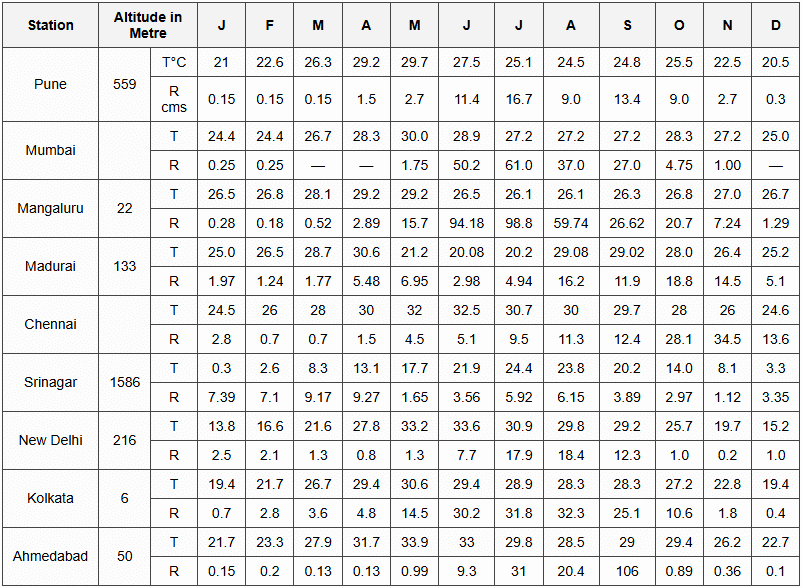
Refer to the Data of Chennai, Pune, New Delhi, and Kolkata to answer this question.
Answer the following questions:
- Calculate the annual range of temperature.
- What is the total rainfall experienced by the station?
- When does the station receive maximum rainfall? State a reason for your answer.
Ans:
Chennai
(a) Annual Range of temperature = 32.5 - 24.5 = 8
(b) Total rainfall = 2.8 + 0.7 + 0.7 + 1.5 + 4.5 + 5.1 + 9.5 + 11.3 + 12.4 + 28.1 + 34.5 + 13.6 = 124.7 cm
(c) Chennai receives maximum rainfall in November. Reason: The North-East monsoon winds, after crossing the Bay of Bengal, pick up moisture and strike the Coromandel coast, giving heavy rainfall to Chennai in November.
Pune
(a) Annual range of temperature = 29.7 - 20.5 = 9.2
(b) Total rainfall = 0.15 + 0.15 + 0.15 + 1.5 + 2.7 + 11.4 + 16.7 + 9.0 + 13.4 + 9.0 + 2.7 + 0.3 = 67.15 cm
(c) Pune receives maximum rainfall in July because the South-West monsoon reaches the western coast in June and the rain spreads inland by July; Pune, however, gets less total rain because it lies in the rain shadow of the Western Ghats.
New Delhi
(a) Annual range of temperature = 33.6 - 13.8 = 19.8
(b) Total rainfall = 2.5 + 2.1 + 1.3 + 0.8 + 1.3 + 7.7 + 17.9 + 18.4 + 12.3 + 1.0 + 0.2 + 1.0 = 66.5 cm
(c) Delhi receives maximum rainfall in August because the South-West monsoon reaches the plains later and is strongest around July-August in north India; hence August shows the peak.
Kolkata
(a) Annual range of temperature = 30.6 - 19.4 = 11.2
(b) Total rainfall = 0.7 + 2.8 + 3.6 + 4.8 + 14.5 + 30.2 + 31.8 + 32.3 + 25.1 + 10.6 + 1.8 + 0.4 = 158.6 cm
(c) Kolkata receives maximum rainfall in August because the Bay of Bengal branch of the monsoon brings heavy rain to the eastern coast by that time.
Question 34Give reasons for the following:
- Mumbai gets more rainfall than Pune
- The moisture laden winds passing over Rajasthan do not saturate.
- S.W. monsoon withdraws from India in October/November.
Ans:
- Mumbai lies on the western coast and directly faces the incoming South-West monsoon; it is on the windward side of the Western Ghats and therefore receives heavy rain. Pune is inland on the leeward side and is in the rain shadow, so it gets much less rain.
- As moisture-laden winds travel over the hot desert regions of Rajasthan, high temperatures increase the air's capacity to hold moisture so the air does not reach saturation easily, and therefore little rainfall occurs.
- By October/November the apparent position of the sun shifts southwards, the low pressure over central India weakens and the temperature contrasts that attract the monsoon reduce. Consequently the South-West monsoon withdraws from India during October-November.
Answer in one word :
- Withdrawal of SW monsoon.
- Low pressure depressions during winter in North West India.
- Land and sea breeze on a large scale.
Ans:
- Retreating Monsoon
- Western disturbance
- Monsoon Winds
FAQs on Veena Bhargava Textbook Solutions: Climate of India
| 1. What are the main factors that influence the climate of India? |  |
| 2. What are the different seasons experienced in India? | |
| 3. How do the monsoon winds affect agriculture in India? | |
| 4. What are the climatic variations across different regions of India? | |
| 5. How has climate change impacted the climate of India? | |




