Veena Bhargava Textbook Solutions: Water Resources

Multiple Choice Questions
Question 1Irrigation in India is essential for continuous agricultural growth due to the following reasons:
- Ever-increasing demand for food crops.
- The tropical monsoon climate in India is unevenly distributed, unreliable, and erratic.
- A wide variety of crops are cultivated in India.
- Rainfall scarcity.
Ans: (b)
Explanation: The tropical monsoon climate in India is uneven and often unreliable, so rainfall alone cannot meet crop water needs throughout the year. Irrigation provides a dependable and controllable supply of water to ensure regular crop growth and stable agricultural output.
Question 2Perennial canals can be constructed in regions with:
- Uneven terrain.
- Low-level relief with deep fertile soil.
- Deltaic regions.
- Mountainous regions.
Ans: (b)
Explanation: Perennial canals need a relatively flat, low-lying area with deep soils so water can be carried and distributed easily over large agricultural tracts. Steep or uneven terrain makes canal construction and water flow control difficult.
Question 3Tanks can be built in areas characterized by:
- Undulating relief.
- Hard rock formations.
- Natural depressions.
- All of the above.
Ans: (d)
Explanation: Tanks are suitable where there are natural depressions to collect water, undulating relief to form catchment areas, and hard or rocky bases that prevent excessive seepage. All these features make tanks effective and economical.
Question 4Tank irrigation is predominantly practiced in:
- Punjab.
- Uttarakhand.
- Haryana.
- Tamil Nadu.
Ans: (d)
Explanation: Tamil Nadu has many natural depressions and a tradition of tank construction and maintenance. The local relief and geology make tank irrigation particularly suitable and widespread there.
Question 5A tube well is classified as:
- Borewell.
- Pond.
- Lake.
- Surface well.
Ans: (a)
Explanation: A tube well is a deep, narrow well bored into the ground and fitted with a tube casing. It taps groundwater like a borewell and is not a surface water body such as a pond or lake.
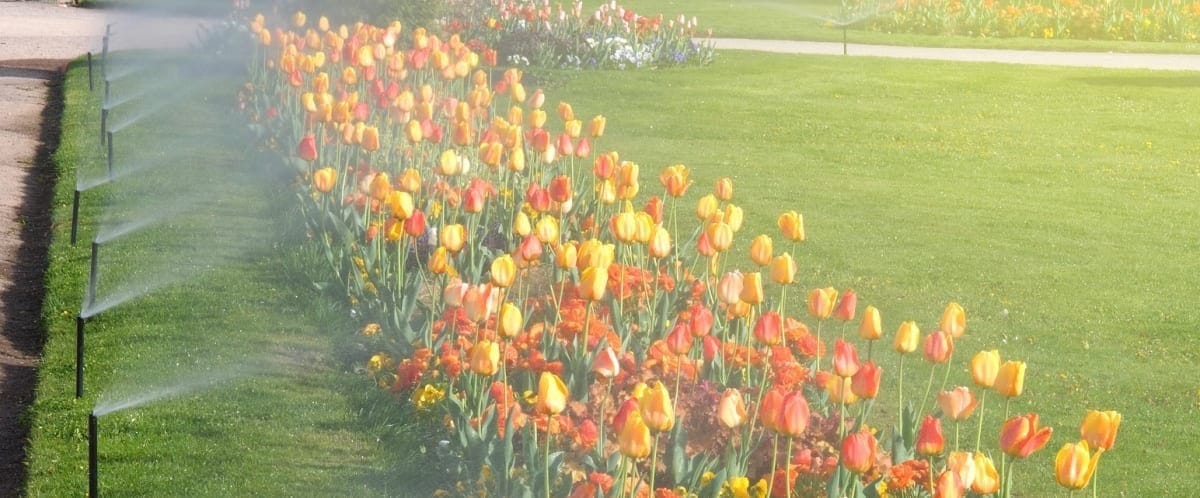
Question 6The type of modern irrigation useful for arid regions is:
- Bamboo irrigation.
- Tube well irrigation.
- Drip irrigation.
- Sprinkler irrigation.
Ans: (d)
Explanation: Sprinkler irrigation sprays water over fields in a controlled manner and can cover large areas without relying on surface water. It is well suited to arid and semi-arid regions because it reduces losses from run-off and, when managed correctly, limits evaporation compared with open channels.
Question 7Canal irrigation is more suitable in Northern India because:
- It is cost-effective.
- It can cover larger areas.
- The northern plains have flat surfaces with soft soil.
- It is a perennial source of water.
Ans: (c)
Explanation: The northern plains are broad and flat with soft soils, which make it easier and more effective to construct canals and distribute water over extensive agricultural tracts. Such terrain favours canal networks more than the rocky or undulating areas of the south.
Question 8Canal irrigation can lead to unproductiveness of surrounding land due to:
- Waterlogging reduces soil's water absorption capacity, potentially ruining crops.
- Canal percolation can cause swamp formation.
- Salt effervescence from over-flooding degrades soil quality.
Ans: (d)
Explanation: Excessive irrigation can cause waterlogging and raise the water table, while percolation from canals may form swamps. Over-irrigation also leads to salinisation of soils as dissolved salts concentrate at the surface, all of which reduce land productivity.
Question 9Rainwater harvesting is beneficial for:
- Industrial use.
- Recharging groundwater.
- Domestic use.
- Agriculture.
Ans: (b)
Explanation: One of the main benefits of rainwater harvesting is directing collected rainwater to recharge aquifers and replenish groundwater levels. This makes water available in wells and borewells and helps sustain supplies during dry periods.
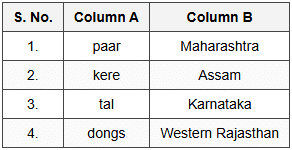
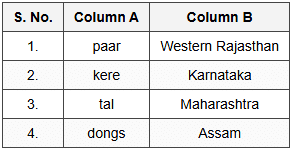
Question 10Connect the correct pairs.
Ans:
What is irrigation?
Ans: Irrigation is the artificial application of water to soil from sources such as canals, wells, tube wells and tanks, carried out to help crops grow when rainfall is insufficient or irregular.
Question 2Why is irrigation necessary for a country like India?
Ans: Irrigation is crucial for India for several reasons:
- Monsoon rainfall is seasonal, erratic and unevenly distributed across the country.
- To enable continuous cultivation throughout the year rather than only during the rainy season.
- Certain crops such as paddy and sugarcane require large and regular water supplies.
- Growing population and commercial agriculture increase demand for food and water.
- Proper irrigation allows double cropping, for example rice followed by wheat in suitable areas.
List the different methods of irrigation.
Ans: Irrigation methods can be grouped as follows:
- Primitive / Traditional Methods:
- Canal irrigation.
- Tank irrigation.
- Wells.
- Modern Methods:
- Sprinkler irrigation.
- Drip irrigation.
- Bamboo irrigation.
Which type of canal irrigation is superior? Why?
Ans: Perennial canals are superior because they provide a continuous and regulated supply of water throughout the year, whereas inundation canals work only during high flows or floods and are unreliable for regular cropping.
Question 5What is tank irrigation?
Ans: Tank irrigation uses water stored in artificial tanks-created by building embankments or bunds in natural depressions-to irrigate nearby fields. Tanks collect and store rainwater and runoff for later use.
Question 6What are the advantages and disadvantages of tank irrigation?
Ans:
Advantages of tank irrigation include:
- Cost-effective and well suited to regions with natural depressions, such as parts of the Deccan Plateau.
- Helps maintain water levels in nearby wells during dry seasons.
- Provides domestic water supply for villages in the vicinity.
- Acts as a local water source where perennial rivers are absent.
Disadvantages include:
- Shallow tanks lose much water to evaporation.
- Tanks may dry up in summer and can be costly to maintain compared with wells or tube wells.
- Tanks occupy large areas that could otherwise be used for cultivation.
Where is tank irrigation most commonly practiced and why?
Ans: Tank irrigation is most commonly practised in peninsular India because the region has many natural depressions suitable for tanks and a rocky subsoil that reduces seepage and helps retain water.
Question 8Which type of well is superior, and why?
Ans: Tube wells (borewells) are generally superior to shallow surface wells because they can draw water from deeper aquifers, irrigate larger areas, take less surface land for the same yield and are more reliable during dry periods.
Question 9Name two states where tank irrigation and well irrigation are practiced.
Ans: Andhra Pradesh and Telangana.
Question 10Identify two methods of extracting water from wells.
Ans: Two traditional methods are the Persian wheel (Rehat) and the moat.
Question 11Why is groundwater irrigation gaining popularity despite major river projects?
Ans: Groundwater irrigation is becoming more popular because:
- It is often available in remote areas where large irrigation projects do not reach.
- Groundwater extraction is relatively inexpensive and easy to implement at the farm level.
- Variability and unreliability of rainfall make groundwater a more dependable source for many farmers.
List two advantages of well irrigation over canal irrigation for Indian farmers.
Ans:
- Wells are simple and economical, making irrigation accessible to small and poor farmers.
- Wells provide water on demand and give farmers autonomy, unlike canal water, which is controlled by external authorities.
Differentiate between surface water resources and groundwater resources by stating two advantages of each.
Ans:
| S. No. | Surface water resource | Groundwater resource |
|---|---|---|
| 1. | Surface water is available on the earth's surface in the form of rivers, lakes, ponds and canals. | Groundwater is the part of rainwater that soaks into the ground and fills cracks and pores in soil and rock. |
| 2. | Surface water resources are mostly seasonal in many regions. | Groundwater is often available throughout the year and is recharged every monsoon. |
| 3. | Can be used directly. | Requires pumping to bring to the surface. |
| 4. | Often contaminated due to open exposure. | Often fit for drinking with less contamination. |
Advantages of surface water resources:
- Surface water is easily available for drinking and irrigation in many places.
- Surface water is used for thermoelectric power generation and industrial needs.
Advantages of groundwater resources:
- Groundwater is a reliable source for drinking and domestic supply, especially during dry periods.
- Groundwater is not lost to evaporation in the way surface water is.
Question 14
Name two important canal systems in Uttar Pradesh and Punjab.
Ans:
In Uttar Pradesh, the major canal systems include:
- Ganga Canal.
- East Yamuna Canal.
In Punjab, the important canal systems are:
- Sirhind Canal.
- Makhu Canal.
Identify two problems faced by India in irrigation.
Ans:
- Rainfall is highly irregular and concentrated within a few months; many rivers are seasonal.
- Large parts of the country still lack adequate irrigation infrastructure.
Differentiate between inundation canals and perennial canals.
Ans:
| S. No. | Inundation canal | Perennial canal |
|---|---|---|
| 1. | Inundation canals are taken from rivers without regulating structures like weirs and barrages. | Perennial canals are taken from rivers with regulating structures to control and store water. |
| 2. | Inundation canals are useful mainly during floods or high flows. | Perennial canals supply water throughout the year. |
| 3. | They are relatively easy and cheap to build. | They are more expensive to construct because of the regulating works required. |
Why are inundation canals being converted to perennial canals?
Ans:
- Inundation canals are unreliable because they function only during floods or high river flow; converting to perennial canals provides a steady supply of water year-round.
- Perennial canals can irrigate a wider range of crops and support more intensive farming than inundation canals that serve only low-lying areas during high water periods.
Why is tube well irrigation more significant in northern India compared to southern India?
Ans:
- The alluvial soils of northern India are softer and deeper, making it easier and cheaper to drill tube wells than through the hard, rocky terrain of much of southern India.
- Southern India often relies on other sources such as tanks, ordinary wells and coastal supplies, reducing the relative importance of tube wells there.
Why is tank irrigation more popular in southern India?
Ans:
- Peninsular India has many natural depressions suitable for making tanks.
- The rocky base of the Deccan Plateau reduces seepage and helps tanks retain water, making them effective local waterstores.
Identify two states that periodically suffer from droughts and explain why.
Ans:
Rajasthan and Gujarat periodically suffer from droughts because they receive low rainfall; the monsoon winds lose much of their moisture before reaching these areas. The Aravalli Range also affects the movement of winds, reducing rain-bearing winds over parts of western India.
Question 21What are the objectives of the National Water Policy?
Ans: The National Water Policy aims to:
- Assess the national water situation and plan for its sustainable use.
- Establish a framework of laws and institutions for effective water management.
- Promote recycling, treatment and reuse of wastewater to conserve freshwater resources.
Define Rainwater Harvesting.
Ans: Rainwater harvesting is the collection and storage of rainwater from roofs, land surfaces or other structures for direct use or for recharging groundwater aquifers.
Question 23Why is water conservation necessary?
Ans: Water conservation is necessary because:
- Rainfall is uncertain and unevenly distributed.
- Available water resources are often over-exploited.
- Water is contaminated by pollution, pesticides and fertilisers.
- Population growth increases demand for water.
- Industrialisation and urbanisation add further pressure on water supplies.
Describe how rainwater harvesting is implemented.
Ans: Rainwater harvesting is implemented in two main ways:
- Storing rainwater: Rainwater is collected in tanks, ponds and small reservoirs for later use in irrigation or domestic purposes.
- Groundwater recharge: Rooftop rainwater is led through pipes into soak pits, sumps, wells or recharge shafts so that it percolates down and replenishes the groundwater.
What are the benefits of rooftop rainwater harvesting?
Ans:
- Maximises the use of available rainwater.
- Is cost-effective and straightforward to implement on individual buildings.
- Helps recharge groundwater and raise water tables.
- Reduces surface runoff and prevents loss of rainwater.
Which state commonly practices rainwater harvesting?
Ans: Rainwater harvesting is commonly practised in Tamil Nadu and Andhra Pradesh.
Question 27Provide geographical explanations for the following:
- The Damodar River is known as the "river of sorrow."
- Canal irrigation is more suitable in northern India compared to the south.
- Tank irrigation is practiced in peninsular India.
Ans:
- The Damodar River has caused severe floods historically in West Bengal and surrounding areas, causing loss of life and property; hence it was called the "river of sorrow." Construction of dams and embankments has reduced floods but some lower valley areas still face flood risks.
- Canal irrigation is more suitable in northern India because many northern rivers are perennial and the plains are flat, allowing canals to distribute water efficiently. Southern rivers are often seasonal and the terrain is more undulating or rocky, making large canal systems less practical.
- Tank irrigation is common in peninsular India because natural depressions and the rocky subsoil help to collect and retain rainwater, making tanks effective local water storage systems for irrigation.
Answer in one word -
- A plastic tube which has small holes through which water keeps on dripping
- An ancient irrigation system in North East part of India.
- Tube-wells are used extensively in UP and Bihar and are very popular
Ans:
- Drip irrigation
- Bamboo irrigation
- Borewell
State the advantages and disadvantages of Sprinkler Irrigation.
Ans:
Advantages of Sprinkler Irrigation are:
- Minimises water loss by seepage or evaporation compared with open-channel supply because water is delivered through closed pipes.
- One of the best methods for conserving water in arid and semi-arid regions.
- Well suited to uneven or rolling land where surface irrigation is difficult.
- Allows easier water management and more uniform application than many surface systems.
- Higher application efficiency and possibility of frequent watering.
- Does not interfere with most field operations and allows mechanisation.
- Chemicals and fertilisers can be applied through the system where appropriate.
Disadvantages of Sprinkler Irrigation:
- High initial installation cost.
- Higher operating cost due to energy needs for pumping.
- Efficiency is affected by wind, which can blow water away from the target area.
- Some crops may suffer leaf damage or salt deposits if water quality is poor.
- Requires continual maintenance to keep nozzles and pipes clear and working.
- Saline water can cause soil and crop problems if used without treatment.
Water used in sprinklers must be free from sand, debris and excessive salts to prevent clogging and crop damage.
Question 30Name the modern methods of Irrigation.
Ans:
The modern methods of irrigation are
- Sprinkler Irrigation
- Drip Irrigation
- Bamboo Irrigation
Study the picture and answer the questions that follows :
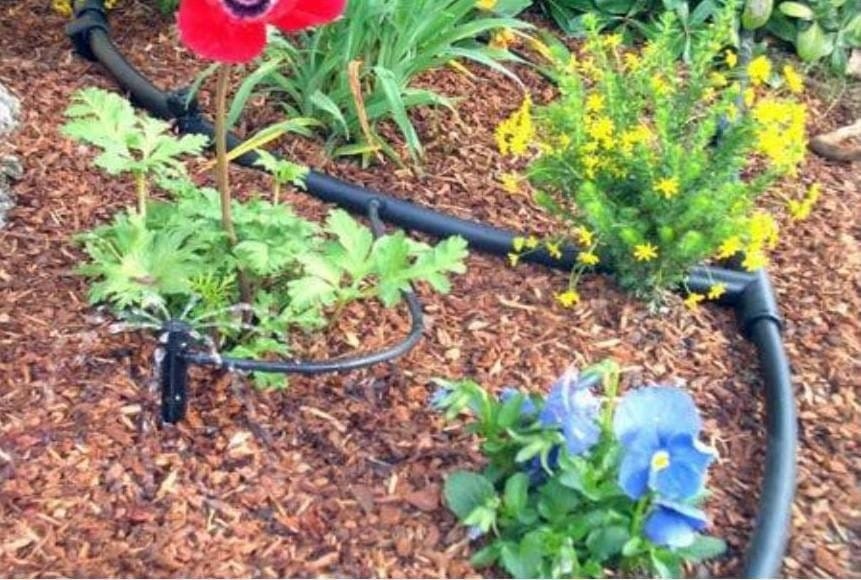
- Name the type of irrigation.
- What are the advantages of this type of irrigation?
Ans:
- Drip Irrigation
- Advantages of Drip Irrigation are:
- Loss of fertiliser and nutrients by leaching is minimised because water is applied directly to the root zone.
- High water application efficiency if the system is properly managed.
- Field levelling is not required as water is delivered locally to plants.
- Recycled or non-potable water can be used where appropriate.
- Moisture in the root zone can be maintained close to field capacity, improving plant growth.
- Reduces soil erosion compared with surface flooding.
- Provides uniform water distribution to plants.
- Labour costs are reduced compared with many traditional systems.
- Supply can be varied by adjusting valves and drippers to suit crop needs.
- Fertigation (applying fertiliser through the system) reduces waste.
- Often operates at low pressure, reducing energy costs compared with high-pressure sprinkler systems.
FAQs on Veena Bhargava Textbook Solutions: Water Resources
| 1. What is the main purpose of irrigation in agriculture? |  |
| 2. How does rainfall variability impact irrigation practices in India? | |
| 3. What are the two main categories of irrigation methods? | |
| 4. Why are tube wells considered more advantageous than surface wells? | |
| 5. What role does rainwater harvesting play in water conservation? | |




