Veena Bhargava Textbook Solutions: Waste Generation and Management - Methods of Safe Disposal of Waste

Multiple Choice Questions
Question 1Refer to the image & answer the question that follows.
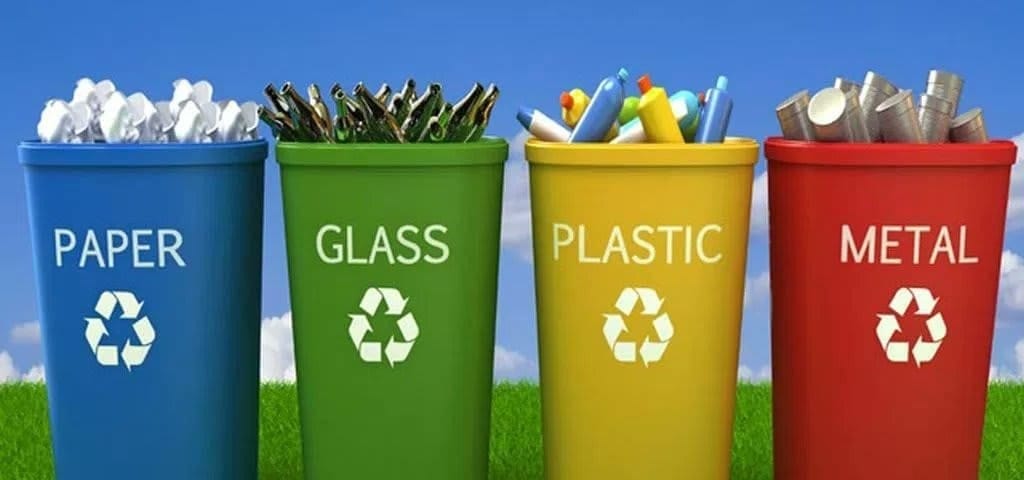
Which of the following waste management processes is practised here?
- Dumping
- Segregation
- Composting
- Landfill
Ans: (b)
Explanation: The picture shows separate containers and people sorting different types of waste. Segregation means separating biodegradable, recyclable and hazardous waste at the source so each type can be handled correctly. This practice reduces contamination and makes recycling and composting easier.
Question 2This is the process which involves the deposition of waste on or in the ground and covering it with earth in a large area on the outskirts of cities.
- Segregation
- Composting
- Vermicomposting
- Landfill
Ans: (d)
Explanation: The description matches a landfill, where municipal waste is deposited in a designated area, compacted and covered with soil. Landfills are usually located away from densely populated areas and require proper lining and management to prevent pollution.
Question 3Refer to the image & answer the question that follows.
Which of the following waste management processes is practised here?
- Fermentation
- Segregation
- Composting
- Landfill
Ans: (d)
Explanation: The image depicts a large area where waste is being dumped and covered, which is characteristic of a landfill. Landfills are intended for the final disposal of municipal solid waste after suitable processing and segregation.
Question 4Most of the garbage of Delhi is recycled in the Timarpur plant to generate
- Biogas
- Fertilizer
- Cooking gas & electricity
- All of the above
Ans: (c)
Explanation: The Timarpur plant processes municipal waste to produce gases that are used as cooking fuel and to generate electricity. The plant uses organic waste to produce usable energy rather than just producing fertiliser alone.
Question 5According to you, which of the following is the best suitable site for landfill?
- Centre of the city
- Garbage beside each house
- Large area away from the city
- All the above
Ans: (c)
Explanation: A landfill requires a large area and should be located away from residential zones to reduce health hazards, odour and pollution. Locating it near the city centre or beside houses would create serious environmental and social problems.
Question 6Which of the following statements related to composting is not correct?
- Composting involves decomposition of both organic & inorganic wastes.
- Earthworms play a significant role in composting.
- Composting involves decomposition of organic waste into humus.
- Both (b) & (c).
Ans: (a)
Explanation: Composting deals only with organic wastes such as kitchen scraps, garden waste and leaves. Inorganic wastes cannot be decomposed by composting. Earthworms and microorganisms help convert organic matter into humus, so statements (b) and (c) are correct.
Question 7Which of the following set of microorganisms is involved in the process of composting?
- Algae, Viruses
- Protozoa, algae
- Helminths, archaea
- Bacteria, fungi, actinomycetes
Ans: (d)
Explanation: Composting is driven mainly by bacteria, fungi and actinomycetes. These organisms break down complex organic matter into simpler substances and ultimately form humus. Other groups listed do not play the primary role in composting.
Question 8Which of the following is/are not the advantages of composting?
- Reduction in the quantity of waste
- Conversion of organic waste into valuable fertilizer
- Aerobic composting is relatively expensive & emits bad odours.
- Both (a) & (b)
Ans: (c)
Explanation: Statements (a) and (b) are advantages of composting. The claim in (c) is incorrect because aerobic composting usually requires oxygen, is relatively quick, and when managed properly it does not emit strong bad odours; anaerobic decomposition is the one that commonly produces foul smells.
Answer the following questionsQuestion 1Why is it necessary to segregate waste at source?
Ans:
- Different kinds of waste - biomedical, industrial and municipal - need different methods of treatment and disposal; mixing them can be dangerous and complicates disposal.
- Segregation at source allows separation into categories such as vegetable/fruit waste, leaves, garden waste, glass and paper, so recyclable and biodegradable materials can be processed correctly.
- Keeping waste in closed containers at the source prevents scattering, reduces health risks and makes collection safer and more efficient.
What precautions should be observed while collecting the waste?
Ans:
- Collection should be organised area-wise using covered trucks, vans or rickshaws so that waste is not dropped on the roads during transport.
- Collections must be regular to prevent accumulation, which can cause disease outbreaks and local pollution.
- Construction and demolition debris should be collected separately and disposed of in a suitable way to avoid mixing with household waste.
Why should the waste bins be kept covered?
Ans: Waste bins should be kept covered to prevent access by stray animals and flies, to reduce odours and to stop litter from being scattered by wind. Covered bins also reduce the risk of disease spread and keep public places cleaner.
Question 4Why should manual handling of waste be avoided?
Ans: Waste often contains infectious germs and toxic materials. Avoiding manual handling protects people from exposure to dangerous diseases and injuries; mechanical handling and protective equipment should be used instead.
Question 5How is waste transferred? What happens if the vehicles used for transporting waste are not covered?
Ans: Waste is usually transferred in specially designed vehicles such as covered trucks or compactors. If vehicles are not covered, waste can fall off and litter the roads, spread odour and disease, and cause local environmental pollution.
Question 6What are landfills? What factors must be kept in mind while planning a landfill?
Ans: Landfills are large areas on the outskirts of cities where waste is deposited into or on the ground and then covered with soil.
When planning a landfill the following factors must be considered:
- Land requirement and its cost - The size and cost of land must match the quantity and type of waste generated.
- Accessibility - The site should be reasonably accessible from areas of waste generation to reduce transport time and cost.
- Cover - A sanitary landfill should provide a daily or periodic soil cover; typically a compacted soil layer is used to reduce odour and vermin.
- Climate - Rainfall, wind direction and temperature must be considered as they affect leachate formation, gas movement and site operation.
State the problems associated with landfills.
Ans:
- Landfills often emit unpleasant odours, which can affect the quality of life for people living or working nearby.
- Leachate from landfills can contaminate nearby soil, groundwater and surface water if not properly contained.
- Decomposing waste in landfills produces gases such as methane, which can be harmful if it accumulates and may contribute to greenhouse gas emissions if not captured.
What is leachate? Why is it harmful to soil and water?
Ans: Leachate is the liquid that forms when rainwater percolates through a landfill and dissolves soluble substances from the waste. It becomes contaminated with acids, heavy metals and chemicals and can pollute soil and water bodies if it escapes the landfill containment systems.
Question 9What is meant by composting?
Ans: Composting is the biological process by which microorganisms and sometimes earthworms decompose organic waste (such as kitchen scraps and garden waste) to produce humus, a dark nutrient-rich material that improves soil fertility.
Question 10Explain the process of composting in brief.
Ans:
- Anaerobic composting - This occurs without oxygen. Anaerobic decomposition is slower and produces gases such as methane and hydrogen sulphide, which can cause bad odour. Anaerobic systems are sometimes used to capture biogas for energy, but they require careful management to control odour and gas release.
- Aerobic composting - This process requires oxygen and is carried out by bacteria, fungi and actinomycetes. It is faster, generates less foul smell when properly managed, and produces compost (humus) that can be used as a soil conditioner. Regular turning or aeration helps maintain aerobic conditions.
State any three advantages of composting.
Ans:
- It converts organic household and garden waste into valuable fertiliser that improves soil fertility.
- It reduces the volume of waste that needs to be transported to landfills or dumps.
- It recycles nutrients back into the soil, helping conserve resources and supporting plant growth.
FAQs on Veena Bhargava Textbook Solutions: Waste Generation and Management - Methods of Safe Disposal of Waste
| 1. Why is waste segregation at source important? |  |
| 2. What are some key precautions to take during waste collection? | |
| 3. What are the implications of leaving waste bins uncovered? | |
| 4. What are the environmental consequences of using uncovered vehicles for transporting waste? | |
| 5. What is leachate, and why is it a concern for landfills? | |

