IBPS RRB PO Reasoning Syllabus 2026: Topic-wise Weightage & Strategy

IBPS RRB PO Exam Pattern 2026
The Institute of Banking Personnel Selection (IBPS) conducts the Common Recruitment Process (CRP) for Regional Rural Banks (RRBs) to identify qualified candidates for managerial-level positions across India. This national-level examination serves as a gateway to becoming a Probationary Officer (Officer Scale-I), as well as Managers (Scale-II) and Senior Managers (Scale-III) within the country's rural banking network.
Building a career as an RRB PO offers a unique opportunity to contribute directly to the nation's financial development while securing a stable, rewarding position in the public sector. The role is designed for professionals who aim to lead banking operations in rural and semi-urban areas, focusing on essential functions such as credit management, loan processing, and agricultural banking.
The recruitment drive is structured to assess foundational aptitude, specialized professional knowledge, and banking suitability through a multi-stage evaluation process. By standardizing the assessment across various scales, the IBPS RRB PO 2026 exam ensures a merit-driven selection of future leaders for India's Regional Rural Banks.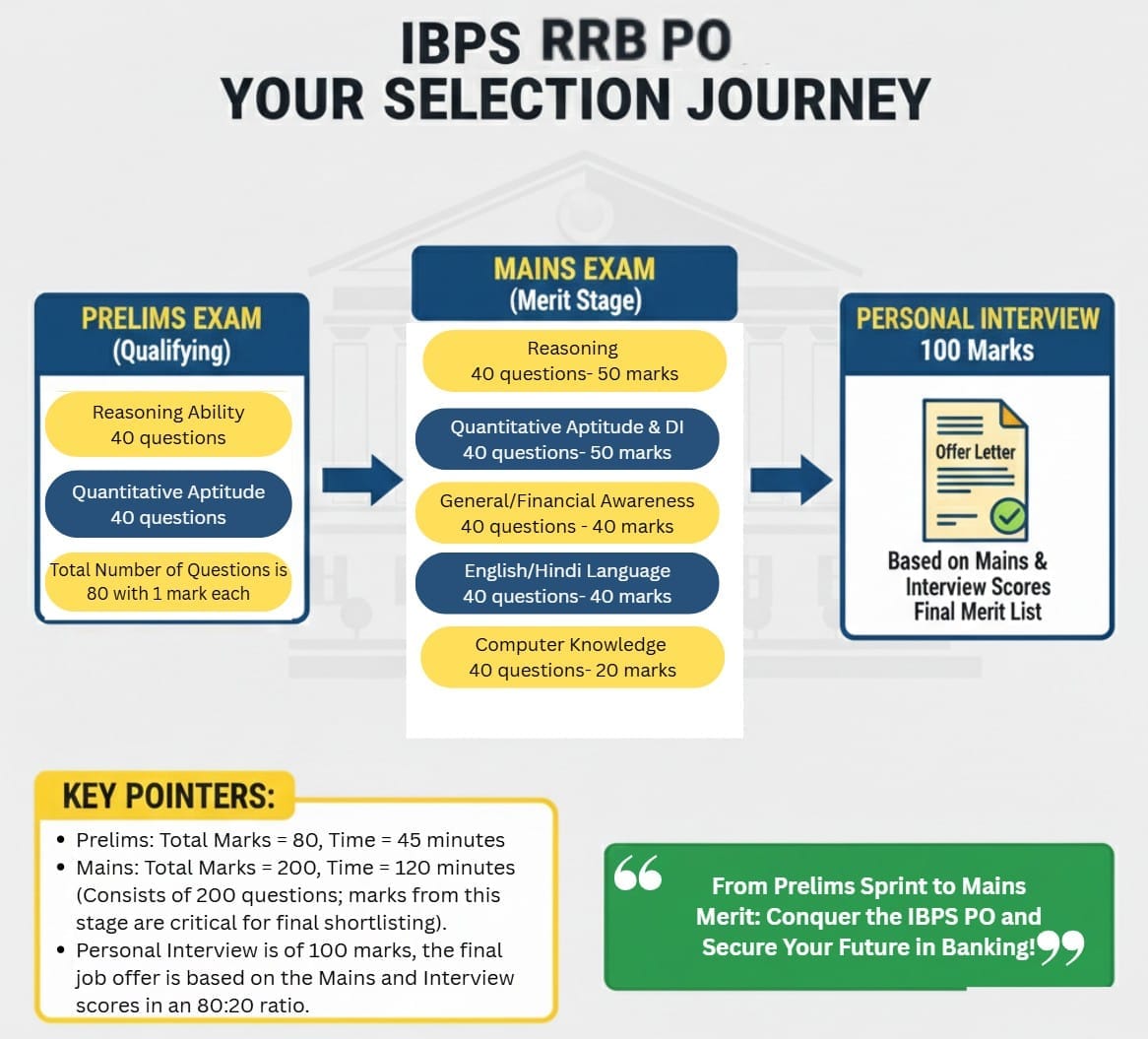
1. Selection Process by Scale
The recruitment process is divided into three Group "A" officer categories:
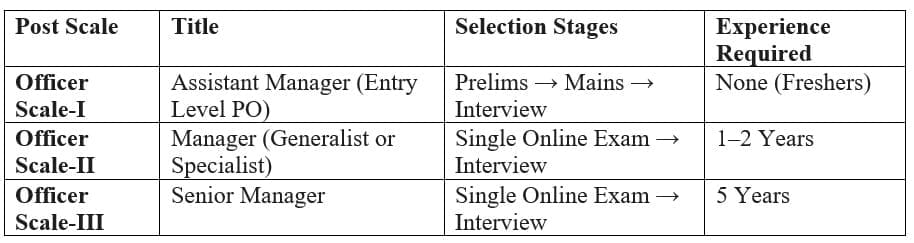
I. Preliminary Examination Pattern (Scale-I)
The Preliminary stage is a speed-based qualifying round designed to test your foundational aptitude in logic and calculation.
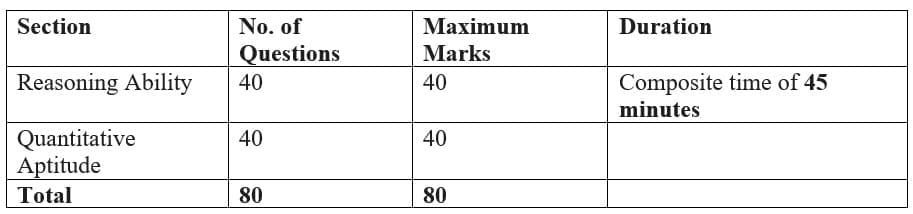
Key Detail: There are no sectional timers; you are free to allocate the 45 minutes between the two sections as you see fit. A penalty of 0.25 marks applies for every wrong answer in all exams.
II. Main Examination Pattern (Scale-I)
The Mains exam is the merit-defining stage that tests a broader range of skills, including digital literacy and financial awareness.
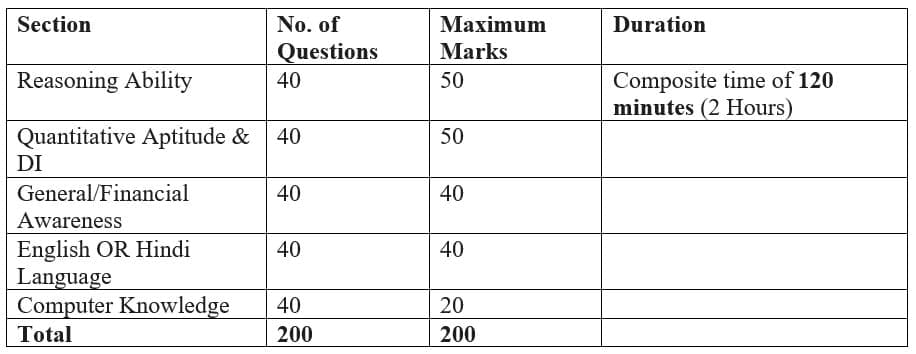
You have the unique option to choose between English or Hindi for the language section based on your proficiency.
III. Scale-II (General Banking Officer) & Scale-III Pattern
This pattern is designed for Generalist roles and mirrors the complexity of a Mains-level examination in a single sitting.
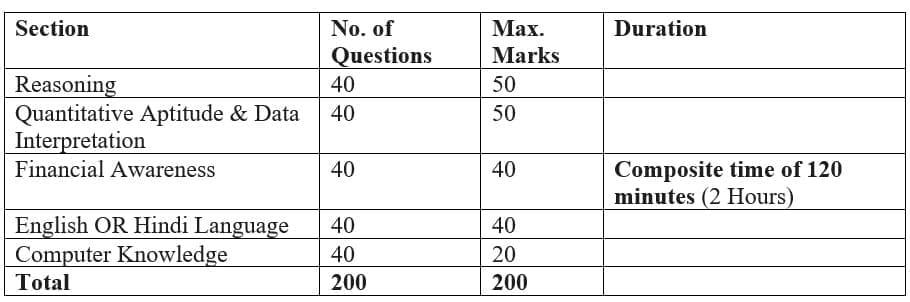
Unlike Scale-I, there is no Preliminary round; your performance in this single exam determines your interview shortlisting. Reasoning and Quantitative Aptitude are the highest-scoring sections, with a weightage of 1.25 marks per question.
IV. Scale-II (Specialist Cadre) Pattern
This pattern applies to specialist roles such as IT, Chartered Accountant, Law, Treasury, Marketing, and Agriculture Officers.
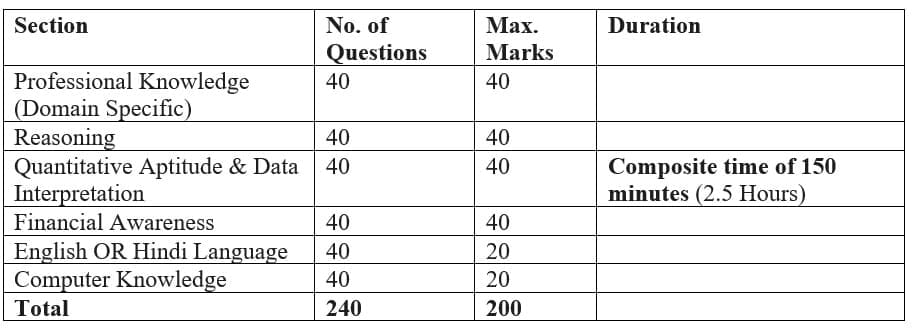
Candidates are given an additional 30 minutes to account for the increased question count and technical depth. The core "Professional Knowledge" section tests your specific field of expertise (e.g., JAVA/Networking for IT Officers).
IBPS RRB PO Reasoning 2026 Syllabus
Stage I. Preliminary Reasoning Syllabus (Qualifying Stage)
The Preliminary stage is designed to test speed and accuracy, with a heavy emphasis on core logical structures and basic arrangements.
I. Puzzles & Seating Arrangements (The Core):
- Linear Seating: Single row, double row facing each other, and rows with an "Uncertain Number" of persons.
- Circular & Square Seating: Facing inside, outside, or both directions; includes rectangular and triangular arrangements.
- Box & Floor Puzzles: Items stacked in boxes or people living on specific floors/flats.
- Scheduling Puzzles: Arrangements based on Days of the week, Months, Years, or specific Dates.
- Comparison Puzzles: Ranking persons or items based on height, weight, age, or marks.
II. Logical & Speed Topics:
- Syllogism: Direct cases and modern "Only a few," "Few," and "Possibility" patterns.
- Inequalities: Comparing elements using mathematical symbols (>, <, =) in direct or combined statements.
- Coding-Decoding: Sentence-based (Chinese) coding, substitution patterns, and letter shifting.
- Alphanumeric Series: Sequences involving letters, numbers, and symbols; includes missing and wrong term identification.
III. Miscellaneous Foundations:
- Blood Relations: Family tree construction and generation-based diagrams.
- Direction & Distance: Standard path-finding, shadow-based problems, and shortest distance calculations.
- Order & Ranking: Determining a person's position in a row or comparing multiple attributes.
Stage II. Main Examination Reasoning Syllabus (Merit Stage)
The Mains syllabus includes all Preliminary topics at an "Advanced" or "Multi-variable" level, along with high-weightage logical reasoning topics.
I. Advanced Arrangements:
- Multi-Parameter Puzzles: Arrangements involving 3 or more variables (e.g., Floor + Color + Department + City).
- Coded Logic: Coded Syllogism (Reverse cases), Coded Inequalities, Coded Blood Relations, and Coded Direction Sense.
II. Mains "Exclusives" (High Weightage):
- Machine Input-Output: Complex word-number shifting and mathematical operations in steps.
- Data Sufficiency: Determining if given statements (2-statement or 3-statement formats) are enough to solve a problem.
III. Critical (Verbal) Reasoning:
- Analytical Thinking: Statement & Assumptions, Statement & Conclusion, and Strength of Arguments.
- Decision Making: Course of Action, Cause & Effect, and Inference-based logical deductions.
IV. Computer Aptitude (Merged with Reasoning):
- Binary Logic: Number system conversions (Binary to Decimal/Hexadecimal).
- Technical Logic: Understanding logic gates (AND, OR, NOT) and flowchart-based aptitude problems.
Spend the first 45-60 seconds of a puzzle identifying the most definite piece of information (the "Anchor") before drawing. Starting with a fixed point instead of multiple "possibilities" can reduce your solution time significantly.
IBPS RRB PO Reasoning Topic-wise Weightage
The table below provides the topic wise weightage based on the latest trends.
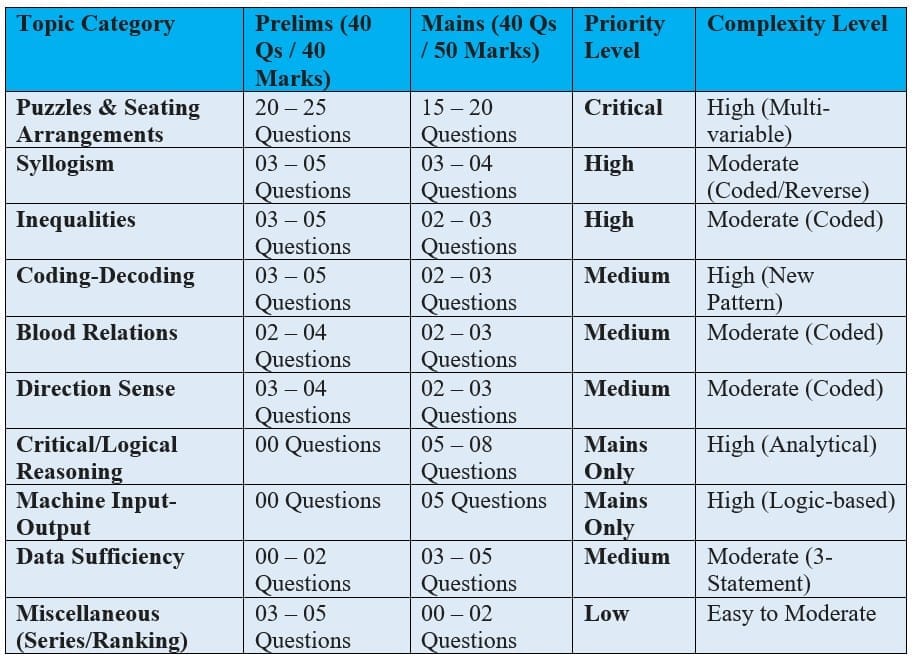
Edurev Tip: Puzzles and Seating Arrangements consistently account for 50% or more of the total questions in both stages, making them the most critical area for practice.
IBPS RRB PO Reasoning- Success Strategy
Why You Should Crack the IBPS RRB PO 2026
Transitioning from a student to a professional is a major milestone. Cracking this exam offers more than just a job; it provides a platform for both personal and societal impact.
- Financial Independence & Stability: A career as an RRB PO offers a competitive starting salary (approx. ₹74,000+ in-hand) alongside benefits like medical aid, pension schemes, and concessional loans.
- Rapid Career Trajectory: The promotional hierarchy is clear and merit-based. Starting as an Assistant Manager, you can advance to Deputy Manager, Branch Manager, and eventually reach senior leadership roles like General Manager.
- Direct Social Impact: Unlike urban banking, an RRB PO works at the grassroots level, facilitating agricultural growth, supporting local farmers, and implementing government development schemes that directly uplift rural India.
- Professional Identity: Beyond the designation, it offers a respected identity in society, providing a sense of pride for your family and establishing you as a leader in your community.
Phase I: Prelims Preparation Strategy
The Goal: 40/40 marks. In banking exams, the cut-offs are high and competitive, so speed is your primary weapon.
Study Commitment: 2 hours of daily focused Reasoning practice.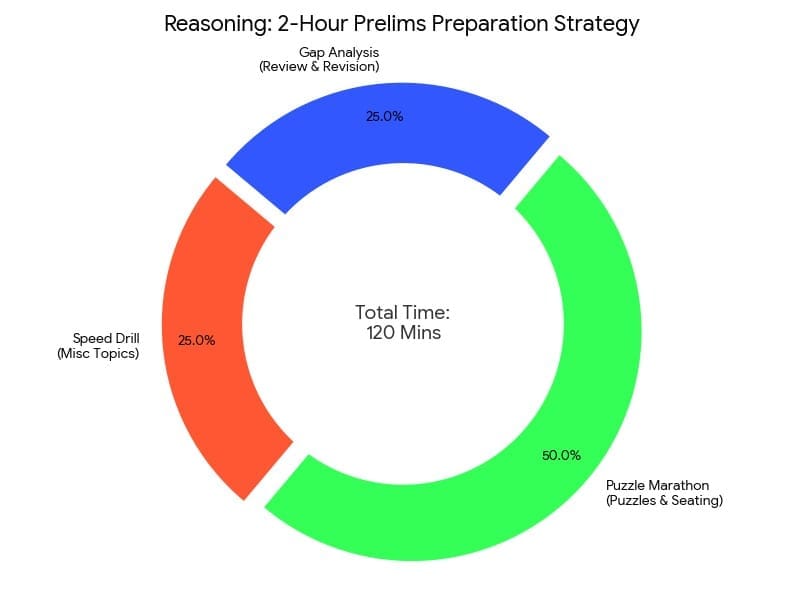
Part 1: The Speed Drill (30 Minutes)
- Focus: Miscellaneous Topics (Inequalities, Syllogism, Alphanumeric Series, Coding-Decoding).
- The Task: Solve 20-30 questions using a stopwatch.
- The Goal: These topics are your "buffer." If you can finish them in 7-10 minutes during the exam, you've already won. Aim for 100% accuracy at high speed.
Part 2: The Puzzle Marathon (60 Minutes)
- Focus: 4 Sets of Puzzles/Seating Arrangements daily.
- The Task: Solve 1 Linear, 1 Circular, 1 Floor-based, and 1 Box puzzle.
- The Technique:
- Attempt 1: Solve with a 3-minute timer.
- Attempt 2: If you fail, solve it without a timer to understand the logic.
- Reflection: Look at the "Anchor Clue" (the one that started the puzzle). If you missed it, you've found your core weakness.
Part 3: The "Gap" Analysis (30 Minutes)
- Focus: Review and Revision.
- The Task: Open your "Error Notebook." Look at the questions you got wrong yesterday. Can you solve them in half the time today?
- The Goal: Never make the same mistake twice. If a "Blood Relation" tree or complex pattern confused you, draw it again until the logic becomes muscle memory.
Phase II: Mains Preparation Strategy
The Goal: 45+ Marks in the merged Reasoning & Computer section. This stage requires depth, logical patience, and extreme accuracy.
Study Commitment: 2 hours of daily advanced-level practice.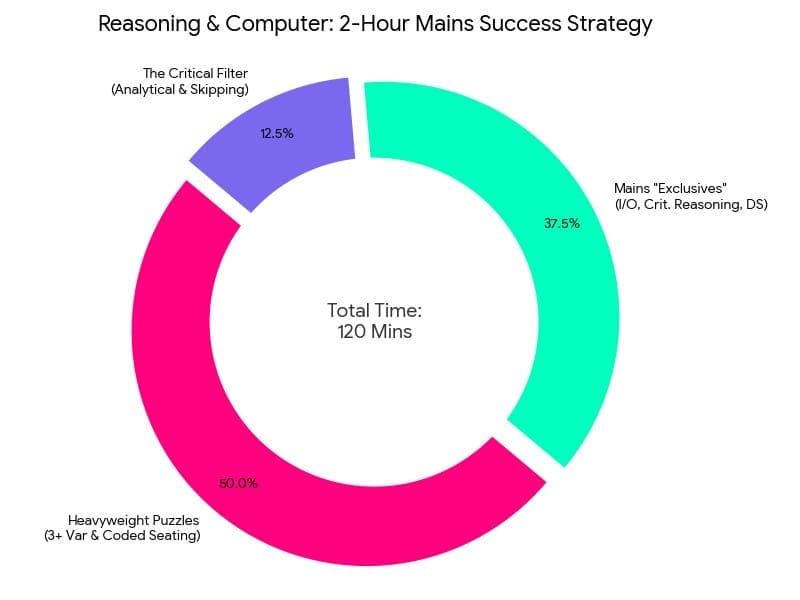
Part 1: The Heavyweight Puzzles (60 Minutes)
- Focus: High-level Puzzles (3+ Variables) and Coded Seating Arrangements.
- The Task: Solve exactly 2 advanced-level puzzles using the "Mapping" technique-map the variables for 3 minutes before drawing.
- The Goal: To build endurance for the composite 120-minute timer and ensure you can handle the most complex sets correctly.
Part 2: The Mains "Exclusives" (45 Minutes)
- Focus: Machine Input-Output, Critical Reasoning, and Data Sufficiency.
- The Task: Alternating days between these topics. For Critical Reasoning, focus on the "Elimination" method rather than guessing.
- The Goal: Secure the "hidden" marks that most students skip, as these are often more scoring than the most complex puzzles.
Part 3: The Critical Filter (15 Minutes)
- Focus: Analytical Reasoning (Statement-Assumption, Cause-Effect, Course of Action).
- The Strategy: Develop a "Zero-Error" mindset. If the logic feels subjective or you are unsure, learn to Skip.
- The Goal: Prevent "negative-mark leakage." One wrong guess here can wipe out the marks of a correctly solved 5-mark puzzle
Edurev Tip: Before you start solving any section, take exactly 60 seconds to scan through the questions. Identify the "low-hanging fruit"-these are the standalone topics like Inequalities, Syllogisms, and basic Number Series that you can solve in seconds.
The 30-day preparation Roadmap
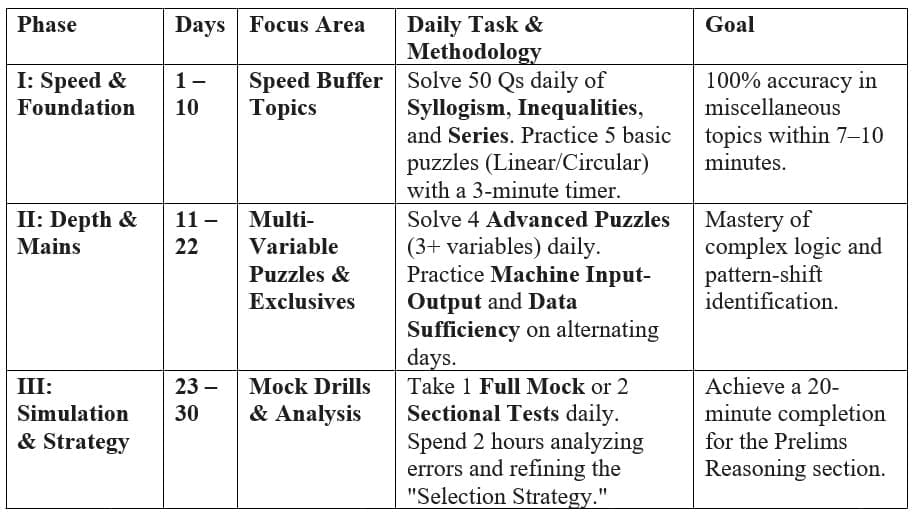
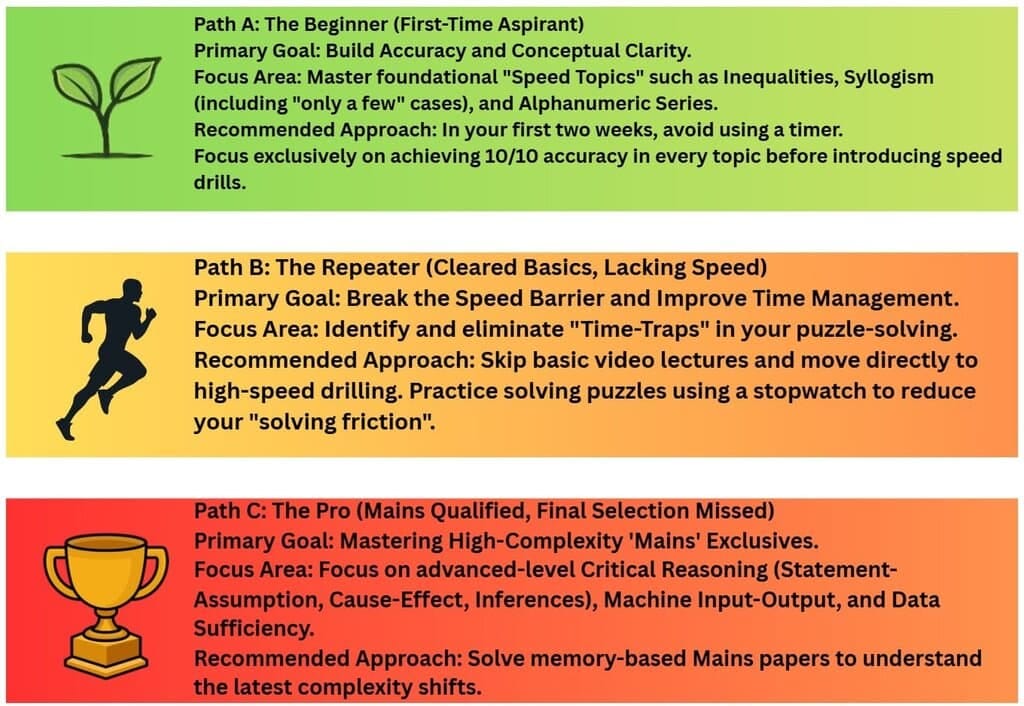
Custom Roadmap- Where do you stand
Success in the IBPS PO 2026 exam depends on identifying your unique strengths and weaknesses to turn daily effort into a definitive job offer.
"Cracking the IBPS RRB PO 2026 is not just about mastering a syllabus; it is about demonstrating the discipline and resilience required to lead India's rural banking transformation. Every puzzle you solve and every mock you analyze brings you one step closer to the cabin of an Officer. Stay focused, stay consistent, and secure your future in banking!"
FAQs on IBPS RRB PO Reasoning Syllabus 2026: Topic-wise Weightage & Strategy
| 1. What is the exam pattern for the IBPS RRB PO? |  |
| 2. What topics are included in the IBPS RRB PO Reasoning syllabus? | |
| 3. How is the topic-wise weightage determined for the IBPS RRB PO Reasoning section? | |
| 4. What is the success strategy for preparing for the IBPS RRB PO Reasoning section? | |
| 5. Why is it important to understand the syllabus and weightage for the IBPS RRB PO Reasoning section? | |