NABARD Manager General Awareness Syllabus 2026: Topic-wise Weightage & Strategy

NABARD Manager Grade 'B' Exam Pattern 2026
The National Bank for Agriculture and Rural Development (NABARD) is India's apex development bank, wholly owned by the Government of India. The recruitment for Managers (Grade B) is one of the most prestigious and competitive annual events in the regulatory banking sector.
Joining NABARD as a Grade B officer offers a unique opportunity to directly impact India's rural and agricultural economy through policy formulation, project monitoring, and support for rural credit institutions. Unlike commercial banking roles, this position focuses on sustainable rural development and fostering prosperity across the nation.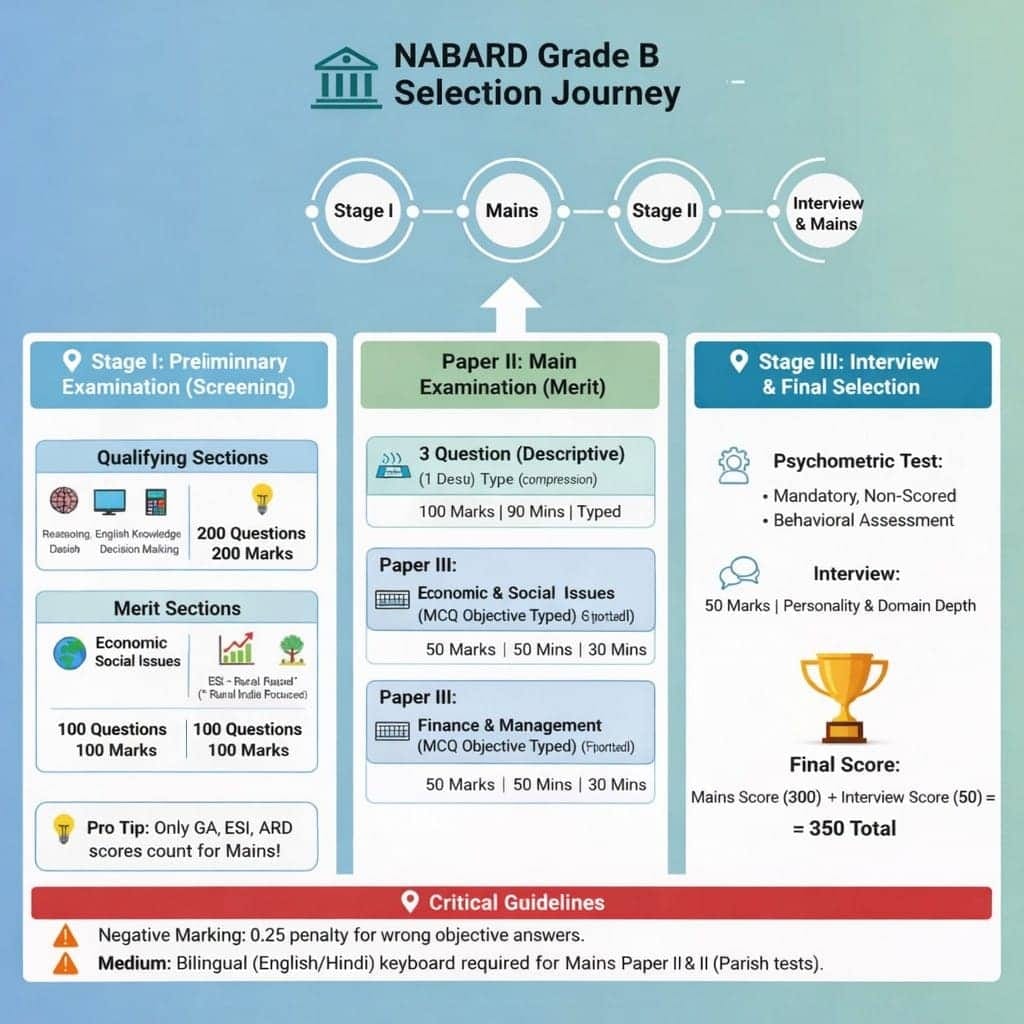
I. Preliminary Examination (Screening Stage)
The Prelims is an online objective test with 200 questions for 200 marks, to be completed in a composite time of 120 minutes.
NABARD categorizes sections into "Qualifying" and "Merit" sections. Your performance in the merit sections alone determines if you qualify for the Mains.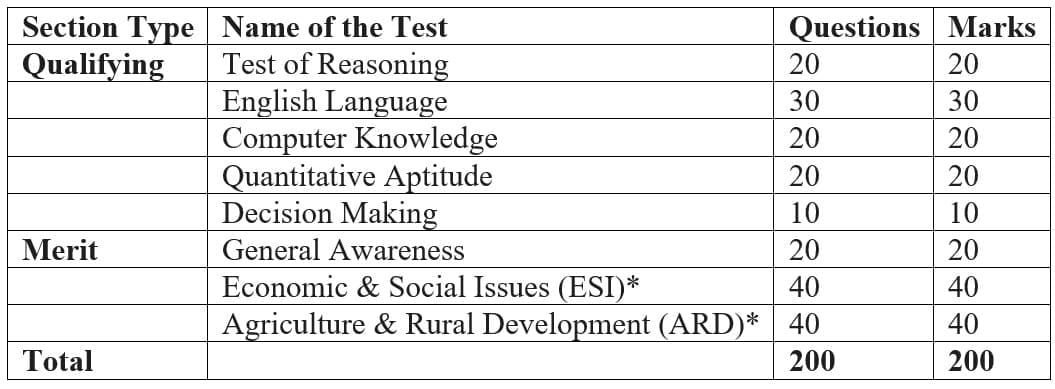
Key Pointer: While you must meet minimum cut-offs in all sections, only marks from GA, ESI, and ARD (Total 100) are used to shortlist candidates for the Mains. *Focus on Rural India for ESI and ARD.
II. Main Examination (Merit Stage)
The final selection merit list is based on your performance in the Mains and the Interview. It consists of two papers, both conducted online.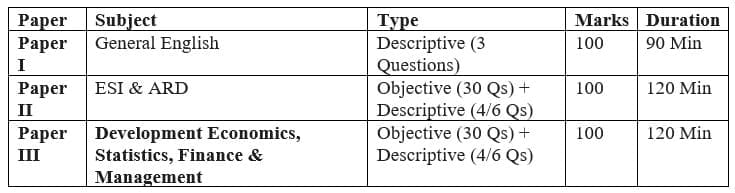
Grade B Paper III requires advanced knowledge in Macro & Micro Economics, Statistical Measures (Correlation, Probability), and Management Control Systems.
III. Final Stage: Psychometric Test & Interview
- Psychometric Test: Mandatory online behavioral assessment; it is non-scored but required for final selection.
- Interview: Worth 75 marks (compared to 50 marks for Grade B), reflecting the higher managerial responsibility of the role.
- Final Merit: Calculated by adding Mains Score (300) + Interview Score (75) = 375 Total.
NABARD Manager Grade 'B' General Awareness Syllabus 2026
The General Awareness (GA) section is one of the three Merit Sections in Phase I. Unlike qualifying sections, your marks here directly determine your eligibility for the Mains examination. It consists of 20 questions for 20 marks.
I. Banking & Financial Awareness
- Banking Terminology: Basic concepts of Repo Rate, Reverse Repo, MSF, and SLR.
- Regulatory Bodies: Role and functions of RBI, SEBI, IRDAI, and specifically NABARD.
- Financial Inclusion: Schemes like PMJDY, APY, and digital banking initiatives.
- Monetary Policy: Basics of how inflation and money supply are managed in India.
II. Current Affairs (National & International)
- Last 6 Months News: Focused on summits, conferences, and bilateral agreements.
- Awards & Honors: Recent recipients of civilian and sports awards.
- Sports: Major tournaments, winners, and venues.
- Appointments: New heads of international organizations, banks, and government bodies.
III. Government Schemes & Policies (High Priority)
- Rural Development Schemes: Focus on MGNREGA, PM-Kisan, and NRLM.
- Sustainable Initiatives: Green technology, renewable energy, and Viksit Bharat goals.
- Union Budget & Economic Survey: Key highlights, fund allocations, and growth projections for the current year.
IV. Static General Knowledge
- National Parks & Sanctuaries: Specifically those in news or related to biodiversity.
- Important Days: Themes and dates of internationally recognized days.
- International Organizations: Headquarters and heads (e.g., UN, World Bank, IMF).
NABARD Assistant Manager Grade 'B' General Awareness - Topic-Wise Weightage
The General Awareness (GA) section is a Merit Section, meaning your score here determines if you move on to the Mains. It consists of 20 questions (20 marks) that focus heavily on recent developments in the economy and rural sector.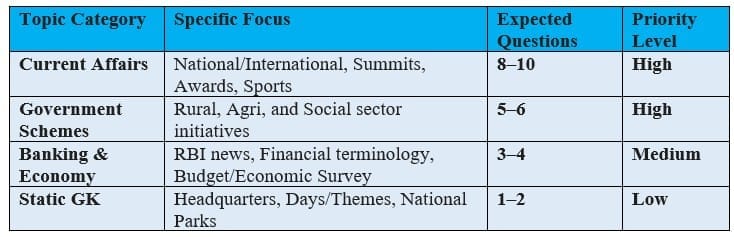
Edurev Tip: The majority of questions will come from the 4-6 months immediately preceding the exam date. Don't waste time on news older than 6 months.
NABARD Assistant Manager Grade 'B' General Awareness- Success Strategy
Why Crack NABARD Grade B (Manager)?
Before diving into the "how," it is vital to understand the "why." The NABARD Grade B role is one of the most prestigious and sought-after careers in the Indian regulatory and developmental banking sector for several key reasons:
- Elite Officer Status: Unlike clerical roles, you enter directly as an Manager (Officer Grade B), placing you in a position of authority and decision-making from Day 1.
- Direct Social Impact: Your work is not just about transactions; it literally transforms rural India by implementing government policies, managing credit for farmers, and promoting sustainable agriculture.
- Superior Work-Life Balance: NABARD is renowned for its professional and stable work culture, typically following a 5-day workweek (Monday to Friday) with standard office hours, which is rare in commercial banking.
- Lucrative Compensation & Perks: A new joinee receives a competitive gross monthly salary of approximately ₹1,00,000, along with exceptional perks like fuel allowance (up to 150-200 liters), household help allowance, and festival advances.
- High-End Educational Support: NABARD actively encourages growth by reimbursing 100% of fees for higher studies at prestigious institutions and offering study leaves or sabbaticals after your probation period.
- Fast-Track Career Growth: The promotion path is clear and structured. You can rise from Assistant Manager to Manager (Grade B) in just 3-5 years, eventually reaching senior management levels like General Manager or even Chief General Manager.
- Urban Lifestyle with Rural Purpose: While your work focuses on rural development, most postings are in State Capitals (Regional Offices) or the Head Office in Mumbai, ensuring you enjoy urban amenities while serving a rural cause.
General Awareness - Success Strategy
Since General Awareness is a Merit Section, your daily approach must balance breadth with deep retention to ensure you qualify for the Mains.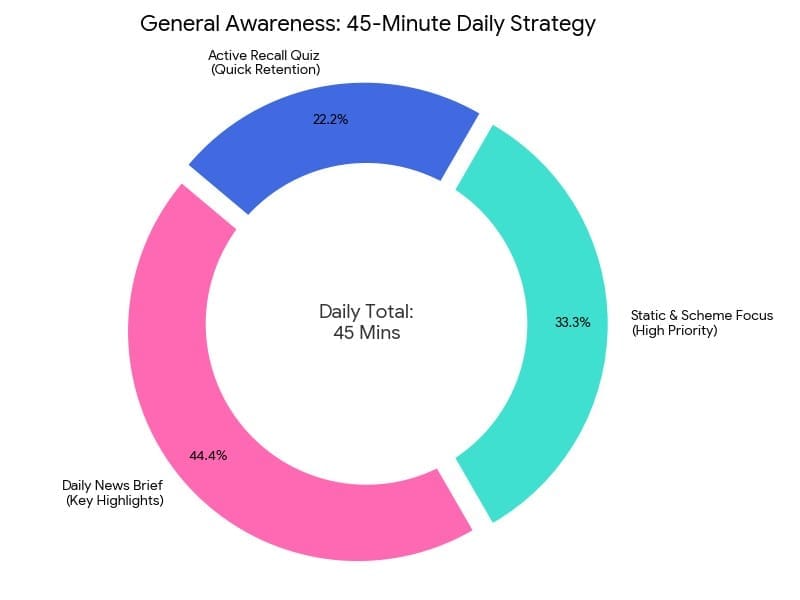
1. The "Daily News Hour"
- Time Commitment: Dedicate 45-60 minutes every morning to current affairs.
- The Routine: Read a reliable financial daily or use a dedicated banking exam portal to track news from the last 6 months.
- Note-Taking: Maintain a "One-Liner" notebook for appointments, awards, and sports to facilitate quick weekend revisions.
2. Government Scheme Deep-Dives
- The Technique: Instead of just memorizing names, understand the objective, nodal ministry, and budget allocation for key rural schemes like PM-Kisan or MGNREGA.
- Context: NABARD heavily favors schemes related to sustainable agriculture and rural infrastructure.
3. Banking & Economy Integration
- Strategic Linkage: Relate static banking terms (like Repo Rate or CRR) to current RBI notifications.
- Budget Tracking: For 2026, focus on the Viksit Bharat objectives and any new fund allocations for rural credit institutions.
4. Active Recall & Quizzing
- Goal: Attempt at least 20-30 daily MCQs on current affairs to test your retention.
- Accuracy: Since there is a 0.25 negative marking penalty, use these quizzes to practice the Elimination Strategy for dates and figures.
5. Weekend Revision Cycle
- Frequency: Spend every Sunday reviewing only what you studied during the week.
- Focus: Re-read complex data points like GDP growth projections or international summit themes that are easy to forget.
30-Day General Awareness Roadmap
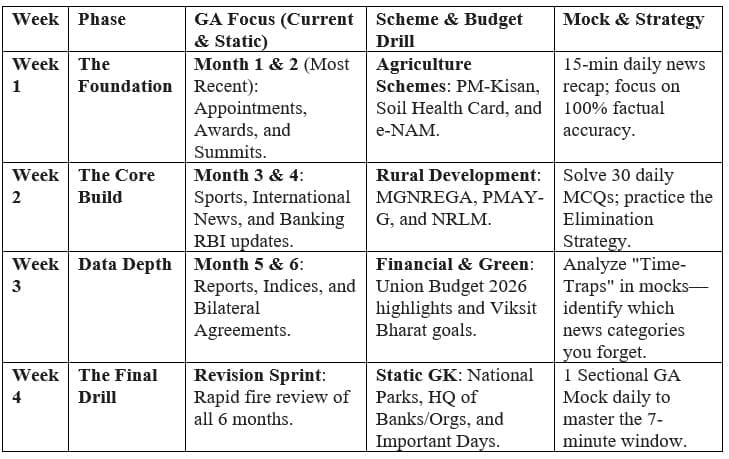
Edurev Tip: Focus on the "Rural India" context even in General Awareness; NABARD favors questions related to the agricultural economy and rural infrastructure.
Custom Roadmap - Where do you stand?
The strategy for a first-time aspirant is vastly different from someone who missed the cut-off by 0.5 marks. Choose the path that matches your current level: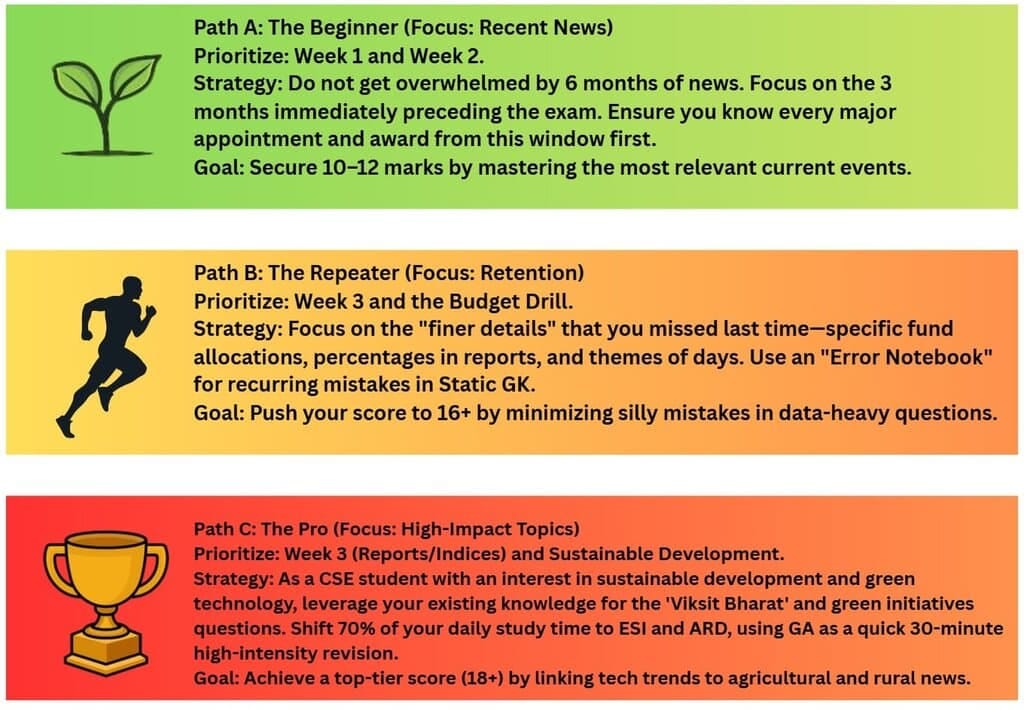
"Success in General Awareness is about the curiosity and connectedness required to lead a national development bank-stay informed today to drive India's rural prosperity tomorrow!"
FAQs on NABARD Manager General Awareness Syllabus 2026: Topic-wise Weightage & Strategy
| 1. What is the exam pattern for NABARD Manager Grade 'B'? |  |
| 2. What topics are covered under the General Awareness syllabus for NABARD Assistant Manager Grade 'B'? | |
| 3. How can candidates prepare effectively for the General Awareness section of the NABARD exam? | |
| 4. What is the topic-wise weightage for General Awareness in the NABARD Assistant Manager Grade 'B' exam? | |
| 5. What strategies can be employed to tackle the General Awareness section in the NABARD Manager exam? | |