D.N. Kundra Textbook Solutions: The Growth of Nationalism : The Age of Revolutions

History - Chapter 2The Growth of Nationalism: The Age of RevolutionsClass 8 - DN Kundra History & Civics SolutionsObjective Type QuestionsQuestion 1
Read the two statements given below about the results of the French Revolution. Select the option that shows the correct relationship between (A) and (R).
Assertion (A): It introduced democratic ideas and ended the supreme rule of kings.
Reason (R): In 1790 a new constitution was framed at Paris under the leadership of Napoleon Bonaparte.
- (R) contradicts (A)
- (R) is the reason for (A)
- (A) is true but (R) is false
- (A) and (R) are independent of each other
Ans: (A) is true but (R) is false
Explanation: (i) Assertion: The French Revolution did introduce democratic ideas and weakened the absolute rule of kings by challenging royal authority and promoting liberty and equality.
(ii) Reason: Incorrect. The constitution referred to was not framed under Napoleon's leadership. Napoleon rose to power later as a military leader and then as ruler.
(iii) Justification: The new constitution was prepared by the National Assembly (the Constituent Assembly) during the Revolution, not by Napoleon.
Identify the achievements of George Washington.
P: The Continental Army was led by him.
Q: He established the Young Socialist Party at Boston.
R: He became the first President of the United States of America.
S: He wrote 'A History of the English-speaking Peoples'.
- P and Q
- R and S
- P and R
- Q and S
Ans: (c)
Explanation: George Washington led the Continental Army during the American War of Independence and later became the first President of the United States. Options Q and S are incorrect: Washington did not found a socialist party, nor did he write the work named in S.
Question 3Sonali is preparing a project on "French Revolution". Which of the following philosophers would MOST LIKELY be part of her project?
- Voltaire
- John Locke
- Dante
- Aristotle
Ans: (a)
Explanation: Voltaire was a leading Enlightenment thinker whose ideas about liberty, reason and criticism of unjust authority influenced the French Revolution. John Locke influenced liberal ideas too, but Voltaire is most closely associated with French revolutionary thought among the options.
Question 4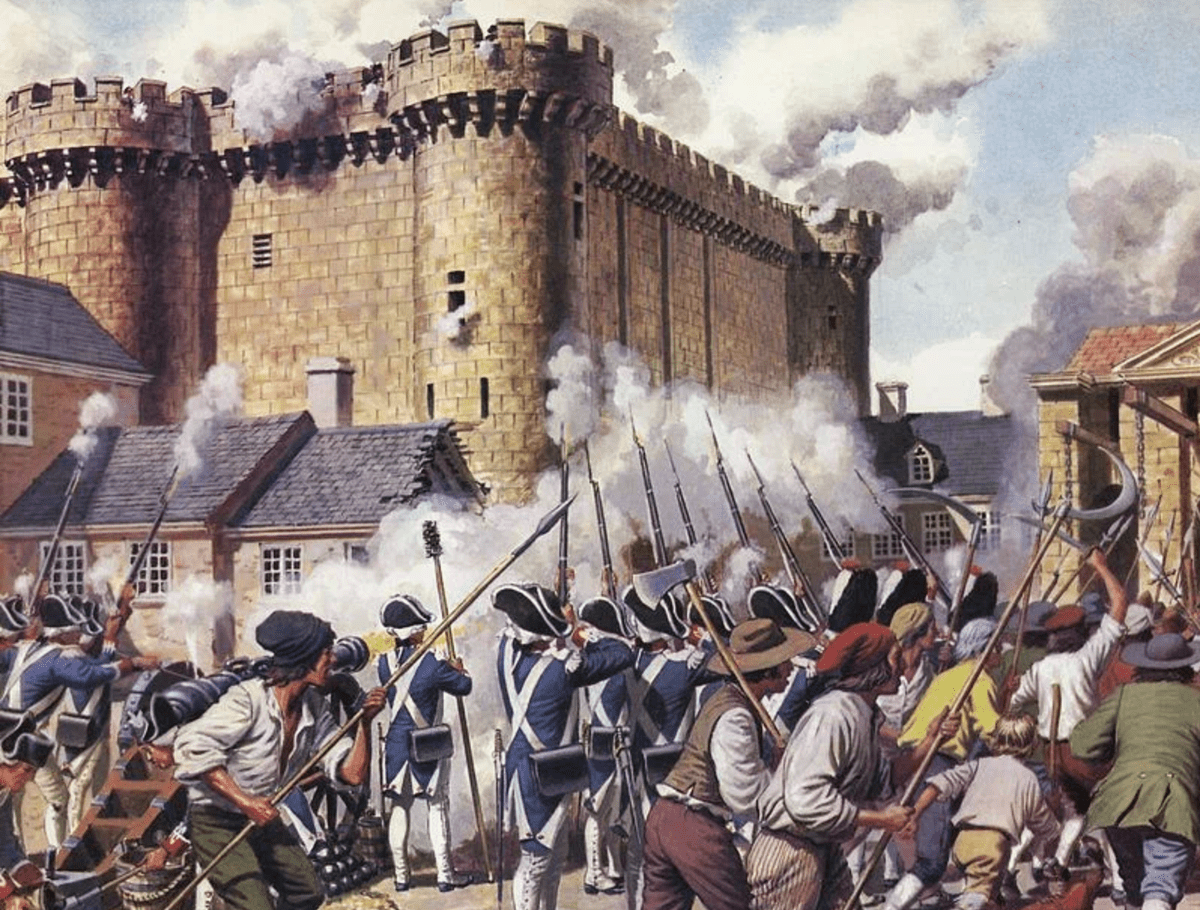
Which of the following events is being depicted by the given picture?
- Fall of Paris
- Arrest of Rousseau
- Boston Tea Party
- Storming of the Bastille
Ans: (d)
Explanation: The picture shows an armed crowd attacking a fortress-like prison, which represents the Storming of the Bastille on 14 July 1789 - a key event that symbolised the start of the French Revolution and the people's struggle against royal tyranny.
Question 5American Revolution : 1776 :: French Revolution : ...............
- 1787
- 1784
- 1789
- 1781
Ans: (c)
Explanation: The French Revolution began in 1789, marked notably by the Storming of the Bastille in July of that year.
Question 6Meghna is preparing a speech on the American Revolution. Which of the following person's contribution she must mention in her speech?
- Louis XVI
- Thomas Jefferson
- Napoleon Bonaparte
- Marie Antoinette
Ans: (b)
Explanation: Thomas Jefferson was a leading American thinker and the principal author of the Declaration of Independence (1776). His ideas about natural rights and government by consent were central to the American Revolution.
Question 7Consider the statements given below and choose the correct answer.
Statement I: In 1765, the English Parliament passed the Stamp Act which imposed stamp taxes on all business transactions.
Statement II: In 1774, Louis XVI of the Bourbon family of kings ascended the throne of France.
- Statement (I) is correct and statement (II) is incorrect.
- Statement (I) is incorrect and statement (II) is correct.
- Both statements (I) and (II) are incorrect.
- Both statements (I) and (II) are correct.
Ans: (d)
Explanation: Both statements are correct. The Stamp Act (1765) imposed taxes on many printed materials and transactions in the American colonies and caused strong protests. Louis XVI did become king of France in 1774.
Question 8Which among the following statements is correct?
- America was discovered by Columbus in CE 1492.
- Rousseau wrote that subjects have the right to overthrow a king who does not rule according to the general will.
- The most important effect of the French Revolution was that it awakened national feelings.
- All the above
Ans: (d)
Explanation: All three statements are correct: Columbus's voyage to the Americas was in 1492; Rousseau argued that people have the right to replace rulers who violate the general will; and the French Revolution helped awaken strong national feelings across Europe.
Question 9The Americans celebrate 4th of July every year as their
- Martyrdom day
- Constitution day
- Republic day
- Independence day
Ans: (d)
Explanation: 4 July is celebrated as Independence Day in the United States because the Declaration of Independence was adopted on 4 July 1776.
Question 10Who among the following was finally defeated in 1815 in the battle of Waterloo?
- George Washington
- Rousseau
- Woodrow Wilson
- Napoleon Bonaparte
Ans: (d)
Explanation: Napoleon Bonaparte was defeated at the Battle of Waterloo in 1815. This defeat ended his rule and led to his final exile.
Fill in the BlanksQuestion IIFill in the blanks.
- The thirteen American colonies were assisted by France under Louis XVI in gaining their freedom from their mutual enemy, Britain.
- The American Revolution began in 1776.
- The First Estate in France was made up of the Clergy.
- The USA has a written constitution, which makes the country a Federal, Democratic Republic.
- England had thirteen colonies in North America.
- American thinker Thomas Jefferson asked the people to rebel against their oppressors (England).
- A new country called the United States of America (USA) was born after the American Revolution.
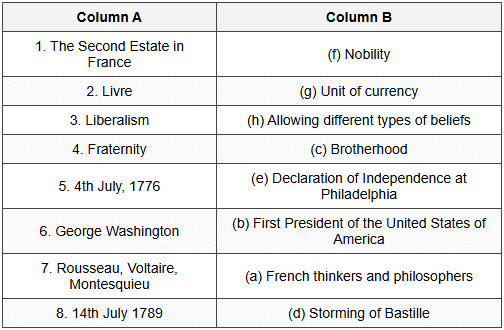
Match Column A with Column B.
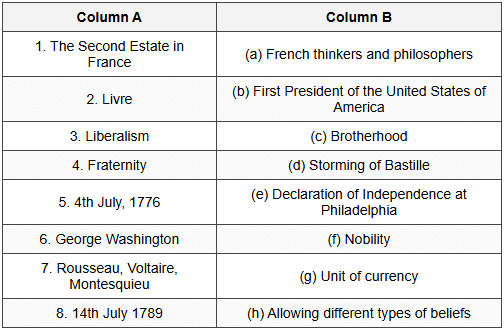
Answer:
State whether the following statements are True or False.
- The 13 colonies of North America were dissatisfied with the rule of the master country, England.
- The French society was divided into three classes, each enjoying similar rights and privileges.
- The French Revolution began with the storming of Bastille in 1789.
- A new constitution was framed by the French Assembly in 1785.
- The French Revolution led to the rise of nationalism in Europe.
- India was greatly inspired by both the American and French Revolution.
Ans:
- True. The 13 colonies were unhappy with British control, restrictions on trade, and heavy taxation, which led to protests and the push for independence.
- False. Correct statement: French society was divided into three estates (the Clergy, the Nobility and the Third Estate), and these estates did not enjoy similar rights and privileges; the Clergy and Nobility had many privileges that the common people did not.
- True. The Storming of the Bastille on 14 July 1789 is widely regarded as the event that marked the beginning of the French Revolution.
- False. Correct statement: A new constitution was framed by the National Constituent Assembly in 1791, which limited royal power and attempted to establish a constitutional monarchy.
- True. The Revolution awakened national feelings across Europe and encouraged people to seek self-determination and national unity.
- True. The ideas and events of both the American and French Revolutions inspired Indian thinkers and later freedom movements by showing that colonial or monarchical rule could be challenged.
Define the term Nationalism.
Ans: Nationalism is a strong feeling of love, loyalty and devotion towards one's nation. It is the belief that people who share a common language, culture, history and territory should unite under one government and work together for the welfare, independence and progress of their country.
Question 2What were the causes for the American War of Independence?
Ans:
- The colonists were restricted in trade and industry and were forced to trade mainly with England; they also bore heavier taxes than people in Britain.
- The English Parliament passed the Stamp Act in 1765, imposing taxes on many printed materials and business transactions, which caused strong resentment among colonists.
- Colonists were inspired by European philosophers such as John Locke, Voltaire, Rousseau and Montesquieu, who wrote about liberty, equality and the rights of people.
- American leaders and thinkers, including Thomas Jefferson, urged people to stand up against what they considered tyrannical rule by Britain.
- Events like the Boston Tea Party (1773), where colonists protested by dumping British tea into the sea, intensified conflict and led toward open rebellion.
Explain the significance of the American Revolution.
Ans:
- The American Revolution was a landmark event that led to the formation of the United States of America as an independent nation.
- It established principles of liberty, equality and individual rights and demonstrated that a colony could successfully gain independence from a colonial power.
- The Revolution inspired other peoples and colonies around the world, including in Europe and India, to seek freedom and democratic forms of government.
- It also influenced political thought and was an important example for the later French Revolution.
Why did the French Revolution take place?
Ans:
- France faced severe financial problems after long years of war; the treasury was nearly empty when Louis XVI became king.
- Huge debts had built up partly because France helped the American colonies against Britain, increasing the burden on the state.
- To raise money the state increased taxes, but the burden fell mainly on the Third Estate (common people), while the Clergy and Nobility paid little or no tax and kept many privileges.
- The common people lived in hardship and were angered by unequal treatment and privileges enjoyed by the rich.
- Enlightenment ideas from writers such as Rousseau, Montesquieu and Voltaire encouraged people to demand liberty, equality and justice, and the American example gave them hope that change was possible. All these factors led to the Revolution.
What were the results of the French Revolution?
Ans:
- The Revolution introduced democratic ideas and significantly weakened the absolute power of kings.
- The Church and many nobles lost their lands and privileges; some land was redistributed, and social power shifted.
- Slavery in some French colonies was challenged and slaves were set free in certain cases.
- The slogans Liberty, Equality, Fraternity promoted a new democratic and social order in Europe.
- National feelings were awakened; common people became ready to defend their new rights and privileges.
- The Revolution inspired other European peoples to challenge oppressive governments and seek national self-determination.
- The ideals of liberty and equality had a long-lasting influence and are reflected in many later democratic documents; they are also echoed in the Preamble to the Indian Constitution.
Read the passage given below and answer the questions that follow.
The most potent effect of the French Revolution was that it awakened national feelings. The common people were prepared to die for the sake of protecting the rights and privileges they had got due to the Revolution. It also inspired other European people to overthrow their oppressive governments. The words Liberty, Equality, and Fraternity find a mention in the Preamble to the Indian Constitution.
(i) The French Revolution took place in 1789.
(ii) Liberty, Equality, and Fraternity were the chief slogans of the French Revolution.
(iii) The word 'Preamble' means introduction or preface.
Ans: (i) 1789; (ii) Liberty, Equality and Fraternity were the chief slogans of the French Revolution; (iii) 'Preamble' means introduction or preface.
A Period of Transition
The American Civil War
Contents