D.N. Kundra Textbook Solutions: The Great Uprising of 1857

History - Chapter 7
The Great Uprising of 1857
Class 8 - DN Kundra History & Civics Solutions
Objective Type Questions
Question 1Read the two statements given below about the Great Uprising of 1857. Select the option that shows the correct relationship between (A) and (R).
Assertion (A): There was constant drain of wealth from India to Britain.
Reason (R): An Indian soldier called Sepoy could not rise above the post of a Subedar.
- (R) contradicts (A)
- (R) is the reason for (A)
- (A) is true but (R) is false
- (A) and (R) are independent of each other
Ans: (A) and (R) are independent of each other
Explanation:
(i) Assertion: There was a steady drain of wealth from India to Britain caused by colonial trade policies, heavy taxation and revenue transfers to Britain.
(ii) Reason: Sepoys being unable to rise above the rank of Subedar refers to limits in the military and social status of Indian soldiers under British rule.
(iii) Justification: The first statement is an economic grievance affecting the whole country, while the second is a military and social grievance specific to Indian soldiers. One did not cause the other, so they are independent.
Question 2Identify the main results of the Great Uprising of 1857.
P: Continuation of Sati system.
Q: Discouragement of English education among Indians.
R: End of the East India Company.
S: Abolition of Doctrine of Lapse.
- P and Q
- R and S
- P and R
- Q and S
Ans: (b)
Explanation: The uprising led to the end of the East India Company in 1858 when the British Crown took direct control of India, and the policy of annexation by the Doctrine of Lapse was abandoned to placate Indian rulers. Continuation of Sati and discouragement of English education were not outcomes of the revolt.
Question 3Vineeta is preparing a project on the "Importance of Lucknow in the Great uprising of 1857". Which of the following rulers is she MOST LIKELY to highlight?
- Kunwar Singh
- Mangal Pandey
- Bahadur Shah Zafar
- Begum Hazrat Mahal
Ans: (d)
Explanation: Begum Hazrat Mahal played a leading role in the Lucknow revolt, organising resistance against the British and administering affairs after her husband was deposed. Her leadership makes her the most relevant figure for a project on Lucknow.
Question 4Identify the ODD ONE out of the following main causes of the Great uprising of 1857.
- Vernacular Press Act
- Constant drain of wealth from India to Britain
- Doctrine of Lapse
- Introduction of a new rifle "Enfield" for the Sepoys
Ans: (a)
Explanation: The Vernacular Press Act (1878) came later and was aimed at controlling the Indian-language press; it was not a direct cause of the 1857 uprising. The other three items-economic drain, Doctrine of Lapse, and the Enfield cartridge controversy-were direct causes or immediate triggers of the 1857 revolt.
Question 5Which of the following events is being depicted in the below picture?
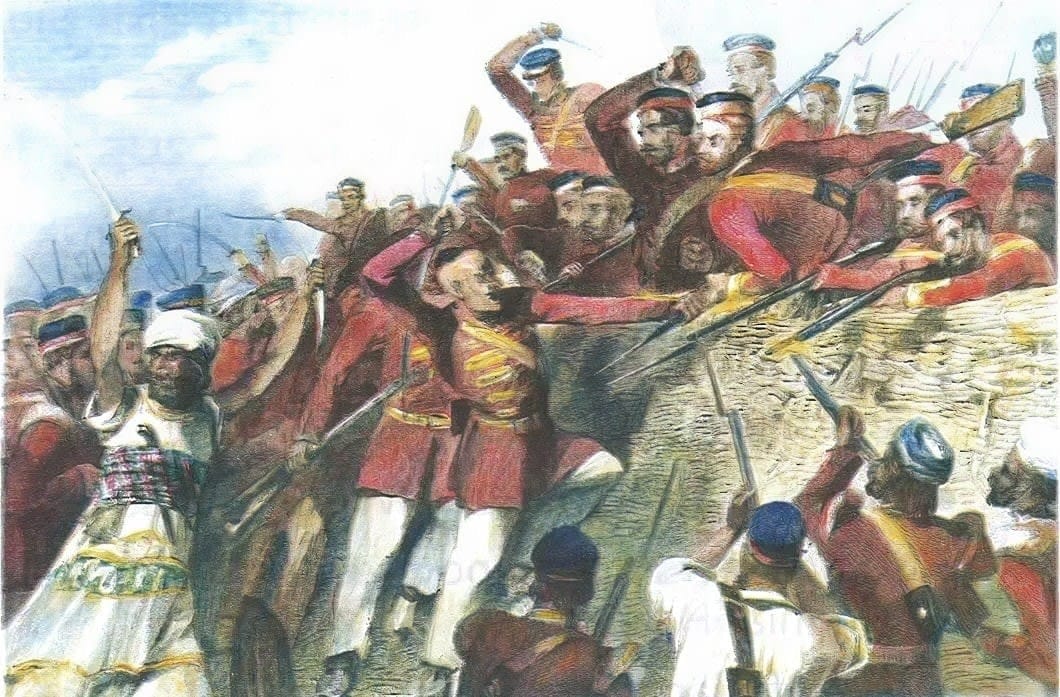
- Santhal Revolt
- Sepoy Mutiny
- Fishermen Mutiny
- Peasants Revolt
Ans: (b)
Explanation: The picture depicts soldiers and conflict between Indian troops and British officers, which refers to the Sepoy Mutiny (the widespread uprising of 1857 involving Indian soldiers).
Question 6Consider the statements given below and choose the correct answer.
Statement I: The introduction of western education was also viewed as an attack on the Indian social and religious customs.
Statement II: India's wealth was used to expand British trade and maintain their huge administrative staff in India.
- Statement (I) is correct and statement (II) is incorrect.
- Statement (I) is incorrect and statement (II) is correct.
- Both statements (I) and (II) are incorrect.
- Both statements (I) and (II) are correct.
Ans: (d)
Explanation: Both statements are correct. Western education and missionary activity were seen by many Indians as attacks on their customs and religion. At the same time, colonial policies led to transfer of wealth from India to Britain, which helped expand British trade and pay for a large administrative and military establishment in India.
Question 7Which among the following statements is incorrect?
- Mangal Panday, a Sepoy at Barrackpore, refused to bite the cartridges.
- Historians have held same views about the nature of the outbreak of 1857.
- During the uprising, the British soldiers were well equipped with modern weapons than the Indian soldiers who fought with outdated weapons.
- After the Revolt of 1857, the British started following the policy of 'divide and rule' to minimize the threat of any future rebellion.
Ans: (b)
Explanation: Historians have not held the same view about the 1857 outbreak; interpretations vary widely (mutiny, rebellion, religious war, national uprising). The other statements are broadly correct: Mangal Pandey's actions were important, British forces had superior arms, and 'divide and rule' policies were reinforced after 1857.
Question 8Identify the ruler on the basis of the given clues.
- He was the last Mughal emperor.
- He was imprisoned and exiled to Rangoon where he died in 1862.
- Ahmad Shah Abdali
- Murshid Quli Khan
- Alivardi Khan
Ans: Bahadur Shah Zafar
Question 9The East India Company passed the General Service Enlistment Act in 1856 which made it compulsory for:
- all new recruits to serve overseas if required.
- all new recruits to work till the age of 50 years.
- all new recruits to work till the age of 35 years.
- all new recruits to work for Bengal Royal Army for the period of at least five years.
Ans: (a)
Explanation: The General Service Enlistment Act required all new Indian recruits to serve overseas if called upon. This caused resentment among sepoys who feared service outside India for religious or social reasons and contributed to unrest.
Question 10Match the following columns:
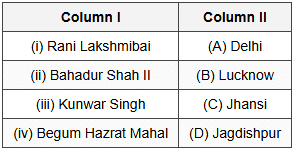
Select an appropriate option:
- (i) B, (ii) D, (iii) A, (iv) C
- (i) C, (ii) D, (iii) B, (iv) A
- (i) A, (ii) B, (iii) D, (iv) C
- (i) C, (ii) A, (iii) D, (iv) B
Ans: (d)
Explanation: Option (d) gives the correct pairings as (i) C, (ii) A, (iii) D, (iv) B. These match the items in Column A to the appropriate descriptions in Column B as shown in the diagram.
Fill in the blanks
Question IIFill in the blanks.
By his policy of Doctrine of Lapse ............... annexed ............... and ............... .
In Lucknow ............... led the revolt.
The rebels proclaimed ............... as the emperor of India.
The General Service Enlistment Act was passed in ............... .
Ans:
Lord Dalhousie, Satara, Jhansi, Nagpur.
Begum Hazrat Mahal.
Bahadur Shah Zafar.
1856.
Match the following
Question IIIMatch Column A with Column B.
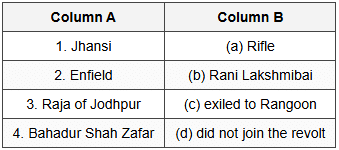
Ans:
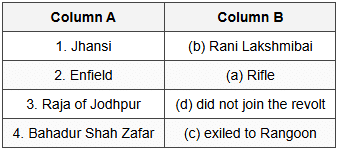
True or False
Question IVState whether the following statements are True or False.
Awadh was annexed on the ground of maladministration.
The British supported Sati.
The Indian soldiers were paid much less as compared to their British counterparts.
The Revolt of 1857 did not involve the masses.
Ans:
Ans: True
Explanation: Awadh was annexed by Lord Dalhousie in 1856 on the pretext of maladministration, which was one of the political causes of resentment.Ans: False
Explanation: The British opposed the practice of Sati and banned it (Regulation XVII, 1829). They did not support Sati; instead, reform measures prohibited it.Ans: True
Explanation: Indian sepoys were generally paid less than their British counterparts and faced discrimination in allowances and promotions, which created resentment among Indian soldiers.Ans: False
Explanation: The Revolt of 1857 involved large sections of society in many regions - soldiers, peasants, artisans, and some local rulers - and was not confined to the army alone.
Answer the following questions briefly
Question 1How were the economic policies of the British responsible for the Revolt of 1857?
Ans:
- The new land revenue systems required cash payments and allowed seizure of land, which burdened peasants and increased indebtedness to moneylenders and zamindars.
- Cheap machine-made imports from Britain flooded Indian markets after the Industrial Revolution, causing a sharp decline in Indian handicraft industries and unemployment among artisans and weavers.
- Annexation policies deprived many princely states' officials and soldiers of service and jagirs, creating discontent among displaced personnel.
- Wealth was transferred out of India to finance British trade and to maintain a large administrative and military establishment in India, creating widespread economic hardship.
- Confiscation of jagirs under governors such as Bentinck and Dalhousie caused discontent among loyal zamindars and taluqdars, removing their traditional incomes and support for the British.
Discuss the social and religious causes responsible for the Revolt of 1857.
Ans:
- Reform measures promoted by the British-such as the abolition of Sati and restrictions on practices-were seen by many Indians as interference in social and religious customs, creating distrust.
- Christian missionary activity and the spread of Western ideas made many Indians fear forced conversions and loss of religious identity.
- The introduction of Western education threatened traditional learned classes and their influence, and it was viewed by some as an attack on established customs.
- Racial discrimination and contempt shown by many British officials and officers added to the resentment felt by Indians in social and official life.
Why do you think the Revolt of 1857 failed? Discuss any four causes for its failure.
Ans:
- The revolt lacked unity of purpose and organisation; it did not become an all-India movement and was not coordinated across regions.
- Several important rulers and large military units (for example, many Sikh and some princely forces) remained loyal to the British, denying the rebels wider support.
- The rebels generally had inferior weaponry and lacked trained leadership and discipline compared with the British forces.
- The rebels lacked adequate financial resources and administrative organisation to sustain a prolonged struggle against a better equipped and funded British government.
Discuss the nature of the Uprising of 1857.
Ans:
- Some British historians called it a 'mutiny' limited to the army and not supported by the masses.
- Others described it as a 'religious war' against the Christians or a racial struggle between Europeans and Indians.
- Some wrote of it as a clash between Oriental and Occidental cultures and civilisations.
- A few attributed it to a Hindu-Muslim conspiracy to overthrow British rule.
- Indian nationalists later described it as the 'First War of Indian Independence', viewing it as an early national struggle.
Give reasons
Question 1Give reasons: State of Awadh was annexed by the British.
Ans:
The state of Awadh was annexed by Lord Dalhousie in 1856 on the pretext of maladministration. This annexation caused widespread anger among the people and dispossessed many nobles and officials.
Question 2Give reasons: Indian artisans, weavers, and craftsmen lost their means of livelihood.
Ans:
With the Industrial Revolution, British manufactured goods flooded Indian markets at low prices. Indian handicrafts and textile industries could not compete with machine-made imports, leading to decline of local industries and loss of livelihood for artisans and weavers.
Question 3Give reasons: The Indian sepoys refused to bite the cartridges of the Enfield rifle.
Ans:
It was rumoured that the Enfield rifle cartridges were greased with cow and pig fat. This offended Hindu and Muslim religious sensitivities (cow sacred to Hindus; pig taboo for Muslims). The sepoys saw it as an attempt to defile their religions, so they refused to bite the cartridges.
Picture Study
Question 1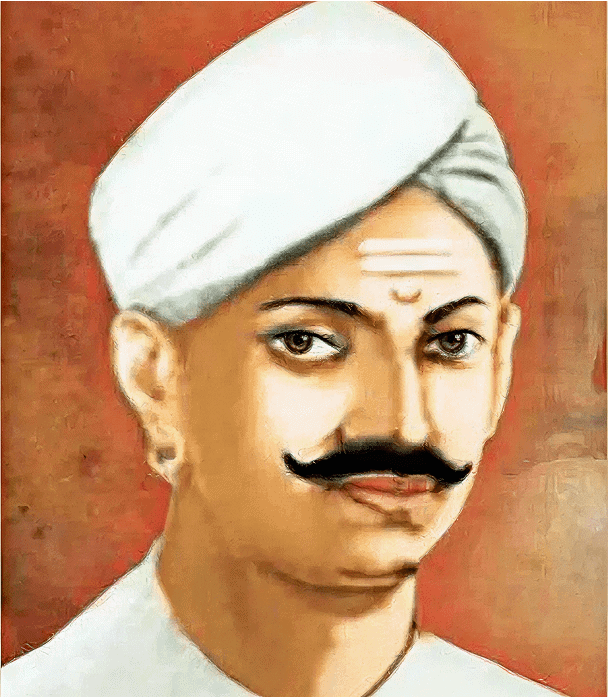
- Name the Indian soldier who fired on the British officers at Barrackpore.
- How far were the greased cartridges responsible for the Revolt?
- Give your opinion as to how the Revolt would have been successful.
Ans:
- Mangal Pandey.
- The greased cartridges were an immediate and visible trigger that sparked anger among the sepoys because they violated religious sensibilities. However, they were only the tipping point; deep-rooted economic exploitation, political annexations, social reforms viewed as interference, and discrimination had already created widespread discontent that made a large-scale uprising possible.
- For greater success, the revolt would have needed:
- United leadership and a clear common aim to coordinate actions across regions.
- Broader support from more princely states, zamindars, peasants and artisans to provide political legitimacy and resources.
- Better military organisation and access to modern weapons to match British firepower.
- Effective communication and planning to sustain prolonged resistance rather than isolated uprisings.
Assertion Reason Type Questions
Question 1Assertion (A): The Uprising of 1857 failed in India.
Assertion (A): Reason (R): Rulers like Sindhia, Holkar, Raja of Jodhpur did not join the revolt. Instead,