Ratna Sagar Textbook Solutions: Nervous System in Humans

Check your progress
Q1: The reaction of an organism to a stimulus is called a ............... .
Ans: The reaction of an organism to a stimulus is called a response.
Q2: The basic structural unit of the nervous system is called a ............... .
Ans: The basic structural unit of the nervous system is called a neuron .
Q3: ............... nourishes the brain and absorbs shocks.
Ans: Cerebrospinal fluid nourishes the brain and absorbs shocks.
Q4: .............. is the largest part of the brain.
Ans: Cerebrum is the largest part of the brain.
Q5:............... maintains the balance of the body.
Ans: Cerebellum maintains the balance of the body.
Tick the most appropriate Answer
Q1: Short fibres extending from the cell body of a nerve cell are called
- dendrons
- axons
- dendrites
- ganglia
Ans: dendrons
Reason: Short fibres extending from the cell body of a nerve cell are called dendrons which further divide to form dendrites.
Q2: The message that travels along a nerve is called
- stimulus
- response
- sensation
- impulse
Ans: impulse
Reason: Messages along the neuron travel in the form of a wave of chemical disturbance. This chemical disturbance is called an impulse.
Q3: Breathing and heartbeat are controlled by the
- cerebellum
- cerebrum
- medulla oblongata
- nerve cells
Ans: medulla oblongata
Reason: Medulla oblongata controls involuntary movements like breathing and heartbeat.
Q4: This is the centre for intelligence and memory
- cerebellum
- cerebrum
- medulla oblongata
- spinal cord
Ans: cerebrum
Reason: Centre for intelligence and memory is cerebrum.
Q5: This part of the brain maintains the balance of the body.
- cerebellum
- cerebrum
- medulla oblongata
- spinal cord
Ans: cerebellum
Reason: Cerebellum maintains the balance of the body.
Fill in the blanks
Q1: ............... is the basic structural unit of the nervous system.
Ans: Neuron is the basic structural unit of the nervous system.
Q2: A single long fibre extending from the cell body of a neuron is called ............... .
Ans: A single long fibre extending from the cell body of a neuron is called axon .
Q3: The central nervous system comprises ............... and ............... .
Ans: The central nervous system comprises brain and spinal cord .
Q4: The ............... nervous system comprises the nerves arising from the brain and spinal cord.
Ans: The peripheral nervous system comprises the nerves arising from the brain and spinal cord.
Q5: The brain is enveloped by three membranes called ............... .
Ans: The brain is enveloped by three membranes called meninges.
Match the following
Q1: Match the following
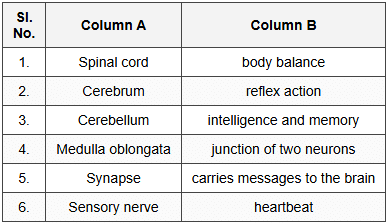
Ans: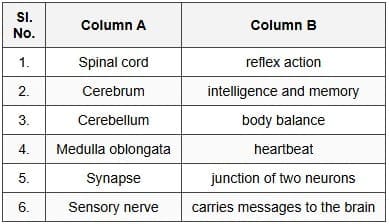
Write true or False. Correct the false statements.
Q1: Each nerve cell consists of a cell body, many short fibres and a long fibre.
Ans: False
Corrected statement: Each nerve cell consists of a cell body, many short fibres which further divide into dendrites and a long fibre.
Q2: Mixed nerves carry impulses from the sense organs to the spinal cord.
Ans: False
Corrected statement: Mixed nerves contain both sensory and motor fibres hence they perform the function of both sensory nerves and motor nerves.
Q3: The cerebellum is the largest part of the brain.
Ans: False
Corrected statement: The cerebrum is the largest part of the brain.
Q4: Thinking, reasoning and memory are controlled by the medulla oblongata.
Ans: False
Corrected statement: Thinking, reasoning and memory are controlled by the cerebrum.
Q5: The cerebrum controls the balance of the body.
Ans: False
Corrected statement: The cerebellum controls the balance of the body.
Differentiate between
Q1: neuron and nerve
Ans:
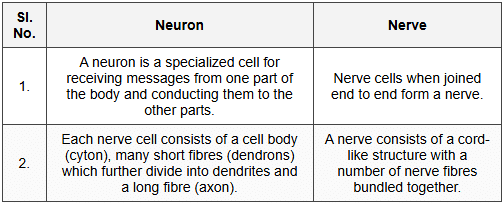
Q2: sensory nerves and mixed nerves.
Ans:
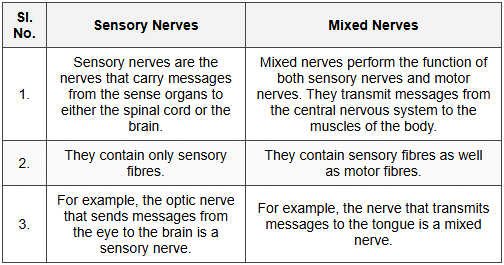
Q3: central nervous system and peripheral nervous system
Ans:
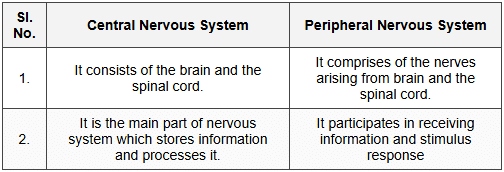
Q4: cerebrum and cerebellum
Ans:
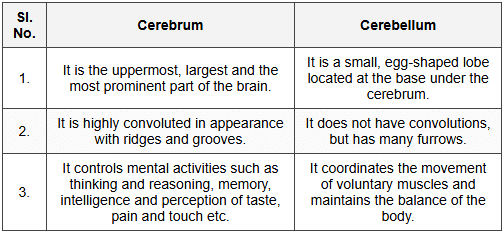
Ans:
Find the odd one out. Give reasons for your choice.
Q1: dendron, cyton, cerebrum, dendrite, axon
Ans: cerebrum
Reason: Cerebrum is the part of brain while others are part of nerve cell or neuron.
Q2: thinking, reasoning, memory, body balance
Ans: body balance
Reason: Body balance is the function of cerebellum while thinking, reasoning and memory are functions of cerebrum
Ans: the following in short
Q1: What is a stimulus?
Ans: Any sudden change in the environment of an organism that causes a reaction in that organism is called a stimulus.
Q2: Name the three important parts of the brain.
Ans: The three important parts of the brain are:
- Cerebrum
- Cerebellum
- Medulla oblongata
Q3: Write the function of the cerebrospinal fluid.
Ans: The functions of the cerebrospinal fluid are:
- Nourishes the brain.
- Protects it by absorbing shocks
Q4: What is a reflex action?
Ans: Reflex action is a quick, automatic response to a stimulus, without the involvement of the brain.
Ans: the following in detail
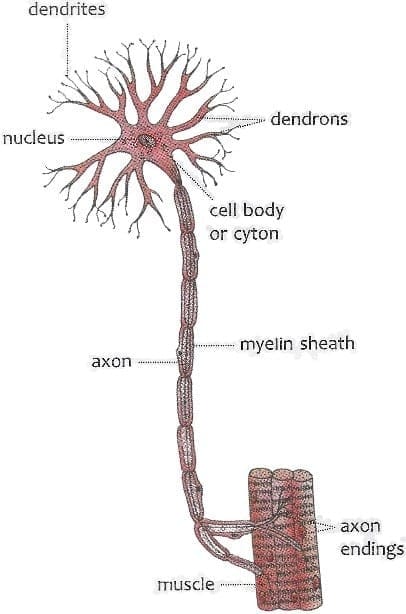
Q1: Explain the structure of a nerve cell with the help of a diagram.
Ans: A nerve cell or neuron is the basic structural unit of the nervous system. It has three parts - cell body, axon and dendrites.
- The cell body called cyton contains the nucleus.
- Many short fibres called dendrons arise from the cell. They further divide to form dendrites. Dendrites receive messages from other neurons.
- A single, long fibre called axon extends from the other side of the cell body. It is covered by a sheath called myelin sheath.
Below diagram shows the structure of a neuron:
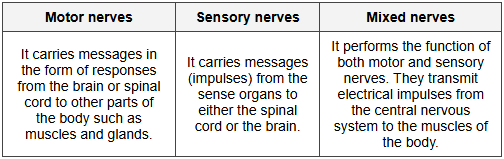
Q2: Distinguish between motor, sensory and mixed nerves with respect to their functions.
Ans:
Q3: Describe the central nervous system along with its parts and functions.
Ans: The central nervous system consists of the brain and the spinal cord. It is the control centre for all body functions. It is the site for all information processing in the body. It is responsible for processing every sensation and thought a human being experiences. It has two parts - Brain and Spinal Cord.
- Brain: The Brain is the main control centre of the nervous system situated in the cranium of the skull. It controls our thinking, feelings, movement and senses. It has three parts - Cerebrum, Cerebellum and Medulla oblongata.
- Cerebrum: The cerebrum is the uppermost, largest and the most prominent part of the brain. It is responsible for the sensation of pain, temperature, touch, sight, sound, taste and smell. It also controls mental activities such as memory, intelligence, thinking and reasoning.
- Cerebellum: The cerebellum is a small, egg-shaped lobe located at the base under the cerebrum. It helps in the muscle coordination and balance of the body.
- Medulla oblongata: The Medulla oblongata is the lowermost part of the brain located at the base of the skull. It controls breathing, heartbeat, coughing, sneezing and other involuntary functions.
- Spinal cord: The spinal cord is the continuation of the medulla oblongata of the brain. It is like a cord that emerges from a hole at the base of the skull and runs through the vertebral column. The spinal cord conducts reflexes below the neck. It conducts sensory impulses from the skin and muscles to the brain. It conducts motor responses from the brain to the muscles of the trunk and limbs.
Q4: Explain how messages reach the brain.
Ans: The peripheral nervous system transmits messages to and from the sense organs and is responsible for voluntary actions such as cycling, swimming and so on. Messages enter the spinal cord from all parts of the body and reach the brain, which sends back the messages to various body parts through the spinal cord.
Label the parts
Q1: When you step on a needle, you immediately withdraw your foot. Which part of the nervous system makes this happen?Ans: Spinal cord is responsible for this action. Immediately withdrawing our foot after stepping on a needle is a reflex action which happens without thinking i.e., the brain is not involved. Reflex actions are controlled by spinal cord.
FAQs on Ratna Sagar Textbook Solutions: Nervous System in Humans
| 1. What is the basic structural unit of the nervous system? |  |
| 2. What are the functions of the cerebrum? | |
| 3. How does the medulla oblongata contribute to involuntary actions? | |
| 4. What is the difference between sensory nerves and mixed nerves? | |
| 5. What is a reflex action, and how does it occur? | |




