Frank Textbook Solutions: The Vedic Period

Chapter 5
The Vedic Period
Class 6 - Frank History & Civics Solutions
Multiple Choice Questions
Question 1The oldest Veda is the:
- Rig Veda.
- Sama Veda.
- Yajur Veda.
Explanation: Rig Veda is the earliest of the four Vedas. It consists mainly of hymns that were composed first and used in early Vedic rituals. Scholars and traditional accounts both regard the Rig Veda as the oldest Vedic text, while the Sama and Yajur Vedas were developed later for specific ritual purposes. Question 2
The epic Mahabharata tells us about:
- the story of the prince of Kosala, Rama.
- a war fought between the Pandavas and Kauravas.
- the king of Lanka, who abducted Sita.
Explanation: The Mahabharata narrates the great war fought at Kurukshetra between the Pandavas and the Kauravas. It also contains teachings, moral lessons and stories about many characters involved in that conflict, distinguishing it from the Ramayana, which tells Rama's story. Question 3
............... is associated with the land known as Brahmavarta that lay around the river Saraswati. Choose the most appropriate option.
- The Vedic Age
- The Rig Vedic Age
- The Later Vedic Age
Explanation: Brahmavarta is associated with the early settlements around the Saraswati river and is linked to the Rig Vedic Age. This period saw the composition of the Rig Vedic hymns and the settlement of people in the Sapta-Sindhu region close to the Saraswati. Question 4
Griha was the name for a:
- village
- village headman
- family
Explanation: In Vedic times, the Sanskrit word griha referred to a household or family. It denoted the domestic unit rather than the whole village or a village headman. Question 5
Choose one option to match the items given in Column I with those in Column II.
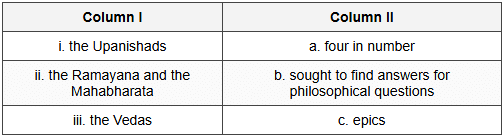
- i-b, ii-c, iii-a
- i-c, ii-a, iii-b
- i-a, ii-b iii-c
Explanation: The correct matching is i-b, ii-c, iii-a as shown in option (a). This choice pairs each item in Column I with the most appropriate corresponding item in Column II based on the descriptions given in the question.
Reflective Learning Question 1
'Rituals helped the kings in establishing their power in the Later Vedic Age.' Support this statement with examples.
Ans: In the Later Vedic Age, kings used public rituals and sacrifices to strengthen their authority and win support. Examples include:- The rajasuya sacrifice performed when a king claimed sovereignty; it showed his right to rule and brought other rulers under his influence.
- The ashvamedha (horse sacrifice) was carried out by powerful kings to demonstrate control over neighbouring lands; it required the king to send a horse across territories, and those who did not accept his authority could be fought.
Which of the following statements are opinions rather than facts? You may tick more than one option.
- The society was divided on the basis of occupation in the Early Vedic Age.
- The varna system became rigid in the Later Vedic Age.
- The rigid varna system in the Later Vedic Age was beneficial to the society.
- Inter-varna marriages may have led to the decline of the Later Vedic Age.
Explanation: Statements (iii) and (iv) express value judgements or causal suggestions that cannot be proved as facts from evidence alone. Statement (iii) says the rigid varna system was beneficial-this is a value judgement. Statement (iv) suggests a possible cause for decline (inter-varna marriages), which is a hypothesis rather than an established fact. In contrast, (i) and (ii) describe social arrangements supported by historical evidence.
Read the paragraph Question III
The philosophical thinkers of the Vedic period felt that the universe comprised something permanent that even death could not end. The individual soul, atman, and the universal soul, brahman, together formed this 'permanence'.
- In your own words, outline what the philosophical thinkers of the Vedic period felt.
- Which two elements formed a 'permanence' in the universe according to the philosophical thinkers of the Vedic period?
The Vedic philosophers believed that beneath change and death there was an unchanging reality. They taught that each person has an inner soul, called atman, which does not perish with the body. This atman is linked to a universal, eternal reality called brahman. Together these explained a permanence that survives death and connects individuals to the whole universe.
The two elements are the individual soul, atman, and the universal soul, brahman.
Answer in brief Question 1
According to some historians, who were the Indo-Aryans?
Ans:Many historians believe the Indo-Aryans were groups of people who spoke Indo-European languages and moved into India from regions of Central Asia. These migrations brought new languages and cultural practices that mixed with local traditions.
Question 2What is meant by Sapta-Sindhu?
Ans:Sapta-Sindhu means "the land of seven rivers." It refers to the area of the Punjab where several important rivers flowed and where early Vedic settlements were located.
Question 3What were the sabha and the samiti?
Ans:The sabha and the samiti were tribal assemblies. The sabha was a council of leading and respected members who handled important decisions and disputes. The samiti was a larger assembly that included all adult members of the tribe and met to discuss major matters affecting the community.
Question 4Comment upon the dress and ornaments worn by people during the Early Vedic period.
Ans:People in the Early Vedic period wore clothes made of cotton and wool. Both men and women decorated themselves with ornaments such as earrings, necklaces and bangles. Footwear made from leather or wood was used. Richer people had finer cloth and more jewellery.
Question 5Write a note on the gurukul system.
Ans:The gurukul system was the traditional method of education. Boys (usually from about seven years old) lived with their teacher, the guru, in his household or ashrama and learned subjects such as religion, grammar, medicine, singing, and moral duties. Lessons included practical skills and values like respect and obedience. Education was usually provided without payment; pupils showed gratitude later by giving a gift called guru dakshina.
Many developments took place Question 1
Compare the areas of settlement during the Early and Later Vedic Age.
Ans:In the Early Vedic Age the Indo-Aryans mainly settled in the Sapta-Sindhu region (the Punjab), which had many rivers and grazing land. In the Later Vedic Age they moved east into the Gangetic plain (Aryavarta), settling the fertile valleys of the Ganges and Yamuna and expanding agriculture and villages there.
Question 2What were the political changes that took place in the Later Vedic Age?
Ans:Tribal groups gradually became organised as kingdoms ruled by hereditary kings. Kings grew more powerful, took command in war, and performed grand sacrifices to show their status. The old assemblies (sabha and samiti) lost some authority as kingly power increased and administration became more centralised.
Question 3How did the position of women change in the Later Vedic Age?
Ans:In the Later Vedic Age the social position of many women appears to have declined. They were expected to focus more on household duties and supporting their husbands. Rights and public roles that some women had earlier became more limited over time.
Question 4What was the nature of social classification in the Early Vedic Age? How did it differ from that of the Later Vedic Age?
Ans:In the Early Vedic Age society was organised into four varnas based on occupation - Brahmanas (priests), Kshatriyas (warriors), Vaishyas (farmers and traders) and Shudras (workers). This system was relatively flexible. In the Later Vedic Age the varna divisions became more rigid and hereditary. Social mobility was limited and the higher varnas (Brahmanas and Kshatriyas) held greater privileges while Shudras had lower status.
Question 5What was the nature of worship in the Early Vedic period? What were the new features of Vedic religion in the Later Vedic Age?
Ans:Nature of worship in the Early Vedic period:
- People worshipped natural forces as gods, with Indra (rain and thunder) being very important.
- Worship involved yajnas (sacrifices) and chanting of Rig Vedic hymns.
- There were no idols or temples; offerings like grains, ghee, milk and animal sacrifice were given during rituals.
- Priests performed these ceremonies to seek good health, prosperity and cattle.
New features in the Later Vedic Age:
- Prajapati (later called Brahma in some texts) became more prominent as a cosmic creator figure.
- Rituals and prayers became more elaborate and costly, increasing the importance and power of the brahmanas.
- Religion grew more ritualistic, and religious ceremonies came to play a larger role in legitimising social and political order.
Name the stages of life of an upper class man in Vedic society.
Ans:The four stages of life were:
- Brahmacharya - student life
- Grihastha - householder life
- Vanaprastha - the hermit or retired stage
- Sanyasa - renounced life
What were the main occupations in the Early Vedic period?
Ans:The Indo-Aryans were initially nomadic herders who kept cattle, horses, sheep and goats. As they settled, agriculture became important. People also practised crafts such as weaving, carpentry and chariot-making. Cattle remained a key sign of wealth and status.
Question 8What were the occupations that developed in the Later Vedic Age?
Ans:In the Later Vedic Age agriculture became the main occupation, with continued cattle rearing. Skilled trades grew, including coppersmiths, ironsmiths, weavers, leather workers, carpenters, chariot-makers and jewellers. Pottery such as painted Grey Ware was also produced.
Ancient River Valley Civilisation: China
Great Preachers: Mahavira and Buddha
Contents