Frank Textbook Solutions: The Golden Age: Gupta Empire


Chapter 9
The Golden Age: Gupta Empire
Class 6 - Frank History & Civics Solutions
Multiple Choice Questions
Question 1Chandragupta I received Pataliputra as a part of his dowry from the:
- Nagas.
- Lichchavis.
- Vakatakas.
Ans: (b)
Explanation: Chandragupta I married Kumaradevi, a princess of the Lichchhavi family. As part of this marriage alliance he received Magadha, including the important city of Pataliputra, as dowry. This alliance strengthened the Gupta position in eastern India and helped them expand their power.
Question 2The most important source about the conquest of Samudragupta is the:
- Aihole Inscription.
- Prayag Prashasti.
- Hathi Gumpha Inscription.
Ans: (b)
Explanation: The Prayaga Prashasti (also called the Allahabad Pillar inscription) is a eulogistic inscription written by Harishena, the court poet of Samudragupta. It records Samudragupta's military campaigns, his victories and the states that accepted his suzerainty, making it the most important source for information about his conquests.
Question 3The Chinese pilgrim who visited India during the reign of Chandragupta II:
- Fa-hsien
- Heiun-Tsang
- I-Tsing
Ans: (a)
Explanation: Fa-hsien (also spelled Fa-Hien) was a Chinese pilgrim who visited India during the Gupta period and wrote about social and religious life. His observations provide valuable independent evidence about the prosperity and social conditions under Chandragupta II.
Question 4The paintings on the caves of Ajanta can most appropriately be called:
- frescoes.
- landscapes
- Portraits.
Ans: (a)
Explanation: The Ajanta paintings are frescoes, meaning they were painted on wet plaster so the colours became part of the wall surface. These paintings show scenes from the lives of the Buddha and many other themes and are regarded as outstanding examples of Gupta-period art.
Question 5Which of the following statements does not apply to the lyrical poem Meghaduta?
- It was written by Kalidasa.
- It was written in Sanskrit.
- It was written by Vishnusharman.
Ans: (c)
Explanation: Meghaduta was composed by the classical Sanskrit poet Kalidasa and is written in Sanskrit. Vishnusharman is associated with the Panchatantra, not with Meghaduta, so the statement that Meghaduta was written by Vishnusharman is incorrect.
Reflective Learning
Question 1Gupta Age is commonly called the Golden Age of ancient Indian history. Which of the following statements best supports this claim? You may choose more than one option.
- Samudragupta issued eight different types of coins, most of them in gold.
- Chandragupta II controlled a vast empire, which extended from the Ganga to the Indus, and from north Pakistan to the Narmada.
- Chandragupta II was a great patron of literature and numerous scholars adorned his court - the most prominent being the legendary Kalidasa.
- Fa-hsien described people as honest, prosperous, and happy. Corporal punishments were also rare.
Ans: The statements which best support the claim of the Gupta Age being the Golden Age of ancient Indian history are:
- Samudragupta issued eight different types of coins, most of them in gold. - This shows economic prosperity and a flourishing trade and monetary system during the Gupta period.
- Chandragupta II was a great patron of literature and numerous scholars adorned his court - the most prominent being the legendary Kalidasa. - Royal patronage of arts and literature led to great achievements in culture and learning.
- Fa-hsien described people as honest, prosperous, and happy. Corporal punishments were also rare. - Such an account from a foreign visitor indicates good governance, social stability and general prosperity.
Number the following statements
Question IIINumber the following statements to put them in the correct chronological order.
- Chandragupta I succeeded his father Ghatotkacha.
- Samudragupta granted permission to the king of Ceylon (Sri Lanka) to build a Buddhist temple in Gaya.
- The beginning of Samudragupta's reign was marked by the defeat of his immediate neighbours.
Ans: 1 → 3 → 2
Explanation: First Chandragupta I succeeded his father Ghatotkacha and established the Gupta rise. After him Samudragupta began his reign and first conquered his immediate neighbours (statement 3). Later in his rule he was powerful enough to grant permission to the king of Ceylon to build a temple at Gaya (statement 2).
Answer in brief
Question 1List the areas that formed a part of the kingdom of Chandragupta I.
Ans: The kingdom of Chandragupta I included regions of modern Bihar, parts of eastern Uttar Pradesh, Bengal and Magadha. Its capital was Pataliputra, which became an important centre of administration and power for the Guptas.
Question 2What is the most important source of information regarding the reign of Samudragupta?
Ans: The Prayaga Prashasti (Allahabad Pillar inscription) is the most important source. It was composed by Harishena, Samudragupta's court poet, and records his military campaigns, victories and honours, providing detailed information about his reign.
Question 3Outline the main points of Fa-hsien's accounts on the reign of Chandragupta II.
Ans: Fa-hsien described north India under Chandragupta II as a land where people were honest, prosperous and generally content. He noted that corporal punishments were rare, which suggests a stable and well-ordered society during that time.
Question 4What was the administrative structure during the Gupta Age?
Ans:
- The Guptas had a strong central government with the king at its head, but local administration was allowed to function with some autonomy.
- The empire was divided into provinces, and each province was further divided into districts or vishayas administered by vishayapatis.
- Councils in each district assisted the vishayapatis in local administration and justice.
- Members of the royal family often served as governors of provinces and were helped by officials called kumaramatyas.
- Overall, the Gupta system combined central control with local participation to ensure effective administration.
Write a feature of temple architecture during the Gupta Age.
Ans: The Dasavatara Temple at Deogarh is a fine example. Gupta temples typically had a simple and harmonious plan with a sanctum and porch; their roofs and pillars were artistically decorated with fine sculptures and delicate carvings that show high workmanship.
Question 6What were the scientific achievements of Aryabhata?
Ans: Aryabhata wrote the Aryabhatiya and made important contributions to mathematics and astronomy. He estimated the value of π more accurately, explained that the Earth rotates on its axis, gave reasons for solar and lunar eclipses, and used a decimal place-value system that improved methods of calculation.
Enumerate the following
Question VThe Gupta rulers were great conquerors and administrators. In this context, enumerate the following:
- The reign of Chandragupta I
- Samudragupta as the Indian Napoleon
- Rule of Chandragupta II
Ans:
The Reign of Chandragupta I -
- Chandragupta I succeeded his father Ghatotkacha around 319 CE and was the first important ruler who established the foundations of Gupta power.
- He married Kumaradevi of the Lichchhavi family and received Magadha with Pataliputra as dowry, which strengthened his position.
- With this base he expanded his territory to include parts of Bihar, eastern Uttar Pradesh and Bengal and assumed the title of Maharajadhiraja.
Samudragupta as the Indian Napoleon -
- Samudragupta is often called the 'Napoleon of India' because of his military genius and rapid conquests.
- The Prayaga Prashasti records his campaigns: he defeated many neighbours in the Ganga-Yamuna region and extended Gupta influence across northern India.
- He also led a successful southern campaign in which many kings became his tributaries, while he retained direct control over the core northern areas.
- Samudragupta issued many gold coins and was a patron of learning, music and the arts.
- He even granted permission to the king of Ceylon to build a Buddhist temple at Gaya, showing his influence beyond the subcontinent.
Rule of Chandragupta II -
- Chandragupta II (also known as Vikramaditya) ruled around 380-412 CE at the height of Gupta power.
- His victory over the Shaka-Kshatrapas brought Gujarat under Gupta control and opened access to important seaports, aiding overseas trade.
- His empire stretched from the Ganga to the Indus and from parts of present-day Pakistan to the Narmada.
- He was a great patron of literature and learning; poets and scholars like Kalidasa flourished at his court.
- Accounts by visitors such as Fa-hsien describe his realm as prosperous and well-governed.
Explain the following
Question VIThe Gupta Age is considered to be the Golden Age of ancient history. In this context, explain the following:
- Development in the field of literature
- Scientific discoveries and education
Ans:
Sanskrit literature flourished under Gupta patronage. Poets and dramatists like Kalidasa produced classic works such as the lyrical poem Meghaduta and plays like Abhijnanashakuntalam, Malavikagnimitram and Vikramorvasiyam. Many Puranas were compiled during this period. Stories like the Panchatantra were put together by authors such as Vishnusharman, and other dramatic works like Mrichchhakatika by Shudraka also became known. This literary activity marks a high point in classical Indian literature.
Scientific Discoveries - The Gupta Age saw important advances in science and medicine. Aryabhata wrote the Aryabhatiya, estimated π, explained the Earth's rotation, and gave scientific accounts of eclipses. Mathematics benefited from the decimal place-value system.
Education - Centres of learning and higher studies received patronage. Subjects such as medicine, astronomy, philosophy, grammar and Vedic studies were taught and studied, helping spread knowledge and training scholars.
Picture Study
Question 1This is the painting of a scene from a drama written during the Gupta Age.
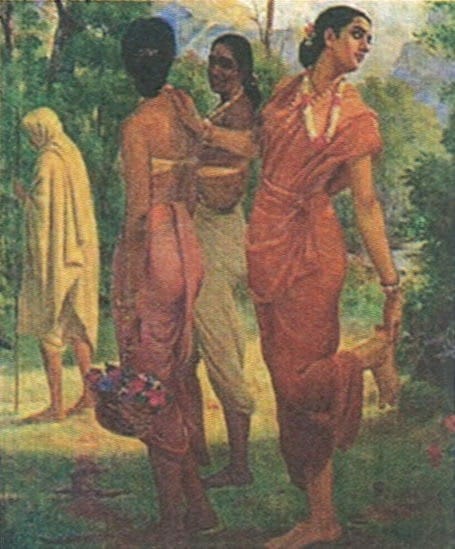
(a) Can you name this great playwright? (b) Whose patronage did he enjoy? (c) What were his other contributions to Sanskrit literature?
Ans:
(a) Kalidasa.
(b) He enjoyed the patronage of Chandragupta II, also known as Vikramaditya.
(c) Kalidasa wrote the lyrical poem Meghaduta and several plays, including Abhijnanashakuntalam, Malavikagnimitram and Vikramorvasiyam, which are important works of classical Sanskrit literature.
The Mauryan Empire
Worksheet 3
Contents

