

Government schemes reflect the state's commitment to achieving inclusive growth, social justice, and sustainable development. They translate constitutional ideals and policy objectives into actionable programmes targeting health, education, agriculture, infrastructure, and vulnerable sections of society. A clear understanding of their objectives, design, funding structure, and implementation challenges helps in assessing their real impact on governance and development. Ultimately, these schemes serve as vital instruments for strengthening institutional capacity and improving citizens' quality of life.
UPSC Exam > UPSC Notes > Indian Economy CSE > Cheat Sheet: Government Schemes
Cheat Sheet: Government Schemes
Government schemes are structured policy instruments designed by the Union Government to achieve socio-economic objectives such as poverty reduction, inclusive growth, human development, infrastructure expansion, environmental sustainability, and social justice.
Government schemes derive their legitimacy from:
- Directive Principles of State Policy (Part IV of the Constitution) - welfare orientation of the state
- Fundamental Rights - especially equality, life, and dignity
- Union Budget allocations
- Five-Year Plan legacy (now replaced by NITI Aayog-driven strategy)
- Sustainable Development Goals (SDGs)
Classification of Government Schemes
Government schemes are broadly classified into:
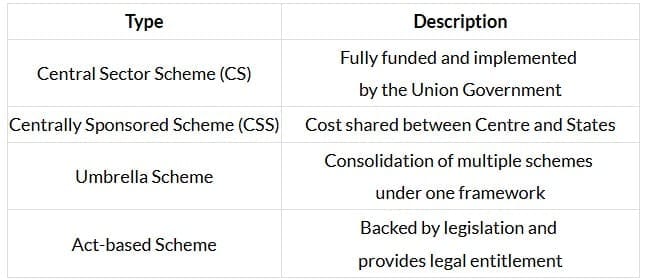
Understanding this classification is crucial because UPSC frequently tests funding patterns and implementation responsibility.
Evolution of Government Schemes
- Early Phase - Poverty alleviation and employment generation
- Reform Era - Targeted subsidies and financial inclusion
- Digital Governance Era - DBT, JAM Trinity, Aadhaar-linked benefits
- Contemporary Phase - Infrastructure push, climate transition, manufacturing incentives
Social Sector Schemes
A. Health

B. Education

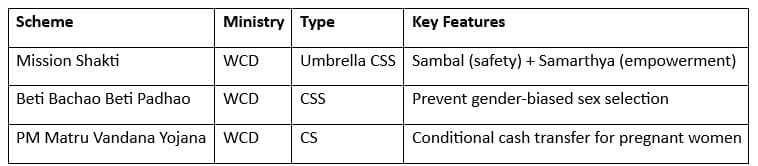
C. Women & Child Development
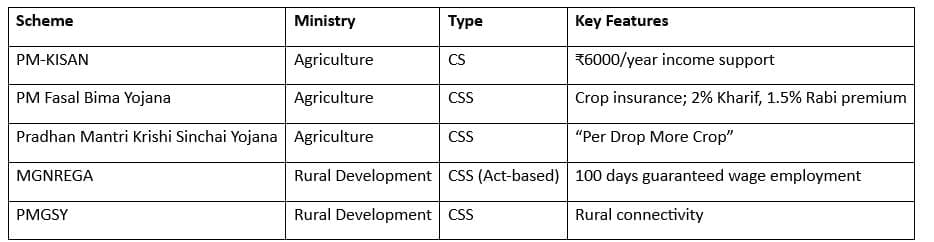
Agriculture and Rural Development
Urban Development
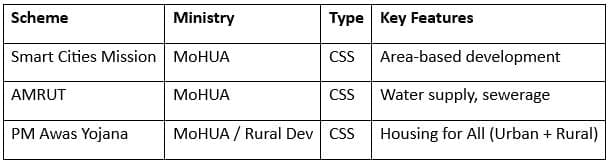
Infrastructure and Industry

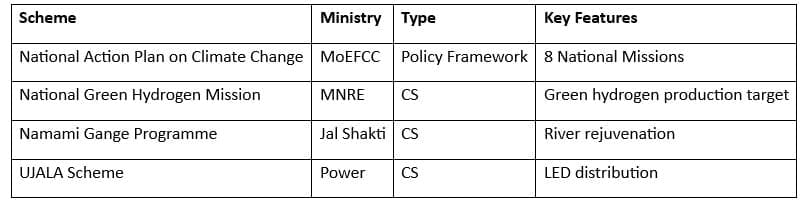
Environment and Energy
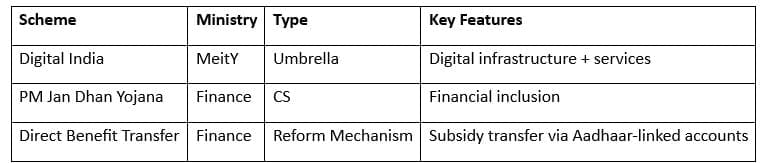
Governance and Digital India
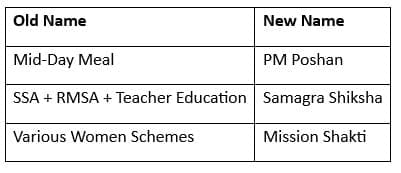
Important Renamed / Merged Schemes
The document Cheat Sheet: Government Schemes is a part of the UPSC Course Indian Economy for UPSC CSE.
All you need of UPSC at this link: UPSC
FAQs on Cheat Sheet: Government Schemes
| 1. What are government schemes, and why are they important for socio-economic development? |  |
Ans. Government schemes are structured initiatives undertaken by the government to address various social, economic, and developmental issues. They are important for socio-economic development as they aim to improve living standards, promote welfare, provide support for vulnerable populations, and enhance infrastructure. These schemes often focus on sectors like health, education, agriculture, and rural development, thereby fostering inclusive growth and reducing inequalities.
| 2. How have government schemes evolved over time in India? | |
Ans. Government schemes in India have evolved from being primarily focused on welfare and charity to a more comprehensive approach that includes sustainable development and empowerment. Initially, schemes were designed to provide direct aid to the poor, but over time, they have integrated elements of skill development, self-reliance, and technological advancement. The evolution reflects changing priorities in governance and the need for more effective solutions to contemporary challenges.
| 3. What are some key social sector schemes implemented by the Indian government? | |
Ans. Key social sector schemes include the Mahatma Gandhi National Rural Employment Guarantee Act (MGNREGA), which provides guaranteed employment; the Pradhan Mantri Awas Yojana (PMAY), aimed at providing affordable housing; and the National Health Mission (NHM), which focuses on improving healthcare access. These schemes are designed to enhance the well-being of citizens, particularly those in underprivileged communities.
| 4. How do government schemes contribute to urban development? | |
Ans. Government schemes contribute to urban development by promoting sustainable urban planning, improving infrastructure, and enhancing the quality of life in cities. Initiatives like the Smart Cities Mission aim to modernise city infrastructure through technology and efficient service delivery. Other schemes focus on slum rehabilitation, waste management, and public transport, thereby fostering inclusive urbanisation and addressing the needs of growing urban populations.
| 5. What are some important renamed or merged government schemes, and why is this significant? | |
Ans. Important renamed or merged government schemes include the National Rural Livelihoods Mission (NRLM) and the Deen Dayal Antyodaya Yojana, which were consolidated to create a more cohesive approach to poverty alleviation. Such changes are significant as they reflect the government's strategy to streamline initiatives for better implementation and effectiveness, ensuring that resources are optimally utilised and that beneficiaries receive integrated support.
About this Document

4.84/5 Rating

Apr 19, 2026 Last updated
Related Exams
Document Description: Cheat Sheet: Government Schemes for UPSC 2026 is part of Indian Economy for UPSC CSE preparation. The notes and questions for Cheat Sheet: Government Schemes have been prepared according to the UPSC exam syllabus. Information about Cheat Sheet: Government Schemes covers topics like and Cheat Sheet: Government Schemes Example, for UPSC 2026 Exam. Find important definitions, questions, notes, meanings, examples, exercises and tests below for Cheat Sheet: Government Schemes.
Introduction of Cheat Sheet: Government Schemes in English is available as part of our Indian Economy for UPSC CSE for UPSC & Cheat Sheet: Government Schemes in Hindi for Indian Economy for UPSC CSE course. Download more important topics related with notes, lectures and mock test series for UPSC Exam by signing up for free. UPSC: Cheat Sheet: Government Schemes
Description
Cheat Sheet: Government Schemes of Indian Economy to help you remember important concepts with short tricks. Start learning for UPSC exam & improve retention with EduRev.
Information about Cheat Sheet: Government Schemes
In this doc you can find the meaning of Cheat Sheet: Government Schemes defined & explained in the simplest way possible. Besides explaining types of Cheat Sheet: Government Schemes theory, EduRev gives you an ample number of questions to practice Cheat Sheet: Government Schemes tests, examples and also practice UPSC tests



Related Searches
Exam, pdf , Cheat Sheet: Government Schemes, mock tests for examination, MCQs, Free, study material, ppt, Previous Year Questions with Solutions, Objective type Questions, Viva Questions, shortcuts and tricks, Important questions, video lectures, Summary, Cheat Sheet: Government Schemes, Sample Paper, past year papers, practice quizzes, Cheat Sheet: Government Schemes, Extra Questions, Semester Notes;