NEET Exam > NEET Notes > Physics Class 12 > Mind Map (JEE Mains): Ray Optics and Optical Instruments
Mind Map (JEE Mains): Ray Optics and Optical Instruments

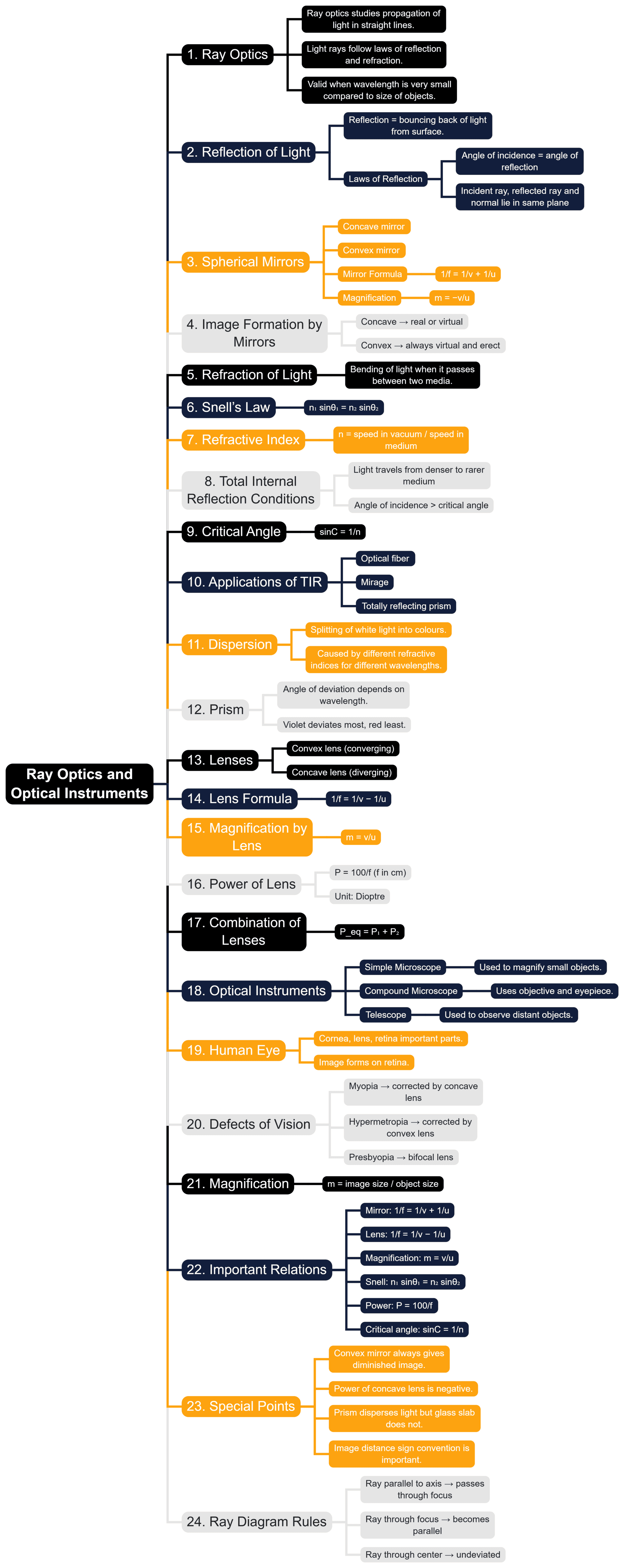
The document Mind Map (JEE Mains): Ray Optics and Optical Instruments is a part of the NEET Course Physics Class 12.
All you need of NEET at this link: NEET
FAQs on Mind Map (JEE Mains): Ray Optics and Optical Instruments
| 1. What are the fundamental laws of reflection and refraction in ray optics? |  |
Ans. The fundamental laws of reflection state that the angle of incidence is equal to the angle of reflection, and both angles are measured from the normal at the point of incidence. In refraction, the law states that the ratio of the sines of the angles of incidence and refraction is constant and is known as Snell's law, which can be expressed as n₁sin(i) = n₂sin(r), where n₁ and n₂ are the refractive indices of the two media.
| 2. How does a convex lens differ from a concave lens in terms of light behaviour? | |
Ans. A convex lens converges light rays that are incident parallel to its principal axis, focusing them to a point known as the focal point. It is thicker at the centre than at the edges. In contrast, a concave lens diverges light rays, causing them to spread out as if they are emanating from a virtual focal point located on the same side as the incoming light. It is thinner at the centre than at the edges.
| 3. What is the significance of the focal length in optical instruments? | |
Ans. The focal length of a lens or mirror is the distance from the lens or mirror to its focal point. It is significant as it determines the magnification, image distance, and the nature of the images formed by the optical instruments. A shorter focal length indicates a greater curvature of the lens or mirror, leading to stronger magnification and a larger field of view.
| 4. Explain the concept of total internal reflection and its application. | |
Ans. Total internal reflection occurs when a light ray attempts to move from a denser medium to a less dense medium at an angle greater than the critical angle. In this case, the light is completely reflected back into the denser medium rather than refracting out. This principle is utilised in optical fibres, which transmit light over long distances with minimal loss, enhancing communication technologies.
| 5. What role do optical instruments like microscopes and telescopes play in scientific observation? | |
Ans. Optical instruments such as microscopes and telescopes enhance human capability to observe objects that are too small or too distant to see with the naked eye. Microscopes magnify tiny specimens, revealing fine details in biological samples, while telescopes collect and magnify light from distant celestial bodies, allowing for the study of stars, planets, and galaxies. Both instruments rely on lenses or mirrors to manipulate light, thus expanding our understanding of the microscopic and macroscopic worlds.
About this Document

4.75/5 Rating

Apr 18, 2026 Last updated
Document Description: Mind Map (JEE Mains): Ray Optics and Optical Instruments for NEET 2026 is part of Physics Class 12 preparation. The notes and questions for Mind Map (JEE Mains): Ray Optics and Optical Instruments have been prepared according to the NEET exam syllabus. Information about Mind Map (JEE Mains): Ray Optics and Optical Instruments covers topics like and Mind Map (JEE Mains): Ray Optics and Optical Instruments Example, for NEET 2026 Exam. Find important definitions, questions, notes, meanings, examples, exercises and tests below for Mind Map (JEE Mains): Ray Optics and Optical Instruments.
Introduction of Mind Map (JEE Mains): Ray Optics and Optical Instruments in English is available as part of our Physics Class 12 for NEET & Mind Map (JEE Mains): Ray Optics and Optical Instruments in Hindi for Physics Class 12 course. Download more important topics related with notes, lectures and mock test series for NEET Exam by signing up for free. NEET: Mind Map (JEE Mains): Ray Optics and Optical Instruments
Description
Mind Map (JEE Mains): Ray Optics & Optical Instruments of Physics Class 12 provides you one-page visual summary of the chapter covering all the important topics. Download the PDF from EduRev.
Information about Mind Map (JEE Mains): Ray Optics and Optical Instruments
In this doc you can find the meaning of Mind Map (JEE Mains): Ray Optics and Optical Instruments defined & explained in the simplest way possible. Besides explaining types of Mind Map (JEE Mains): Ray Optics and Optical Instruments theory, EduRev gives you an ample number of questions to practice Mind Map (JEE Mains): Ray Optics and Optical Instruments tests, examples and also practice NEET tests



Related Searches
pdf , Important questions, Previous Year Questions with Solutions, practice quizzes, Summary, Mind Map (JEE Mains): Ray Optics and Optical Instruments, Mind Map (JEE Mains): Ray Optics and Optical Instruments, Sample Paper, Extra Questions, video lectures, shortcuts and tricks, MCQs, past year papers, ppt, Viva Questions, mock tests for examination, study material, Mind Map (JEE Mains): Ray Optics and Optical Instruments, Semester Notes, Exam, Objective type Questions, Free;