Debt Recovery of Tribunal


Debt Recovery Tribunals (DRTs) are specialized quasi-judicial institutions established to expedite recovery of debts due to banks and financial institutions. These tribunals reduce the burden on civil courts and provide a faster mechanism for debt resolution, which is critical for maintaining the health of the banking sector and preventing accumulation of Non-Performing Assets (NPAs).
1. Constitutional and Legal Framework
1.1 Legislative Foundation
- Recovery of Debts Due to Banks and Financial Institutions Act, 1993 (RDDBFI Act): The primary legislation establishing DRTs. Also called the DRT Act.
- Objective: To provide expeditious adjudication and recovery of debts due to banks and financial institutions without the procedural delays of civil courts.
- Amendment Act, 2000: Introduced Debt Recovery Appellate Tribunals (DRATs) to hear appeals against DRT orders.
- Constitutional Validity: Upheld by the Supreme Court in M/s. Allahabad Bank v. Canara Bank (2000).
1.2 Jurisdiction and Scope
- Monetary Threshold: Originally ₹10 lakh, reduced to ₹20 lakh by the Enforcement of Security Interest and Recovery of Debts Laws (Amendment) Act, 2016, then further revised to ₹10 lakh in 2016 itself after reconsideration.
- Applicability: Covers debts due to banks, financial institutions, and consortiums of banks/financial institutions.
- Financial Institutions Covered: Public sector banks, private banks, Regional Rural Banks (RRBs), State Financial Corporations, and institutions notified under Section 2(1)(e) of the Act.
- Exclusion: Does not cover cooperative banks and Non-Banking Financial Companies (NBFCs) unless specifically notified.
2. Structure and Composition
2.1 Debt Recovery Tribunals (DRTs)
- Establishment: Central Government establishes DRTs through notification in the Official Gazette.
- Territorial Jurisdiction: Each DRT has jurisdiction over a specified area defined by the Central Government.
- Composition: Single Presiding Officer appointed by the Central Government.
- Qualifications of Presiding Officer: Must be a person qualified to be a District Judge under the Constitution, or has been a member of Indian Legal Service (Grade I) for at least three years, or has experience as an advocate for at least ten years.
- Tenure: Five years or until attaining the age of 62 years, whichever is earlier.
- Number of DRTs: As of recent data, there are 39 DRTs and 5 DRATs across India.
2.2 Debt Recovery Appellate Tribunals (DRATs)
- Establishment: Created under Section 8 of the RDDBFI Act, 1993 (as amended in 2000).
- Function: Hear appeals against orders passed by DRTs.
- Composition: Chairperson appointed by the Central Government.
- Qualifications of Chairperson: Must be a person who is or has been a Judge of a High Court, or has been a member of Indian Legal Service (Grade I) for at least three years and has experience in dealing with legal matters.
- Appellate Jurisdiction: Any person aggrieved by an order of DRT can appeal to DRAT within 30 days (extendable by another 30 days for sufficient cause).
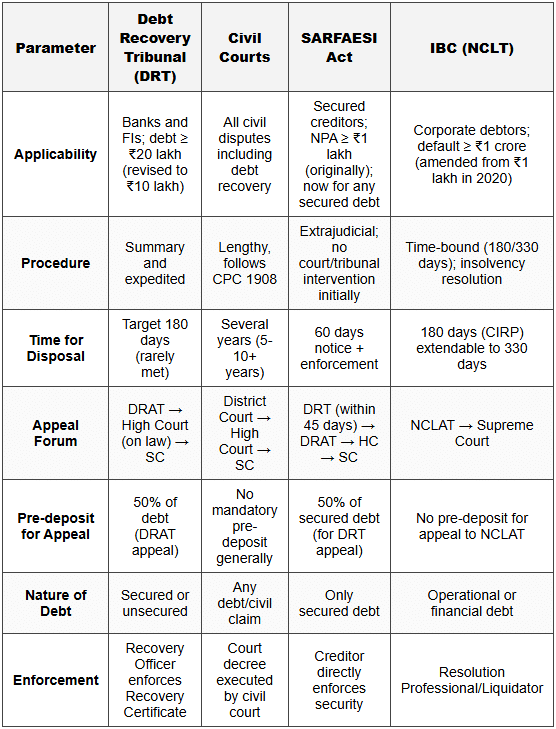
- Pre-deposit Requirement: Appellant must deposit at least 50% of the amount of debt due as determined by DRT before filing appeal (under Section 18 of DRT Act). This is a critical condition for maintainability of appeal.
3. Powers and Functions
3.1 Adjudicatory Powers of DRT
- Original Jurisdiction: DRTs entertain applications from banks and financial institutions for recovery of debts exceeding the monetary threshold.
- Powers of Civil Court: DRTs have the same powers as a civil court under the Code of Civil Procedure, 1908 regarding summoning witnesses, examining evidence, issuing commissions, and enforcing attendance.
- Summary Procedure: DRTs follow summary procedure to ensure speedy disposal of cases, avoiding lengthy civil litigation procedures.
- Time Limit for Disposal: Ideally, cases should be disposed of within 180 days from the date of application, though this is often not achieved in practice.
- Recovery Certificate: On determination of debt, DRT issues a Recovery Certificate specifying the amount due, which is then enforced by the Recovery Officer.
3.2 Recovery Mechanism
- Recovery Officers: Appointed under Section 3 of the Act to enforce Recovery Certificates issued by DRTs.
- Powers of Recovery Officers: Attachment and sale of movable/immovable property, arrest and detention of debtor (in civil prison for maximum 3 months), appointment of receiver for property management.
- Mode of Recovery: Similar to recovery of land revenue or public dues under relevant state laws.
- Priority in Recovery: Debts due to secured creditors under SARFAESI Act have priority over DRT proceedings in certain circumstances.
3.3 Complementarity with SARFAESI Act, 2002
- SARFAESI Act: Securitisation and Reconstruction of Financial Assets and Enforcement of Security Interest Act, 2002 allows banks to enforce security without court intervention for NPAs above ₹1 lakh.
- Relationship: Banks can choose either DRT route or SARFAESI route for debt recovery. SARFAESI is faster as it doesn't require tribunal proceedings for secured assets.
- Appeal Mechanism under SARFAESI: Appeals against actions under SARFAESI Act go to DRT (not civil courts), making DRT a forum for both original jurisdiction and appellate jurisdiction.
- Section 17 of SARFAESI: Provides that aggrieved person can appeal to DRT within 45 days against measures taken under Section 13(4) of SARFAESI Act.
4. Procedural Aspects
4.1 Filing of Application
- Who Can File: Banks, financial institutions, or consortium of banks/financial institutions to which debt is due.
- Application Content: Must specify the amount claimed, grounds for claim, relief sought, and details of security (if any).
- Territorial Jurisdiction: Application filed in DRT within whose jurisdiction the defendant carries on business, resides, or the cause of action arises.
- Limitation Period: Subject to provisions of Limitation Act, 1963. Generally, 3 years from the date of default.
4.2 Examination and Determination
- Notice to Defendant: DRT issues notice to defendant after admitting the application, requiring written response within 30 days.
- Hearing: Both parties are given opportunity to present evidence and arguments.
- Summary Nature: Technical procedural requirements are minimized to expedite proceedings.
- Orders: DRT passes orders determining the amount of debt recoverable and directs payment within specified time (usually 3 months).
- Interim Relief: DRT can grant interim orders for attachment of property to prevent alienation during pendency of proceedings.
4.3 Appeal Process
- Appeal to DRAT: Within 30 days of DRT order (extendable by 30 days).
- Mandatory Pre-deposit: 50% of debt amount determined by DRT must be deposited. Trap Alert: This pre-deposit is a condition precedent; appeal cannot be entertained without it.
- DRAT Order: Final factual determination; no further appeal on facts.
- Further Appeal to High Court: Only on substantial questions of law under Section 20 of the Act. No appeal lies on factual findings.
- Supreme Court: Special Leave Petition (SLP) under Article 136 of the Constitution against High Court order.
5. Challenges and Limitations
5.1 Operational Challenges
- Pendency: High pendency of cases due to insufficient number of DRTs and DRATs relative to volume of NPAs.
- Vacancies: Frequent vacancies in Presiding Officer positions lead to delays.
- Infrastructure Deficiency: Many DRTs lack adequate physical infrastructure, staff, and technological support.
- Time Overruns: The 180-day disposal target is rarely met; average disposal time often exceeds 2-3 years.
5.2 Procedural and Legal Limitations
- Limited Scope: DRTs do not cover NBFCs and cooperative banks unless specifically notified, leaving significant financial sector entities outside the mechanism.
- Pre-deposit Requirement: The 50% pre-deposit for appeals is often criticized as too onerous and may prevent genuine appellants from accessing appellate remedy.
- Enforcement Delays: Even after obtaining Recovery Certificate, actual recovery through Recovery Officers faces practical difficulties such as disputed titles, concealment of assets, and lack of cooperation from state authorities.
- Overlap with IBC: Post the enactment of Insolvency and Bankruptcy Code, 2016, there is overlap between DRT jurisdiction and NCLT (National Company Law Tribunal) jurisdiction for corporate debtors, creating forum shopping issues.
5.3 Recent Reforms and Initiatives
- Enforcement of Security Interest and Recovery of Debts Laws (Amendment) Act, 2016: Streamlined procedures, reduced monetary thresholds, and provided for electronic filing.
- E-DRT Portal: Online filing and case tracking to improve transparency and efficiency.
- Increase in Number of Tribunals: Gradual expansion of DRT network to cover more regions and reduce pendency.
- Integration with IBC Framework: Recognition that DRT route is suitable for individual and non-corporate debtors, while IBC handles corporate insolvency more comprehensively.
6. Comparison: DRT vs. Civil Courts vs. SARFAESI vs. IBC
7. Key Judgments and Legal Principles
7.1 Important Supreme Court Rulings
- M/s. Allahabad Bank v. Canara Bank (2000): Upheld constitutional validity of DRT Act; held that establishment of specialized tribunals for debt recovery does not violate Article 14 (Equality before Law) or judicial independence.
- Nahar Industrial Enterprises Ltd. v. Hong Kong and Shanghai Banking Corporation (2009): Clarified jurisdiction of DRTs and held that civil courts are barred from entertaining debt recovery suits falling within DRT jurisdiction.
- Transcore v. Union of India (2006): Held that 50% pre-deposit requirement under Section 18 of DRT Act for filing appeal before DRAT is constitutional and not violative of Article 14 or Article 21.
- Mardia Chemicals Ltd. v. Union of India (2004): Provisions of SARFAESI Act upheld; held that special statute for debt recovery does not violate natural justice principles.
7.2 Principle of Ouster of Civil Court Jurisdiction
- Section 18 of DRT Act: Expressly bars jurisdiction of civil courts and other authorities in matters where DRT has jurisdiction. This is called ouster clause.
- Rationale: To prevent multiplicity of proceedings and ensure expeditious recovery through specialized forum.
- Trap Alert: If a debt recovery matter falls within DRT jurisdiction (debt ≥ ₹10/20 lakh), filing suit in civil court is not maintainable; it will be rejected for lack of jurisdiction.
8. Economic Significance and Policy Context
8.1 Role in NPA Resolution
- Non-Performing Assets (NPAs): Loans on which interest or principal repayment is overdue for more than 90 days.
- DRT as Resolution Mechanism: DRTs are one of the four major mechanisms for NPA resolution (others being Lok Adalats, SARFAESI, and IBC).
- Recovery Rate: Historically low; DRTs recover approximately 10-12% of the amount involved in cases, though this varies widely.
- Volume of Cases: DRTs handle a significant volume of cases; pendency often exceeds 1 lakh cases cumulatively across all DRTs.
8.2 Banking Sector Health
- Impact on Credit Discipline: Effective debt recovery mechanisms improve credit discipline and reduce moral hazard among borrowers.
- Capital Adequacy: Faster recovery helps banks maintain capital adequacy ratios and provision requirements under Basel III norms.
- Credit Availability: Efficient recovery frees up capital for fresh lending, supporting economic growth and financial inclusion.
8.3 Complementarity with Other Reforms
- IBC Precedence: For corporate debtors, IBC route via NCLT is now preferred over DRT due to time-bound resolution and emphasis on going concern value.
- Asset Reconstruction Companies (ARCs): DRTs also adjudicate matters where ARCs have acquired NPAs from banks and are seeking recovery.
- NCLT for Corporate Debtors, DRT for Others: Post-IBC, DRTs primarily handle recovery from individuals, partnerships, and non-corporate entities.
Conclusion: Debt Recovery Tribunals are specialized quasi-judicial bodies designed to expedite recovery of debts due to banks and financial institutions, addressing the limitations of civil courts. Despite challenges such as high pendency, vacancies, and infrastructure deficits, DRTs remain an important pillar of India's debt recovery architecture. Understanding their jurisdiction (₹10/20 lakh threshold), procedural requirements (180-day target, 50% pre-deposit for appeals), and complementarity with SARFAESI and IBC is essential for exam preparation. The ouster of civil court jurisdiction, Recovery Certificate mechanism, and appellate structure (DRT → DRAT → High Court on law) are key points frequently tested in competitive exams.
FAQs on Debt Recovery of Tribunal
| 1. What is the constitutional and legal framework governing the Debt Recovery Tribunal (DRT)? |  |
| 2. What is the structure and composition of the Debt Recovery Tribunal? | |
| 3. What are the key powers and functions of the Debt Recovery Tribunal? | |
| 4. What challenges and limitations does the Debt Recovery Tribunal face? | |
| 5. How does the Debt Recovery Tribunal compare with civil courts, SARFAESI Act, and Insolvency and Bankruptcy Code (IBC)? | |




