JEE Exam > JEE Notes > Physics Main & Advanced > Mind Map (JEE Advanced): Work, Energy and Power
Mind Map (JEE Advanced): Work, Energy and Power

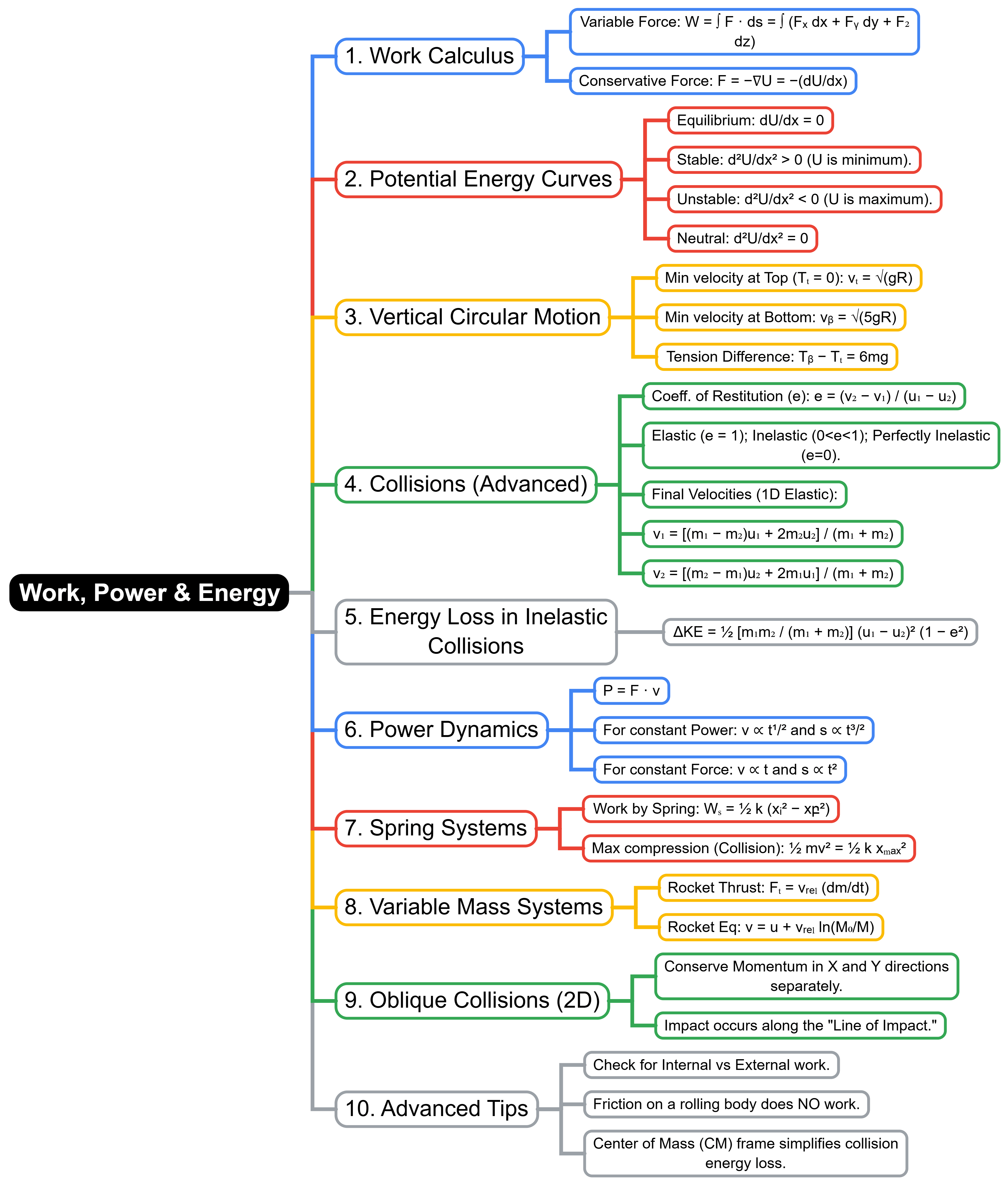
The document Mind Map (JEE Advanced): Work, Energy and Power is a part of the JEE Course Physics for JEE Main & Advanced.
All you need of JEE at this link: JEE
FAQs on Mind Map (JEE Advanced): Work, Energy and Power
| 1. What is the definition of work in physics? |  |
Ans. In physics, work is defined as the product of the force applied to an object and the distance over which that force is applied in the direction of the force. Mathematically, it can be expressed as W = F × d × cos(θ), where W is work, F is the force, d is the distance, and θ is the angle between the force and the direction of motion.
| 2. How is kinetic energy calculated? | |
Ans. Kinetic energy is the energy possessed by an object due to its motion. It is calculated using the formula KE = ½ mv², where KE is kinetic energy, m is the mass of the object, and v is its velocity. This equation illustrates that kinetic energy increases with the square of the velocity, meaning that even small increases in speed result in significant increases in kinetic energy.
| 3. What is the principle of conservation of energy? | |
Ans. The principle of conservation of energy states that energy cannot be created or destroyed; it can only be transformed from one form to another. In a closed system, the total energy remains constant over time. For example, potential energy can be converted into kinetic energy and vice versa, but the total energy in the system remains unchanged.
| 4. What is the relationship between work, energy, and power? | |
Ans. Work and energy are closely related concepts in physics. When work is done on an object, energy is transferred to that object. Power, on the other hand, is the rate at which work is done or energy is transferred. It is calculated as P = W/t, where P is power, W is work done, and t is the time taken. Thus, power indicates how quickly energy is converted or transferred in a system.
| 5. How do you calculate gravitational potential energy? | |
Ans. Gravitational potential energy is the energy an object possesses due to its position in a gravitational field. It is calculated using the formula PE = mgh, where PE is gravitational potential energy, m is the mass of the object, g is the acceleration due to gravity, and h is the height above a reference point. This equation shows that potential energy increases with height and mass.
About this Document

4.60/5 Rating

Apr 19, 2026 Last updated
Related Exams
Document Description: Mind Map (JEE Advanced): Work, Energy and Power for JEE 2026 is part of Physics for JEE Main & Advanced preparation. The notes and questions for Mind Map (JEE Advanced): Work, Energy and Power have been prepared according to the JEE exam syllabus. Information about Mind Map (JEE Advanced): Work, Energy and Power covers topics like and Mind Map (JEE Advanced): Work, Energy and Power Example, for JEE 2026 Exam. Find important definitions, questions, notes, meanings, examples, exercises and tests below for Mind Map (JEE Advanced): Work, Energy and Power.
Introduction of Mind Map (JEE Advanced): Work, Energy and Power in English is available as part of our Physics for JEE Main & Advanced for JEE & Mind Map (JEE Advanced): Work, Energy and Power in Hindi for Physics for JEE Main & Advanced course. Download more important topics related with notes, lectures and mock test series for JEE Exam by signing up for free. JEE: Mind Map (JEE Advanced): Work, Energy and Power
Description
Mind Map (JEE Advanced): Work, Energy & Power of Physics provides you one-page visual summary of the chapter covering all the important topics. Download the PDF from EduRev.
Information about Mind Map (JEE Advanced): Work, Energy and Power
In this doc you can find the meaning of Mind Map (JEE Advanced): Work, Energy and Power defined & explained in the simplest way possible. Besides explaining types of Mind Map (JEE Advanced): Work, Energy and Power theory, EduRev gives you an ample number of questions to practice Mind Map (JEE Advanced): Work, Energy and Power tests, examples and also practice JEE tests



Related Searches
Sample Paper, past year papers, Previous Year Questions with Solutions, Mind Map (JEE Advanced): Work, Extra Questions, shortcuts and tricks, Semester Notes, Important questions, Free, Viva Questions, practice quizzes, Energy and Power, video lectures, Energy and Power, MCQs, Mind Map (JEE Advanced): Work, Objective type Questions, ppt, Mind Map (JEE Advanced): Work, Summary, Exam, study material, mock tests for examination, pdf , Energy and Power;