Goyal Brothers Prakashan Textbook Solutions: Friction And its Effects

Understanding Friction and Its Effects for Class 6 - Goyal Brothers Physics Solutions
- By PANDEY TUTORIAL
- -
- -
Join our WhatsApp Group
This document provides a comprehensive understanding of "Friction and its Effects" as outlined in Chapter 3, Unit 2 of the Goyal Brothers Physics Solutions for Class 6. The content includes step-by-step answers to various types of questions such as objectives, true or false statements, fill in the blanks, matching, and study questions associated with this chapter. For more information, please refer to the official CISCE website regarding the ICSE Board for Class 6.
Friction and its Effects for Class 6CISCE
CISCE Friction and its Effects - Class 6 Goyal Brothers Physics Solutions Chapter-3 (Unit 2)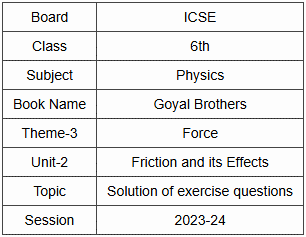
Physics Solutions for Chapter-3, Unit-2
A. Fill in the Blanks:- The force of friction generally produces Ans: heat energy.
- The force of friction increases with the increase in Ans: weight of a body.
- The SI unit of force is Ans: Newton.
- The tool used to measure the magnitude of force is Ans: spring balance.
- The force of friction between two surfaces can be reduced by Ans: oiling them.
- The force of friction is a consequential force. Ans: True.
Explanation: Friction arises because of contact between surfaces, so it is a force that results from interaction, not a separate fundamental force. - The force of friction is a disadvantage when moving a vehicle on the road. Ans: False.
Explanation: Friction is useful for vehicles because it provides the grip needed for tyres to move the vehicle and to stop safely; without it, wheels would slip. - Friction wears out moving parts of a machine. Ans: True.
Explanation: Continuous rubbing between moving parts causes wear and tear, which is why lubrication is used to reduce friction. - The force required to lift a mass of 1 kg in a vertically upward direction is called a newton. Ans: False.
Explanation: A newton is the SI unit of force; it is the force needed to accelerate a 1 kg mass at 1 m/s², not specifically to lift 1 kg. - Streamlining reduces the friction between a body and a fluid. Ans: True.
Explanation: A streamlined shape reduces resistance from air or water, so the body faces less frictional force when moving through a fluid.
1. The tyres of vehicles are provided with deep grooves to decrease friction between the road and tyres.
Correct Statement: The tyres of vehicles are provided with deep grooves to increase friction between the road and tyres.
2. The force of friction is an example of gravitational force.
Correct Statement: The force of friction is an example of consequential force.
3. The force of friction always acts in the direction of the applied force.
Correct Statement: The force of friction always acts in the opposite direction of the applied force.
4. Boats are streamlined to give them a better look.
Correct Statement: The boats are streamlined to reduce friction.
5. The rough surface offers very little friction.
Correct Statement: The rough surface offers very high friction.
(a) Newton (N) (a)
(b) Kilogram force (Kgf) (b)
(c) Gramforce (gf) (c)
(d) Dyne (d)
Ans: (a) Newton (N)Explanation: The newton is the SI unit of force. It is defined as the force that gives a mass of 1 kg an acceleration of 1 m/s². 2. Deep grooves in the tyre of a tractor:
(a) Decrease friction (a)
(b) Increase friction (b)
(c) Makes it stable (c)
(d) Makes it attractive (d)
Ans: (b) Increase frictionExplanation: Deep grooves help the tyre bite into soft ground and provide better grip, so they increase traction and prevent slipping. 3. Force of friction:
(a) Increases with the increase in weight of the body (a)
(b) Decreases with the increase in weight of the body (b)
(c) Is not affected by the weight of the body (c)
(d) None of these (d)
Ans: (a) Increases with the increase in weight of the bodyExplanation: A heavier body presses the surfaces together with a larger normal force, and greater normal force usually produces greater friction. 4. Which is not the correct statement?
(a) Reduces speed of body (a)
(b) Brings about wear and tear (b)
(c) Heats the body (c)
(d) Polishes the surface of body (d)
Ans: (d) Polishes the surface of bodyExplanation: Friction usually causes wear and roughening, not polishing; it reduces speed and produces heat as surfaces rub against each other. E. Match the Statements in Column A with Those in Column B:
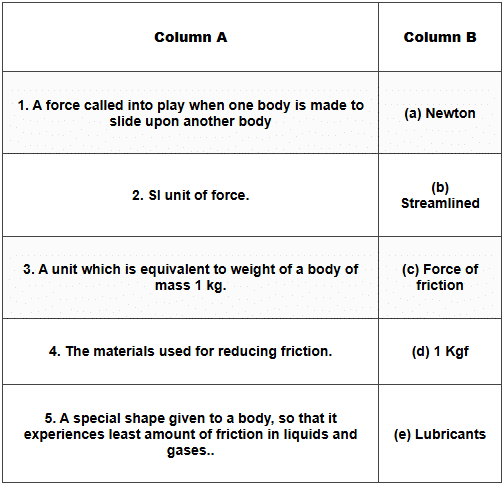
Answer:
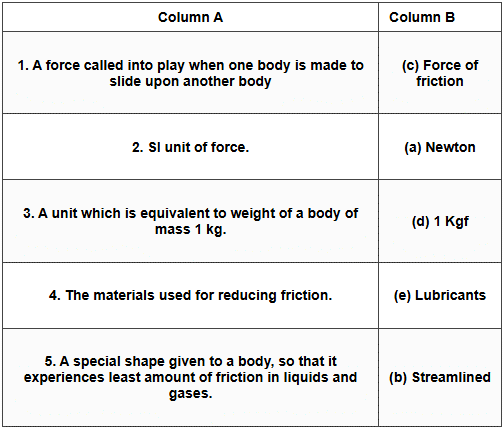
Ans: The force of friction is the force that acts in the direction opposite to the motion of a body when two surfaces rub against each other. For example, a ball rolling on the ground slows down and stops because friction between the ball and ground opposes its motion.
(b) When does the force of friction come into play?Ans: Friction comes into play when two surfaces are in contact and there is relative motion or a tendency to move between them. If one surface moves or tries to move over another, friction acts.
(c) If a force is applied towards the East to move an object, in which direction does the force of friction act?Ans: Friction acts in the opposite direction to the applied force, so if the object is pushed East, friction acts towards the West.
Question 2: Give two examples where the force of friction is advantageous.Ans:
- Friction helps brakes to stop a moving vehicle by converting motion into heat.
- Friction between our shoes and the ground allows us to walk without slipping.
Ans:
- It causes the soles of shoes to wear out with time.
- It produces wear in machine parts, increasing maintenance and energy loss.
Ans:
- Make the contacting surfaces rougher so they grip each other better.
- Remove any lubrication (oil or grease) between the surfaces so they do not slide easily.
Ans:
- Apply a lubricant such as oil to the surfaces to reduce rubbing.
- Give the object a streamlined shape to reduce resistance when moving through air or water.
Ans: Streamlining means shaping an object so that it moves more easily through a fluid (air or water) by reducing resistance.
- (a) In nature: Fish have streamlined bodies to swim faster with less resistance.
- (b) Man-made: Aeroplanes and cars are given streamlined shapes to reduce air resistance and save fuel.
Ans: Tyres have deep grooves to increase friction and provide better grip on the road. The grooves also help to channel away water on wet roads, reducing the chance of slipping.
Question 8: Why does a knot tied in jute thread not slip easily compared to silk thread?Ans: Jute fibres have a rough and fibrous surface that creates more friction at the knot, so it holds better. Silk is smooth and slippery, so a knot in silk is more likely to slip.
Question 9: Explain the statement "Friction is a necessary evil" with examples.Ans: Friction is called a necessary evil because it has both good and bad effects. It is bad because it causes wear and tear and wastes energy as heat, for example, moving machine parts wear out and engines lose energy due to friction. It is good because many daily activities need friction, for example, walking without slipping and braking a vehicle. Thus, while friction can cause problems, it is also essential for safety and movement.
Question 10: (a) State the common unit of force and define it.Ans: The common unit of force is the newton (N). One newton is the force that makes a mass of 1 kg gain an acceleration of 1 m/s2.
(b) Name the unit of force in the SI system. How much mass can be lifted by this force in grams?Ans: The SI unit of force is the newton (N). One newton can lift a mass of about 102 grams vertically upwards (since 1 N is roughly the weight of 0.102 kg under Earth's gravity).
Thank you for reading! Please share this resource with friends if you find it useful.
Related Post