Goyal Brothers Prakashan Textbook Solutions: Rectilinear Propagation of Light, Pinhole Camera And Shadows

Rectilinear Propagation Of Light ICSE Class-6th Goyal Brothers Physics Solutions Chapter-5 Unit-2
- By PANDEY TUTORIAL
- -
- -
WhatsApp Group
Rectilinear Propagation Of Light ICSE Class-6th Goyal Brothers Physics Solutions Chapter-5 Unit-2 We provide step-by-step answers to objective questions, true/false statements, incorrect and correct statements, fill in the blanks, match the following, and study questions of Chapter-5 (Light, Unit-2: Rectilinear Propagation Of Light, Pinhole Camera, and Shadows).
Light
Camera
CISCECISCE
Rectilinear Propagation Of Light Pinhole Camera And Shadows ICSE Class-6th Goyal Brothers Physics Solutions Chapter-5 Unit-2
OBJECTIVE QUESTIONS
OBJECTIVE QUESTIONSRectilinear Propagation Of Light Pinhole Camera And Shadows ICSE Class-6th Goyal Brothers Physics Solutions Chapter-5 Unit-2
Que: A. Fill in the blank spaces by choosing the correct words from the list given below:
Que: A. Fill in the blank spaces by choosing the correct words from the list given below:List : high, solar, shadow, straight lines, inverted
- 1. The pinhole camera is based on the principle that light travels in straight lines.
- 2. For the formation of a shadow, there must be an opaque body to obstruct the path of light.
- 3. The image formed in a pinhole camera is always inverted.
- 4. An airplane flying high in the sky does not cast its shadow.
- 5. During a solar eclipse, the shadow of the moon falls on the day side of the Earth.
Que: B. Statements given below are incorrect. Write the correct statements.
Que: B. Statements given below are incorrect. Write the correct statements.Question: 1. An opaque body as a screen is not necessary in the formation of a shadow.
Ans:An opaque body as a screen is necessary in the formation of a shadow because a shadow is formed when an object blocks light and a surface is needed to show the dark region. Without a screen (or surface) the dark region cannot be clearly observed.
Question: 2. The image formed by a pinhole camera is always virtual and erect.
Ans:The image formed by a pinhole camera is always real and inverted. Light from each point of the object crosses through the pinhole and falls on the opposite side of the box, producing a real image on the screen which is upside down.
Question: 3. Solar eclipse takes place more frequently than the lunar eclipse.
Ans:Solar eclipse takes place less frequently than the lunar eclipse. This is because the Moon's shadow on the Earth is very small and lies along a narrow path, whereas the Earth's shadow on the Moon is much larger and easier for the Moon to enter.
Question: 4. The size of umbra increases as the opaque body is moved away from the screen.
Ans:The size of the umbra decreases as the opaque body is moved away from the screen. When the object moves away from the screen, the fully dark region becomes smaller because the light from the source can reach more of the screen around the object.
Question: 5. Solar eclipse lasts longer than the lunar eclipse.
Ans:Solar eclipse lasts for a shorter time than a lunar eclipse. The Moon's shadow moves quickly across the Earth and the area of totality is small, so totality at any given place lasts only a few minutes, while a lunar eclipse can be seen from the whole night side of Earth and therefore lasts longer.
Que: C. State whether the following statements are true or false :
Que: C. State whether the following statements are true or false :Answer:
Answer: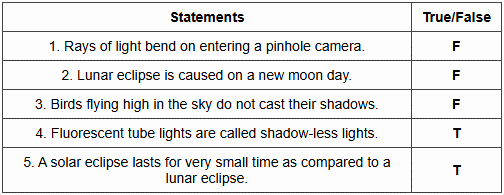
Que: E. Match the statements in Column A, with those in Column B :
Que: E. Match the statements in Column A, with those in Column B :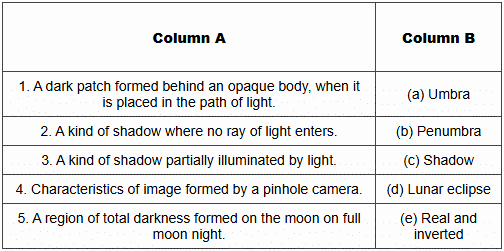
Answer:
Answer: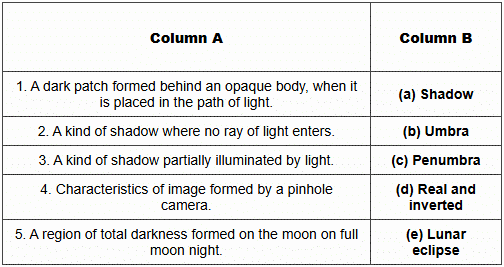
STUDY QUESTIONS
STUDY QUESTIONSRectilinear Propagation Of Light Pinhole Camera And Shadows ICSE Class-6th Goyal Brothers Physics Solutions Chapter-5 Unit-2
1. Briefly describe an experiment to prove that light travels in straight lines.
Ans:Materials: Three identical cardboard sheets, a pin or small hole, a candle or small lamp and a stand.
Procedure:
- Make a small hole at the centre of each cardboard.
- Hold the three cardboards parallel and in line so that all three holes are exactly one above the other.
- Place a lit candle near one end and look through the hole at the other end.
Observation: You can see the candle flame only when all three holes are exactly aligned. If any one cardboard is moved slightly so the holes are not in a straight line, the flame is no longer visible.
Conclusion: This shows that light travels in straight lines because only when the holes form a straight path can rays from the candle reach the eye.
2. (a) What is the principle of a pinhole camera?
Ans:The principle of a pinhole camera is that light travels in straight lines (rectilinear propagation). Rays of light from different points of an object pass through the pinhole and form corresponding points on the screen, producing an image which is real and inverted.
(b) Briefly describe the construction and working of a pinhole camera. Draw a diagram in support of your answer.
Ans:Construction:
- Use a light-proof box or a closed dark room.
- Make a very small hole (the pinhole) on one side of the box.
- Place a translucent screen or white paper on the opposite side inside the box to catch the image.
Working:
- Light from each point of the object travels in straight lines and some rays pass through the pinhole.
- Each ray falls on a particular point on the screen, so a real image is formed on the screen.
- The image is inverted because the rays from the top of the object cross through the pinhole and reach the lower part of the screen, and vice versa.
Note: A clear diagram showing rays from the top and bottom of an object crossing at the pinhole and forming an inverted image on the screen should be drawn to support this explanation.
3. (a) State three characteristics of an image formed by a pinhole camera.
Ans:- A real image is obtained because the image is formed on the screen inside the box.
- The image is smaller than the actual object when the screen is close to the pinhole (but may change with distance).
- The image is inverted (upside down) both vertically and horizontally compared with the object.
(b) How is the image formed in a pinhole camera affected when (i) the distance of the screen from the pinhole increases, (ii) the distance of the object from the pinhole increases?
Ans:(i) If the distance between the pinhole and the screen increases, the image size on the screen increases because rays travel a longer distance and spread out more. However, the image becomes dimmer since the same light energy spreads over a larger area.
(ii) If the object is moved farther from the pinhole, the image size on the screen becomes smaller because the rays from the object spread less by the time they reach the pinhole. The image may also become slightly less bright.
4. (a) What is a shadow? State three conditions for the formation of a shadow.
Ans:A shadow is a dark region formed on a surface when light from a source is blocked by an opaque object.
Three conditions necessary for the formation of a shadow:
- There must be a source of light.
- There must be an opaque object to block the light.
- There must be a screen or surface on which the shadow can form.
(b) Define the terms: (i) Umbra, (ii) Penumbra.
Ans:- (i) Umbra: The region of complete shadow where all direct light from the source is blocked by the object. In this region the screen appears fully dark.
- (ii) Penumbra: The region of partial shadow around the umbra where only a part of the light from the source is blocked. The penumbra appears lighter than the umbra.
5. By drawing a neat diagram show the formation of shadow when the extended source of light is smaller than the opaque body. How are the umbra and penumbra shadows affected when the screen is moved away from the opaque body?
Ans:When the source is smaller than the object, there is a clear umbra (completely dark region) behind the object and a smaller penumbra around it. As the screen is moved farther from the object, the umbra becomes smaller because more rays from different parts of the source can reach around the object, while the penumbra becomes larger and fainter. If the screen is moved very far, the umbra may shrink and eventually disappear, leaving mostly penumbra.
6. By drawing a diagram show the formation of shadow when the extended source of light is bigger than the opaque body. How are the umbra and penumbra affected when the screen is moved away from the opaque body?
Ans:When the source is larger than the object there is a large penumbra and a small or sometimes no umbra. The penumbra is wide because different parts of the large source send rays that are partially blocked. As the screen moves away, the penumbra grows wider and the umbra (if present) becomes smaller and may disappear altogether, leaving only a faint, large penumbra.
7. By drawing a diagram explain why the birds flying high in the sky do not cast their shadows.
Ans:Birds flying very high appear not to cast noticeable shadows on the ground because the distance between the bird and the ground is large. Light rays from the Sun come from many directions (the Sun is effectively an extended source) so the small umbra produced by the bird is tiny by the time it reaches the ground and the penumbra is very spread out and faint. Thus any shadow becomes too small or too faint to see.
8. Why are fluorescent tube lights called shadowless lights?
Ans:Fluorescent tube lights are called shadowless lights because the tube is an extended source of light. Light comes from many points along the tube so the shadows from these many points overlap. This makes the umbra very small or absent and produces only a faint penumbra, so distinct sharp shadows are not visible.
9. (a) What is a solar eclipse? Support your answer by a neat diagram.
Ans:A solar eclipse occurs when the Moon comes between the Sun and the Earth and blocks all or part of the Sun's light from reaching a part of the Earth. During a total solar eclipse the Moon completely covers the Sun as seen from a small region on Earth, producing a dark area called the umbra on Earth's surface.
(b) Why does a solar eclipse last for a very small time?
Ans:A solar eclipse lasts for a short time at any one place because the Moon's shadow moves quickly over the Earth's surface and the path of totality is narrow. The Moon's shadow travels across the Earth at high speed, so the period of totality at a given location is only a few minutes.
(c) Why is a total solar eclipse not very frequent?
Ans:A total solar eclipse is not frequent because the Moon's orbit is tilted by about 5° to the Earth's orbit. This tilt means that the Moon's shadow does not fall on the Earth every new moon. Only when the Moon is near the plane of Earth's orbit during a new moon do eclipses occur, making total solar eclipses uncommon.
10. (a) What is a lunar eclipse? Support your answer by a neat diagram.
Ans:A lunar eclipse happens when the Earth comes between the Sun and the Moon so that the Moon passes into the Earth's shadow. During a total lunar eclipse the whole Moon moves into the Earth's umbra and appears dark or reddish.
(b) Why does a lunar eclipse last longer than a solar eclipse?
Ans:A lunar eclipse lasts longer because the Earth's shadow is much bigger than the Moon's shadow, and the Moon moves more slowly through the Earth's shadow compared with the speed of the Moon's shadow over the Earth's surface. As a result, the Moon can remain in the shadow for a longer time.
(c) Why is a lunar eclipse more frequent compared to a solar eclipse?
Ans:Lunar eclipses are more frequent from any one place because the Earth's shadow is large and a lunar eclipse can be seen by anyone on the night side of Earth when it occurs. The Moon more often passes through Earth's larger shadow than the Moon's small shadow falls on the Earth, so solar eclipses are rarer.
11. Why should a solar eclipse not be seen with naked eyes? How is a solar eclipse seen? Explain.
Ans:Direct viewing of a solar eclipse with the naked eye is dangerous because the Sun's bright visible light and invisible ultraviolet rays can damage the retina and may cause permanent blindness.
Safe ways to observe a solar eclipse:
- Use a pinhole projector or a simple paper projection: let the Sun's image fall on a screen instead of looking directly.
- Use specially made solar eclipse glasses or solar filters that meet safety standards (do not use regular sunglasses).
- Use a telescope or binoculars only with a proper solar filter fixed over the front of the instrument.
- Attend public viewing events where proper equipment and safety measures are provided by experts.
Never look directly at the Sun through unfiltered optical devices or ordinary glasses.
- : End Rectilinear Propagation Of Light Pinhole Camera And Shadows ICSE Class-6th Goyal Brothers Physics Solutions Chapter-5 Unit-2 :--
Return to- ICSE Class -6 Goyal Brothers Physics Solutions
Return to- ICSE Class -6 Goyal Brothers Physics SolutionsICSE Class -6 Goyal Brothers Physics Solutions
Thanks
Please share with your friends if you find it useful
Related Post