JEE Exam > JEE Notes > Chemistry Main & Advanced > Infographic: Equilibrium
Infographic: Equilibrium

The document Infographic: Equilibrium is a part of the JEE Course Chemistry for JEE Main & Advanced.
All you need of JEE at this link: JEE
FAQs on Infographic: Equilibrium
| 1. What is the concept of equilibrium in chemistry? |  |
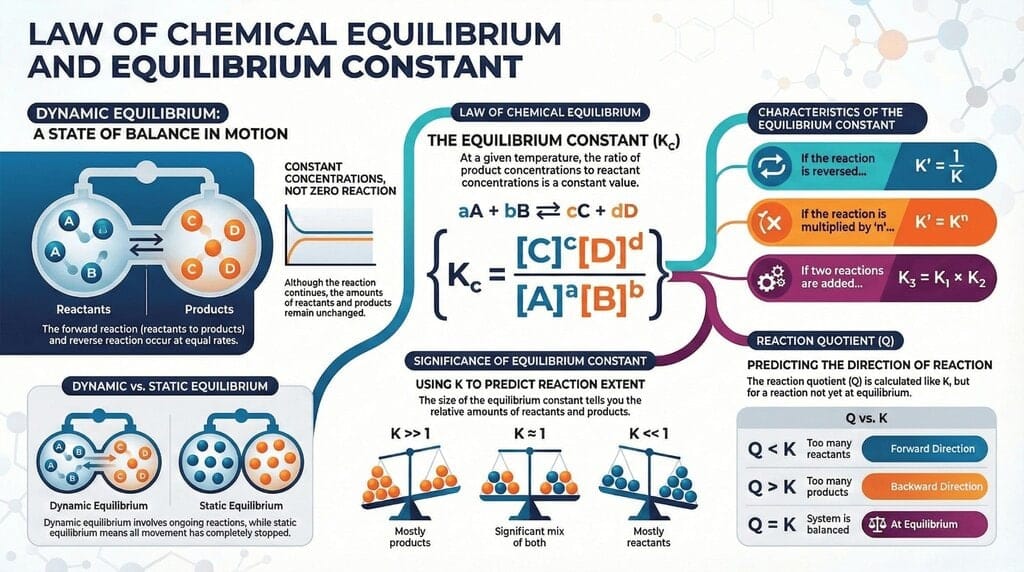
Ans. Equilibrium in chemistry refers to the state in a reversible reaction where the rates of the forward and reverse reactions are equal, resulting in constant concentrations of reactants and products over time. This state can be dynamic, meaning the reactions still occur, but there is no net change in the concentrations of the substances involved.
| 2. How is the equilibrium constant (K) expressed? | |
Ans. The equilibrium constant (K) is expressed as the ratio of the concentrations of the products raised to their coefficients to the concentrations of the reactants raised to their coefficients, according to the balanced chemical equation. For a reaction aA + bB ⇌ cC + dD, the expression for K is K = [C]ⁿ[D]ᵐ / [A]ˡ[B]ᵇ, where square brackets denote molarity.
| 3. What factors can affect the position of equilibrium? | |
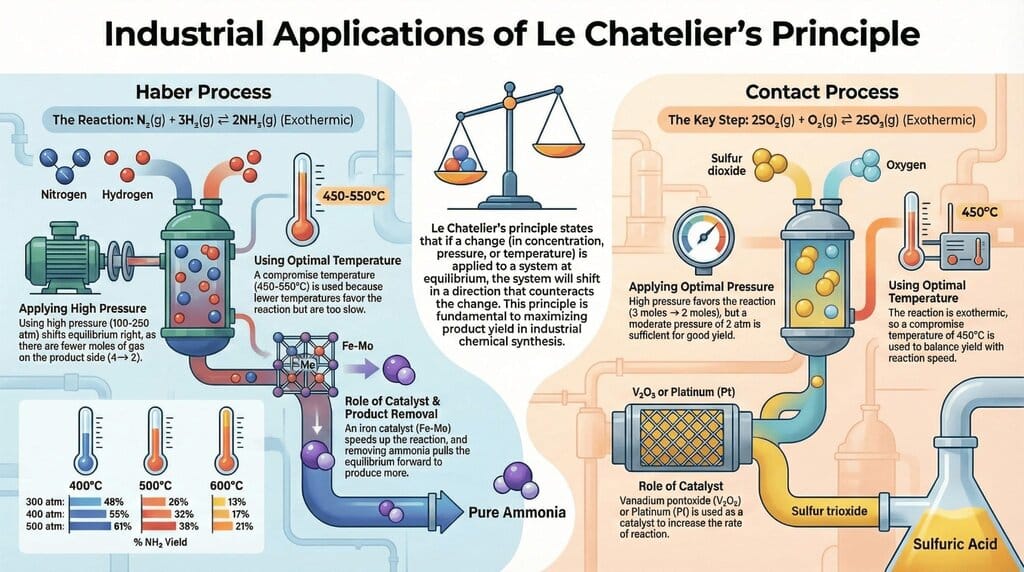
Ans. The position of equilibrium can be affected by changes in concentration, temperature, and pressure. According to Le Chatelier's principle, if a system at equilibrium is subjected to a change, the system adjusts to counteract that change and restore a new equilibrium. For instance, increasing the concentration of reactants shifts the equilibrium to favour the formation of products.
| 4. What is the significance of the reaction quotient (Q) in relation to equilibrium? | |
Ans. The reaction quotient (Q) is a ratio similar to the equilibrium constant (K) but is calculated using the current concentrations of reactants and products at any point in time. By comparing Q to K, one can determine the direction in which the reaction will proceed to reach equilibrium: if Q < k,="" the="" reaction="" will="" shift="" right="" to="" produce="" more="" products;="" if="" q=""> K, it will shift left to produce more reactants.
| 5. Can equilibrium be reached in all chemical reactions? | |
Ans. Not all chemical reactions can reach equilibrium. Some reactions are irreversible, meaning they go to completion and do not have a reversible nature. Equilibrium is typically associated with reversible reactions where both forward and reverse processes can occur, allowing for a balance between reactants and products.
About this Document

4.63/5 Rating

Apr 29, 2026 Last updated
Document Description: Infographic: Equilibrium for JEE 2026 is part of Chemistry for JEE Main & Advanced preparation. The notes and questions for Infographic: Equilibrium have been prepared according to the JEE exam syllabus. Information about Infographic: Equilibrium covers topics like and Infographic: Equilibrium Example, for JEE 2026 Exam. Find important definitions, questions, notes, meanings, examples, exercises and tests below for Infographic: Equilibrium.
Introduction of Infographic: Equilibrium in English is available as part of our Chemistry for JEE Main & Advanced for JEE & Infographic: Equilibrium in Hindi for Chemistry for JEE Main & Advanced course. Download more important topics related with notes, lectures and mock test series for JEE Exam by signing up for free. JEE: Infographic: Equilibrium
Description
Infographic: Equilibrium of Chemistry provides you one-page visual summary of the chapter covering all the important topics. Download the PDF from EduRev.
Information about Infographic: Equilibrium
In this doc you can find the meaning of Infographic: Equilibrium defined & explained in the simplest way possible. Besides explaining types of Infographic: Equilibrium theory, EduRev gives you an ample number of questions to practice Infographic: Equilibrium tests, examples and also practice JEE tests



Related Searches
Sample Paper, video lectures, Exam, Important questions, mock tests for examination, Semester Notes, shortcuts and tricks, practice quizzes, Infographic: Equilibrium, study material, Free, pdf , Viva Questions, Summary, Infographic: Equilibrium, MCQs, past year papers, Previous Year Questions with Solutions, Infographic: Equilibrium, Objective type Questions, Extra Questions, ppt;