Cell Cycle


The cell cycle is the series of events that a cell undergoes from its formation to its division into two daughter cells. Understanding the cell cycle is crucial because it explains how plants grow, how tissues regenerate, and how crop improvement techniques like tissue culture work. This topic is fundamental for agriculture as it relates to plant breeding, propagation, and crop productivity.
1. Cell Cycle Overview
The cell cycle is the sequence of phases a cell passes through during its lifetime. It consists of two major phases: Interphase (non-dividing phase) and M phase (dividing phase). The entire cycle ensures accurate replication of genetic material and equal distribution to daughter cells.
- Duration: Varies widely among organisms and cell types. In meristematic cells of higher plants, it typically takes 10-30 hours.
- Purpose: Growth, repair, and reproduction of cells in multicellular organisms.
- Control: Regulated by cyclins and cyclin-dependent kinases (CDKs) at specific checkpoints.
2. Interphase
Interphase is the longest phase of the cell cycle where the cell grows and prepares for division. It occupies about 90-95% of the total cell cycle duration. During interphase, the cell is metabolically active but not dividing.
2.1 G1 Phase (Gap 1 or First Growth Phase)
- Duration: Most variable phase; can last hours to years depending on cell type.
- Cell activities: Active growth, synthesis of enzymes and proteins required for DNA replication.
- Organelles: Mitochondria, chloroplasts, endoplasmic reticulum, and Golgi apparatus increase in number.
- RNA and protein synthesis: Highly active to support cell growth.
- DNA content: Remains constant at 2n (diploid).
- G0 Phase: Cells that exit G1 and stop dividing enter a quiescent state called G0 phase. Examples include mature neurons and differentiated cells in permanent tissues.
2.2 S Phase (Synthesis Phase)
- Key event: DNA replication occurs. Each chromosome is duplicated to form two sister chromatids joined at the centromere.
- DNA content: Doubles from 2n to 4n by the end of S phase.
- Duration: Relatively constant for a given cell type; typically 6-8 hours in plant meristematic cells.
- Chromosome number: Remains the same but DNA amount doubles.
- Histone proteins: Synthesized simultaneously with DNA replication.
- Centriole duplication: In animal cells, centrioles duplicate during S phase (not applicable to most higher plant cells).
2.3 G2 Phase (Gap 2 or Second Growth Phase)
- Duration: Typically 3-4 hours in plant meristematic cells.
- Cell activities: Synthesis of proteins essential for mitosis, including tubulin for spindle fiber formation.
- Cell growth: Continues to increase cell size.
- Organelles: Further increase in number to be distributed to daughter cells.
- DNA content: Remains at 4n.
- Preparation: Cell prepares all machinery required for chromosome separation and cell division.
3. M Phase (Mitotic Phase)
The M phase includes both karyokinesis (nuclear division) and cytokinesis (cytoplasmic division). This phase is relatively short, lasting 1-2 hours in plant cells.
3.1 Karyokinesis (Mitosis)
Mitosis is the process of nuclear division that produces two genetically identical daughter nuclei. It is divided into four distinct stages.
3.1.1 Prophase
- Chromatin condensation: Chromatin fibers condense and become visible as distinct chromosomes. Each chromosome consists of two sister chromatids joined at the centromere.
- Centriole movement: In animal cells, centrioles move to opposite poles. Higher plants lack centrioles but have equivalent structures.
- Spindle apparatus: Formation begins with spindle fibers (made of microtubules) starting to appear.
- Nuclear envelope: Begins to break down towards the end of prophase.
- Nucleolus: Gradually disappears as ribosomal RNA synthesis stops.
- Duration: Longest phase of mitosis.
3.1.2 Metaphase
- Chromosome alignment: All chromosomes align at the metaphase plate (equatorial plane) of the cell.
- Spindle attachment: Kinetochore fibers (spindle fibers) attach to the kinetochore region of each centromere.
- Complete spindle formation: Spindle apparatus is fully formed with fibers extending from both poles.
- Checkpoint: The metaphase checkpoint (spindle checkpoint) ensures all chromosomes are properly attached before proceeding.
- Best stage for study: Chromosomes are most condensed and clearly visible; ideal for counting chromosome number and studying chromosome morphology.
3.1.3 Anaphase
- Centromere division: The centromere of each chromosome splits, separating sister chromatids.
- Chromatid movement: Sister chromatids (now called daughter chromosomes) move to opposite poles of the cell.
- Movement mechanism: Shortening of kinetochore fibers pulls chromosomes toward poles; polar fibers elongate, pushing poles apart.
- Chromosome shape: Chromosomes appear V, L, J, or I-shaped depending on centromere position during movement.
- Duration: Shortest phase of mitosis.
- Result: Each pole receives an identical set of chromosomes.
3.1.4 Telophase
- Chromosome decondensation: Chromosomes at each pole uncoil and become less distinct, returning to chromatin state.
- Nuclear envelope reformation: Nuclear membrane reforms around each set of chromosomes, creating two daughter nuclei.
- Nucleolus reappearance: Nucleoli reappear as ribosomal RNA synthesis resumes.
- Spindle apparatus: Spindle fibers disassemble and disappear.
- Reverse of prophase: Essentially the reverse sequence of prophase events.
3.2 Cytokinesis
Cytokinesis is the division of cytoplasm that produces two daughter cells. The mechanism differs significantly between plant and animal cells.
3.2.1 Cytokinesis in Plant Cells
- Method: Cell plate formation (centrifugal method - from center to periphery).
- Phragmoplast formation: Vesicles from the Golgi apparatus accumulate at the equatorial plane, guided by a structure called phragmoplast.
- Cell plate assembly: Vesicles fuse to form the cell plate in the middle of the cell.
- Growth direction: Cell plate grows outward toward the cell wall.
- Middle lamella: The cell plate develops into the middle lamella, which later forms the primary cell wall.
- Completion: Cell plate fuses with the existing cell wall, completely separating two daughter cells.
- Timing: Usually begins during late anaphase or early telophase.
3.2.2 Cytokinesis in Animal Cells
- Method: Cleavage furrow formation (centripetal method - from periphery to center).
- Mechanism: Contractile ring of actin and myosin filaments forms beneath the plasma membrane at the equator.
- Furrow formation: Plasma membrane is drawn inward, creating a cleavage furrow.
- Completion: Furrow deepens until the cell is pinched into two daughter cells.
4. Significance of Mitosis
- Growth: Increases cell number in meristematic tissues, enabling plant growth in length and girth.
- Genetic stability: Produces genetically identical daughter cells, maintaining chromosome number across generations of cells.
- Tissue repair and regeneration: Replaces damaged or dead cells in plant tissues.
- Asexual reproduction: Basis of vegetative propagation in plants through cuttings, grafting, and tissue culture.
- Cell replacement: Continuous replacement of cells in regions of wear and tear.
5. Meiosis
Meiosis is a specialized type of cell division that reduces chromosome number by half. It produces four haploid daughter cells from one diploid parent cell. This process is essential for sexual reproduction in plants.
5.1 Features of Meiosis
- Location: Occurs in reproductive organs - anthers (pollen mother cells) and ovules (megaspore mother cells) in flowering plants.
- Divisions: Consists of two successive nuclear divisions: Meiosis I (reductional division) and Meiosis II (equational division).
- Chromosome reduction: Reduces chromosome number from diploid (2n) to haploid (n).
- Products: Produces four non-identical haploid cells.
- Genetic recombination: Creates genetic variation through crossing over and independent assortment.
5.2 Meiosis I (Reductional Division)
Meiosis I separates homologous chromosome pairs, reducing chromosome number from diploid to haploid. It is divided into four stages.
5.2.1 Prophase I
Prophase I is the longest and most complex phase of meiosis. It is further subdivided into five substages.
- Leptotene: Chromatin condenses into visible thin thread-like chromosomes. Chromosomes begin to coil.
- Zygotene: Homologous chromosomes (maternal and paternal chromosomes of the same type) pair up precisely, gene by gene. This pairing is called synapsis. The paired chromosomes form a bivalent or tetrad (four chromatids).
- Pachytene: Chromosomes become shorter and thicker. Crossing over occurs - exchange of genetic material between non-sister chromatids of homologous chromosomes. The point of exchange is called chiasma (plural: chiasmata). This is the key stage for genetic recombination.
- Diplotene: Homologous chromosomes begin to separate but remain attached at chiasmata. The separation points where crossing over occurred become visible. Each bivalent clearly shows four chromatids.
- Diakinesis: Chromosomes become maximally condensed and shortened. Chiasmata move toward chromosome ends (terminalization). Nuclear envelope breaks down, nucleolus disappears, and spindle apparatus forms.
5.2.2 Metaphase I
- Bivalent alignment: Bivalents (paired homologous chromosomes) align at the metaphase plate.
- Spindle attachment: Kinetochore fibers from opposite poles attach to centromeres of homologous chromosomes.
- Orientation: Orientation of each bivalent is random, providing basis for independent assortment of chromosomes.
- Key difference from mitosis: Homologous pairs align (not individual chromosomes).
5.2.3 Anaphase I
- Homologue separation: Homologous chromosomes separate and move to opposite poles.
- Centromere intact: Unlike mitosis, centromeres do not split. Each chromosome still consists of two sister chromatids joined at the centromere.
- Reduction: Chromosome number is halved; each pole receives only one chromosome from each homologous pair.
- Genetic variation: Random distribution of maternal and paternal chromosomes creates variation.
5.2.4 Telophase I
- Nuclear envelope: Reforms around each group of chromosomes at the poles.
- Chromosome state: Chromosomes may partially decondense.
- Cytokinesis: Usually occurs, forming two haploid cells.
- Chromosome number: Each daughter cell has haploid number of chromosomes (n), but each chromosome still consists of two chromatids.
- DNA content: Each cell has 2n amount of DNA (though chromosome number is n).
5.3 Interkinesis
- Brief interphase: Short resting period between Meiosis I and Meiosis II.
- No DNA replication: Unlike true interphase, DNA synthesis does not occur.
- Duration: May be very brief or absent in some organisms.
5.4 Meiosis II (Equational Division)
Meiosis II resembles mitosis. It separates sister chromatids, producing four haploid cells. The chromosome number remains the same but DNA content is halved.
5.4.1 Prophase II
- Chromosome condensation: Chromosomes condense again if they had decondensed.
- Nuclear envelope: Breaks down if it had reformed.
- Spindle formation: New spindle apparatus forms perpendicular to the old one.
- Centrioles: Move to opposite poles in animal cells.
5.4.2 Metaphase II
- Chromosome alignment: Individual chromosomes (each with two chromatids) align at the metaphase plate.
- Spindle attachment: Spindle fibers from opposite poles attach to the centromere of each chromosome.
- Similar to mitosis: Arrangement resembles metaphase of mitosis.
5.4.3 Anaphase II
- Centromere division: Centromere of each chromosome splits.
- Chromatid separation: Sister chromatids separate and move to opposite poles as individual chromosomes.
- Similar to mitosis: Resembles anaphase of mitosis.
5.4.4 Telophase II
- Nuclear envelope: Reforms around each set of chromosomes.
- Chromosome decondensation: Chromosomes uncoil and become less distinct.
- Cytokinesis: Follows, resulting in four haploid daughter cells.
- Final products: Four non-identical haploid cells, each with n chromosomes and n amount of DNA.
5.5 Significance of Meiosis
- Chromosome number maintenance: Maintains constant chromosome number across generations in sexually reproducing organisms. Without meiosis, chromosome number would double with each fertilization.
- Genetic variation: Creates variation through crossing over (recombination) and independent assortment. This is crucial for evolution and crop improvement.
- Gamete formation: Produces haploid gametes (pollen and egg cells in plants) necessary for sexual reproduction.
- Breeding applications: Understanding meiosis is essential for plant breeding programs, especially for creating genetic variations and understanding inheritance patterns.
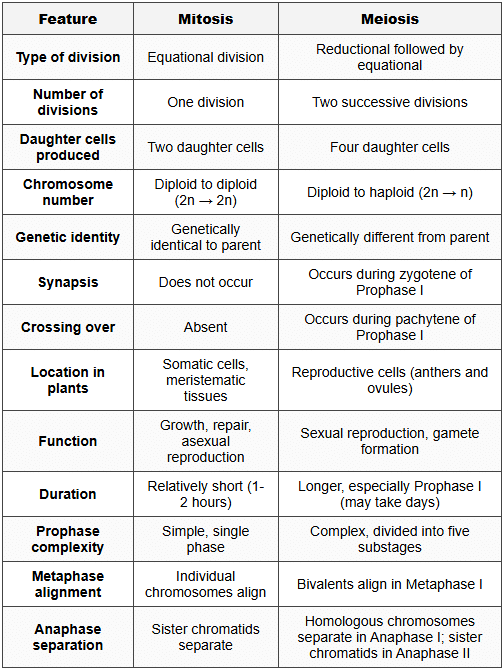
6. Comparison: Mitosis vs. Meiosis
7. Cell Cycle Regulation and Checkpoints
The cell cycle is tightly regulated to ensure accurate DNA replication and chromosome distribution. Errors can lead to cell death or uncontrolled growth (cancer-like conditions in animal cells or abnormal growth in plant tissues).
7.1 Major Checkpoints
- G1 Checkpoint (Restriction Point): Checks for cell size, nutrient availability, growth signals, and DNA damage. Decides whether the cell should proceed to S phase, enter G0, or undergo apoptosis.
- G2 Checkpoint: Ensures DNA has been completely and accurately replicated. Checks for DNA damage before entering mitosis. Verifies that all proteins needed for mitosis are present.
- M Checkpoint (Spindle Checkpoint): Occurs at metaphase. Ensures all chromosomes are properly attached to spindle fibers before anaphase begins. Prevents premature separation of sister chromatids.
7.2 Regulatory Molecules
- Cyclins: Proteins whose concentration varies cyclically during the cell cycle. Different cyclins regulate different phases (G1 cyclins, S cyclins, M cyclins).
- Cyclin-Dependent Kinases (CDKs): Enzymes that become active only when bound to specific cyclins. The cyclin-CDK complex phosphorylates target proteins to drive cell cycle progression.
- Checkpoints proteins: Include tumor suppressor proteins that halt the cycle if problems are detected.
8. Agricultural Applications of Cell Cycle Knowledge
- Tissue culture and micropropagation: Understanding mitosis enables rapid multiplication of disease-free, elite plant varieties through in vitro techniques.
- Plant breeding: Knowledge of meiosis is crucial for understanding inheritance, creating hybrid varieties, and predicting offspring traits.
- Polyploidy induction: Cell cycle manipulation using chemicals like colchicine can disrupt spindle formation, leading to polyploid plants with improved traits (larger fruits, higher yield).
- Mutation breeding: Understanding cell division helps in timing mutagen application for maximum effect during DNA replication.
- Crop improvement: Genetic recombination during meiosis is exploited to combine desirable traits from different parents.
- Somatic hybridization: Cell cycle synchronization is important in protoplast fusion techniques for creating novel plant varieties.
9. Common Student Mistakes and Trap Alerts
- Trap: Students often confuse chromosome number with DNA content. After S phase, DNA content doubles (2n becomes 4n in terms of DNA), but chromosome number remains the same.
- Trap: In Anaphase I of meiosis, centromeres do NOT divide. Homologous chromosomes separate, but each chromosome still has two chromatids. Centromeres divide only in Anaphase II.
- Trap: Crossing over occurs between non-sister chromatids of homologous chromosomes, NOT between sister chromatids of the same chromosome.
- Trap: Cytokinesis in plant cells occurs by cell plate formation (centrifugal), not by cleavage furrow (centripetal) like in animal cells.
- Trap: G0 phase is NOT the same as G1 phase. G0 is a quiescent state where cells have exited the cell cycle and stopped dividing.
- Trap: The equatorial plate in metaphase is NOT a physical structure. It is an imaginary plane where chromosomes align.
- Trap: Meiosis produces four cells, but in plants, only one of the four megaspores typically survives in female gametophyte formation.
- Mistake: Students often write that chromosomes "appear" in prophase. Chromosomes are always present as chromatin; they become visible due to condensation.
Understanding the cell cycle is fundamental to agriculture, particularly in areas like plant breeding, tissue culture, and crop improvement programs. The precise regulation and execution of cell division ensure genetic stability in vegetative propagation (mitosis) and genetic diversity in sexual reproduction (meiosis). Both processes are exploited extensively in modern agricultural biotechnology for developing improved crop varieties with enhanced yield, disease resistance, and stress tolerance.




