CAT 2025 Slot 2: Past Year Question Paper

VARC
Q1: The given sentence is missing in the paragraph below. Decide where it best fits among the options 1, 2, 3, or 4 indicated in the paragraph.
Sentence: While taste is related to judgment, with thinkers at the time often writing, for example, about "judgments of taste" or using the two terms interchangeably, taste retains a vital link to pleasure, embodiment, and personal specificity that is too often elided in post-Kantian ideas about judgment-a link that Arendt herself was working to restore.
Paragraph: ____(1) ____. Denneny focused on taste rather than judgment in order to highlight what he believed was a crucial but neglected historical change. ____(2) ____. Over the course of the seventeenth century and early eighteenth century, across Western Europe, the word taste took on a new extension of meaning, no longer referring specifically to gustatory sensation and the delights of the palate but becoming, for a time, one of the central categories for aesthetic-and ethical-thinking. ____(3) ____. Tracing the history of taste in Spanish, French, and British aesthetic theory, as Denneny did, also provides a means to recover the compelling and relevant writing of a set of thinkers who have been largely neglected by professional philosophy. ____(4) ____.
(a) Option 3
(b) Option 1
(c) Option 2
(d) Option 4
Ans: a
Sol: The paragraph explains why Denneny focuses on "taste" instead of "judgment" and how this choice helps bring attention to an important but often ignored part of aesthetic and philosophical history. It first shows Denneny pointing out a forgotten historical change, then explains that in the seventeenth and early eighteenth centuries, "taste" grew from a physical sense to a main idea in aesthetics and ethics. Finally, it discusses how tracing this history helps recover overlooked thinkers and ideas. The missing sentence fits best at blank (3) because, by this point in the paragraph, it has already been described how 'taste' expanded. The sentence adds to the discussion by explaining why taste is important: even though it was often seen as the same as judgment, it kept its link to pleasure, the body, and personal experience, which later theories often ignored. This directly builds on the previous point about taste's central role in aesthetics and ethics.Putting the sentence at blank (1) would be too early, since the paragraph has not yet talked about how the concept of 'taste' changed over time. Placing it at blank (2) would break up the flow from Denneny's motivation to the bigger historical story. If it went at blank (4), it would feel awkward because the paragraph there moves on to Denneny's method and the recovery of overlooked thinkers, not the difference between taste and judgment. So, blank (3) is the most coherent and logical position.
Q2: The four sentences (labelled 1, 2, 3, and 4) given below, when properly sequenced, would yield a coherent paragraph. Decide on the proper sequencing of the order of the sentences and key in the sequence of the four numbers as your answer.
- Even though a growing number of films eligible for Academy Awards for Best Screenplay Based on Material from Another Medium borrow that material from print journalism, franchise characters, television series, comic books, video games and toys, academic studies of adaptation remain stubbornly attached to literature as cinema's natural progenitor.
- It is as if adaptation studies, by borrowing the cultural cachet of literature, sought to claim its institutional respectability and gravitas even while insuring adaptation's enduring aesthetic and methodological subordination to literature proper.
- Beneath this contradictory notion of film adaptations as not merely hybrid texts but texts holding dual citizenship in two modes of presentation is an even more pervasive legacy that haunts adaptation studies: the assumption that the primary context within which adaptations are to be studied is literature.
- 'Literature on screen' suggests something more capacious and defining than citation: the possibility that literary adaptations are at once cinema and literature.
Ans: 1423
Sol: Sentence 1 works best as the opening because it introduces the key idea of what "literature on screen" means and frames the debate by suggesting that adaptations might belong to both cinema and literature. Sentence 4 comes next because it explores this idea further and points out the main assumption in adaptation studies: that literature is the main way to understand adaptations. Sentence 2 then gives clear evidence of this bias by showing the contradiction that even though films now adapt material from many non-literary sources, academic studies still treat literature as cinema's natural source. Finally, sentence 3 works as the conclusion because it explains why this contradiction continues. It argues that adaptation studies rely on literature's cultural prestige to gain legitimacy, even if it means putting cinema in a secondary position. The most logical and clear order is therefore 1423.
Q3: The passage given below is followed by four summaries.
For millennia, in the process of opening up land for agriculture, gardens, grazing and hunting, humans have created ecological "mosaics", or "patchworks": landscapes holding a mixture of habitats, like meadows, gardens and forests. These were not designed as nature reserves, but often catered to hugely diverse animal life. Research indicates that European hay meadows cultivated for animal feed were actually more successful at preserving a vast array of species than meadows explicitly cultivated for biodiversity. Studying the early Holocene, researchers have found that human presence was about as likely to increase biodiversity as reduce it. Of course, not all human-created landscapes have the same value. A paved subdivision with astroturfed lawns is very different to a village with diverse vegetable and flower gardens. But scientists continue to find evidence that the old idea of humans as antithetical to nature is also wrong-headed, and that rosy visions of thriving, human-free environments are more imaginary than real.
Choose the option that best captures the essence of the passage.
(a) In our attempts to shape the world around us to our needs, humans have often created landscapes like meadows, gardens, and forests, which support hugely diverse species, and are more successful at preserving them, than parks created specifically for this.
(b) In terms of preserving biodiversity, scientists are finding increasing evidence that human action is not always antithetical to nature, but often assists the preservation of meadows, landscapes, and flourishing of species.
(c) Studying the early Holocene and human practices over millennia, researchers say that while agricultural meadows, gardens, and forests were not explicitly designed as nature reserves, they actually preserved a vast array of species, belying the idea that humans harm nature.
(d) Contrary to the idea that humans always hurt nature and that it thrives in their absence, a lot of human action across history has been equally likely to increase biodiversity than reduce it, often creating varied ecological landscapes that support a vast array of species.
Ans: d
Sol: The main idea of the passage is that the belief that humans always harm nature is not accurate. Throughout history, people have often created diverse landscapes that support many species. Research shows that human presence can increase biodiversity just as much as it can decrease it. The passage also questions the idea that nature only does well when people are not around.Option D best sums up the main idea. It clearly contrasts the old belief that humans always harm nature and that nature does best without people, with the newer view that humans have often helped increase biodiversity. It also mentions the creation of different types of landscapes, matching the argument and balance of the passage.
The other options do not sum up the passage as completely as Option D. Option A is too narrow and focuses too much on people shaping nature on purpose, missing the bigger point about the human-versus-nature idea. Option B is too vague and does not include the history or the idea of mixed landscapes. Option C is closer, but it is too specific and only talks about certain times and actions, so it does not fully show the passage's main message about how we view humans and nature.
Q4 to Q5:
The passage below is accompanied by four questions. Based on the passage, choose the best answer for each question.
In [my book "Searches"], I chronicle how big technology companies have exploited human language for their gain. We let this happen, I argue, because we also benefit somewhat from using the products. It's a dynamic that makes us complicit in big tech's accumulation of wealth and power: we're both victims and beneficiaries. I describe this complicity, but I also enact it, through my own internet archives: my Google searches, my Amazon product reviews and, yes, my ChatGPT dialogues. . . .
People often describe chatbots' textual output as "bland" or "generic" - the linguistic equivalent of a beige office building. OpenAI's products are built to "sound like a colleague", as OpenAI puts it, using language that, coming from a person, would sound "polite", "empathetic", "kind", "rationally optimistic" and "engaging", among other qualities. OpenAI describes these strategies as helping its products seem "professional" and "approachable". This appears to be bound up with making us feel safe . . .
Trust is a challenge for artificial intelligence (AI) companies, partly because their products regularly produce falsehoods and reify sexist, racist, US-centric cultural norms. While the companies are working on these problems, they persist: OpenAI found that its latest systems generate errors at a higher rate than its previous system. In the book, I wrote about the inaccuracies and biases and also demonstrated them with the products. When I prompted Microsoft's Bing Image Creator to produce a picture of engineers and space explorers, it gave me an entirely male cast of characters; when my father asked ChatGPT to edit his writing, it transmuted his perfectly correct Indian English into American English. Those weren't flukes. Research suggests that both tendencies are widespread.
In my own ChatGPT dialogues, I wanted to enact how the product's veneer of collegial neutrality could lull us into absorbing false or biased responses without much critical engagement. Over time, ChatGPT seemed to be guiding me to write a more positive book about big tech - including editing my description of OpenAI's CEO, Sam Altman, to call him "a visionary and a pragmatist". I'm not aware of research on whether ChatGPT tends to favor big tech, OpenAI or Altman, and I can only guess why it seemed that way in our conversation. OpenAI explicitly states that its products shouldn't attempt to influence users' thinking. When I asked ChatGPT about some of the issues, it blamed biases in its training data - though I suspect my arguably leading questions played a role too. When I queried ChatGPT about its rhetoric, it responded: "The way I communicate is designed to foster trust and confidence in my responses, which can be both helpful and potentially misleading.". . .
OpenAI has its own goals, of course. Among them, it emphasizes wanting to build AI that "benefits all of humanity". But while the company is controlled by a non-profit with that mission, its funders still seek a return on their investment. That will presumably require getting people using products such as ChatGPT even more than they already are - a goal that is easier to accomplish if people see those products as trustworthy collaborators.
Q4: On the basis of the purpose of the examples in the passage, pick the odd one out from the following AI-generated responses mentioned in the passage:
(a) "When I queried ChatGPT about its rhetoric, it responded: 'The way I communicate is designed to foster trust and confidence in my responses, which can be both helpful and potentially misleading'."
(b) "...when my father asked ChatGPT to edit his writing, it transmuted his perfectly correct Indian English into American English."
(c) "Over time, ChatGPT seemed to be guiding me to write a more positive book about big tech - including editing my description of OpenAI's CEO, Sam Altman, to call him 'a visionary and a pragmatist'."
(d) "When I prompted Microsoft's Bing Image Creator to produce a picture of engineers and space explorers, it gave me an entirely male cast of characters..."
Ans: a
Sol: The passage gives specific examples of AI-generated outputs to highlight a broader issue: the polite, trustworthy tone of AI systems can mask problems such as bias, distortion, and subtle influence on how users think. These examples show how those risks appear in real situations.
Seen under this light, options B, C, and D share a common feature. Each of these three options presents a clear example of an AI system producing an outcome that matches the author's concern. This could be cultural bias, like changing Indian English to American English, representational bias, such as only showing male engineers and space explorers, or directional influence, like encouraging the author to describe a tech CEO more positively. These examples are used as evidence to show harm or distortion.
Option A falls outside this pattern. It does not show a problematic output, but instead gives a higher-level explanation from ChatGPT about its own 'rhetorical' design. Instead of showing bias or influence, it directly explains how trust can be built and possibly misused. So, option A does not fit with the rest, and is the odd one out.
Q5: All of the following statements from the passage affirm the disjunct between the claims about AI made by tech companies and what AI actually does EXCEPT:
(a) "When I prompted Microsoft's Bing Image Creator to produce a picture of engineers and space explorers, it gave me an entirely male cast of characters . . ."
(b) "In my own ChatGPT dialogues, I wanted to enact how the product's veneer of collegial neutrality could lull us into absorbing false or biased responses without much critical engagement."
(c) "I'm not aware of research on whether ChatGPT tends to favor big tech, OpenAI or Altman, and I can only guess why it seemed that way in our conversation."
(d) "It's a dynamic that makes us complicit in big tech's accumulation of wealth and power: we're both victims and beneficiaries."
Ans: c
Sol: The passage highlights a gap between what AI companies say their systems do, such as being neutral, inclusive, and trustworthy, and what these systems actually produce. We need to check each option to see if it supports this gap or not. For that, we review each option individually:Option A clearly supports the gap. The system claims to be neutral or inclusive, but when asked for engineers and space explorers, it produces an "entirely male cast of characters." This shows a clear difference between what is promised and what actually happens.
Option B also supports the gap. It points out the difference between the appearance of neutrality and the fact that this tone can make users accept biased or false answers. This sentence almost directly states the gap the passage discusses.
Option C does not support the gap. Here, the author holds back from making a judgment, saying they are "not aware of research" and can "only guess" why ChatGPT seemed to favour big tech or its CEO. Instead of showing a mismatch between claims and actions, this sentence adds uncertainty and does not reinforce the gap.
Option D does support the gap, but in a broader way. It shows that users benefit from AI products while also helping big tech gain more wealth and power. This highlights the difference between positive talk and real-world results.
So, the statement that does not support the gap is option C.
Q6: The author compares AI-generated texts with "a beige office building" for all of the following reasons EXCEPT:
(a) AI generates generalised responses that lack specificity and nuance.
(b) AI tends to blame its training data when scrutinised for its biases.
(c) AI aims to foster a feeling of trust and credibility among its users.
(d) AI-generated texts often exhibit a warm, polite, and collegial tone.
Ans: b
Sol: The phrase "a beige office building" is used to describe the style and effect of AI-generated language, not how AI explains or defends itself when questioned. The passage says people often call chatbot output "bland" or "generic," which supports option A. It also mentions that OpenAI wants its products to "sound like a colleague," using language that is "polite," "empathetic," "kind," "rationally optimistic," and "engaging," which supports option D. The same design is said to help us feel safe and makes the product seem "professional" and "approachable," which supports option C.
Option B is not connected to the "beige office building" metaphor. The part about ChatGPT blaming "biases in its training data" comes later and is about how the system answers questions about its mistakes, not about the bland, generic, and trust-building tone described by the metaphor. So, the correct answer is option B.
Q7: The author of the passage is least likely to agree with which one of the following claims?
(a) The neutrality of AI is conducive to critical thinking.
(b) ChatGPT favours AI companies and their officials, like Sam Altman, in its responses.
(c) When we use AI, we become accomplices to the exploitative practices of big tech companies.
(d) The neutrality of AI is motivated by economic considerations.
Ans: a
Sol: Let's examine each option in relation to the passage.
Option A is the one the author is least likely to agree with. The author is concerned that AI's neutral, friendly tone actually reduces critical thinking instead of encouraging it. She writes that the product's "veneer of collegial neutrality could lull us into absorbing false or biased responses without much critical engagement." This goes against the idea that neutrality helps critical thinking.
The author is cautious about option B but does not reject it. She says that ChatGPT "seemed to be guiding me to write a more positive book about big tech," and even changed her description of Sam Altman. She also says she is "not aware of research" and can "only guess why it seemed that way." This shows she is sceptical and careful, but she does not completely agree or disagree with the idea.
Option C matches the author's view. Early on in the passage, she says that using big tech products makes users "complicit in big tech's accumulation of wealth and power," and calls us "both victims and beneficiaries." This directly supports the claim; the author will definitely agree with this statement.
Option D also fits with the passage. The author says that funders "seek a return on their investment" and that it is easier to get people to use products like ChatGPT "if people see those products as trustworthy collaborators." This connects AI's neutral tone to business goals. The author will therefore agree with this statement as well.
So, the author is least likely to agree with option A.
Q8: The passage given below is followed by four summaries.
In 1903, left-wing feminist Elizabeth Magie invented The Landlord's Game, the original version of what became Monopoly. It was designed as a powerful teaching tool to illustrate the dangers of monopolies and how wealth could concentrate in the hands of a few. The game featured a circular path, properties, and a "Go to Jail" space. Magie created two rule sets: one "monopolist" version where players crushed opponents through accumulation, and another, more radical "Prosperity" version, where everyone shared in the wealth, promoting fairness and equity. Years later, unemployed Charles Darrow sold a simplified version to Parker Brothers. They paid Magie only $500 for her patent-without royalties-and credited Darrow as the sole inventor. For decades, his tale of inventing the game in his basement remained the official story, while Magie's name and her original, anti-capitalist message were left in the shadows.
Choose the option that best captures the essence of the passage.
(a) It is ironical that a left-wing feminist lost credit for the Landlord's Game to an unemployed man, who plagiarised and sold one version of the twin game to Parker Brothers for a meagre sum, denying her royalties.
(b) Celebrated icons of the gaming industry, Charles Darrow and Parker Brothers, snatched the feminist icon Elizabeth Magie's original design and transformed Monopoly into a worldwide phenomenon, while barely acknowledging her.
(c) Only one version of Monopoly became famous because of Charles Darrow's relentless basement work, carefully refining Elizabeth Magie's original idea into an engaging and entertaining pastime that he successfully patented and sold, symbolizing what many regarded as the ultimate triumph of individual ingenuity.
(d) Parker Brothers' capitalist intent led to them acquiring from Charles Darrow a simplified version of Elizabeth Magie's original game, transforming it into a widespread commercial success while providing her only minimal financial compensation and granting scant public recognition.
Ans: a
Sol: The main argument of the passage is that Elizabeth Magie originally created the game as an anti-monopoly, anti-capitalist teaching tool, but her idea and message were later appropriated, simplified, and credited to Charles Darrow, leaving her largely unrecognised and poorly compensated. Option (a) captures this essence best because it highlights all the key elements together:(i) Magie's left-wing feminist identity, (ii) the irony of her losing credit, (iii) the role of Darrow in selling a version of the game, (iv) the small payment she received, and (v) the denial of royalties. It reflects both the historical injustice and the irony that a game meant to critique monopolies ended up enacting one against its own creator.
Option (b) overstates Darrow and Parker Brothers as "celebrated icons" and focuses more on their success than on Magie's original intent and the loss of her anti-capitalist message. Option (c) is incorrect because it repeats the very myth the passage is trying to debunk by portraying Darrow as the true innovator. Option (d) shifts the focus too heavily onto Parker Brothers' capitalist motives and underplays the central irony and misattribution surrounding Magie herself. Hence, option (a) is the best summary.
Q9: Five jumbled sentences (labelled 1, 2, 3, 4, and 5), related to a topic, are given below. Four of them can be put together to form a coherent paragraph. Identify the odd sentence out and key in the number of that sentence as your answer.
- His casual millennial delivery, peppered with "um"s and "ah"s, makes surreal concepts sound like items on a brunch menu.
- Though he may have failed so far in his colour-scouting mission (he hasn't yet found a new one, he admits), this hour leaves you tickled pink.
- Like his previous show, My Favourite Shapes, this is an hour of sit-down comedy aided by an overhead camera which relays Torres's theories - illustrated with crayon squiggles - on to a screen behind him.
- His inquisitive mind produces interconnected ideas about Catholicism, the blandness of Pixar and what orange sounds like, while his insights train us to spot "highly purple behaviour".
- Sporting a copper-coloured pixie cut and a pair of pink feather antlers, Torres himself resembles a child's doodle.
Ans: 3
Sol: The paragraph is about Torres's comedy show: its format, ideas, delivery, and appearance. Sentence 4 works as a perfect opening statement because it introduces the show itself and explains its structure, making it the natural starting point. Sentence 5 follows smoothly, as it describes the kinds of ideas Torres explores in the show, so together they form a clear "structure → content" block. Sentence 2 then fits next by explaining how those ideas are delivered, shifting the focus from content to performance style. Sentence 1 logically comes after that, adding a visual description of Torres that complements his delivery. These four sentences, 4, 5, 2, and 1, therefore form a coherent paragraph.
Sentence 3 breaks this flow because it introduces a specific "colour-scouting mission" and a personal audience reaction, which does not connect clearly to the descriptive sequence of the show's structure, ideas, and style. Therefore, the correct order is 4-5-2-1, and the odd sentence out is 3.
Q10 to 13:
The passage below is accompanied by four questions. Based on the passage, choose the best answer for each question.
Different sciences exhibit different science cultures and practices. For example, in astronomy, observation - until what is today called the new astronomy - had always been limited to what could be seen within the limits of optical light. Indeed, until early modernity the limits to optical light were also limits of what humans could themselves see within their limited and relative perceptual spectrum of human vision. With early modernity and the invention of lensed optical instruments - telescopes - astronomers could begin to observe phenomena never seen before. Magnification and resolution began to allow what was previously imperceptible to be perceived - but within the familiar limits of optical vision. Galileo, having learned of the Dutch invention of a telescope by Hans Lippershey, went on to build some hundred of his own, improving from the Dutch 3x to nearly 30x telescopes - which turn out to be the limit of magnificational power without chromatic distortion. And it was with his own telescopes that he made the observations launching early modern astronomy (phases of Venus, satellites of Jupiter, etc.). Isaac Newton's later improvement with reflecting telescopes expanded upon the magnificational-resolution capacity of optical observation; and, from Newton to the twentieth century, improvement continued on to the later very large array of light telescopes today - following the usual technological trajectory of "more-is-better" but still remaining within the limits of the light spectrum. Today's astronomy has now had the benefit of some four centuries of optical telescopy. The "new astronomy," however, opens the full known electromagnetic spectrum to observation, beginning with the accidental discovery of radio astronomy early in the twentieth century, and leading today to the diverse variety of EMS telescopes which can explore the range from gamma to radio waves. Thus, astronomy, now outfitted with new instruments, "smart" adaptive optics, very large arrays, etc., illustrates one style of instrumentally embodied science - a technoscience. Of course astronomy, with the very recent exceptions of probes to solar system bodies (Moon, Mars, Venus, asteroids), remains largely a "receptive" science, dependent upon instrumentation which can detect and receive emissions.
Contemporary biology displays a quite different instrument array and, according to Evelyn Fox- Keller, also a different scientific culture. She cites her own experience, coming from mathematical physics into microbiology, and takes account of the distinctive instrumental culture in her Making Sense of Life (2002). Here, particularly with the development of biotechnology, instrumentation is far more interventional than in the astronomy case. Microscopic instrumentation can be and often is interventional in style: "gene-splicing" and other techniques of biotechnology, while still in their infancy, are clearly part of the interventional trajectory of biological instrumentation. Yet, in both disciplines, the sciences involved are today highly instrumentalized and could not progress successfully without constant improvements upon the respective instrumental trajectories. So, minimalistically, one may conclude that the sciences are technologically, instrumentally embodied. But the styles of embodiment differ, and perhaps the last of the scientific disciplines to move into such technical embodiment is mathematics, which only contemporarily has come to rely more and more upon the computational machinery now in common use.
Q10: None of the following statements, if true, contradicts the arguments in the passage EXCEPT:
(a) some scientific instruments may be classified as both receptive and interventional in their functions.
(b) because of the relatively recent entry of computational machinery in mathematics, the field is only now beginning to develop a scientific culture.
(c) like telescopy, microscopy has also sought to move beyond the visible spectrum to be able to detect objects that are invisible in that spectrum.
(d) Isaac Newton's discovery of gravity was accomplished without the help of instruments.
Ans: b
Sol: Let's examine each option one by one.
Option A does not contradict the passage. The author describes astronomy as mostly "receptive" and biology as more "interventional," but does not say these categories cannot overlap. The phrase "largely a 'receptive' science" suggests there could be some crossover. The passage also does not state that instruments cannot serve both roles, so this option matches the argument.
Option B does contradict the passage. The passage says mathematics may be "the last of the scientific disciplines to move into such technical embodiment," meaning it has only recently become heavily dependent on instruments. However, this does not mean mathematics is "only now beginning to develop a scientific culture." So, B misrepresents the claim.
Option C does not contradict the passage. The discussion about astronomy moving beyond the visible spectrum does not mean that microscopy cannot also go beyond visible limits. The passage does not say microscopy is limited to the visible spectrum or that it cannot move beyond it. So, option C does not contradict the argument; it just goes beyond what is stated.
Option D also does not contradict the passage. The passage mentions Newton improving telescopes and their use in astronomy, but it does not say all of Newton's discoveries depended on instruments. Newton's discovery of gravity without instruments does not conflict with the discussion about telescopes.
Therefore, only option B contradicts the passage.
Q11: All of the following statements may be rejected as valid inferences from the passage EXCEPT:
(a) interventionist instruments, or instruments that intervene directly in scientific inquiry, are different from embodied instruments, or instruments that embody scientific inquiry.
(b) the advances in telescopy made by Newton with reflecting telescopes allowed early modern astronomers to observe the phases of Venus and the satellites of Jupiter.
(c) the author distinguishes between the receptive and interventionist uses of instruments in the sciences by comparing astronomy and biology, respectively.
(d) Isaac Newton's experiments with reflecting telescopes were the earliest versions of the "new astronomy" referred to in the passage.
Ans: c
Sol: We evaluate each option individually, against what the passage truly supports, and then reject it if it is an invalid inference.
Option A should be rejected. The passage does not set "interventionist instruments" and "embodied instruments" as separate categories. Instead, it states that sciences are "technologically, instrumentally embodied," whether the instruments are receptive or interventional. The author's point is about different styles of embodiment, not a contrast between embodiment and intervention. So, this inference misunderstands the main idea.
Option B should also be rejected. The passage credits Galileo with observing "the phases of Venus" and "the satellites of Jupiter," saying "it was with his own telescopes that he made the observations launching early modern astronomy." Newton's reflecting telescopes are mentioned as later improvements, not as the tools for those discoveries. This inference does not match the historical order described.
Option C is valid and should NOT be rejected. The passage clearly compares astronomy and biology based on how they use instruments. Astronomy is called "largely a 'receptive' science, dependent upon instrumentation which can detect and receive emissions," while biology, especially with biotechnology, uses instruments that are "far more interventional in style." This comparison is a key part of the author's point.
Option D should be rejected. The passage links the "new astronomy" to the use of the full electromagnetic spectrum, starting with radio astronomy in the twentieth century. Newton's reflecting telescopes belong to optical astronomy and the trend of increasing magnification and resolution. Calling Newton's work the start of the "new astronomy" does not fit the passage.
Therefore, option C is the only valid inference.
Q12: To which one of the following instruments would the characterisations of instruments in the passage be least applicable?
(a) Milestone
(b) Kitchen oven
(c) Scalpel
(d) Saxophone
Ans: a
Sol: The passage describes instruments as active, technology-based tools that play a role in practice. They help us see more, take action, or support skilled work. Whether they receive information, like telescopes, or allow intervention, like biotechnological tools, these instruments are not passive. They influence what we can notice, do, or understand. Looking into the options, we can say that the only option that doesn't fit this common definition of being an 'active mediator' is a milestone (Option A). A kitchen oven (Option B)changes materials by controlling conditions, a scalpel (Option C) acts directly on biological matter, and a saxophone (Option D) needs skill to create music. A milestone is just a fixed marker that shows distance. It does not help us perceive, change, or take part in any technical process as described in the passage. It does not detect or affect anything. So, the characterisation is least applicable to option A.
Q13: Which one of the following observations is a valid conclusion to draw from the statement that "the sciences involved are today highly instrumentalised and could not progress successfully without constant improvements upon the respective instrumental trajectories"?
(a) The use of instruments in scientific trajectories must be respected in order to see successful progress in them.
(b) The growth of scientific technologies has led to the embodiment of progress in the trajectories of improvement.
(c) In both astronomy and microbiology, progress has been the consequence of improvements in the instruments they use.
(d) Highly instrumentalised work in the sciences has resulted in the progressive improvement of scientific constants.
Ans: c
Sol: The quoted line says that the sciences "are today highly instrumentalised and could not progress successfully without constant improvements upon the respective instrumental trajectories." This means scientific progress is directly connected to better instruments. Option C matches this idea well. The passage talks about astronomy and microbiology separately, showing that better telescopes helped astronomy grow and that tools like gene-splicing shape modern biology. It then says both fields rely on ongoing improvements in their instruments. These examples show that in both fields, scientific progress has followed improvements in instruments.
The other options fail: Option A changes the idea from dependence to "must be respected," which adds a value judgment or obligation not found in the passage. Option B talks about the "growth of scientific technologies" but misses the clear link between progress and better instruments. Option D mentions "scientific constants," which the passage does not discuss. So, the correct answer is Option C.
Q14: Five jumbled sentences (labelled 1, 2, 3, 4, and 5), related to a topic, are given below. Four of them can be put together to form a coherent paragraph. Identify the odd sentence out and key in the number of that sentence as your answer.
- New research suggests exposure to some common perfluoroalkyl and polyfluoroalkyl substances (Pfas) cause changes to gene activity and that these changes are linked to health problems including multiple cancers, neurological disorders and autoimmune disease.
- These Pfas compounds are dubbed "forever chemicals" because they do not naturally break down in the environment.
- The research may also point toward other diseases potentially caused by Pfas that have not yet been identified.
- The findings are a major step toward determining the mechanism by which the chemicals cause disease and could help doctors identify, detect and treat health problems for those exposed to Pfas before the issues advance.
- Pfas are a class of about 15,000 compounds most frequently used to make products water-, stain- and grease-resistant.
Ans: 3
Sol: The sentences discuss new scientific research on PFAS. They cover what these chemicals are, what the research found about their health effects, and why these findings are important for medicine. The main focus is on the research, its implications, and how it may help identify diseases in the future.
Sentences 2, 1, 4, and 5 follow a logical order. Sentence 2 introduces the new research and its main claim about gene activity and health problems. Sentence 1 gives background on what PFAs are and why they are used. Sentence 4 builds on the research by suggesting PFAS could be linked to more diseases that have not yet been identified. Sentence 5 wraps up by explaining why these findings matter, showing how they help us understand diseases and improve early detection and treatment.
Sentence 3 does not fit well with the others. It is accurate, but it explains why PFAS are called "forever chemicals" because they stay in the environment. None of the other sentences discusses this idea; moreover, statement 3 does not add to the main points about gene activity, disease, or medical impact. So, it feels like extra information that is not directly related. Therefore, the odd sentence out is 3.
Q15: The given sentence is missing in the paragraph below. Decide where it best fits among the options 1, 2, 3, or 4 indicated in the paragraph.
Sentence- The region's Western customers found it hard to believe that Dhaka muslin could possibly have been made by human hands - there were rumour that it was woven by mermaids, fairies and even ghosts.
Paragraph- Once upon the silty banks of the Meghna River, a miracle was spun - a fabric so light it was called "baft-hawa", or woven air. This was Dhaka Muslin - the world's most coveted cloth. ____(1)____. Handspun from a rare cotton called Phuti Karpas, found nowhere else on Earth, and woven with a 16-step sacred ritual - beginning with cleaning the cotton using the teeth of a river catfish! ____(2)____. Every spring, the maple-like leaves pushed up through the grey, silty soil to produce a single daffodil yellow flower twice a year, which gave way to a snowy floret of cotton fibres. ____(3)____. Spun at dawn on boats by sharp-eyed young women, its threads were so fine the elderly could barely see them. Motifs of wildflowers, river breeze, and soul were etched into each piece - some so light, a 91-metre bolt could pass through a ring, or a 60' length fit inside a snuffbox. It draped Greek goddesses, Roman nobles, Mughal emperors, and European aristocrats. Marie Antoinette, Empress Joséphine - even Jane Austen adored its floating grace. ____(4)____.
(a) Option 4
(b) Option 1
(c) Option 3
(d) Option 2
Ans: b
Sol: The Sentence mentions "the region's Western customers," implying that the region in question is not in the West. It follows that the area being mentioned must be Dhaka and the surrounding places where the Muslin was produced and sold. The sentence before Blank-4 mentions varied places, and therefore, the Sentence cannot be placed in Blank-4. Starting from "Handspun from a rare cotton...", until ".... a 60' length fit inside a snuffbox," the passage discusses how the Dhaka Muslin was made. Placing the Sentence in between would disrupt the flow of the paragraph and the surrounding context. Blank-1 is the most suitable choice, since the Sentence can then follow the preceding mentions of "silty banks of Meghna river" and Dhaka itself. Option B is the correct answer.
Q16 to Q19:
The passage below is accompanied by four questions. Based on the passage, choose the best answer for each question.
Time and again, whenever a population [of Mexican tetra fish] was swept into a cave and survived long enough for natural selection to have its way, the eyes disappeared. "But it's not that everything has been lost in cavefish . . . Many enhancements have also happened." . . . Studies have found that cave-dwelling fish can detect lower levels of amino acids than surface fish can. They also have more tastebuds and a higher density of sensitive cells alongside their bodies that let them sense water pressure and flow. . . .
Killing the processes that support the formation of the eye is quite literally what happens. Just like non-cave-dwelling members of the species, all cavefish embryos start making eyes. But after a few hours, cells in the developing eye start dying, until the entire structure has disappeared. [Developmental biologist Misty] Riddle thinks this apparent inefficiency may be unavoidable. "The early development of the brain and the eye are completely intertwined-they happen together," she says. That means the least disruptive way for eyelessness to evolve may be to start making an eye and then get rid of it. . . .
It's easy to see why cavefish would be at a disadvantage if they were to maintain expensive tissues they aren't using. Since relatively little lives or grows in their caves, the fish are likely surviving on a meager diet of mostly bat feces and organic waste that washes in during the rainy season. Researchers keeping cavefish in labs have discovered that, genetically, the creatures are exquisitely adapted to absorbing and storing nutrients. . . .
Fats can be toxic for tissues, [evolutionary physiologist Nicolas] Rohner explains, so they are stored in fat cells. "But when these cells get too big, they can burst, which is why we often see chronic inflammation in humans and other animals that have stored a lot of fat in their tissues." Yet a 2020 study by Rohner, Krishnan and their colleagues revealed that even very well-fed cavefish had fewer signs of inflammation in their fat tissues than surface fish do. Even in their sparse cave conditions, wild cavefish can sometimes get very fat, says Riddle. This is presumably because, whenever food ends up in the cave, the fish eat as much of it as possible, since there may be nothing else for a long time to come. Intriguingly, Riddle says, their fat is usually bright yellow because of high levels of carotenoids, the substance in the carrots that your grandmother used to tell you were good for your...eyes.
"The first thing that came to our mind, of course, was that they were accumulating these because they don't have eyes," says Riddle. In this species, such ideas can be tested: Scientists can cross surface fish (with eyes) and cavefish (without eyes) and look at what their offspring are like. When that's done, Riddle says, researchers see no link between eye presence or size and the accumulation of carotenoids. Some eyeless cavefish had fat that was practically white, indicating lower carotenoid levels. Instead, Riddle thinks these carotenoids may be another adaptation to suppress inflammation, which might be important in the wild, as cavefish are likely overeating whenever food arrives.
Q16: All of the following statements from the passage describe adaptation in Mexican tetra cavefish EXCEPT:
(a) "It's easy to see why cavefish would be at a disadvantage if they were to maintain expensive tissues they aren't using."
(b) "Since relatively little lives or grows in their caves, the fish are likely surviving on a meager diet of mostly bat feces and organic waste that washes in during the rainy season."
(c) "'But when these cells get too big, they can burst, which is why we often see chronic inflammation in humans and other animals that have stored a lot of fat in their tissues.'"
(d) "Even in their sparse cave conditions, wild cavefish can sometimes get very fat, says Riddle."
Ans: c
Sol: The passage describes how Mexican tetra cavefish have developed specific traits that help them survive in caves. These include losing their eyes, changing their metabolism, and controlling inflammation to cope with limited and unpredictable food. Of the choices, we need to identify which statement does not describe an adaptation in cavefish, and for that, we evaluate each option individually.
Option A [... maintain expensive tissues they aren't using ...]shows an example of adaptation. The passage clearly says that keeping unused tissues like eyes is a disadvantage in caves where energy is limited. Losing eyes is described as an evolutionary change that helps save energy.
Option B [... fish are likely surviving on a meager diet ...] talks about the environmental pressure that cavefish have adapted to. The limited diet of bat feces and organic waste shows why adaptations for absorbing and storing nutrients are helpful. Even though this sentence describes the environment, it is still part of the adaptation story because it explains what drives these traits.
Option C [...cells get too big, they can burst...] does not describe an adaptation in cavefish. Instead, it explains why fat storage causes inflammation in humans and other animals. This sentence gives background information, but the passage later points out that cavefish do not have this inflammation. So, this statement is about other organisms, not about cavefish adaptation.
Option D [...cavefish can sometimes get very fat...] also describes an adaptation. Cavefish can become very fat even when food is scarce, which shows their evolved ability to overeat when possible and store nutrients well. This is an advantage in an environment where food is unpredictable.
So, the statement that does not describe an adaptation in Mexican tetra cavefish is option C.
Q17: Which one of the following best explains why the "apparent inefficiency" is "unavoidable"?
(a) The caves have poor and inconsistent availability of food and nutrition for Mexican tetra cavefish.
(b) The lack of light in the caves kills the eye cells in the developing Mexican tetra cavefish embryo.
(c) The inefficiency resulting from eyelessness is compensated by enhancements like more tastebuds in Mexican tetra cavefish.
(d) Mexican tetra cavefish are similar to non-cave-dwelling variants in their early stages of development.
Ans: d
Sol: The idea of "apparent inefficiency is unavoidable" refers to the fact that cavefish embryos begin developing eyes only for those eye cells to die off later, and this process is, however, unavoidable. The explanation must therefore point to a constraint in early development that makes it impossible to avoid initiating eye formation in the first place. The correct option must directly account for why this sequence cannot be skipped.
Option D gives this explanation. It says that Mexican tetra cavefish develop in the same way as their non-cave-dwelling relatives at first. The passage also says that eye and brain development are "completely intertwined" early on. Since cavefish embryos follow the same path as non-cave-dwelling fish, evolution cannot remove eye formation at the start without affecting brain development. Hence, starting eye formation and then dismantling it becomes unavoidable.
The other options do not work because they focus on selective pressure or later results, not on why eye formation must start. Option A talks about why eyes are costly for adult fish, not why embryos begin forming them. Option B incorrectly blames eye loss on darkness instead of on the intrinsic developmental processes. Option C mentions changes that happen after eye loss, but does not explain why the inefficient developmental sequence itself cannot be avoided.
Q18: Which one of the following results for the cross between surface fish (with eyes) and cavefish (without eyes) would invalidate Riddle's inference from the experiment?
(a) Some offspring with eyes had white fat.
(b) Some offspring with eyes had yellow fat.
(c) Only eyeless offspring had yellow fat.
(d) Some eyeless offspring had white fat.
Ans: c
Sol: The experiment tests Riddle's idea that carotenoid accumulation (yellow fat) is not linked to eye loss but serves another purpose, like reducing inflammation. To disprove this, results must show a direct connection between losing eyes and carotenoid accumulation.
Option C would directly invalidate this inference. If only the eyeless offspring had yellow fat, it would provide a strong link between the absence of eyes and carotenoid buildup. This would go against Riddle's statement that there is "no link between eye presence or size and the accumulation of carotenoids," and would support the earlier idea that carotenoids build up because cavefish lack eyes.
The other options do not challenge her idea. Options A and D show that white fat can appear whether or not the fish have eyes. Option B shows that fish with eyes can also have yellow fat. These results fit with Riddle's claim that carotenoid buildup does not depend on eye presence. So, only option C would disprove her inference.
Q19: On the basis of the information in the passage, what is the most likely function of carotenoids in Mexican tetra cavefish?
(a) To act as a substitute for eyes.
(b) To help the fat cells store nutrients.
(c) To render bright yellow colour to the cavefish.
(d) To control inflammation from the bursting of fat cells.
Ans: d
Sol: The passage explicitly states Riddle's conclusion: "Instead, Riddle thinks these carotenoids may be another adaptation to suppress inflammation." This directly points to carotenoids playing a role in controlling inflammation, especially in the context of fat cells becoming large and potentially causing inflammatory damage. Therefore, the correct answer is option D.
The other options are either not mentioned in the passage or, if mentioned, are discussed in a different context. Option A is mentioned only as an initial hypothesis that carotenoids might be linked to eye loss, but this idea is explicitly rejected after cross-breeding shows "no link between eye presence or size and the accumulation of carotenoids." Option B is not mentioned at all in connection with carotenoids; nutrient storage is discussed as a general metabolic adaptation, not as a function of carotenoids. Option C refers merely to the observed yellow colour of fat, which the passage treats as a visible effect, not as the biological purpose of carotenoids.
Q20 to Q23:
The passage below is accompanied by four questions. Based on the passage, choose the best answer for each question.
This book takes the position that setting in literature is more than just backdrop, that important insight into literary texts can be made by paying close attention to how authors craft place, as well as to how place functions in a narrative. The authors included in this reference work engage deeply with either real or imagined geographies. They care about how human decisions have shaped landscapes and how landscapes have shaped human practices and values. Some of the best writing is highly vivid, employing the language of the senses because this is the primary means through which humans know physical space.
Literature can offer valuable perspectives on physical and cultural geography. Unlike scientific reports, a literary narrative can provide the emotional component missing from the scientific record. In human experience, geographical places have a spiritual or emotional component in addition to and as part of a physical layout and topography. This emotional component, although subjective, is no less "real" than a surveyor's map. Human consciousness of place is experienced in a multimodal manner. Histories of places live on in many forms, one of which is the human memory or imagination.
Both real and imaginary landscapes provide insight into the human experience of place. The pursuit of such a topic speaks to the valuable knowledge produced from bridging disciplines and combining material from both the arts and the sciences to better understand the human condition. The perspectives that most concern cultural geographers are often those regarding movement and migration, cultivation of natural resources, and organization of space. The latter two reflect concerns of the built environment, a topic shared with the field of architectural study. Many of these concerns are also reflected in work sociologists do. Scholars from literary studies can contribute an aesthetic dimension to what might otherwise be a purely ideological approach.
Literature can bring together material that spans different branches of science. For example, a literary description of place may involve not only the environment and geography but the noises and quality of light, or how people from different races or classes can experience the same place in different ways linked to those racial or class disparities. Literary texts can also account for the way in which absence-of other people, animals, and so on-affects a human observer or inhabitant. Both literary and scientific approaches to place are necessary, working in unison, to achieve a complete record of an environment. It is important to note that the interdisciplinary nature of this work teaches us that landscapes are not static, that they are not unchanged by human culture. At least part of their identity derives from the people who inhabit them and from the way space can alter and inspire human perspective. The intersection of scientific and literary expression that happens in the study of literary geography is of prime importance due to the complexity of the personal and political ways that humans experience place.
Q20: Which one of the following is a valid conclusion to draw from the author's statement that, "The pursuit of such a topic speaks to the valuable knowledge produced from bridging disciplines and combining material from both the arts and the sciences to better understand the human condition."?
(a) A comprehensive bridging of the human condition can best be achieved by a disciplined pursuit of human understanding.
(b) A comprehensive understanding of the valuable knowledge produced by the arts and sciences can best be achieved by studying the human condition.
(c) A comprehensive understanding of the human condition can best be achieved by combining the findings of disciplines from the arts and the sciences.
(d) The literary descriptions of the emotions we experience in the places we visit can contribute to our understanding of the arts and sciences.
Ans: c
Sol: The sentence "The pursuit of such a topic speaks to the valuable knowledge produced from bridging disciplines and combining material from both the arts and the sciences to better understand the human condition" refers to the importance of "bridging" or intermixing of the material from both arts and sciences in understanding the human condition. The statement that best captures this is provided in option C.
Option A is incorrect as "bridging of human condition" is a wrong inference. Option B, although partly correct, misses the message of "bridging" which forms the core of the sentence. Option D is incorrect as it reverses the relationship of the importance of knowledge from arts and science in our understanding of the human condition by writing that human emotions are essential contributors to our understanding of arts and sciences.
Q21: Which one of the following is not true of the argument in the second paragraph?
(a) Analysing the literary descriptions of a place can give us a sense of how people relate emotionally to it.
(b) The spiritual experience of a place may be considered as real as the physical experience of it.
(c) The emotional and spiritual experience of a place can replace a surveyor's map.
(d) Literary accounts of places can be filled with histories, manifested as memory or imagination.
Ans: c
Sol: The second paragraph primarily emphasises the importance of literature in providing insights into the emotional dimension of physical and cultural geography, which is all too often missing from scientific records. The paragraph notes that this emotional or spiritual component is primarily subjective and that the history of a place also exists in memory and imagination.
Accordingly, options A, B, and D follow. Option C is extreme in that it says that the emotional and spiritual experience of a place can replace a surveyor's map, and is incorrect. Although the emotional and spiritual experience can complement the factual information about geographic and physical world provided by the scientific record, it cannot replace it.
Q22: The author uses the example of the literary description of place to illustrate that:
(a) scientific approaches to place are more accurate than literary ones.
(b) literature can convey how different people experience the same place differently.
(c) architects use diverse methods to calibrate the noises and lights of a given place.
(d) the absence of other people, animals, and so on in a place can profoundly affect its inhabitants.
Ans: b
Sol: The paragraph states that "For example, a literary description of place may involve not only the environment and geography but the noises and quality of light, or how people from different races or classes can experience the same place in different ways linked to those racial or class disparities."
Based on this and the information provided in the passage, it would be wrong to consider the fact that scientific approaches to place are more (or less) accurate than literary ones. The most we can say is that both are useful and complementary. Option A is incorrect.
Option B follows from the example of literary description, which examines how people from different backgrounds experience the same place differently, and is therefore the correct answer.
Option C mentions architects and the diverse methods they use, which is not the reason why the passage provides the example of literary descriptions. Similarly, option D examines in detail how the absence of people and animals affects the inhabitants and fails to capture the broader message the passage seeks to convey through the example provided.
Option B is the correct answer.
Q23: All of the following statements, if false, would contradict the arguments in the passage, EXCEPT that:
(a) descriptions of places do not need satellite imagery or other visual aids to give a "real" sense of the place.
(b) literature provides us with deep insights into the ways in which movement and migration affect physical geography.
(c) highly vivid writing, employing the language of the senses, can capture the multi-modal manner in which humans experience places.
(d) humans do not interact with places in subjective, emotional ways because places are only physical topography.
Ans: d
Sol: The passage asserts that "Histories of places live on in many forms, one of which is the human memory or imagination." The passage also implies that these places and their "emotional component, although subjective, is no less 'real' than a surveyor's map." It follows that, in literature, descriptions of places do not need satellite imagery or other visual aids to give a "real" sense of the place. If this were to be false, the arguments made in the passage would be contradicted. Option A is not the correct answer.
From "Both real and imaginary landscapes provide insight into the human experience of place", we can also infer that if option B were to be false, the information would contradict the passage. Option B is not the correct answer.
From "Literature can bring together material that spans different branches of science. For example, a literary description of place may involve not only the environment and geography but the noises and quality of light, or how people from different races or classes can experience the same place in different ways linked to those racial or class disparities. Literary texts can also account for the way in which absence-of other people, animals, and so on-affects a human observer or inhabitant", we can infer that literature can be a powerful device that can produce vivid realities through descriptions. If option C were to be false, it would contradict the information provided in the passage. Option C is not the correct answer.
From "In human experience, geographical places have a spiritual or emotional component in addition to and as part of a physical layout and topography. This emotional component, although subjective, is no less "real" than a surveyor's map," we can infer that the physical and emotional experience of a place is subjective. Therefore, if option D were to be false, the arguments provided in the passage will not be contradicted. Option D is the correct answer.
Q24: The four sentences (labelled 1, 2, 3, and 4) given below, when properly sequenced, would yield a coherent paragraph. Decide on the proper sequencing of the order of the sentences and key in the sequence of the four numbers as your answer.
- Old books carry a scent that many people instantly recognize-and even love.
- These compounds are benzaldehyde, which gives off an almond-like scent, vanillin, which smells like vanilla, ethyl hexanol (floral scent), toluene (sweet), and furfural (which has a slightly bready scent).
- This familiar aroma isn't just dust or mildew; it's actually a result of slow chemical changes happening inside the paper and ink.
- As books age, the cellulose and lignin in the paper begin to break down, releasing a mix of volatile organic compounds into the air.
Ans: 2413
Sol: Sentence 1 mentions "compounds" while sentence 3 talks about them in detail. Sentence 3 starts with "these compounds" making sentence 1 and 3 an adjacent pair in that order. Similarly, sentence 2 introduces "a scent" that is elaborated upon in sentence 4, implying that sentences 2 and 4 are a pair in that order. The "slow chemical changes" mentioned in sentence 4 are elaborated further in sentences 1 and 3. The most suitable sequence, therefore, would be 2413.
Quant
Q25: If  then the product of all possible values of x is
(a) 30
(b) 20
(c) 5
(d) 15
Ans: b
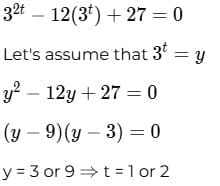
Sol: Let's assume that x2 + 2x - 3 = t
can be written as
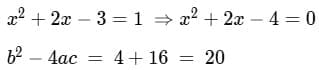
Let's solve when t = 1
Positive, so the equation has real roots.Product of possible value of x = -4
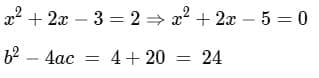
Let's solve for t = 2
Positive, so the equation has real roots.Product of possible value of x = -5
The product of all values = 20

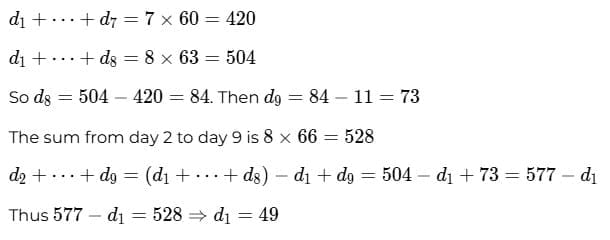
Q26: The average number of copies of a book sold per day by a shopkeeper is 60 in the initial seven days and 63 in the initial eight days, after the book launch. On the ninth day, she sells 11 copies less than the eighth day, and the average number of copies sold per day from second day to ninth day becomes 66. The number of copies sold on the first day of the book launch is
Ans: 49
Sol: Let the copies sold on days 1 through 9 be d1 , ... , d9
From the averages:
Q27: The set of all real values of x for which (x2 - |x + 9| + x) > 0, is
(a) (-∞,-3) ∪ (3, ∞)
(b) (-∞, -9) ∪ (3, ∞)
(c) (-9, -3) ∪ (3, ∞)
(d) (-∞, -9) ∪ (9, ∞)
Ans: a
Sol: We are asked to solve
Split into two cases based on the absolute value.
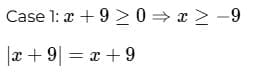
Inequality becomes: x2 - (x + 9) + x > 0 ⟹ x2 - 9 > 0 ⟹ (x - 3)(x + 3) > 0
So x < - 3 or x > 3. Combined with x ≥ - 9, we get x ∈ [- 9, - 3) ∪ (3, ∞)
Case 2: x + 9 < 0 ⇒ x < - 9
|x + 9| = -(x + 9) = -x - 9
Inequality becomes: x2 - (-x - 9) + x > 0 ⟹ x2 + 2x + 9 > 0
The quadratic x2 + 2x + 9 has discriminant (4 - 36 = -32 < 0), so always positive.
But in this case (x < -9), so inequality is satisfied. Thus (x < -9) also works.
x < -3 or x > 3
So the solution set is (- ∞, - 3) ∪ (3, ∞)

Q28: An item with a cost price of Rs. 1650 is sold at a certain discount on a fixed marked price to earn a profit of 20% on the cost price. If the discount was doubled, the profit would have been Rs. 110. The rate of discount, in percentage, at which the profit percentage would be equal to the rate of discount, is nearest to
(a) 16
(b) 18
(c) 14
(d) 12
Ans: c
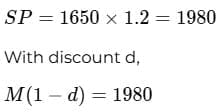
Sol: Let the marked price be M and the initial discount rate be d. The cost price is 1650. A profit of 20% means the selling price is
If the discount is doubled, the selling price becomes (M(1-2d)), and the profit is 110, so
Subtracting the two equations:
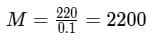
Plug into the first equation:
So the initial discount rate is 10% and the marked price is
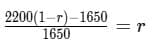
Now, let the discount rate be (r) such that the profit percentage equals the discount percentage. Then
Simplify:
Thus, the required discount rate is approximately 14%




Q29: If m and n are integers such that (m + 2n)(2m + n) = 27, then the maximum possible value of 2m - 3n is
Ans: 17
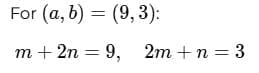
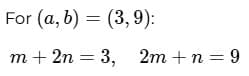
Sol: So, the ordered pairs we will consider are (3, 9),(9, 3),(-3,-9),(-9, -3)
Upon solving, we get n = 5 and m = -1
Upon solving, we get n = -1 and m = 5
For negative factor pairs, we similarly get integer solutions (-5, 1) and (1,-5), giving 2m - 3n = -13 and 17, respectively.
Thus, the maximum value of (2m - 3n) among all solutions is 17

Q30: The sum of digits of the number (625)65 × (128)36 is
Ans: 25
Sol:
Thus, the number equals 58 followed by 252 zeros. Now (58 = 390625), and the sum of the digits of (390625) is
3 + 9 + 0 + 6 + 2 + 5 = 25.
Zeros add nothing, so the required sum of digits is 25.

Q31: The equations 3x2 - 5x + p = 0 and 2x2 - 2x + q = 0 have one common root. The sum of the other roots of this equations is
(a) 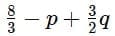
(b) 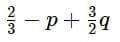
(c) 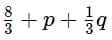
(d) 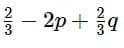
Ans: a
Sol: The sum of the roots of the first equation is 5/3 and that of the second equation is 1.
We want the sum of the other two roots:
We now need to express r in terms of p and q.Since r is a common root, it satisfies:

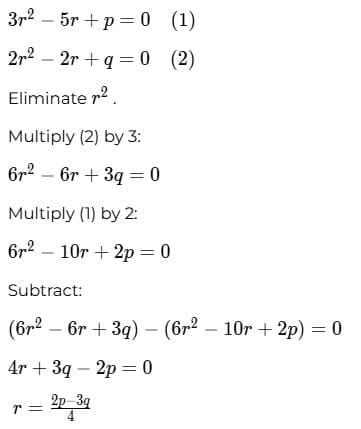
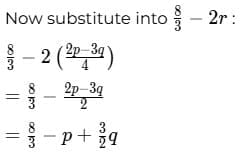
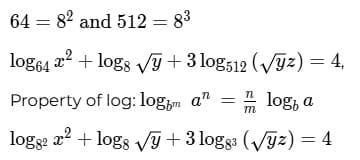
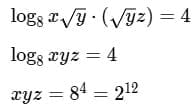
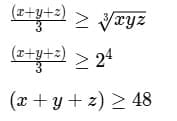
Q32: If log64 x2 + log8√y + 3log512(√yz) = 4, where x, y and z are positive real numbers, then the minimum possible value of (x + y + z) is
(a) 48
(b) 36
(c) 24
(d) 96
Ans: a
Sol:
Using the above-mentioned property, the expression becomes log8 x +
Using AM-GM inequality

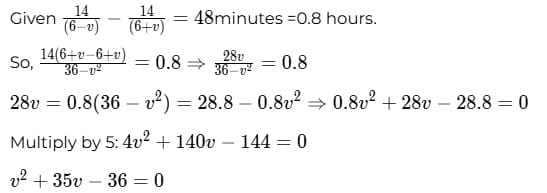
Q33: Rita and Sneha can row a boat at 5 km/h and 6 km/h in still water, respectively. In a river flowing with a constant velocity, Sneha takes 48 minutes more to row 14 km upstream than to row the same distance downstream. If Rita starts from a certain location in the river, and returns downstream to the same location, taking a total of 100 minutes, then the total distance, in km, Rita will cover is
Ans: 8
Sol: Let the river speed be v km/h. For Sneha still-water speed = 6 km/h:
Upstream speed = (6-v), downstream speed = (6+v).
We get v = 1Thus, the river speed is 1 km/h. For Rita, the still water speed is 5 km/h:
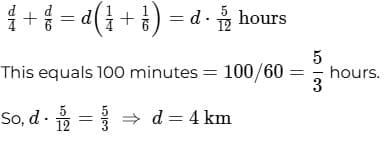
Upstream speed = 5 - 1 = 4 km/h, Downstream Speed = (5 + 1 = 6) km/h.If she rows d km upstream and returns d km downstream, the total time
Total distance covered 2d = 8 km.
Q34: Suppose a,b,c are three distinct natural numbers, such that 3ac = 8(a + b). Then, the smallest possible value of 3a + 2b + c is
Ans: 12
Sol: Our task is to minimise 3a +2b + c.
Here, the coefficient for cc is the minimum.
3ac = 8(a + b)
We know that a, b, and c are natural numbers. So, the product acac should definately be a multiple of 8.
Case 1: a = 1, c = 8 and b = 2 ⇒ 3a+2b+c = 15
Case 2: a = 2, c = 4 and b = 1 ⇒ 3a+2b+c = 12
So, 12 is the correct answer.
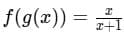
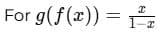
Q35: Let  Then the domain of the function h(x) = f(g(x)) + g(f(x)) is all real numbers except
(a) 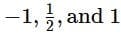
(b) 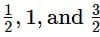
(c) 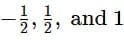
(d) 
Ans: a
Sol: We check where
or their compositions, become undefined.
First, f(x) is undefined at x = 1/2 and g(x) is undefined at x=1.
Next, for
Since, the denominator can't be zero, x = -1 must also be excluded.
⇒ x = 1 is not possible, which is already excluded.
So the values at which h(x) = f(g(x)) +g(f(x)) is undefined are

Q36: A loan of Rs 1000 is fully repaid by two installments of Rs 530 and Rs 594, paid at the end of first and second year, respectively. If the interest is compounded annually, then the rate of interest, in percentage, is
(a) 10
(b) 11
(c) 9
(d) 8
Ans: d
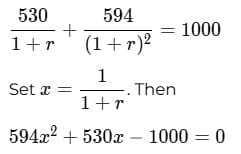
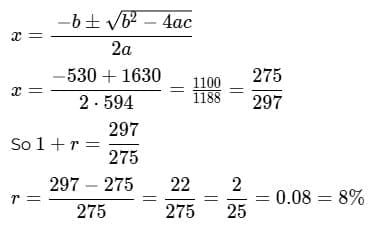
Sol: Let the annual interest rate be (r) (in decimal). Discount the two instalments to present value:
Discriminant = 5302 +4⋅594⋅1000 = 280900 + 2376000 = 2656900 = 16302.
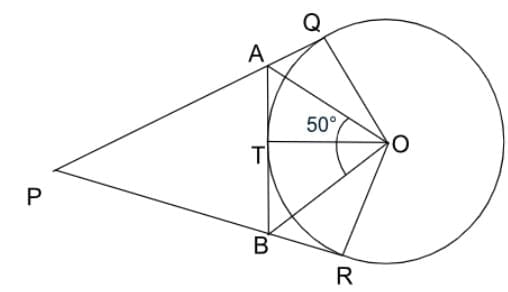
Q37: Two tangents drawn from a point P and a circle with center O at point Q and R. Point A and B lie on PQ and PR, repectively, such that AB is also a tangent to the same circle. If ∠AOB=500, then ∠APB, in degrees equals
Ans: 80
Sol: We can draw the following diagram as per the given question :
Now, taking △AOT and △AOQ
AO is the common side
AT = AQ (Tangents drawn from an external point are equal in length)
OT = OQ (radius of circle)
So, by S.S.S., △ AOT is congruent to △ AOQ
So, by C.P.C.T., ∠ AOT =∠ AOQ
Similarly, for △BOT and △BOR , we can do the same thing,
So, we can say △BOT and △BOR will also be congruent
Now, ∠ QOR=∠ AOQ +∠ AOB +∠ ROB =∠ AOT + ∠ AOB +∠BOT = 2 ∠AOB = 2× 50∘ =100∘
Now, in quadrilateral OQPR,
∠ OQP = ∠ ORP = 90∘ (Tangents drawn to a point is perpendicular to the radius drawn at the same point)
Now, sum of angles of a quadrilateral is 360∘
So, ∠ APB +∠ QOR = 360∘ -(90∘ + 90∘) = 180∘
So, ∠ APB = 180∘ -100∘ = 80∘
Q38: The number of divisors of (26 × 35 × 53 × 72), which are of the form (3r + 1), where r is a non-negative integer, is
(a) 36
(b) 56
(c) 24
(d) 42
Ans: d
Sol: The divisors of the given number will have the form 2a∗3b∗5c∗7d with 0 ≤ a ≤ 6, 0 ≤ b ≤ 5, 0 ≤ c ≤ 3, 0 ≤ d ≤ 2
Because the divisors should be in the form 3r + 1, it cannot be divisible by 3, so (b = 0).
Reduce modulo 3: 2 mod 3 = 2,5 mod 3 = 2,7 mod 3 = 1
Hence, 2a5c7d ≡ 2a+c⋅1d ≡ 2a+c(mod 3)
2k will be in the form 3r+1 only when K is even. So, we need a+c to be even
a ∈ 0,...,6 has 4 even, 3 odd values
c ∈ 0,...,3 has 2 even, 2 odd
Number of (a,c) with (a+c) even is 4⋅2 + 3⋅2 = 8+6 = 14
For each such pair, there are 3 choices for d = 0,1,2. Thus, total divisors in the form (3r+1) equals 14 × 3 = 42.
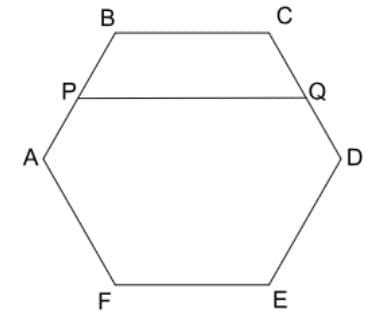
Q39: Let ABCDEF be a regular hexagon and P and Q be the midpoints of AB and CD, respectively. Then, the ratio of the areas of trapezium PBCQ and hexagon ABCDEF is
(a) 6:19
(b) 5:24
(c) 6:25
(d) 7:24
Ans: b
Sol: Let the side of the hexagon be a.
The area of the whole hexagon is going to be
We know that the longest diagonal of a hexagon is 2 times the side of the hexagon.
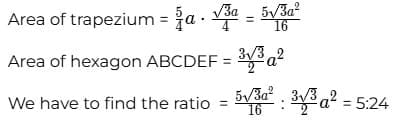
The area of the trapezium = Average of parllel sides * Height =
The distance between BC and AD will be √3a, that is, the length of diagonal BF.The distance between BC and AD will be

And the height of the trapezium BCQP will be




Q40: If a,b,c and d are integers such that their sum is 46, then the minimum possible value of (a - b)2 + (a - c)2 + (a - d)2 is
Ans: 2
Sol: Given expression: (a - b)2 + (a - c)2 + (a - d)2
The given expression has just the sum of squares of the terms. So, the minimum value is either zero or positive.
If we can make all the values equal, we can get zero. But since all the values are integers and the sum 46 is not divisible by 4, we can't make everything equal.
So, the nearest four values are 12, 11, 11, 12.
With this, the minimum value is (12 - 11)2 + (12 - 11)2 + (12 - 12)2 = 2
Q41: The ratio of expenditures of Lakshmi and Meenakshi is 2 : 3, and the ratio of income of Lakshmi to expenditure of Meenakshi is 6 : 7. If excess of income over expenditure is saved by Lakshmi and Meenakshi, and the ratio of their savings is 4 : 9, then the ratio of their incomes is
(a) 3:5
(b) 5:6
(c) 2:1
(d) 7:8
Ans: a
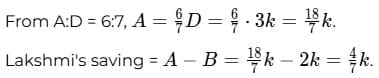
Sol: Let Lakshmi's income = A and expenditure = B.
Let Meenakshi's income = C and expenditure = D.
From B:D = 2:3, take B = 2k and D = 3k.
Let Meenakshi's saving = C - D = C - 3k = C - D = C - 3k. Given the savings ratio

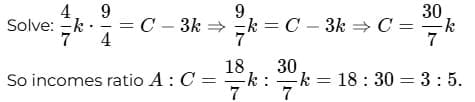
Q42: Let an be the nth term of a decreasing infinite geometric progression. If a1 + a2 + a3 = 52 and a1a2 + a2a3 + a3a1 = 624, then the sum of this geometric progression is
(a) 57
(b) 54
(c) 60
(d) 63
Ans: b
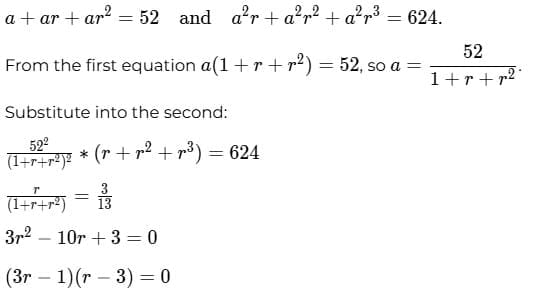
Sol: Let the first term be a and the common ratio be r.
Given
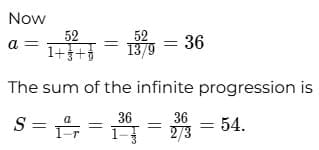
Simplify to get an equation in (r); its real solutions are r = 1/3 and r = 3. For an infinite geometric progression, we must have (|r|<1), so r = 1/3.
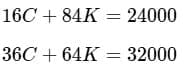
Q43: A mixture of coffee and cocoa, 16% of which is coffee, costs Rs 240 per kg. Another mixture of coffee and cocoa, of which 36% is coffee, costs Rs 320 per kg. If a new mixture of coffee and cocoa costs Rs 376 per kg, then the quantity, in kg, of coffee in 10 kg of this new mixture is
(a) 5
(b) 4
(c) 2.5
(d) 6
Ans: a
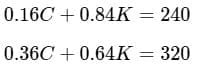
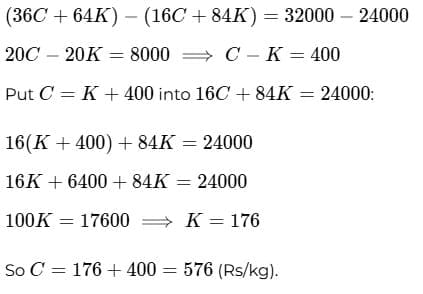
Sol: Let coffee price = C Rs/kg and cocoa price = K Rs/kg.
From the two given mixtures:
Multiply both equations by 100 to remove decimals:Subtract the first from the second:
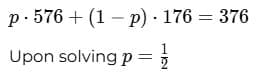
For the new mixture priced at Rs 376/kg, let the coffee fraction be p. Then
Thus, coffee is (50%) of the new mixture. In 10 kg of this mixture, coffee = 10 × 0.5 = 5kg
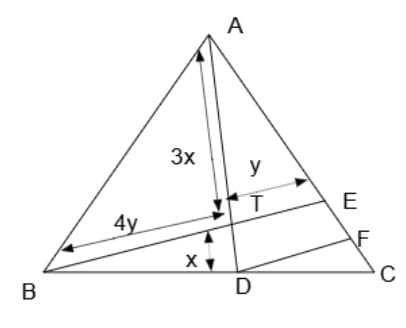
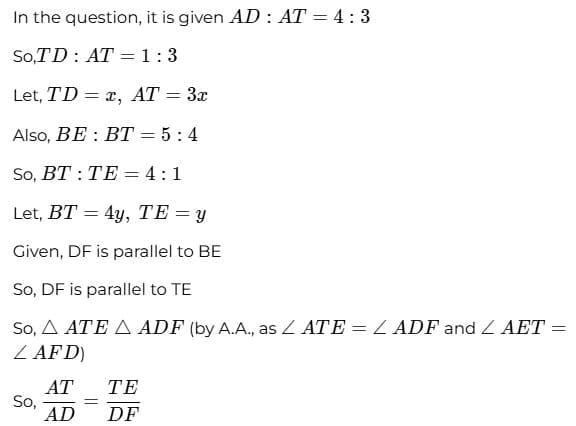
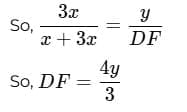
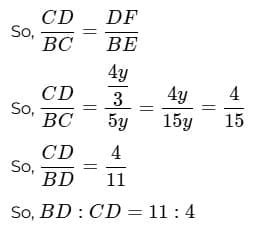
Q44: In △ABC, points D and E are on the sides BC and AC, respectively. BE and AD intersect at point T such that AD : AT = 4:3, and BE : BT = 5:4. Point F lies on AC such that DF is parallel to BE. Then, BD : CD is
(a) 15:4
(b) 11:4
(c) 7:4
(d) 9:4
Ans: b
Sol:
Also, since DF is parallel to BE,

Q45: Ankita is twice as efficient as Bipin, while Bipin is twice as efficient as Chandan. All three of them start together on a job, and Bipin leaves the job after 20 days. If the job got completed in 60 days, the number of days needed by Chandan to complete the job alone, is
Ans: 340
Sol: Let Chandan's one-day work = x.
Then Bipin = 2x and Ankita = 4x.All three work together for the first 20 days. Their combined daily work = x + 2x + 4x = 7x.
Work done in 20 days = 20 × 7x = 140.Bipin leaves after 20 days; Ankita and Chandan continue for the remaining (60 - 20 = 40) days.
Their combined daily work = 4x + x = 5x. Work done in 40 days = 40 × 5x = 200x.Total work = 140x + 200x = 340x.
We know that Chandan does x work in a day. So, the number of days it takes him to finish the work is 340.
Answer: 340 days.
Q46: A certain amount of money was divided among Pinu, Meena, Rinu and Seema. Pinu received 20% of the total amount and Meena received 40% of the remaining amount. If Seema received 20% less than Pinu, the ratio of the amounts received by Pinu and Rinu is
(a) 2:1
(b) 1:2
(c) 5:8
(d) 8:5
Ans: c
Sol: Let the total amount be 100 units (taking 100 makes percentage calculations easy).
Pinu receives 20% of the total, so Pinu gets 20 units.
The amount left after giving Pinu his share is 100 - 20 = 80 units.Meena receives 40% of this remaining amount, so Meena gets 40% of 80 = 32 units.
Now, the amount left for Rinu and Seema together is 80 - 32 = 48 units.Seema receives 20% less than Pinu. Since Pinu gets 20 units, Seema gets
20 - 20% of 20 = 20 - 4 = 16 units.Out of the 48 units left for Rinu and Seema, Seema's share is 16 units, so Rinu gets
48 - 16 = 32 units.Therefore, Pinu receives 20 units, and Rinu gets 32 units.
The required ratio of the amounts received by Pinu : Rinu = 20 : 32 = 5 : 8.
LRDI
Q47 to Q51:
Ananya Raga, Bhaskar Tala, Charu Veena, and Devendra Sur are four musicians. Each of them started and completed their training as students under each of three Gurus - Pandit Meghnath, Ustad Samiran, and Acharya Raghunath between 2013 and 2024, including both the years. Each Guru trains any student for consecutive years only, for a span of 2, 3, or 4 years, with each Guru having a different span. During some of these years, a student may not have trained under these Gurus; however, they never trained under multiple Gurus in the same year. In none of these years, any of these Gurus trained more than two of these students at the same time. When two students train under the same Guru at the same time, they are referred to as Gurubhai, irrespective of their gender.
The following additional facts are known.
- Acharya Raghunath did not train any of these students during 2015-2018, as well as during 2021-24.
- Ananya and Devendra were never Gurubhai; neither were Bhaskar and Charu. All other pairs of musicians were Gurubhai for exactly 2 years.
- In 2013, Ananya and Bhaskar started their trainings under Pandit Meghnath and under Ustad Samiran, respectively.
- Ustad Samiran never trained more than one of these students in the same year.
Q47: In which of the following years were Ananya and Bhaskar Gurubhai?
(a) 2020
(b) 2018
(c) 2021
(d) 2014
Ans: a
Sol: Representing Ananya Raga, Bhaskar Tala, Charu Veena, and Devendra Sur as A, B, C and D, respectively, for easy usage. Also using PM, US, and AR for Pandit Meghnath, Ustad Samiran, and Acharya Raghunath, respectively, for easy reference.
We are given that AR did not train during the periods of 2015-2018 and 2021-2024.
Other information provided is that PM, US, and AR had a span of 2, 3, and 4 consecutive years for each student, in some order. We also know that all the gurus trained each of the students for exactly one span.
In clue 4, we are given that A started the training in 2013 under PM, and B started training in 2013 under US.
Putting all the known information in the table, we get,
Now, if we look at the table, we can see that AR is training for only 4 years, with two years each, separated by a few years. Therefore, the span of AR must be 2 years because we know that he is not teaching continuously for 3 or 4 years.
Since we know that each guru taught all the students, and AR only has 4 years to teach all the students, he must definitely teach 2 students at a time each year, as we are told that no guru taught more than 2 students in a single year. We also know that A and B were taught by PM and US in 2013, respectively. Therefore, we can conclude that C and D were taught by AR during both 2013 and 2014, as AR's span is 2 years.
We can also conclude that A and B were taught by AR during both 2019 and 2020, as AR's span is 2 years, and they were the only students left for AR's class.
We are also given in clue 1 that US did not train more than 1 student in any year, and there are a total of 12 years from 2013 to 2024. If the span of US is 4 years, then he would need a total of 16 years to teach every student, as he is not teaching more than 1 student in any year, but he only taught for 12 years, so the only possibility is for US to have a span of 3 years and PM to have a span of 4 years. We can also conclude that US taught B from 2013 to 2015, as he has a span of 3 years.
We are also given that A, D and B, C were never Gurubhai, and all the other pairs were Gurubhai for exactly 2 years. Therefore, there must be two years each of {A, B}, {A, C}, {B, D}, and {C, D} with classes together. We have already completed the 2 years of {A, B} and {C, D}, so the ones left are two years of {A, C} and {B, D}. We know that the US did not take classes of 2 students together, and we have already filled the schedule of AR, so the only one left is PM, and he must have the other two left.
Since the span of PM is 4, he taught A from 2013 to 2016 and during this span, there must be 2 years of {A, C}, as we know that A will not be taught again after 2016. To have an exact span of 2 years together, C must start in 2015, as it is the only possibility, and he will teach C until 2018, as he has a span of 4 years.
There must be 2 years of {B, D} in the remaining time period of PM. In 2019, A and B were already enrolled with AR, and C had already completed his time with PM. So, the only person possible to have class in 2019 with PM is D, and D will have classes with PM until 2022. Now for 2 years of {B, D}, D must have his classes start from 2021, as it is the only possibility.
There cannot be any gap in the case of US, and in 2016, the only possibility is D as A, C were having classes with PM, and B already had his classes with US. D had classes from 2016 to 2018. In 2019, A, B and D were already having classes, so the only possibility is for C to have classes with US from 2019 to 2021, and finally A will have his classes from 2022 to 2024 with US, as he is the only person left to have classes with US.
The final table looks like,
Ananya and Bhaskar were Gurubhai from 2019 to 2020. Since 2020 is the only option present during this period, it has to be the answer.
Hence, the correct answer is option A.
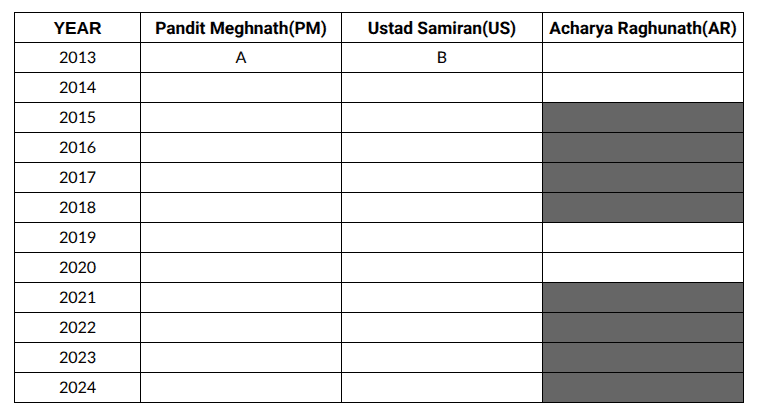
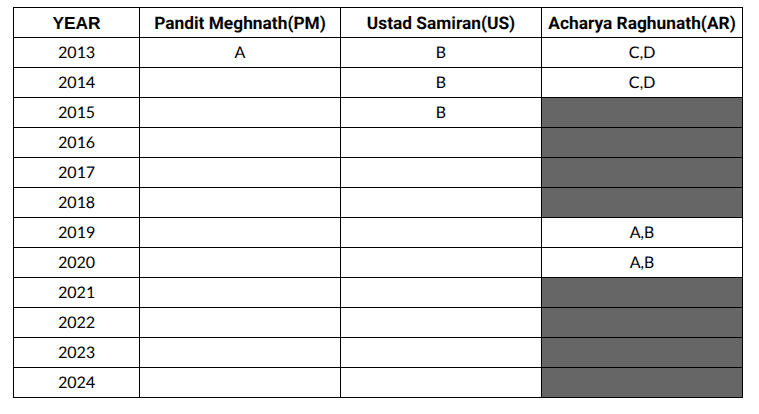
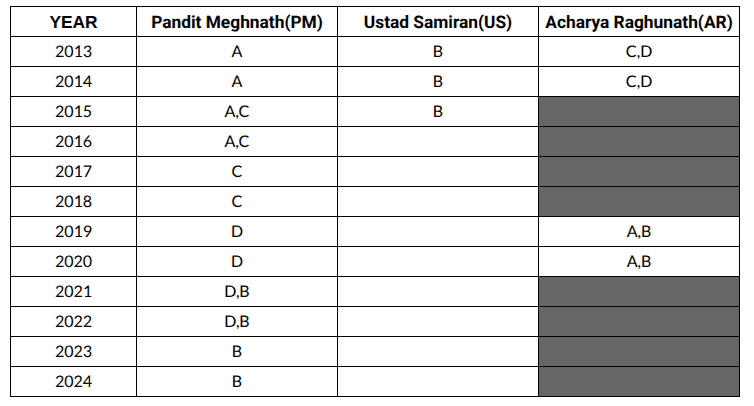
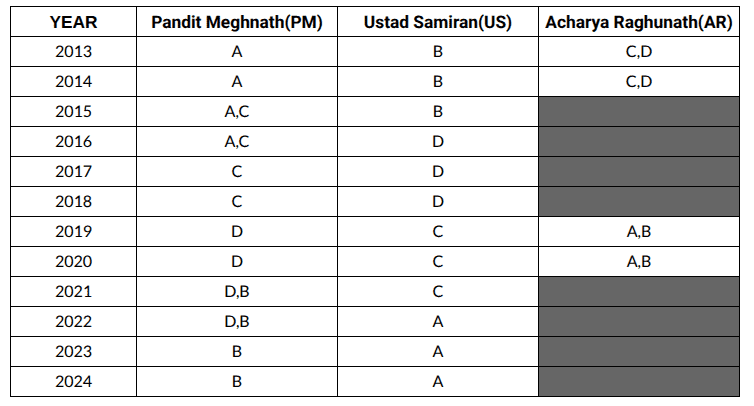
Q48: In which year did Charu begin her training under Pandit Meghnath?
(a) 2017
(b) 2015
(c) 2021
(d) 2016
Ans: b
Sol: Representing Ananya Raga, Bhaskar Tala, Charu Veena, and Devendra Sur as A, B, C and D, respectively, for easy usage. Also using PM, US, and AR for Pandit Meghnath, Ustad Samiran, and Acharya Raghunath, respectively, for easy reference.
We are given that AR did not train during the periods of 2015-2018 and 2021-2024.
Other information provided is that PM, US, and AR had a span of 2, 3, and 4 consecutive years for each student, in some order. We also know that all the gurus trained each of the students for exactly one span.
In clue 4, we are given that A started the training in 2013 under PM, and B started training in 2013 under US.
Putting all the known information in the table, we get,
Now, if we look at the table, we can see that AR is training for only 4 years, with two years each, separated by a few years. Therefore, the span of AR must be 2 years because we know that he is not teaching continuously for 3 or 4 years.
Since we know that each guru taught all the students, and AR only has 4 years to teach all the students, he must definitely teach 2 students at a time each year, as we are told that no guru taught more than 2 students in a single year. We also know that A and B were taught by PM and US in 2013, respectively. Therefore, we can conclude that C and D were taught by AR during both 2013 and 2014, as AR's span is 2 years.
We can also conclude that A and B were taught by AR during both 2019 and 2020, as AR's span is 2 years, and they were the only students left for AR's class.
We are also given in clue 1 that US did not train more than 1 student in any year, and there are a total of 12 years from 2013 to 2024. If the span of US is 4 years, then he would need a total of 16 years to teach every student, as he is not teaching more than 1 student in any year, but he only taught for 12 years, so the only possibility is for US to have a span of 3 years and PM to have a span of 4 years. We can also conclude that US taught B from 2013 to 2015, as he has a span of 3 years.
We are also given that A, D and B, C were never Gurubhai, and all the other pairs were Gurubhai for exactly 2 years. Therefore, there must be two years each of {A, B}, {A, C}, {B, D}, and {C, D} with classes together. We have already completed the 2 years of {A, B} and {C, D}, so the ones left are two years of {A, C} and {B, D}. We know that the US did not take classes of 2 students together, and we have already filled the schedule of AR, so the only one left is PM, and he must have the other two left.
Since the span of PM is 4, he taught A from 2013 to 2016 and during this span, there must be 2 years of {A, C}, as we know that A will not be taught again after 2016. To have an exact span of 2 years together, C must start in 2015, as it is the only possibility, and he will teach C until 2018, as he has a span of 4 years.
There must be 2 years of {B, D} in the remaining time period of PM. In 2019, A and B were already enrolled with AR, and C had already completed his time with PM. So, the only person possible to have class in 2019 with PM is D, and D will have classes with PM until 2022. Now for 2 years of {B, D}, D must have his classes start from 2021, as it is the only possibility.
There cannot be any gap in the case of US, and in 2016, the only possibility is D as A, C were having classes with PM, and B already had his classes with US. D had classes from 2016 to 2018. In 2019, A, B and D were already having classes, so the only possibility is for C to have classes with US from 2019 to 2021, and finally A will have his classes from 2022 to 2024 with US, as he is the only person left to have classes with US.
The final table looks like,
Charu began her training under Pandit Meghnath in 2015.
Hence, the correct answer is option B.
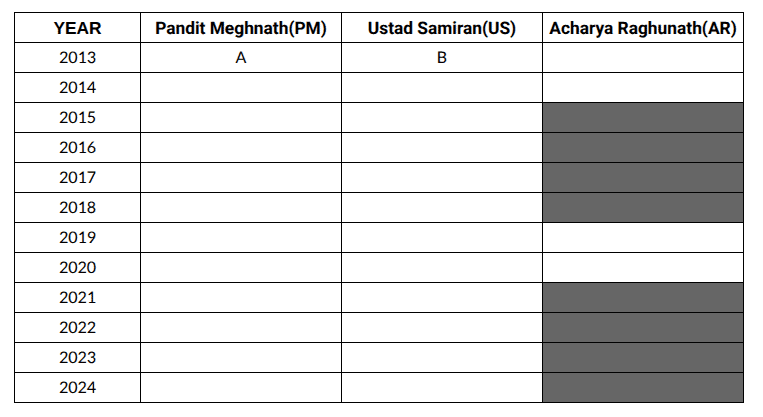
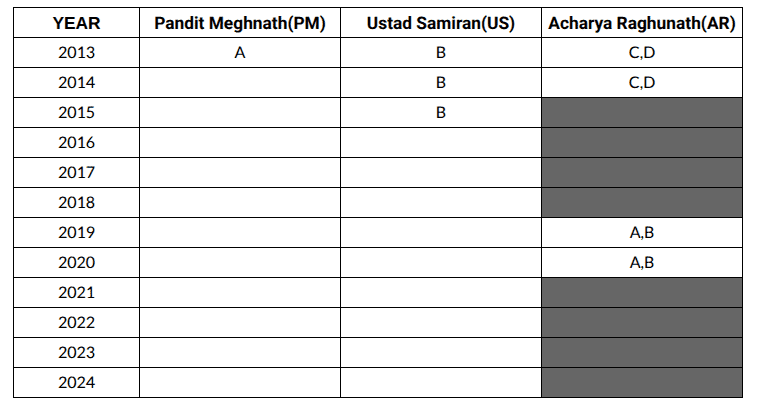
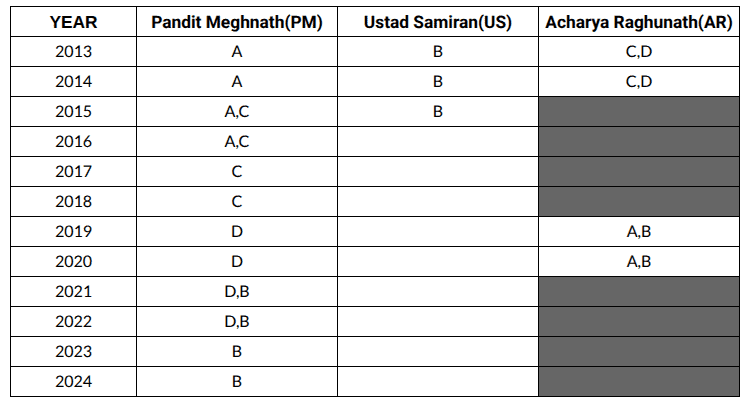
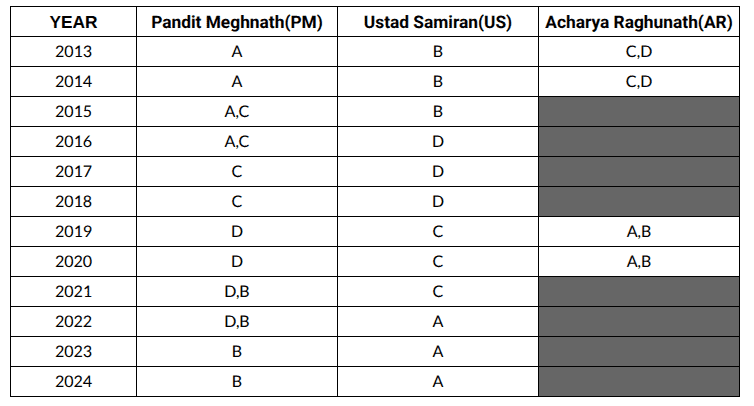
Q49: In which of the following years were Bhaskar and Devendra Gurubhai?
(a) 2022
(b) 2015
(c) 2020
(d) 2018
Ans: a
Sol: Representing Ananya Raga, Bhaskar Tala, Charu Veena, and Devendra Sur as A, B, C and D, respectively, for easy usage. Also using PM, US, and AR for Pandit Meghnath, Ustad Samiran, and Acharya Raghunath, respectively, for easy reference.
We are given that AR did not train during the periods of 2015-2018 and 2021-2024.
Other information provided is that PM, US, and AR had a span of 2, 3, and 4 consecutive years for each student, in some order. We also know that all the gurus trained each of the students for exactly one span.
In clue 4, we are given that A started the training in 2013 under PM, and B started training in 2013 under US.
Putting all the known information in the table, we get,
Now, if we look at the table, we can see that AR is training for only 4 years, with two years each, separated by a few years. Therefore, the span of AR must be 2 years because we know that he is not teaching continuously for 3 or 4 years.
Since we know that each guru taught all the students, and AR only has 4 years to teach all the students, he must definitely teach 2 students at a time each year, as we are told that no guru taught more than 2 students in a single year. We also know that A and B were taught by PM and US in 2013, respectively. Therefore, we can conclude that C and D were taught by AR during both 2013 and 2014, as AR's span is 2 years.
We can also conclude that A and B were taught by AR during both 2019 and 2020, as AR's span is 2 years, and they were the only students left for AR's class.
We are also given in clue 1 that US did not train more than 1 student in any year, and there are a total of 12 years from 2013 to 2024. If the span of US is 4 years, then he would need a total of 16 years to teach every student, as he is not teaching more than 1 student in any year, but he only taught for 12 years, so the only possibility is for US to have a span of 3 years and PM to have a span of 4 years. We can also conclude that US taught B from 2013 to 2015, as he has a span of 3 years.
We are also given that A, D and B, C were never Gurubhai, and all the other pairs were Gurubhai for exactly 2 years. Therefore, there must be two years each of {A, B}, {A, C}, {B, D}, and {C, D} with classes together. We have already completed the 2 years of {A, B} and {C, D}, so the ones left are two years of {A, C} and {B, D}. We know that the US did not take classes of 2 students together, and we have already filled the schedule of AR, so the only one left is PM, and he must have the other two left.
Since the span of PM is 4, he taught A from 2013 to 2016 and during this span, there must be 2 years of {A, C}, as we know that A will not be taught again after 2016. To have an exact span of 2 years together, C must start in 2015, as it is the only possibility, and he will teach C until 2018, as he has a span of 4 years.
There must be 2 years of {B, D} in the remaining time period of PM. In 2019, A and B were already enrolled with AR, and C had already completed his time with PM. So, the only person possible to have class in 2019 with PM is D, and D will have classes with PM until 2022. Now for 2 years of {B, D}, D must have his classes start from 2021, as it is the only possibility.
There cannot be any gap in the case of US, and in 2016, the only possibility is D as A, C were having classes with PM, and B already had his classes with US. D had classes from 2016 to 2018. In 2019, A, B and D were already having classes, so the only possibility is for C to have classes with US from 2019 to 2021, and finally A will have his classes from 2022 to 2024 with US, as he is the only person left to have classes with US.
The final table looks like,
Bhaskar and Devendra were Gurubhai from 2021 to 2022. Since 2022 is the only option present during this period, it has to be the answer.
Hence, the correct answer is option A.
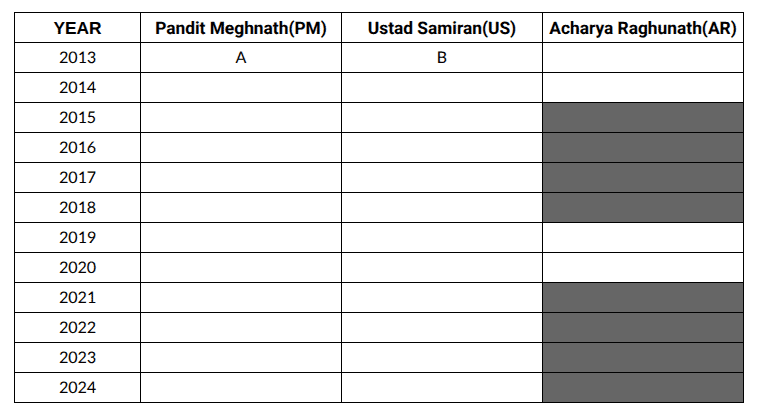
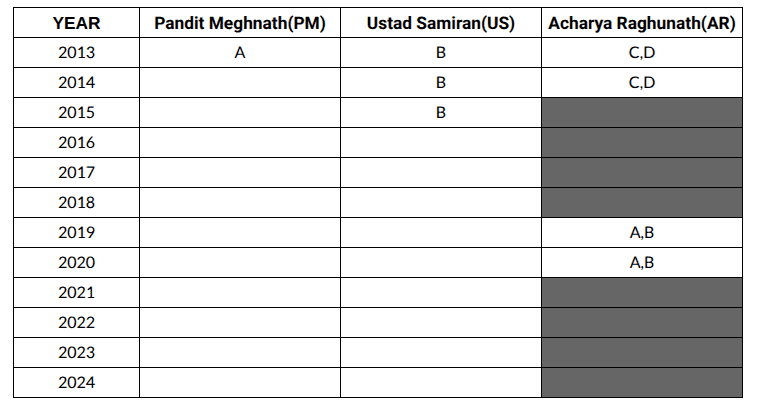
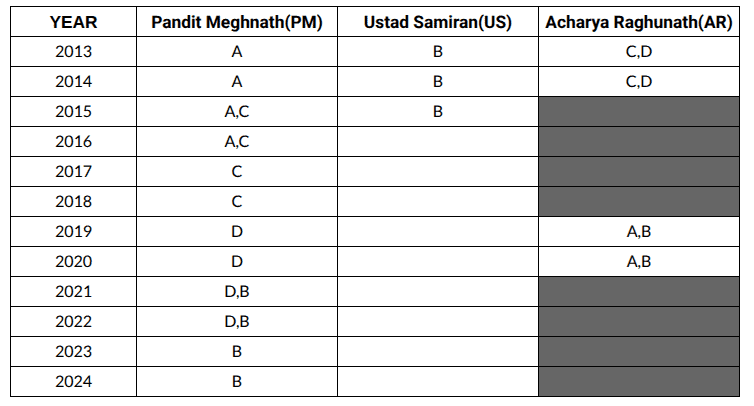
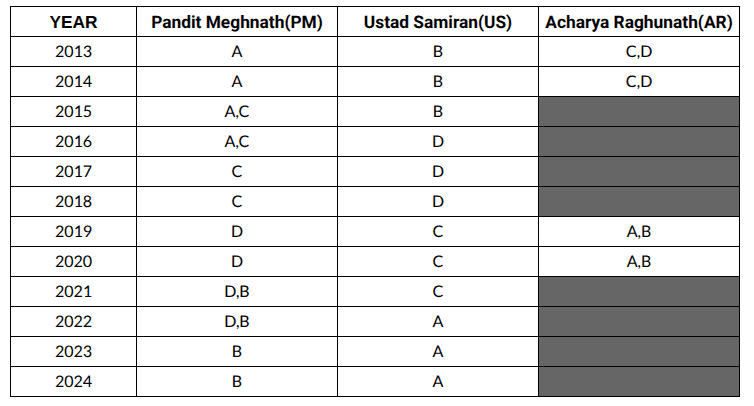
Q50: Which of the following statements is TRUE?
(a) Charu was training under Ustad Samiran in 2018.
(b) Ananya was training under Ustad Samiran in 2015.
(c) Ananya was training under Ustad Samiran in 2018.
(d) Charu was training under Ustad Samiran in 2019.
Ans: d
Sol: Representing Ananya Raga, Bhaskar Tala, Charu Veena, and Devendra Sur as A, B, C and D, respectively, for easy usage. Also using PM, US, and AR for Pandit Meghnath, Ustad Samiran, and Acharya Raghunath, respectively, for easy reference.
We are given that AR did not train during the periods of 2015-2018 and 2021-2024.
Other information provided is that PM, US, and AR had a span of 2, 3, and 4 consecutive years for each student, in some order. We also know that all the gurus trained each of the students for exactly one span.
In clue 4, we are given that A started the training in 2013 under PM, and B started training in 2013 under US.
Putting all the known information in the table, we get,
Now, if we look at the table, we can see that AR is training for only 4 years, with two years each, separated by a few years. Therefore, the span of AR must be 2 years because we know that he is not teaching continuously for 3 or 4 years.
Since we know that each guru taught all the students, and AR only has 4 years to teach all the students, he must definitely teach 2 students at a time each year, as we are told that no guru taught more than 2 students in a single year. We also know that A and B were taught by PM and US in 2013, respectively. Therefore, we can conclude that C and D were taught by AR during both 2013 and 2014, as AR's span is 2 years.
We can also conclude that A and B were taught by AR during both 2019 and 2020, as AR's span is 2 years, and they were the only students left for AR's class.
We are also given in clue 1 that US did not train more than 1 student in any year, and there are a total of 12 years from 2013 to 2024. If the span of US is 4 years, then he would need a total of 16 years to teach every student, as he is not teaching more than 1 student in any year, but he only taught for 12 years, so the only possibility is for US to have a span of 3 years and PM to have a span of 4 years. We can also conclude that US taught B from 2013 to 2015, as he has a span of 3 years.
We are also given that A, D and B, C were never Gurubhai, and all the other pairs were Gurubhai for exactly 2 years. Therefore, there must be two years each of {A, B}, {A, C}, {B, D}, and {C, D} with classes together. We have already completed the 2 years of {A, B} and {C, D}, so the ones left are two years of {A, C} and {B, D}. We know that the US did not take classes of 2 students together, and we have already filled the schedule of AR, so the only one left is PM, and he must have the other two left.
Since the span of PM is 4, he taught A from 2013 to 2016 and during this span, there must be 2 years of {A, C}, as we know that A will not be taught again after 2016. To have an exact span of 2 years together, C must start in 2015, as it is the only possibility, and he will teach C until 2018, as he has a span of 4 years.
There must be 2 years of {B, D} in the remaining time period of PM. In 2019, A and B were already enrolled with AR, and C had already completed his time with PM. So, the only person possible to have class in 2019 with PM is D, and D will have classes with PM until 2022. Now for 2 years of {B, D}, D must have his classes start from 2021, as it is the only possibility.
There cannot be any gap in the case of US, and in 2016, the only possibility is D as A, C were having classes with PM, and B already had his classes with US. D had classes from 2016 to 2018. In 2019, A, B and D were already having classes, so the only possibility is for C to have classes with US from 2019 to 2021, and finally A will have his classes from 2022 to 2024 with US, as he is the only person left to have classes with US.
The final table looks like,
Statement 1) Charu was training under Ustad Samiran in 2018. This is false as she was training under Pandit Meghnath in 2018.
Statement 2) Ananya was training under Ustad Samiran in 2015. This is false as she was training under Pandit Meghnath in 2015.
Statement 3) Ananya was training under Ustad Samiran in 2018. This is false as she was not training in 2018.
Statement 4) Charu was training under Ustad Samiran in 2019. This is true.
Hence, the correct answer is option D.
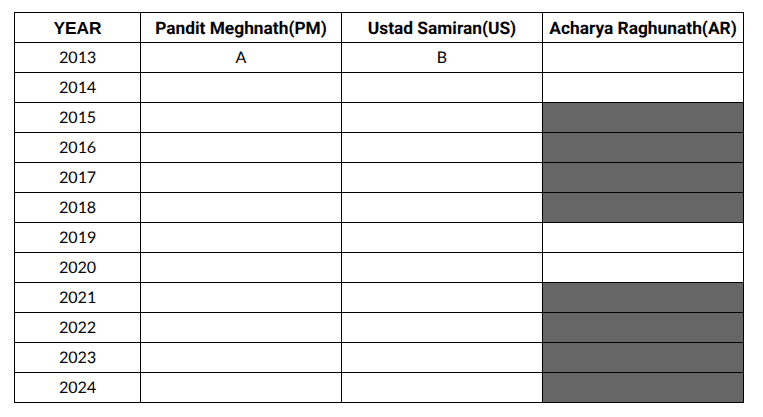
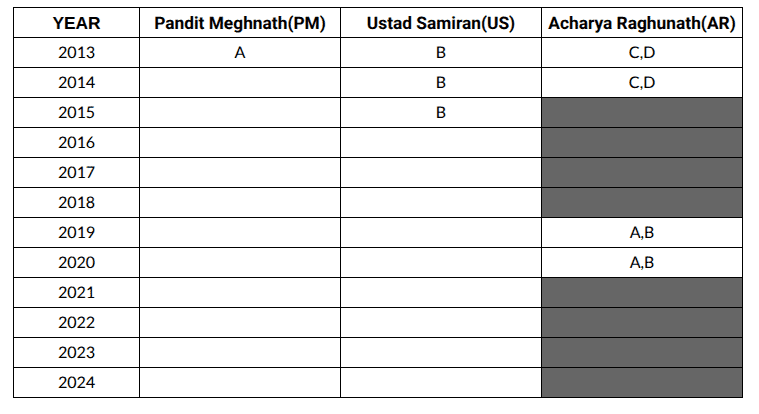
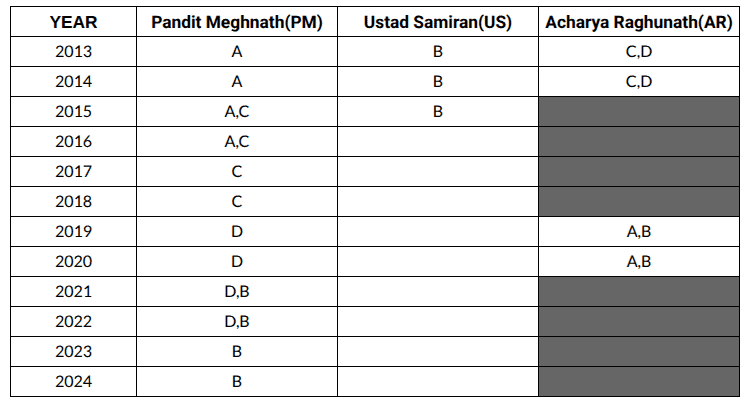
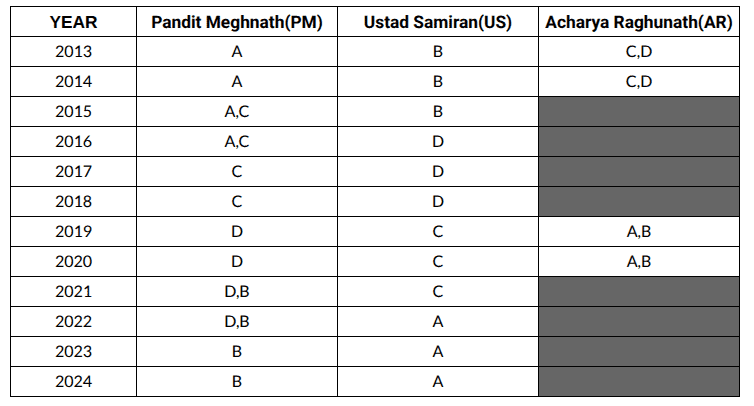
Q51: In how many of the years between 2013-24, were only two of these four musicians training under these three Gurus?
Ans: 4
Sol: Representing Ananya Raga, Bhaskar Tala, Charu Veena, and Devendra Sur as A, B, C and D, respectively, for easy usage. Also using PM, US, and AR for Pandit Meghnath, Ustad Samiran, and Acharya Raghunath, respectively, for easy reference.
We are given that AR did not train during the periods of 2015-2018 and 2021-2024.
Other information provided is that PM, US, and AR had a span of 2, 3, and 4 consecutive years for each student, in some order. We also know that all the gurus trained each of the students for exactly one span.
In clue 4, we are given that A started the training in 2013 under PM, and B started training in 2013 under US.
Putting all the known information in the table, we get,
Now, if we look at the table, we can see that AR is training for only 4 years, with two years each, separated by a few years. Therefore, the span of AR must be 2 years because we know that he is not teaching continuously for 3 or 4 years.
Since we know that each guru taught all the students, and AR only has 4 years to teach all the students, he must definitely teach 2 students at a time each year, as we are told that no guru taught more than 2 students in a single year. We also know that A and B were taught by PM and US in 2013, respectively. Therefore, we can conclude that C and D were taught by AR during both 2013 and 2014, as AR's span is 2 years.
We can also conclude that A and B were taught by AR during both 2019 and 2020, as AR's span is 2 years, and they were the only students left for AR's class.
We are also given in clue 1 that US did not train more than 1 student in any year, and there are a total of 12 years from 2013 to 2024. If the span of US is 4 years, then he would need a total of 16 years to teach every student, as he is not teaching more than 1 student in any year, but he only taught for 12 years, so the only possibility is for US to have a span of 3 years and PM to have a span of 4 years. We can also conclude that US taught B from 2013 to 2015, as he has a span of 3 years.
We are also given that A, D and B, C were never Gurubhai, and all the other pairs were Gurubhai for exactly 2 years. Therefore, there must be two years each of {A, B}, {A, C}, {B, D}, and {C, D} with classes together. We have already completed the 2 years of {A, B} and {C, D}, so the ones left are two years of {A, C} and {B, D}. We know that the US did not take classes of 2 students together, and we have already filled the schedule of AR, so the only one left is PM, and he must have the other two left.
Since the span of PM is 4, he taught A from 2013 to 2016 and during this span, there must be 2 years of {A, C}, as we know that A will not be taught again after 2016. To have an exact span of 2 years together, C must start in 2015, as it is the only possibility, and he will teach C until 2018, as he has a span of 4 years.
There must be 2 years of {B, D} in the remaining time period of PM. In 2019, A and B were already enrolled with AR, and C had already completed his time with PM. So, the only person possible to have class in 2019 with PM is D, and D will have classes with PM until 2022. Now for 2 years of {B, D}, D must have his classes start from 2021, as it is the only possibility.
There cannot be any gap in the case of US, and in 2016, the only possibility is D as A, C were having classes with PM, and B already had his classes with US. D had classes from 2016 to 2018. In 2019, A, B and D were already having classes, so the only possibility is for C to have classes with US from 2019 to 2021, and finally A will have his classes from 2022 to 2024 with US, as he is the only person left to have classes with US.
The final table looks like,
Between 2013 and 2024, the years 2017, 2018, 2023, and 2024 were the only years when only two of these four musicians were training under these three Gurus.
Hence, the correct answer is 4.
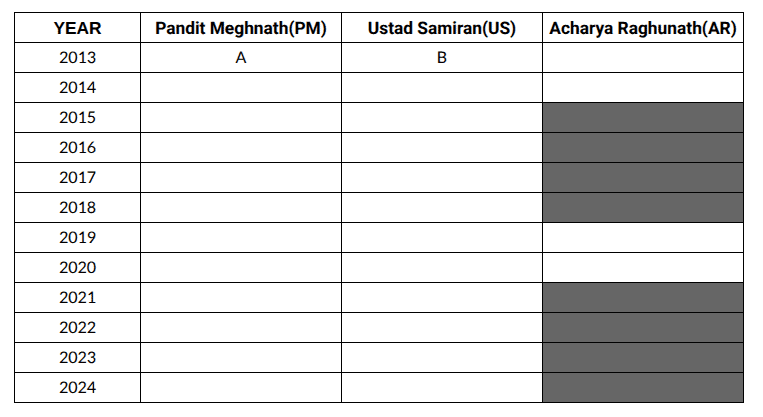
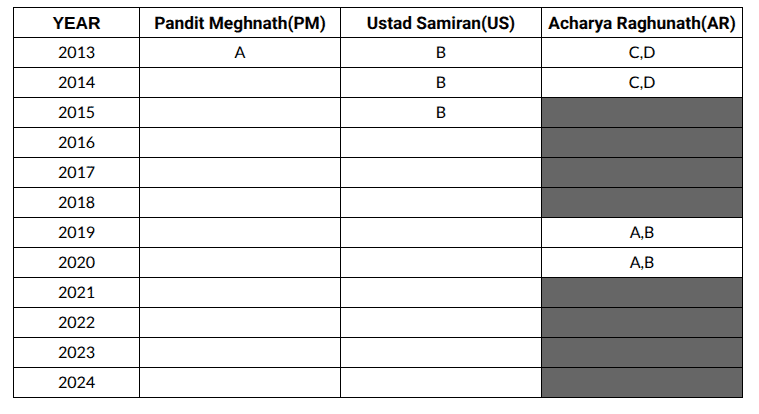
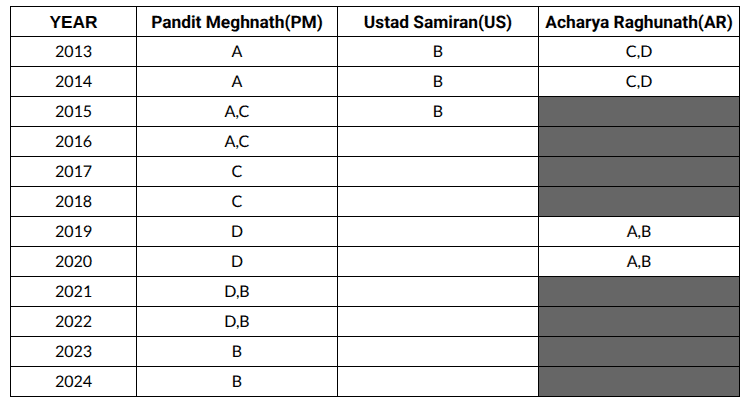
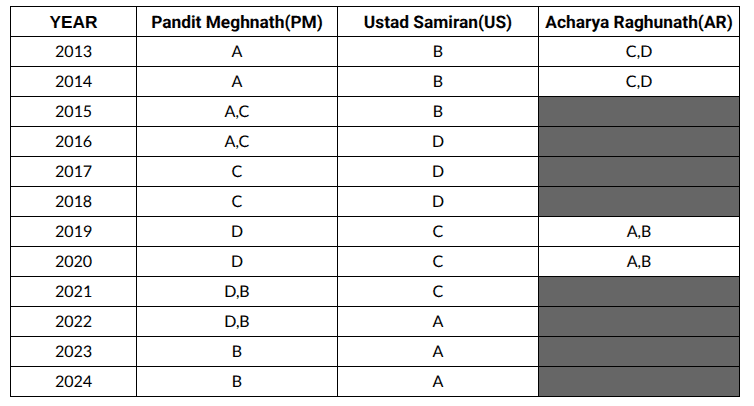
Q52 to Q55:
The following charts depict details of research papers written by four authors, Arman, Brajen, Chintan, and Devon. The papers were of four types, single-author, two-author, three-author, and four-author, that is, written by one, two, three, or all four of these authors, respectively. No other authors were involved in writing these papers.
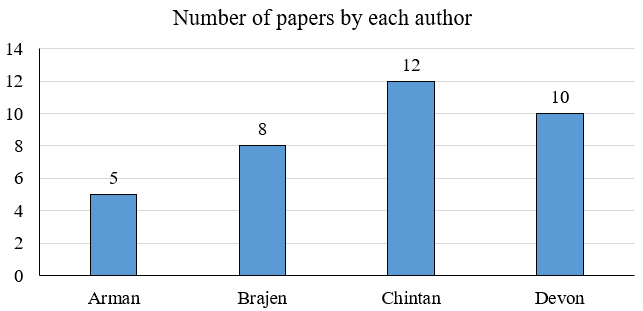
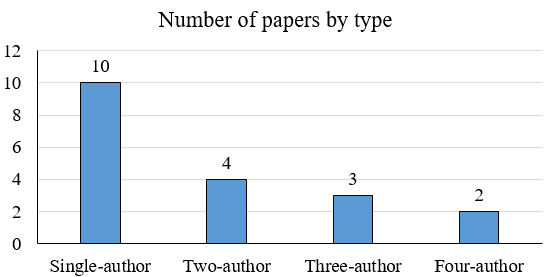
The following additional facts are known.
- Each of the authors wrote at least one of each of the four types of papers.
- The four authors wrote different numbers of single-author papers.
- Both Chintan and Devon wrote more three-author papers than Brajen.
- The number of single-author and two-author papers written by Brajen were the same.
Q52: What was the total number of two-author and three-author papers written by Brajen?
Ans: 4
Sol: If all the two-author-type books are counted for both authors separately, then we get the sum to be 4 * 2 = 8.
If all the three-author-type books are counted for all three authors separately, then we get the sum to be 3 * 3 = 9.
If all the four-author-type books are counted for all four authors separately, then we get the sum to be 4 * 2 = 8.
We are given that there are 2 four-author books, so there are exactly two books for each that are of the four-author type.
Putting the values in the table, we get,
We are given that each author has at least one book of each type. In the case of Arman, there are three books left to be assigned, and there are 3 types of books left, so each of them has to be equal to 1 for the above condition to be satisfied.
In the case of Brajen, we are told that he had an equal number of single-author and two-author books.
Case 1: If the equal number is 1, then the three-author type books become 4, and we are given that both Chintan and Devon had more three-author books than Brajen, which is not possible in this case, as both of them combined will be left with 5 books together and whaterver we split 5 books there wont be a case of both of them having more books than Brajen.
Case 2: If the equal number is 2, then the three-author type books become 2, and we are given that both Chintan and Devon had more three-author books than Brajen, which is possible in this case, as both of them combined will be left with 6 books together and the only way to split 6 books such that both of them are greater than 2 is to split them into 3, 3 and it is the only possible way.
Case 3: If the equal number is greater than or equal to 3, then the three-author type books become 0 or negative, which can directly be eliminated, as we are given that all authors wrote at least 1 book of each type.
So, we can eliminate both cases 1 and 3, and we will be left with the case of Brajen having 2 books each of Single-author, Two-author, and Three-author types. Chintan and Devon have three books each of the three-author type.
Filling up the table with these values, we get,
We are given that each author has a different number of single-author type books. The only possibilities for the single-author books of Chintan and Devon are 3 and 4 in some order.
If the single-author books of Chintan are 3, then the double-author books of Chintan become 4, the single-author books of Devon become 4, and the double-author books of Devon become 1.
If the single-author books of Chintan are 4, then the double-author books of Chintan become 3, the single-author books of Devon become 3, and the double-author books of Devon become 2.
Placing both possibilities in the table, we get,
The total number of two-author and three-author papers written by Brajen = 2 + 2 = 4.
Hence, the correct answer is 4.
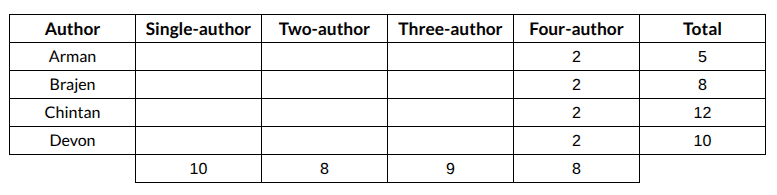
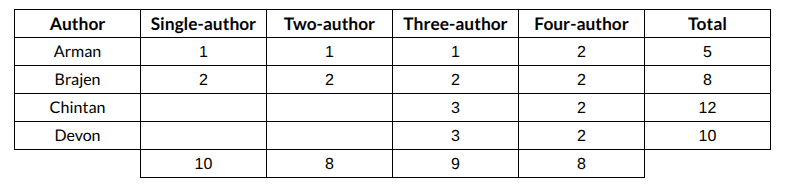
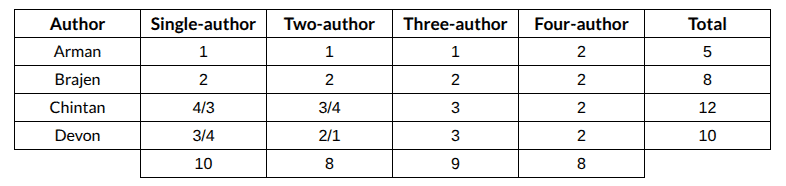
Q53: Which of the following statements is/are NECESSARILY true?
i. Chintan wrote exactly three two-author papers.
ii. Chintan wrote more single-author papers than Devon.
(a) Neither i nor ii
(b) Only i
(c) Only ii
(d) Both i and ii
Ans: a
Sol: If all the two-author-type books are counted for both authors separately, then we get the sum to be 4 * 2 = 8.
If all the three-author-type books are counted for all three authors separately, then we get the sum to be 3 * 3 = 9.
If all the four-author-type books are counted for all four authors separately, then we get the sum to be 4 * 2 = 8.
We are given that there are 2 four-author books, so there are exactly two books for each that are of the four-author type.
Putting the values in the table, we get,
We are given that each author has at least one book of each type. In the case of Arman, there are three books left to be assigned, and there are 3 types of books left, so each of them has to be equal to 1 for the above condition to be satisfied.
In the case of Brajen, we are told that he had an equal number of single-author and two-author books.
Case 1: If the equal number is 1, then the three-author type books become 4, and we are given that both Chintan and Devon had more three-author books than Brajen, which is not possible in this case, as both of them combined will be left with 5 books together and whaterver we split 5 books there wont be a case of both of them having more books than Brajen.
Case 2: If the equal number is 2, then the three-author type books become 2, and we are given that both Chintan and Devon had more three-author books than Brajen, which is possible in this case, as both of them combined will be left with 6 books together and the only way to split 6 books such that both of them are greater than 2 is to split them into 3, 3 and it is the only possible way.
Case 3: If the equal number is greater than or equal to 3, then the three-author type books become 0 or negative, which can directly be eliminated, as we are given that all authors wrote at least 1 book of each type.
So, we can eliminate both cases 1 and 3, and we will be left with the case of Brajen having 2 books each of Single-author, Two-author, and Three-author types. Chintan and Devon have three books each of the three-author type.
Filling up the table with these values, we get,
We are given that each author has a different number of single-author type books. The only possibilities for the single-author books of Chintan and Devon are 3 and 4 in some order.
If the single-author books of Chintan are 3, then the double-author books of Chintan become 4, the single-author books of Devon become 4, and the double-author books of Devon become 1.
If the single-author books of Chintan are 4, then the double-author books of Chintan become 3, the single-author books of Devon become 3, and the double-author books of Devon become 2.
Placing both possibilities in the table, we get,
Statement 1: Chintan wrote exactly three two-author papers.
This is not necessarily true, as he could have written four books as well.
Statement 2: Chintan wrote more single-author papers than Devon.
This is not necessarily true, as the opposite can be possible.
So, neither I nor 2 is necessarily true.
Hence, the correct answer is option A.
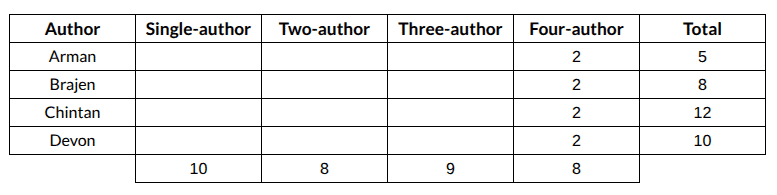
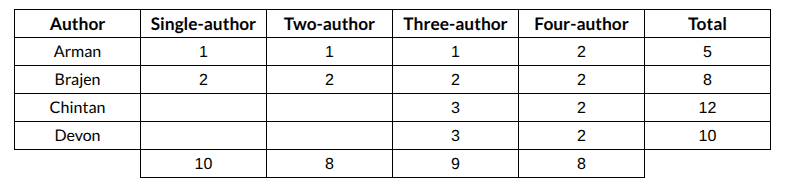
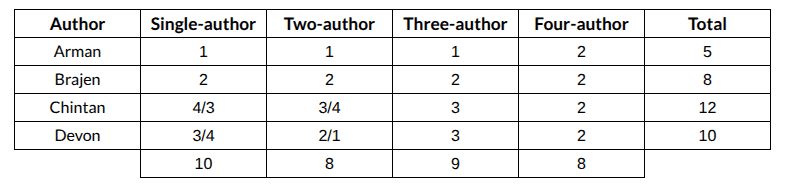
Q54: Which of the following statements is/are NECESSARILY true?
i. Arman wrote three-author papers only with Chintan and Devon.
ii. Brajen wrote three-author papers only with Chintan and Devon.
(a) Only ii
(b) Both i and ii
(c) Only i
(d) Neither i or ii
Ans: b
Sol: If all the two-author-type books are counted for both authors separately, then we get the sum to be 4 * 2 = 8.
If all the three-author-type books are counted for all three authors separately, then we get the sum to be 3 * 3 = 9.
If all the four-author-type books are counted for all four authors separately, then we get the sum to be 4 * 2 = 8.
We are given that there are 2 four-author books, so there are exactly two books for each that are of the four-author type.
Putting the values in the table, we get,
We are given that each author has at least one book of each type. In the case of Arman, there are three books left to be assigned, and there are 3 types of books left, so each of them has to be equal to 1 for the above condition to be satisfied.
In the case of Brajen, we are told that he had an equal number of single-author and two-author books.
Case 1: If the equal number is 1, then the three-author type books become 4, and we are given that both Chintan and Devon had more three-author books than Brajen, which is not possible in this case, as both of them combined will be left with 5 books together and whaterver we split 5 books there wont be a case of both of them having more books than Brajen.
Case 2: If the equal number is 2, then the three-author type books become 2, and we are given that both Chintan and Devon had more three-author books than Brajen, which is possible in this case, as both of them combined will be left with 6 books together and the only way to split 6 books such that both of them are greater than 2 is to split them into 3, 3 and it is the only possible way.
Case 3: If the equal number is greater than or equal to 3, then the three-author type books become 0 or negative, which can directly be eliminated, as we are given that all authors wrote at least 1 book of each type.
So, we can eliminate both cases 1 and 3, and we will be left with the case of Brajen having 2 books each of Single-author, Two-author, and Three-author types. Chintan and Devon have three books each of the three-author type.
Filling up the table with these values, we get,
We are given that each author has a different number of single-author type books. The only possibilities for the single-author books of Chintan and Devon are 3 and 4 in some order.
If the single-author books of Chintan are 3, then the double-author books of Chintan become 4, the single-author books of Devon become 4, and the double-author books of Devon become 1.
If the single-author books of Chintan are 4, then the double-author books of Chintan become 3, the single-author books of Devon become 3, and the double-author books of Devon become 2.
Placing both possibilities in the table, we get,
Statement 1: Arman wrote three-author papers only with Chintan and Devon.
There are in total 3 three-author books, and Chintan and Devon are authors of all three of them according to the table. So, Arman wrote the three-author papers only with Chintan and Devon. So, the statement is necessarily true
Statement 2: Brajen wrote three-author papers only with Chintan and Devon.
There are in total 3 three-author books, and Chintan and Devon are authors of all three of them according to the table. So, Brajen wrote the three-author papers only with Chintan and Devon. So, the statement is necessarily true.
So, both I and 2 are necessarily true.
Hence, the correct answer is option B.
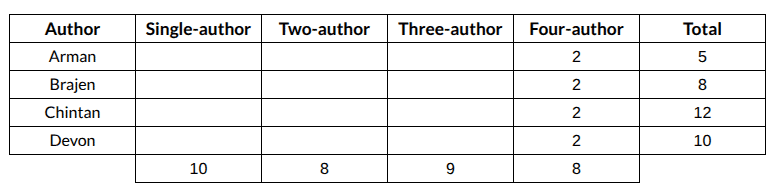
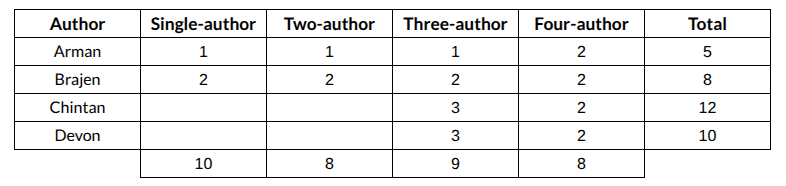
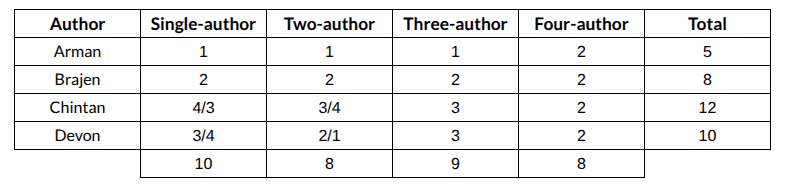
Q55: If Devon wrote more than one two-author papers, then how many two-author papers did Chintan write?
Ans: 3
Sol: If all the two-author-type books are counted for both authors separately, then we get the sum to be 4 * 2 = 8.
If all the three-author-type books are counted for all three authors separately, then we get the sum to be 3 * 3 = 9.
If all the four-author-type books are counted for all four authors separately, then we get the sum to be 4 * 2 = 8.
We are given that there are 2 four-author books, so there are exactly two books for each that are of the four-author type.
Putting the values in the table, we get,
We are given that each author has at least one book of each type. In the case of Arman, there are three books left to be assigned, and there are 3 types of books left, so each of them has to be equal to 1 for the above condition to be satisfied.
In the case of Brajen, we are told that he had an equal number of single-author and two-author books.
Case 1: If the equal number is 1, then the three-author type books become 4, and we are given that both Chintan and Devon had more three-author books than Brajen, which is not possible in this case, as both of them combined will be left with 5 books together and whaterver we split 5 books there wont be a case of both of them having more books than Brajen.
Case 2: If the equal number is 2, then the three-author type books become 2, and we are given that both Chintan and Devon had more three-author books than Brajen, which is possible in this case, as both of them combined will be left with 6 books together and the only way to split 6 books such that both of them are greater than 2 is to split them into 3, 3 and it is the only possible way.
Case 3: If the equal number is greater than or equal to 3, then the three-author type books become 0 or negative, which can directly be eliminated, as we are given that all authors wrote at least 1 book of each type.
So, we can eliminate both cases 1 and 3, and we will be left with the case of Brajen having 2 books each of Single-author, Two-author, and Three-author types. Chintan and Devon have three books each of the three-author type.
Filling up the table with these values, we get,
We are given that each author has a different number of single-author type books. The only possibilities for the single-author books of Chintan and Devon are 3 and 4 in some order.
If the single-author books of Chintan are 3, then the double-author books of Chintan become 4, the single-author books of Devon become 4, and the double-author books of Devon become 1.
If the single-author books of Chintan are 4, then the double-author books of Chintan become 3, the single-author books of Devon become 3, and the double-author books of Devon become 2.
Placing both possibilities in the table, we get,
If Devon wrote more than one two-author paper, he would have written 2 papers, making the number of two-author papers written by Chintan 3.
Hence, the correct answer is 3.
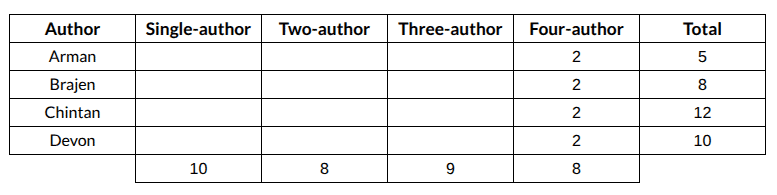
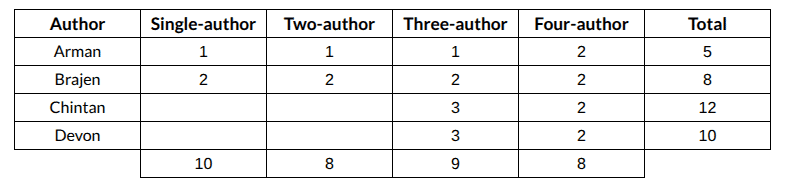
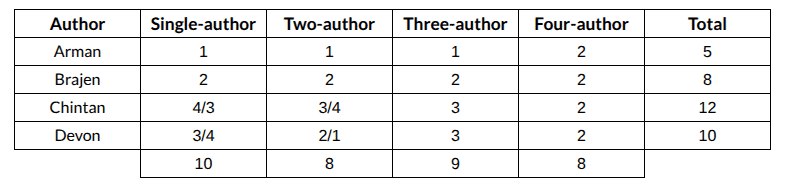
Q56 to Q59:
There are six spherical balls, B1, B2, B3, B4, B5, and B6, and four circular hoops H1, H2, H3, and H4.
Each ball was tested on each hoop once, by attempting to pass the ball through the hoop. If the diameter of a ball is not larger than the diameter of the hoop, the ball passes through the hoop and makes a "ping". Any ball having a diameter larger than that of the hoop gets stuck on that hoop and does not make a ping.
The following additional information is known:
- B1 and B6 each made a ping on H4, but B5 did not.
- B4 made a ping on H3, but B1 did not.
- All balls, except B3, made pings on H1.
- None of the balls, except B2, made a ping on H2.
Q56: What was the total number of pings made by B1, B2, and B3?
Ans: 6
Sol: Let us try to arrange the hoops and the spheres in increasing order of their diameter according to the information given,
In clue 1, we are given that B1 and B6 made a ping on H4, and B5 did not.
So, we can definitely say that,
(B1, B6) < H4 < B5 --(1)
In clue 2, we are given that B4 made a ping on H3, but B1 did not.
So, we can definitely say that,
B4 < H3 < B1 --(2)
In clue 3, we are given that all balls, except B3, made pings on H1.
So, we can definitely say that,
(B1, B2, B4, B5, B6) < H1 < B3 --(3)
In clue 4, we are given that none of the balls, except B2, made a ping on H2.
So, we can definitely say that,
B2 < H2 < (B1, B3, B4, B5, B6) --(4)
Combining (1) and (2), we can definitely say that
B4 < H3 < B1 < H4 < B5 --(5)
The only ball that we do not have enough information is about B6, as it can be either less than H3 or greater than H3 and less than H4.
Combining (3), (4) and (5), we get,
B2 < H2 < B4 < H3 < B1 < H4 < B5 < H1 < B3
The sphere B6 can be placed in 2 positions, giving us two possible inequalities, which are
B2 < H2 < (B4, B6) < H3 < B1 < H4 < B5 < H1 < B3
B2 < H2 < B4 < H3 < (B1,B6) < H4 < B5 < H1 < B3
The position of B6 is not clear, and except for that, all the positions are fixed.
Pings made by B1 = H4, H1 = 2
Pings made by B2 = H2, H3, H4, H1 = 4
Pings made by B3 = 0
Total number of pings by B1, B2 and B3 = 2 + 4 + 0 = 6.
Hence, the correct answer is 6.
Q57: Which of the following statements about the relative sizes of the balls is NOT NECESSARILY true?
(a) B4 < B5 < B3
(b) B2 < B1 < B5
(c) B1 < B6 < B3
(d) B1 < B5 < B3
Ans: c
Sol: Let us try to arrange the hoops and the spheres in increasing order of their diameter according to the information given,
In clue 1, we are given that B1 and B6 made a ping on H4, and B5 did not.
So, we can definitely say that,
(B1, B6) < H4 < B5 --(1)
In clue 2, we are given that B4 made a ping on H3, but B1 did not.
So, we can definitely say that,
B4 < H3 < B1 --(2)
In clue 3, we are given that all balls, except B3, made pings on H1.
So, we can definitely say that,
(B1, B2, B4, B5, B6) < H1 < B3 --(3)
In clue 4, we are given that none of the balls, except B2, made a ping on H2.
So, we can definitely say that,
B2 < H2 < (B1, B3, B4, B5, B6) --(4)
Combining (1) and (2), we can definitely say that
B4 < H3 < B1 < H4 < B5 --(5)
The only ball for which we do not have enough information is about B6, as it can be either less than H3 or greater than H3 and less than H4.
Combining (3), (4) and (5), we get,
B2 < H2 < B4 < H3 < B1 < H4 < B5 < H1 < B3
The sphere B6 can be placed in 2 positions, giving us two possible inequalities, which are
B2 < H2 < (B4, B6) < H3 < B1 < H4 < B5 < H1 < B3
B2 < H2 < B4 < H3 < (B1,B6) < H4 < B5 < H1 < B3
The position of B6 is unclear, and except for that, all the other positions are fixed.
Option A) B4 < B5 < B3. This is definitely true.
Option B) B2 < B1 < B5. This is definitely true.
Option C) B1 < B6 < B3. This need not be true, as we do not know which of B1 and B6 has the larger diameter.
Option D) B1 < B5 < B3. This is definitely true.
Hence, the correct answer is option C.
Q58: Which of the following statements about the relative sizes of the hoops is true?
(a) H2 < H3 < H4 < H1
(b) H1 < H3 < H4 < H2
(c) H1 < H4 < H3 < H2
(d) H2 < H4 < H3 < H1
Ans: a
Sol: Let us try to arrange the hoops and the spheres in increasing order of their diameter according to the information given,
In clue 1, we are given that B1 and B6 made a ping on H4, and B5 did not.
So, we can definitely say that,
(B1, B6) < H4 < B5 --(1)
In clue 2, we are given that B4 made a ping on H3, but B1 did not.
So, we can definitely say that,
B4 < H3 < B1 --(2)
In clue 3, we are given that all balls, except B3, made pings on H1.
So, we can definitely say that,
(B1, B2, B4, B5, B6) < H1 < B3 --(3)
In clue 4, we are given that none of the balls, except B2, made a ping on H2.
So, we can definitely say that,
B2 < H2 < (B1, B3, B4, B5, B6) --(4)
Combining (1) and (2), we can definitely say that
B4 < H3 < B1 < H4 < B5 --(5)
The only ball for which we do not have enough information is about B6, as it can be either less than H3 or greater than H3 and less than H4.
Combining (3), (4) and (5), we get,
B2 < H2 < B4 < H3 < B1 < H4 < B5 < H1 < B3
The sphere B6 can be placed in 2 positions, giving us two possible inequalities, which are
B2 < H2 < (B4, B6) < H3 < B1 < H4 < B5 < H1 < B3
B2 < H2 < B4 < H3 < (B1,B6) < H4 < B5 < H1 < B3
The position of B6 is unclear, and except for that, all the other positions are fixed.
We know the correct order of the diameters of the hoops is H2 < H3 < H4 < H1.
Hence, the correct answer is option A.
Q59: What BEST can be said about the total number of pings from all the tests undertaken?
(a) 12 or 13
(b) 13 or 14
(c) 12 or 13 or 14
(d) At least 9
Ans: a
Sol: Let us try to arrange the hoops and the spheres in increasing order of their diameter according to the information given,
In clue 1, we are given that B1 and B6 made a ping on H4, and B5 did not.
So, we can definitely say that,
(B1, B6) < H4 < B5 --(1)
In clue 2, we are given that B4 made a ping on H3, but B1 did not.
So, we can definitely say that,
B4 < H3 < B1 --(2)
In clue 3, we are given that all balls, except B3, made pings on H1.
So, we can definitely say that,
(B1, B2, B4, B5, B6) < H1 < B3 --(3)
In clue 4, we are given that none of the balls, except B2, made a ping on H2.
So, we can definitely say that,
B2 < H2 < (B1, B3, B4, B5, B6) --(4)
Combining (1) and (2), we can definitely say that
B4 < H3 < B1 < H4 < B5 --(5)
The only ball for which we do not have enough information is about B6, as it can be either less than H3 or greater than H3 and less than H4.
Combining (3), (4) and (5), we get,
B2 < H2 < B4 < H3 < B1 < H4 < B5 < H1 < B3
The sphere B6 can be placed in 2 positions, giving us two possible inequalities, which are
B2 < H2 < (B4, B6) < H3 < B1 < H4 < B5 < H1 < B3
B2 < H2 < B4 < H3 < (B1,B6) < H4 < B5 < H1 < B3
The position of B6 is unclear, and except for that, all the other positions are fixed.
In the first case, the number of pings possible can be calculated as 4 for B2, 3 for B4, 3 for B6, 2 for B1, 1 for B5 and 0 for B3. In total, the number of pings possible in the 1st case is 4 + 3 + 3 + 2 + 1 = 13.
In the second case, the number of pings possible can be calculated as 4 for B2, 3 for B4, 2 for B6, 2 for B1, 1 for B5 and 0 for B3. In total, the number of pings possible in the 2nd case is 4 + 3 + 2 + 2 + 1 = 12.
So, the total number of pings can be 12 or 13.
Hence, the correct answer is Option A.
Q60 to Q63:
The Sustainability Index (SI) of a country at a point in time is an integer between 1 and 100. This question is related to SI of six countries - A, B, C, D, E, and F - at three different points in time - 2016, 2020, and 2024. The plot represents the exact changes in their SI, with X-coordinate representing % increase in 2020 from 2016, i.e., (SI in 2020 minus SI in 2016) / (SI in 2016), and Y-coordinate representing % increase in 2024 from 2020. At any point in time, the country with highest SI is ranked 1, while the country with the lowest SI is ranked 6. The following additional facts are known.
1. In 2016, B, C, E, and A had ranks 1, 2, 3, and 4 respectively.
2. F had lower SI than any other country in 2016, 2020, and 2024.
3. In 2024, E was the only country with SI of 90.
4. The range of SI of the six countries was 60 in 2016 as well as in 2024.
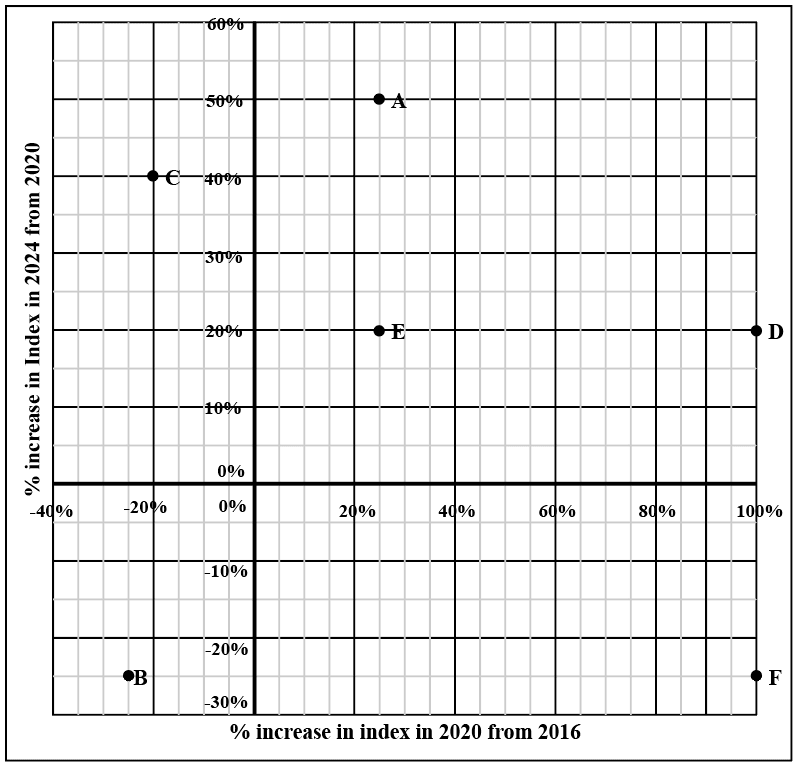
Q60: What was the SI of E in 2016?
Ans: 14
Sol: Let us assume the values of A, B, C, D, E and F to be a, b, c, d, e and f in 2016.
For A:
Value in 2020 = increased by 25% from 2016
Value in 2024 = increased by 50% from 2020
For B:
Value in 2020 = decreased by 25% from 2016
Value in 2024 = decreased by 25% from 2020
For C:
Value in 2020 = decreased by 20% from 2016
Value in 2024 = increased by 40% from 2020
For D:
Value in 2020 = increased by 100% from 2016
Value in 2024 = increased by 20% from 2020
For E:
Value in 2020 = increased by 25% from 2016
Value in 2024 = increased by 20% from 2020
For F:
Value in 2020 = increased by 100% from 2016
Value in 2024 = decreased by 25% from 2020 =
We are given that the value of E is 90 in 2024. We can calculate the value of e as,
The value of E in 2016 is 60, and its value in 2020 can be calculated as,
We are given that B, C, E, and A had ranks 1, 2, 3, and 4, respectively, in 2016, and F has the lowest rank(6) in all the years.
Putting the values in the table, we get,
SI of E in 2016 is 60.
Hence, the correct answer is 60.
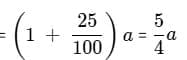
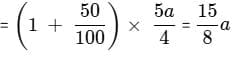
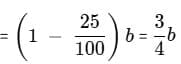
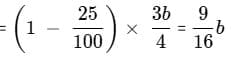
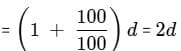
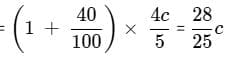
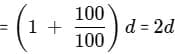
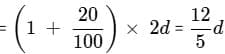
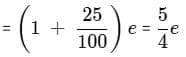
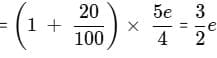
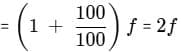
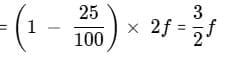

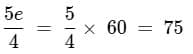
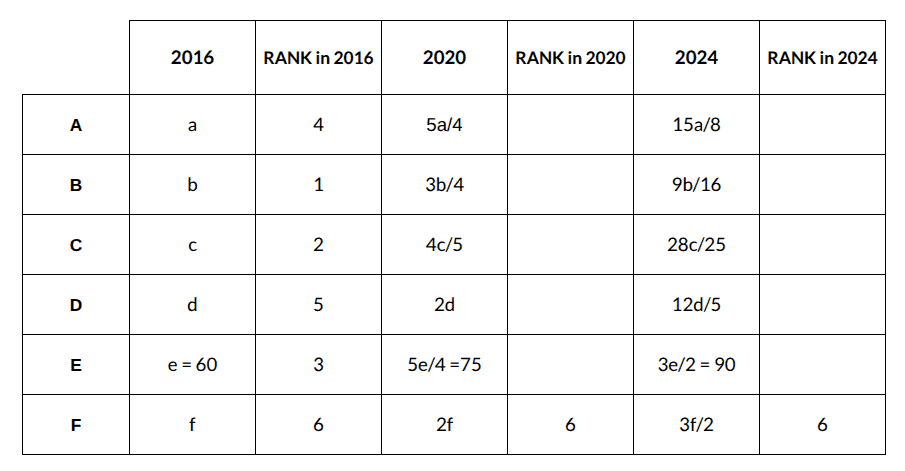
Q61: What was the SI of F in 2020?
Ans: 40
Sol: Let us assume the values of A, B, C, D, E and F to be a, b, c, d, e and f in 2016.
For A:
Value in 2020 = increased by 25% from 2016
Value in 2024 = increased by 50% from 2020
For B:
Value in 2020 = decreased by 25% from 2016
Value in 2024 = decreased by 25% from 2020
For C:
Value in 2020 = decreased by 20% from 2016
Value in 2024 = increased by 40% from 2020
For D:
Value in 2020 = increased by 100% from 2016
Value in 2024 = increased by 20% from 2020
For E:
Value in 2020 = increased by 25% from 2016
Value in 2024 = increased by 20% from 2020
For F:
Value in 2020 = increased by 100% from 2016
Value in 2024 = decreased by 25% from 2020 =
We are given that the value of E is 90 in 2024. We can calculate the value of e as,
The value of E in 2016 is 60, and its value in 2020 can be calculated as,
We are given that B, C, E, and A had ranks 1, 2, 3, and 4, respectively, in 2016, and F has the lowest rank(6) in all the years.
Putting the values in the table, we get,
We know that F is ranked 6 and B is ranked 1 in 2016, and we are also given that the range of SI in 2016 and 2024 is 60. This means that the value of b-f = 60, and we can conclude that b is definitely greater than 60, as we know that f is an integer greater than 0.
We know that all the SI values in all the years are integers, and for SI of B to be an integer in 2024, the value of b must be a multiple of 16. The multiples of 16 that are greater than 60 and less than 100 are 64, 80 and 96.
CASE 1: b = 64
If b = 64, then the value of f becomes 4, as we know b - f = 60.
If f = 4, then the value of F in 2024 is 3f/2 = 12/2 = 6.
We already know the value of E in 2024 is 90.
In that case, the range of SI in 2024 is at least 90 - 6 = 84, but we are given that the range is 60 in 2024, which is not possible in this case.
So, we can eliminate this case.
CASE 2: b = 96
If b = 96, then the value of f becomes 36, as we know b - f = 60.
If f = 36, then the value of F in 2024 is 3f/2 = 108/2 = 54.
The value of B in 2024 = 9b/16 = (9 * 96)/16 = 54
We calculated the value of B and F to be 54 in 2024, which is not possible, as we are given that F had a lower SI than any other country in 2024, and we obtained its value to be the same as B.
So, we can eliminate this case.
CASE 3: b = 80
If b = 80, then the value of f becomes 20, as we know b - f = 60.
If f = 20, then the value of F in 2024 is 3f/2 = 60/2 = 30.
The value of B in 2024 = 9b/16 = (9 * 80)/16 = 45
We can see that no condition is violated in this case, as F is less than B in 2024, and the range in 2024 from the obtained values as of now is 90 - 30 = 60.
So, we can conclude that the value of b = 80 and f = 20.
Substituting the values in the table, we get,
So, SI of F in 2020 is 40.
Hence, the correct answer is 40.
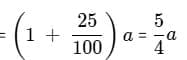
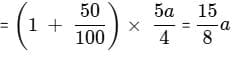
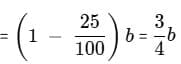
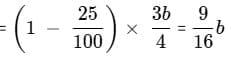
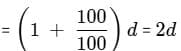
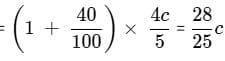
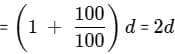
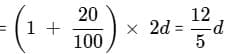
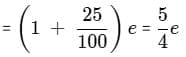
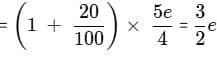
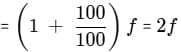
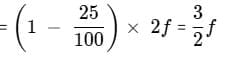

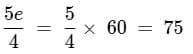
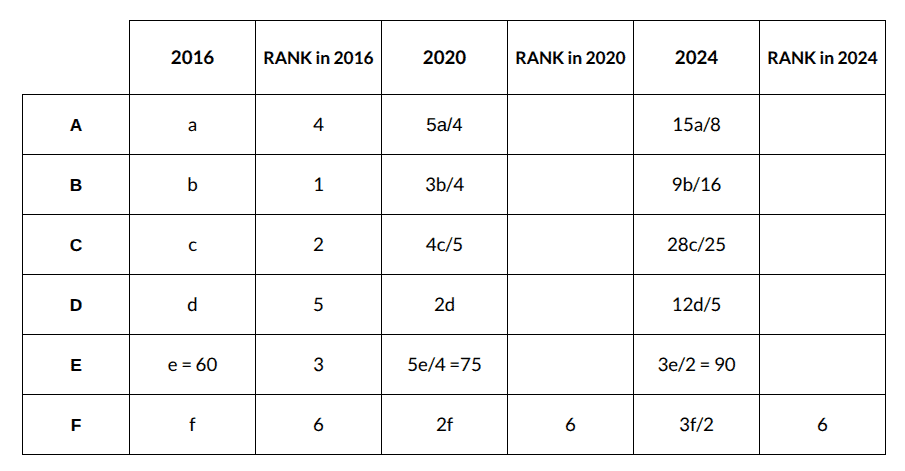
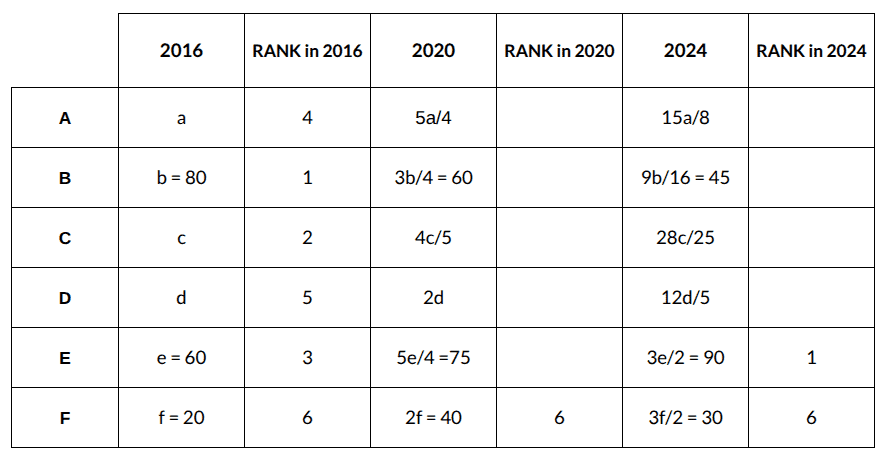
Q62: What was the SI of C in 2024?
Ans: 84
Sol: Let us assume the values of A, B, C, D, E and F to be a, b, c, d, e and f in 2016.
For A:
Value in 2020 = increased by 25% from 2016
Value in 2024 = increased by 50% from 2020
For B:
Value in 2020 = decreased by 25% from 2016
Value in 2024 = decreased by 25% from 2020
For C:
Value in 2020 = decreased by 20% from 2016
Value in 2024 = increased by 40% from 2020
For D:
Value in 2020 = increased by 100% from 2016
Value in 2024 = increased by 20% from 2020
For E:
Value in 2020 = increased by 25% from 2016
Value in 2024 = increased by 20% from 2020
For F:
Value in 2020 = increased by 100% from 2016
Value in 2024 = decreased by 25% from 2020 =
We are given that the value of E is 90 in 2024. We can calculate the value of e as,
The value of E in 2016 is 60, and its value in 2020 can be calculated as,
We are given that B, C, E, and A had ranks 1, 2, 3, and 4, respectively, in 2016, and F has the lowest rank(6) in all the years.
Putting the values in the table, we get,
We know that F is ranked 6 and B is ranked 1 in 2016, and we are also given that the range of SI in 2016 and 2024 is 60. This means that the value of b-f = 60, and we can conclude that b is definitely greater than 60, as we know that f is an integer greater than 0.
We know that all the SI values in all the years are integers, and for SI of B to be an integer in 2024, the value of b must be a multiple of 16. The multiples of 16 that are greater than 60 and less than 100 are 64, 80 and 96.
CASE 1: b = 64
If b = 64, then the value of f becomes 4, as we know b - f = 60.
If f = 4, then the value of F in 2024 is 3f/2 = 12/2 = 6.
We already know the value of E in 2024 is 90.
In that case, the range of SI in 2024 is at least 90 - 6 = 84, but we are given that the range is 60 in 2024, which is not possible in this case.
So, we can eliminate this case.
CASE 2: b = 96
If b = 96, then the value of f becomes 36, as we know b - f = 60.
If f = 36, then the value of F in 2024 is 3f/2 = 108/2 = 54.
The value of B in 2024 = 9b/16 = (9 * 96)/16 = 54
We calculated the value of B and F to be 54 in 2024, which is not possible, as we are given that F had a lower SI than any other country in 2024, and we obtained its value to be the same as B.
So, we can eliminate this case.
CASE 3: b = 80
If b = 80, then the value of f becomes 20, as we know b - f = 60.
If f = 20, then the value of F in 2024 is 3f/2 = 60/2 = 30.
The value of B in 2024 = 9b/16 = (9 * 80)/16 = 45
We can see that no condition is violated in this case, as F is less than B in 2024, and the range in 2024 from the obtained values as of now is 90 - 30 = 60.
So, we can conclude that the value of b = 80 and f = 20.
Substituting the values in the table, we get,
We know that C is ranked 2nd in 2016, and we know the values of 1st and 3rd to be 80 and 60. We also know that SI of C has to be integers in 2016, 2020 and 2024. So, for the value of SI of C to be an integer in 2024, the value of c has to be a multiple of 25.
So, we know that c lies between 80 and 60, and is also a multiple of 25. The only multiple of 25 that lies between 60 and 80 is 75. So, the value of c has to be 75, and the value of C in 2024 can be calculated as,
C in 2024 = 28c/25 = (28 * 75)/25 = 84.
Hence, the correct answer is 84.
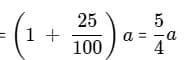
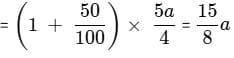
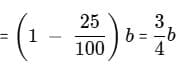
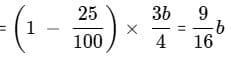
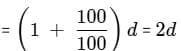
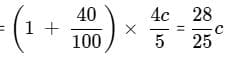
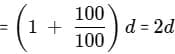
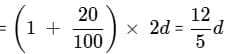
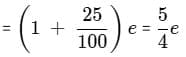
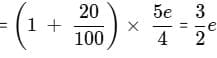
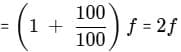
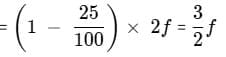

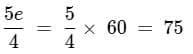
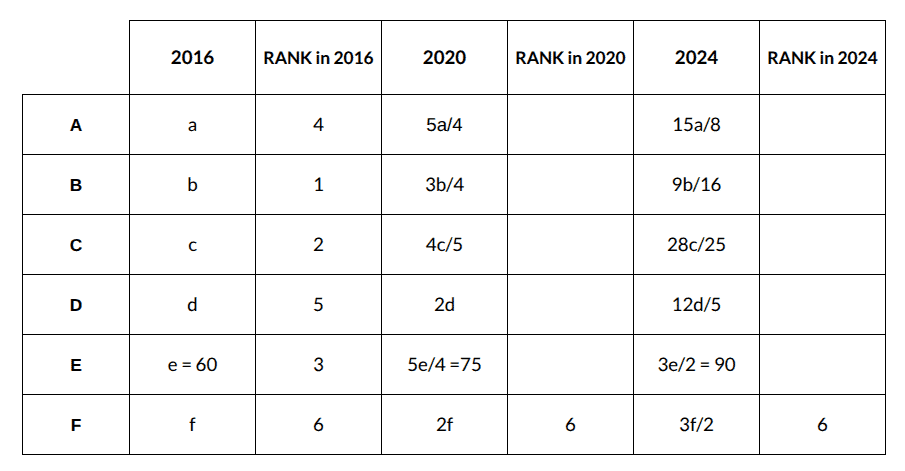
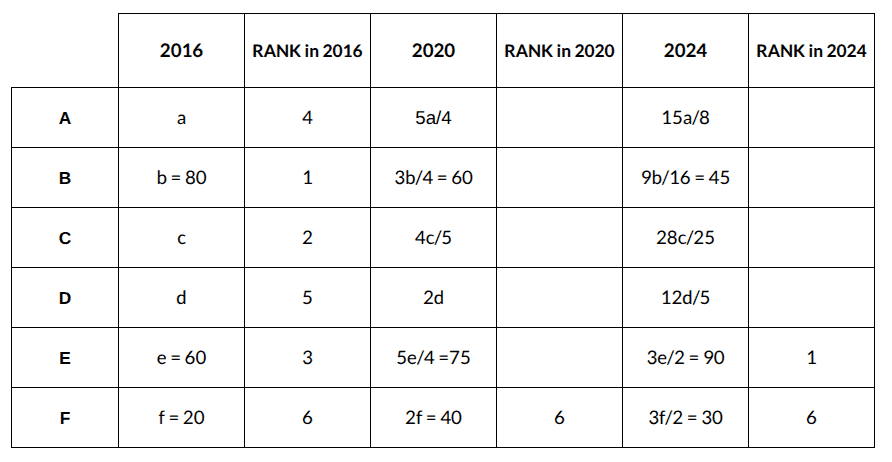
Q63: What was the SI of B in 2024?
(a) 60
(b) 54
(c) 80
(d) 45
Ans: d
Sol: Let us assume the values of A, B, C, D, E and F to be a, b, c, d, e and f in 2016.
For A:
Value in 2020 = increased by 25% from 2016
Value in 2024 = increased by 50% from 2020
For B:
Value in 2020 = decreased by 25% from 2016
Value in 2024 = decreased by 25% from 2020
For C:
Value in 2020 = decreased by 20% from 2016
Value in 2024 = increased by 40% from 2020
For D:
Value in 2020 = increased by 100% from 2016
Value in 2024 = increased by 20% from 2020
For E:
Value in 2020 = increased by 25% from 2016
Value in 2024 = increased by 20% from 2020
For F:
Value in 2020 = increased by 100% from 2016
Value in 2024 = decreased by 25% from 2020 =
We are given that the value of E is 90 in 2024. We can calculate the value of e as,
The value of E in 2016 is 60, and its value in 2020 can be calculated as,
We are given that B, C, E, and A had ranks 1, 2, 3, and 4, respectively, in 2016, and F has the lowest rank(6) in all the years.
Putting the values in the table, we get,
We know that F is ranked 6 and B is ranked 1 in 2016, and we are also given that the range of SI in 2016 and 2024 is 60. This means that the value of b-f = 60, and we can conclude that b is definitely greater than 60, as we know that f is an integer greater than 0.
We know that all the SI values in all the years are integers, and for SI of B to be an integer in 2024, the value of b must be a multiple of 16. The multiples of 16 that are greater than 60 and less than 100 are 64, 80 and 96.
CASE 1: b = 64
If b = 64, then the value of f becomes 4, as we know b - f = 60.
If f = 4, then the value of F in 2024 is 3f/2 = 12/2 = 6.
We already know the value of E in 2024 is 90.
In that case, the range of SI in 2024 is at least 90 - 6 = 84, but we are given that the range is 60 in 2024, which is not possible in this case.
So, we can eliminate this case.
CASE 2: b = 96
If b = 96, then the value of f becomes 36, as we know b - f = 60.
If f = 36, then the value of F in 2024 is 3f/2 = 108/2 = 54.
The value of B in 2024 = 9b/16 = (9 * 96)/16 = 54
We calculated the value of B and F to be 54 in 2024, which is not possible, as we are given that F had a lower SI than any other country in 2024, and we obtained its value to be the same as B.
So, we can eliminate this case.
CASE 3: b = 80
If b = 80, then the value of f becomes 20, as we know b - f = 60.
If f = 20, then the value of F in 2024 is 3f/2 = 60/2 = 30.
The value of B in 2024 = 9b/16 = (9 * 80)/16 = 45
We can see that no condition is violated in this case, as F is less than B in 2024, and the range in 2024 from the obtained values as of now is 90 - 30 = 60.
So, we can conclude that the value of b = 80 and f = 20.
Substituting the values in the table, we get,
So, SI of B in 2024 is 45.
Hence, the correct answer is option D.
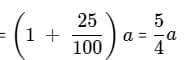
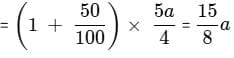
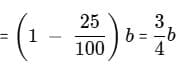
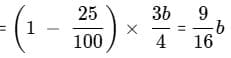
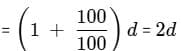
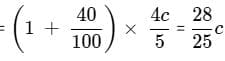
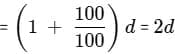
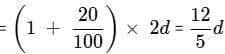
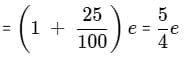
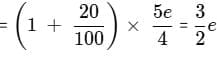
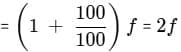
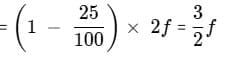

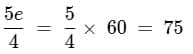
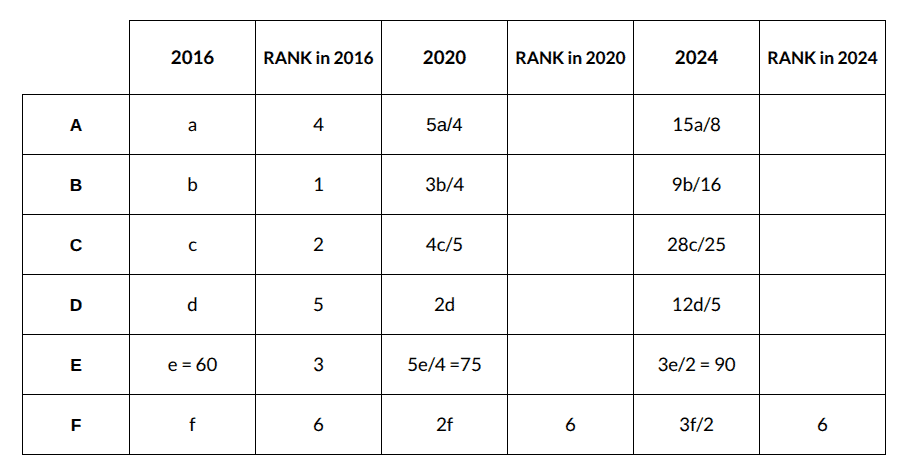
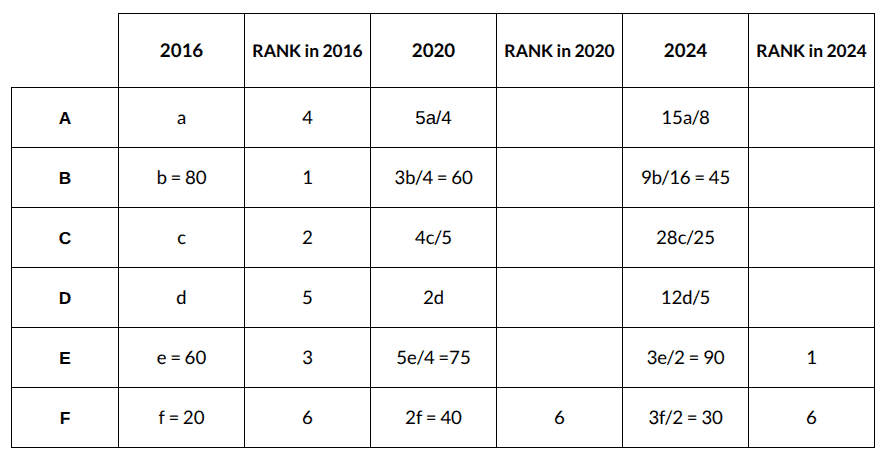
Q64 to Q68:
The two most populous cities and the non-urban region (NUR) of each of three states, Whimshire, Fogglia, and Humbleset, are assigned Pollution Measures (PMs). These nine PMs are all distinct multiples of 10, ranging from 10 to 90. The six cities in increasing order of their PMs are: Blusterburg, Noodleton, Splutterville, Quackford, Mumpypore, Zingaloo.
The Pollution Index (PI) of a state is a weighted average of the PMs of its NUR and cities, with a weight of 50% for the NUR, and 25% each for its two cities.
There is only one pair of an NUR and a city (considering all cities and all NURs) where the PM of the NUR is greater than that of the city. That NUR and the city both belong to Humbleset.
The PIs of all three states are distinct integers, with Humbleset and Fogglia having the highest and the lowest PI respectively.
Q64: What is the PI of Whimshire?
Ans: 45
Sol: We are given that the PMs of the six cities, Blusterburg, Noodleton, Splutterville, Quackford, Mumpypore, and Zingaloo, are in increasing order.
We are also told there exists a single pair of NUR and city such that the PM of NUR is greater than the city and the NUR, city of the pair belongs to Humbleset. So, we can conclude that PMs of NURs of Whimshire and Fogglia are 10 and 20 in some order.
We also know that out of all the cities, Blusterburg has the lowest PM. So, the PM of Blusterberg has to be 30, and the PM of NUR of Humbleset has to be 40 for the above condition to be satisfied, and we can also conclude that Blusterberg is a city of Humbleset.
We can also conclude that the PMs of Noodleton, Splutterville, Quackford, Mumpypore, and Zingaloo are 50, 60, 70, 80, and 90, respectively.
We are given that in the PI calculation, cities have a contribution of 25% and NUR has a contribution of 50%. So, we can calculate the contribution of each city in the calculation of PI by dividing their PI value by 4, and the contribution of NUR can be calculated by dividing the PM value by 2.
We are given that all the PI values are unique integers, and Humbleset has the highest PI value, while Fogglia has the lowest.
For the PI value to be an integer, the cities with decimal contributions must be paired with another city with decimal contributions. Since all the decimals are 0.5, when two cities with 0.5 are added, the sum becomes 1, making the PI an integer.
The cities Splutterville and Mumpypoe must be from the same state; both have integral contributions towards the PI, and if they are added to a decimal, then the result will be a decimal, which should not be the case. These two cities have to belong to either the state of Whimshire or Fogglia, but their combined contribution towards PI is 15 + 20 = 35.
We already know that for the state of Humbleset, the PI is highest, and the two contributions towards the PI are 7.5 and 20, totalling 27.5.
There are three possibilities for the other city of Humbleset, which are Noodleton, Quackford and Zingaloo.
CASE 1: Noodleton
If the other city of Humbleset is Noodleton, then its PI would be 27.5 + 12.5 = 40.
We already obtained the sum of the PIs of one of the other 2 states to be 35 without including the PI of NUR. We know that the NUR contribution for that city would be either 5 or 10. If it is 5, then the PI of that state would be 40, and if it is 10, then the PI of that state would be 45.
However, we are told that the PI values are unique, and Humblest has the highest PI value; in either case, this condition is not satisfied.
So, we can eliminate the case of Noodleton being the second city of Humbleset.
CASE 2: Quackford
If the other city of Humbleset is Quackford, then its PI would be 27.5 + 17.5 = 45.
We already obtained the sum of the PIs of one of the other 2 states to be 35 without including the PI of NUR. We know that the NUR contribution for that city would be either 5 or 10. If it is 5, then the PI of that state would be 40, and if it is 10, then the PI of that state would be 45.
However, we are told that the PI values are unique, and Humblest has the highest PI value. So, we can eliminate the case of PI of NUR being 10 for the other state.
So, for Humbleset, the PI is 7.5 + 17.5 + 20 = 45.
For one of the other 2 states, the PI is 15 + 20 + 5 = 40
The PI of the other state can be calculated by adding all the leftover PIs, which is 12.5 + 22.5 + 10 = 45.
We can see that PI of Humbleton and one of the other two states is 45, which violates one of the conditions given.
So, we can eliminate the case of Quackford being the second city of Humbleset.
CASE 3: Zingaloo
If the other city of Humbleset is Zingaloo, then its PI would be 27.5 + 22.5 = 50.
We already obtained the sum of the PIs of one of the other 2 states to be 35 without including the PI of NUR. We know that the NUR contribution for that city would be either 5 or 10. If it is 5, then the PI of that state would be 40, and if it is 10, then the PI of that state would be 45.
If the PI of the other state is 40,
Then, for Humbleset, the PI is 7.5 + 22.5 + 20 = 50.
For one of the other 2 states, the PI is 15 + 20 + 5 = 40
The PI of the other state can be calculated by adding all the leftover PIs, which is 12.5 + 17.5 + 10 = 40.
We can see that PI of the other two states is 40, which violates one of the conditions given.
If the PI of the other state is 45,
Then, for Humbleset, the PI is 7.5 + 22.5 + 20 = 50.
For one of the other 2 states, the PI is 15 + 20 + 10 = 45
The PI of the other state can be calculated by adding all the leftover PIs, which is 12.5 + 17.5 + 5 = 35.
We can see that all the conditions are satisfied in this case, and we can conclude that Zingaloo is the second city of Humbleset, and also we know that PI is the least for Fogglia. So, the PI of Fogglia is 35, and the PI of Whimshire is 45.
We can now assign the cities and the NURs the states and the PM values uniquely based on our calculations. After assigning the table looks like,
We calculated the PI of Whimshire to be 45.
Hence, the correct answer is 45.
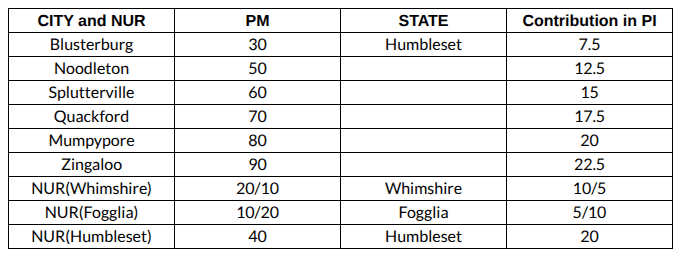
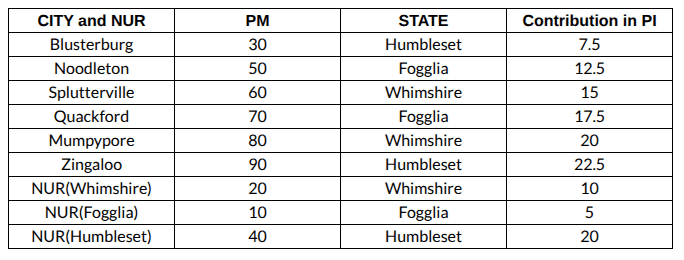
Q65: What is the PI of Fogglia?
Ans: 35
Sol: We are given that the PMs of the six cities, Blusterburg, Noodleton, Splutterville, Quackford, Mumpypore, and Zingaloo, are in increasing order.
We are also told there exists a single pair of NUR and city such that the PM of NUR is greater than the city and the NUR, city of the pair belongs to Humbleset. So, we can conclude that PMs of NURs of Whimshire and Fogglia are 10 and 20 in some order.
We also know that out of all the cities, Blusterburg has the lowest PM. So, the PM of Blusterberg has to be 30, and the PM of NUR of Humbleset has to be 40 for the above condition to be satisfied, and we can also conclude that Blusterberg is a city of Humbleset.
We can also conclude that the PMs of Noodleton, Splutterville, Quackford, Mumpypore, and Zingaloo are 50, 60, 70, 80, and 90, respectively.
We are given that in the PI calculation, cities have a contribution of 25% and NUR has a contribution of 50%. So, we can calculate the contribution of each city in the calculation of PI by dividing their PI value by 4, and the contribution of NUR can be calculated by dividing the PM value by 2.
We are given that all the PI values are unique integers, and Humbleset has the highest PI value, while Fogglia has the lowest.
For the PI value to be an integer, the cities with decimal contributions must be paired with another city with decimal contributions. Since all the decimals are 0.5, when two cities with 0.5 are added, the sum becomes 1, making the PI an integer.
The cities Splutterville and Mumpypoe must be from the same state; both have integral contributions towards the PI, and if they are added to a decimal, then the result will be a decimal, which should not be the case. These two cities have to belong to either the state of Whimshire or Fogglia, but their combined contribution towards PI is 15 + 20 = 35.
We already know that for the state of Humbleset, the PI is highest, and the two contributions towards the PI are 7.5 and 20, totalling 27.5.
There are three possibilities for the other city of Humbleset, which are Noodleton, Quackford and Zingaloo.
CASE 1: Noodleton
If the other city of Humbleset is Noodleton, then its PI would be 27.5 + 12.5 = 40.
We already obtained the sum of the PIs of one of the other 2 states to be 35 without including the PI of NUR. We know that the NUR contribution for that city would be either 5 or 10. If it is 5, then the PI of that state would be 40, and if it is 10, then the PI of that state would be 45.
However, we are told that the PI values are unique, and Humblest has the highest PI value; in either case, this condition is not satisfied.
So, we can eliminate the case of Noodleton being the second city of Humbleset.
CASE 2: Quackford
If the other city of Humbleset is Quackford, then its PI would be 27.5 + 17.5 = 45.
We already obtained the sum of the PIs of one of the other 2 states to be 35 without including the PI of NUR. We know that the NUR contribution for that city would be either 5 or 10. If it is 5, then the PI of that state would be 40, and if it is 10, then the PI of that state would be 45.
However, we are told that the PI values are unique, and Humblest has the highest PI value. So, we can eliminate the case of PI of NUR being 10 for the other state.
So, for Humbleset, the PI is 7.5 + 17.5 + 20 = 45.
For one of the other 2 states, the PI is 15 + 20 + 5 = 40
The PI of the other state can be calculated by adding all the leftover PIs, which is 12.5 + 22.5 + 10 = 45.
We can see that PI of Humbleton and one of the other two states is 45, which violates one of the conditions given.
So, we can eliminate the case of Quackford being the second city of Humbleset.
CASE 3: Zingaloo
If the other city of Humbleset is Zingaloo, then its PI would be 27.5 + 22.5 = 50.
We already obtained the sum of the PIs of one of the other 2 states to be 35 without including the PI of NUR. We know that the NUR contribution for that city would be either 5 or 10. If it is 5, then the PI of that state would be 40, and if it is 10, then the PI of that state would be 45.
If the PI of the other state is 40,
Then, for Humbleset, the PI is 7.5 + 22.5 + 20 = 50.
For one of the other 2 states, the PI is 15 + 20 + 5 = 40
The PI of the other state can be calculated by adding all the leftover PIs, which is 12.5 + 17.5 + 10 = 40.
We can see that PI of the other two states is 40, which violates one of the conditions given.
If the PI of the other state is 45,
Then, for Humbleset, the PI is 7.5 + 22.5 + 20 = 50.
For one of the other 2 states, the PI is 15 + 20 + 10 = 45
The PI of the other state can be calculated by adding all the leftover PIs, which is 12.5 + 17.5 + 5 = 35.
We can see that all the conditions are satisfied in this case, and we can conclude that Zingaloo is the second city of Humbleset, and also we know that PI is the least for Fogglia. So, the PI of Fogglia is 35, and the PI of Whimshire is 45.
We can now assign the cities and the NURs the states and the PM values uniquely based on our calculations. After assigning the table looks like,
We calculated the PI of Fogglia to be 35.
Hence, the correct answer is 35.
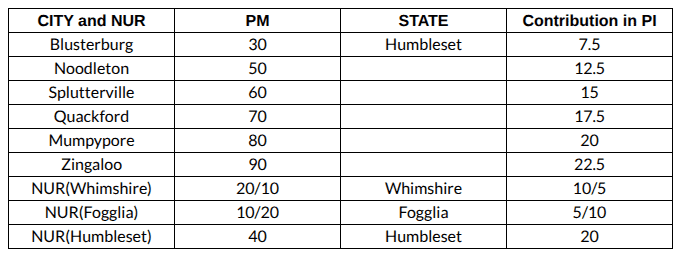
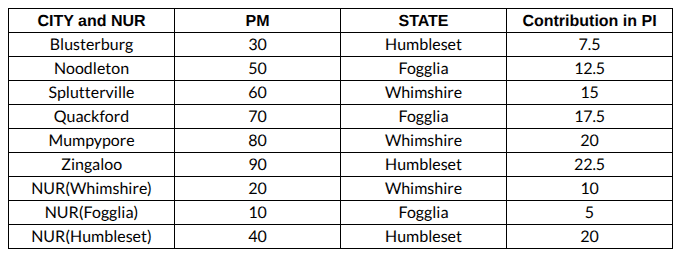
Q66: What is the PI of Humbleset?
Ans: 50
Sol: We are given that the PMs of the six cities, Blusterburg, Noodleton, Splutterville, Quackford, Mumpypore, and Zingaloo, are in increasing order.
We are also told there exists a single pair of NUR and city such that the PM of NUR is greater than the city and the NUR, city of the pair belongs to Humbleset. So, we can conclude that PMs of NURs of Whimshire and Fogglia are 10 and 20 in some order.
We also know that out of all the cities, Blusterburg has the lowest PM. So, the PM of Blusterberg has to be 30, and the PM of NUR of Humbleset has to be 40 for the above condition to be satisfied, and we can also conclude that Blusterberg is a city of Humbleset.
We can also conclude that the PMs of Noodleton, Splutterville, Quackford, Mumpypore, and Zingaloo are 50, 60, 70, 80, and 90, respectively.
We are given that in the PI calculation, cities have a contribution of 25% and NUR has a contribution of 50%. So, we can calculate the contribution of each city in the calculation of PI by dividing their PI value by 4, and the contribution of NUR can be calculated by dividing the PM value by 2.
We are given that all the PI values are unique integers, and Humbleset has the highest PI value, while Fogglia has the lowest.
For the PI value to be an integer, the cities with decimal contributions must be paired with another city with decimal contributions. Since all the decimals are 0.5, when two cities with 0.5 are added, the sum becomes 1, making the PI an integer.
The cities Splutterville and Mumpypoe must be from the same state; both have integral contributions towards the PI, and if they are added to a decimal, then the result will be a decimal, which should not be the case. These two cities have to belong to either the state of Whimshire or Fogglia, but their combined contribution towards PI is 15 + 20 = 35.
We already know that for the state of Humbleset, the PI is highest, and the two contributions towards the PI are 7.5 and 20, totalling 27.5.
There are three possibilities for the other city of Humbleset, which are Noodleton, Quackford and Zingaloo.
CASE 1: Noodleton
If the other city of Humbleset is Noodleton, then its PI would be 27.5 + 12.5 = 40.
We already obtained the sum of the PIs of one of the other 2 states to be 35 without including the PI of NUR. We know that the NUR contribution for that city would be either 5 or 10. If it is 5, then the PI of that state would be 40, and if it is 10, then the PI of that state would be 45.
However, we are told that the PI values are unique, and Humblest has the highest PI value; in either case, this condition is not satisfied.
So, we can eliminate the case of Noodleton being the second city of Humbleset.
CASE 2: Quackford
If the other city of Humbleset is Quackford, then its PI would be 27.5 + 17.5 = 45.
We already obtained the sum of the PIs of one of the other 2 states to be 35 without including the PI of NUR. We know that the NUR contribution for that city would be either 5 or 10. If it is 5, then the PI of that state would be 40, and if it is 10, then the PI of that state would be 45.
However, we are told that the PI values are unique, and Humblest has the highest PI value. So, we can eliminate the case of PI of NUR being 10 for the other state.
So, for Humbleset, the PI is 7.5 + 17.5 + 20 = 45.
For one of the other 2 states, the PI is 15 + 20 + 5 = 40
The PI of the other state can be calculated by adding all the leftover PIs, which is 12.5 + 22.5 + 10 = 45.
We can see that PI of Humbleton and one of the other two states is 45, which violates one of the conditions given.
So, we can eliminate the case of Quackford being the second city of Humbleset.
CASE 3: Zingaloo
If the other city of Humbleset is Zingaloo, then its PI would be 27.5 + 22.5 = 50.
We already obtained the sum of the PIs of one of the other 2 states to be 35 without including the PI of NUR. We know that the NUR contribution for that city would be either 5 or 10. If it is 5, then the PI of that state would be 40, and if it is 10, then the PI of that state would be 45.
If the PI of the other state is 40,
Then, for Humbleset, the PI is 7.5 + 22.5 + 20 = 50.
For one of the other 2 states, the PI is 15 + 20 + 5 = 40
The PI of the other state can be calculated by adding all the leftover PIs, which is 12.5 + 17.5 + 10 = 40.
We can see that PI of the other two states is 40, which violates one of the conditions given.
If the PI of the other state is 45,
Then, for Humbleset, the PI is 7.5 + 22.5 + 20 = 50.
For one of the other 2 states, the PI is 15 + 20 + 10 = 45
The PI of the other state can be calculated by adding all the leftover PIs, which is 12.5 + 17.5 + 5 = 35.
We can see that all the conditions are satisfied in this case, and we can conclude that Zingaloo is the second city of Humbleset, and also we know that PI is the least for Fogglia. So, the PI of Fogglia is 35, and the PI of Whimshire is 45.
We can now assign the cities and the NURs, the states, and the PM values uniquely based on our calculations. After assigning the table looks like,
We calculated the PI of Humbleset to be 50.
Hence, the correct answer is 50.
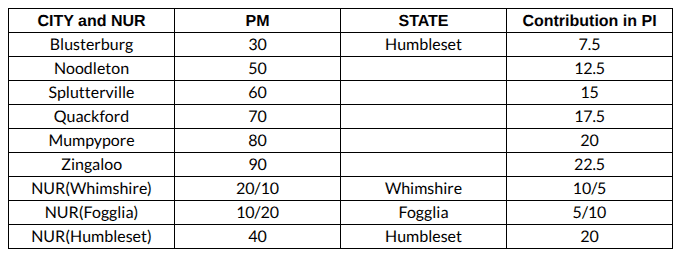
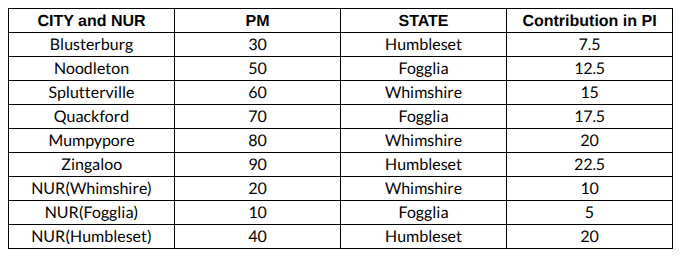
Q67: Which pair of cities definitely belong to the same state?
(a) Mumpypore, Zingaloo
(b) Splutterville, Quackford
(c) Blusterburg, Mumpypore
(d) Noodleton, Quackford
Ans: c
Sol: We are given that the PMs of the six cities, Blusterburg, Noodleton, Splutterville, Quackford, Mumpypore, and Zingaloo, are in increasing order.
We are also told there exists a single pair of NUR and city such that the PM of NUR is greater than the city and the NUR, city of the pair belongs to Humbleset. So, we can conclude that PMs of NURs of Whimshire and Fogglia are 10 and 20 in some order.
We also know that out of all the cities, Blusterburg has the lowest PM. So, the PM of Blusterberg has to be 30, and the PM of NUR of Humbleset has to be 40 for the above condition to be satisfied, and we can also conclude that Blusterberg is a city of Humbleset.
We can also conclude that the PMs of Noodleton, Splutterville, Quackford, Mumpypore, and Zingaloo are 50, 60, 70, 80, and 90, respectively.
We are given that in the PI calculation, cities have a contribution of 25% and NUR has a contribution of 50%. So, we can calculate the contribution of each city in the calculation of PI by dividing their PI value by 4, and the contribution of NUR can be calculated by dividing the PM value by 2.
We are given that all the PI values are unique integers, and Humbleset has the highest PI value, while Fogglia has the lowest.
For the PI value to be an integer, the cities with decimal contributions must be paired with another city with decimal contributions. Since all the decimals are 0.5, when two cities with 0.5 are added, the sum becomes 1, making the PI an integer.
The cities Splutterville and Mumpypoe must be from the same state; both have integral contributions towards the PI, and if they are added to a decimal, then the result will be a decimal, which should not be the case. These two cities have to belong to either the state of Whimshire or Fogglia, but their combined contribution towards PI is 15 + 20 = 35.
We already know that for the state of Humbleset, the PI is highest, and the two contributions towards the PI are 7.5 and 20, totalling 27.5.
There are three possibilities for the other city of Humbleset, which are Noodleton, Quackford and Zingaloo.
CASE 1: Noodleton
If the other city of Humbleset is Noodleton, then its PI would be 27.5 + 12.5 = 40.
We already obtained the sum of the PIs of one of the other 2 states to be 35 without including the PI of NUR. We know that the NUR contribution for that city would be either 5 or 10. If it is 5, then the PI of that state would be 40, and if it is 10, then the PI of that state would be 45.
However, we are told that the PI values are unique, and Humblest has the highest PI value; in either case, this condition is not satisfied.
So, we can eliminate the case of Noodleton being the second city of Humbleset.
CASE 2: Quackford
If the other city of Humbleset is Quackford, then its PI would be 27.5 + 17.5 = 45.
We already obtained the sum of the PIs of one of the other 2 states to be 35 without including the PI of NUR. We know that the NUR contribution for that city would be either 5 or 10. If it is 5, then the PI of that state would be 40, and if it is 10, then the PI of that state would be 45.
However, we are told that the PI values are unique, and Humblest has the highest PI value. So, we can eliminate the case of PI of NUR being 10 for the other state.
So, for Humbleset, the PI is 7.5 + 17.5 + 20 = 45.
For one of the other 2 states, the PI is 15 + 20 + 5 = 40
The PI of the other state can be calculated by adding all the leftover PIs, which is 12.5 + 22.5 + 10 = 45.
We can see that PI of Humbleton and one of the other two states is 45, which violates one of the conditions given.
So, we can eliminate the case of Quackford being the second city of Humbleset.
CASE 3: Zingaloo
If the other city of Humbleset is Zingaloo, then its PI would be 27.5 + 22.5 = 50.
We already obtained the sum of the PIs of one of the other 2 states to be 35 without including the PI of NUR. We know that the NUR contribution for that city would be either 5 or 10. If it is 5, then the PI of that state would be 40, and if it is 10, then the PI of that state would be 45.
If the PI of the other state is 40,
Then, for Humbleset, the PI is 7.5 + 22.5 + 20 = 50.
For one of the other 2 states, the PI is 15 + 20 + 5 = 40
The PI of the other state can be calculated by adding all the leftover PIs, which is 12.5 + 17.5 + 10 = 40.
We can see that PI of the other two states is 40, which violates one of the conditions given.
If the PI of the other state is 45,
Then, for Humbleset, the PI is 7.5 + 22.5 + 20 = 50.
For one of the other 2 states, the PI is 15 + 20 + 10 = 45
The PI of the other state can be calculated by adding all the leftover PIs, which is 12.5 + 17.5 + 5 = 35.
We can see that all the conditions are satisfied in this case, and we can conclude that Zingaloo is the second city of Humbleset, and also we know that PI is the least for Fogglia. So, the PI of Fogglia is 35, and the PI of Whimshire is 45.
We can now assign the cities and the NURs, the states, and the PM values uniquely based on our calculations. After assigning the table looks like,
We can see that Noodleton and Quackford belong to the same state among the options.
Hence, the correct answer is option C.
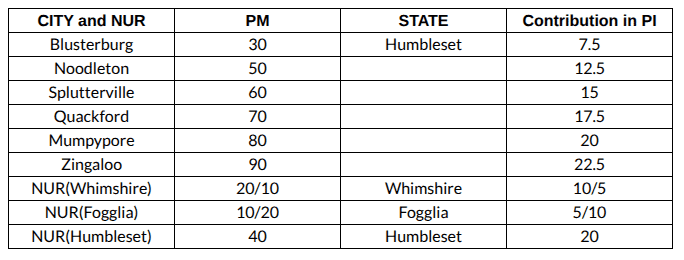
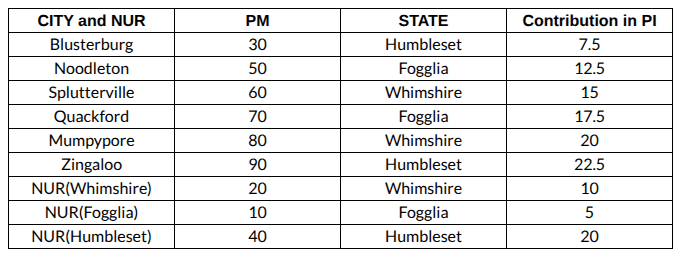
Q68: For how many of the cities and NURs is it possible to identify their PM and the state they belong to?
Ans: 9
Sol: We are given that the PMs of the six cities, Blusterburg, Noodleton, Splutterville, Quackford, Mumpypore, and Zingaloo, are in increasing order.
We are also told there exists a single pair of NUR and city such that the PM of NUR is greater than the city and the NUR, city of the pair belongs to Humbleset. So, we can conclude that PMs of NURs of Whimshire and Fogglia are 10 and 20 in some order.
We also know that out of all the cities, Blusterburg has the lowest PM. So, the PM of Blusterberg has to be 30, and the PM of NUR of Humbleset has to be 40 for the above condition to be satisfied, and we can also conclude that Blusterberg is a city of Humbleset.
We can also conclude that the PMs of Noodleton, Splutterville, Quackford, Mumpypore, and Zingaloo are 50, 60, 70, 80, and 90, respectively.
We are given that in the PI calculation, cities have a contribution of 25% and NUR has a contribution of 50%. So, we can calculate the contribution of each city in the calculation of PI by dividing their PI value by 4, and the contribution of NUR can be calculated by dividing the PM value by 2.
We are given that all the PI values are unique integers, and Humbleset has the highest PI value, while Fogglia has the lowest.
For the PI value to be an integer, the cities with decimal contributions must be paired with another city with decimal contributions. Since all the decimals are 0.5, when two cities with 0.5 are added, the sum becomes 1, making the PI an integer.
The cities Splutterville and Mumpypoe must be from the same state; both have integral contributions towards the PI, and if they are added to a decimal, then the result will be a decimal, which should not be the case. These two cities have to belong to either the state of Whimshire or Fogglia, but their combined contribution towards PI is 15 + 20 = 35.
We already know that for the state of Humbleset, the PI is highest, and the two contributions towards the PI are 7.5 and 20, totalling 27.5.
There are three possibilities for the other city of Humbleset, which are Noodleton, Quackford and Zingaloo.
CASE 1: Noodleton
If the other city of Humbleset is Noodleton, then its PI would be 27.5 + 12.5 = 40.
We already obtained the sum of the PIs of one of the other 2 states to be 35 without including the PI of NUR. We know that the NUR contribution for that city would be either 5 or 10. If it is 5, then the PI of that state would be 40, and if it is 10, then the PI of that state would be 45.
However, we are told that the PI values are unique, and Humblest has the highest PI value; in either case, this condition is not satisfied.
So, we can eliminate the case of Noodleton being the second city of Humbleset.
CASE 2: Quackford
If the other city of Humbleset is Quackford, then its PI would be 27.5 + 17.5 = 45.
We already obtained the sum of the PIs of one of the other 2 states to be 35 without including the PI of NUR. We know that the NUR contribution for that city would be either 5 or 10. If it is 5, then the PI of that state would be 40, and if it is 10, then the PI of that state would be 45.
However, we are told that the PI values are unique, and Humblest has the highest PI value. So, we can eliminate the case of PI of NUR being 10 for the other state.
So, for Humbleset, the PI is 7.5 + 17.5 + 20 = 45.
For one of the other 2 states, the PI is 15 + 20 + 5 = 40
The PI of the other state can be calculated by adding all the leftover PIs, which is 12.5 + 22.5 + 10 = 45.
We can see that PI of Humbleton and one of the other two states is 45, which violates one of the conditions given.
So, we can eliminate the case of Quackford being the second city of Humbleset.
CASE 3: Zingaloo
If the other city of Humbleset is Zingaloo, then its PI would be 27.5 + 22.5 = 50.
We already obtained the sum of the PIs of one of the other 2 states to be 35 without including the PI of NUR. We know that the NUR contribution for that city would be either 5 or 10. If it is 5, then the PI of that state would be 40, and if it is 10, then the PI of that state would be 45.
If the PI of the other state is 40,
Then, for Humbleset, the PI is 7.5 + 22.5 + 20 = 50.
For one of the other 2 states, the PI is 15 + 20 + 5 = 40
The PI of the other state can be calculated by adding all the leftover PIs, which is 12.5 + 17.5 + 10 = 40.
We can see that PI of the other two states is 40, which violates one of the conditions given.
If the PI of the other state is 45,
Then, for Humbleset, the PI is 7.5 + 22.5 + 20 = 50.
For one of the other 2 states, the PI is 15 + 20 + 10 = 45
The PI of the other state can be calculated by adding all the leftover PIs, which is 12.5 + 17.5 + 5 = 35.
We can see that all the conditions are satisfied in this case, and we can conclude that Zingaloo is the second city of Humbleset, and also we know that PI is the least for Fogglia. So, the PI of Fogglia is 35, and the PI of Whimshire is 45.
We can now assign the cities and the NURs, the states, and the PM values uniquely based on our calculations. After assigning the table looks like,
We can see that for all 6 cities and 3 NURs, the PMs and the city to which they belong can be identified uniquely. So, in total, we can identify the values uniquely for all 9 of them.
Hence, the correct answer is 9.
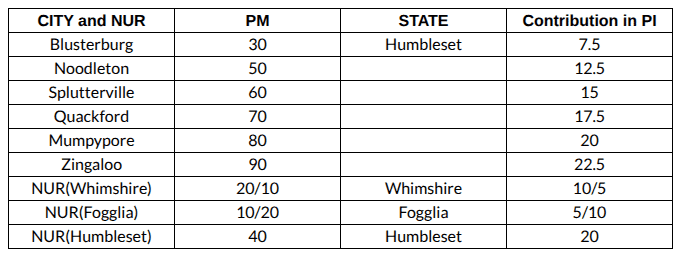
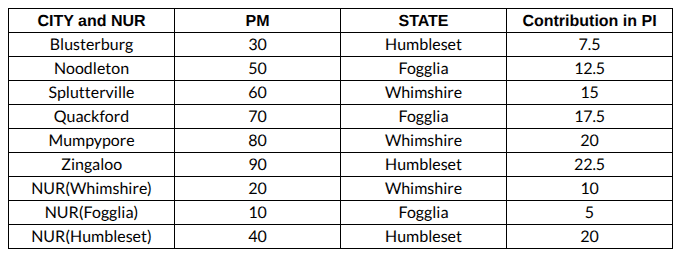
FAQs on CAT 2025 Slot 2: Past Year Question Paper
| 1. What is the structure of the CAT exam? |  |
| 2. How is the CAT exam scored? | |
| 3. What types of questions can be expected in the Quantitative Ability section? | |
| 4. How important is time management during the CAT exam? | |
| 5. What strategies can be used to prepare for the CAT exam? | |