UPSC Exam > UPSC Notes > History CSE > Infographics: The Mughal Empire
Infographics: The Mughal Empire

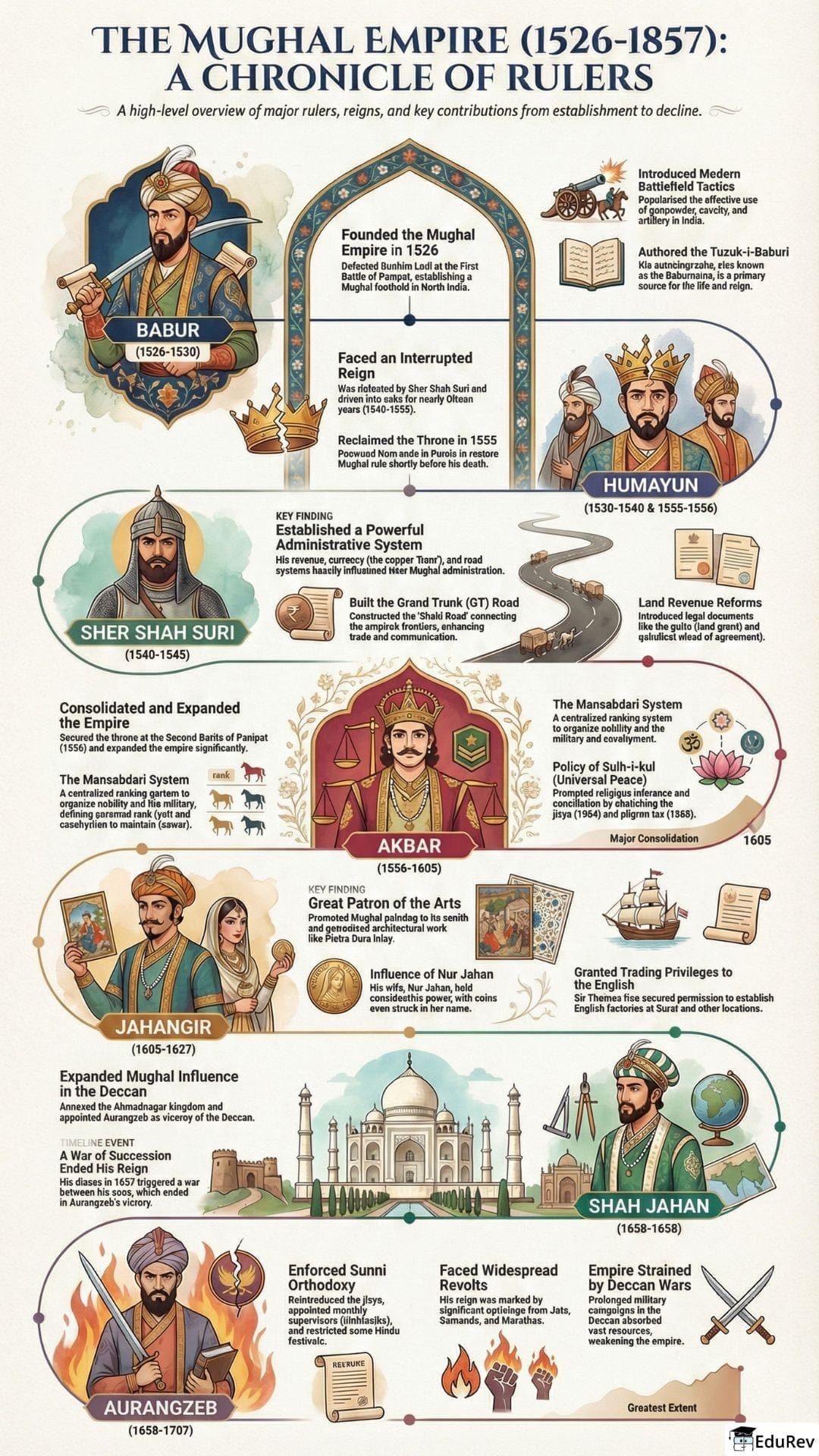
The document Infographics: The Mughal Empire is a part of the UPSC Course History for UPSC CSE.
All you need of UPSC at this link: UPSC
FAQs on Infographics: The Mughal Empire
| 1. What were the main contributions of the Mughal Empire to Indian architecture? |  |
Ans. The Mughal Empire is renowned for its distinctive architectural style that blended Persian, Indian, and Islamic elements. Key contributions include the construction of grand structures such as the Taj Mahal, a UNESCO World Heritage Site, known for its intricate marble inlay and symmetrical gardens. Other significant monuments include the Red Fort in Delhi and Humayun's Tomb, which showcased innovative use of space and water, and the development of the Mughal garden style, which emphasised formal layouts and the use of water features.
| 2. How did the Mughal Empire influence the culture of India? | |
Ans. The Mughal Empire significantly influenced Indian culture through the promotion of art, literature, and cuisine. The Mughals patronised various forms of art, leading to the development of miniature painting and the synthesis of different artistic styles. The period also saw the flourishing of literature in Persian and Hindi, with notable poets and writers emerging. Additionally, Mughal cuisine introduced a blend of Persian and Indian flavours, laying the foundation for many dishes still enjoyed in contemporary Indian cooking.
| 3. What was the administrative structure of the Mughal Empire? | |
Ans. The administrative structure of the Mughal Empire was highly centralised yet allowed local autonomy. The emperor was the supreme authority, supported by a hierarchy of officials known as mansabdars, who were responsible for military and civil administration. The empire was divided into provinces called subahs, each governed by a subahdar. Revenue collection was managed through a system known as zamindari, where local landlords were responsible for collecting taxes from peasants, further integrating local governance with imperial oversight.
| 4. What role did religion play in the Mughal Empire? | |
Ans. Religion played a crucial role in the Mughal Empire, influencing both governance and cultural practices. The empire was predominantly Islamic, yet it was marked by a policy of religious tolerance, especially under rulers like Akbar, who promoted the concept of Sulh-i-Kul, or universal peace. Akbar sought to integrate diverse religious communities by engaging in dialogues with Hindu, Jain, and Christian leaders, leading to the establishment of a syncretic faith known as Din-i Ilahi. This approach fostered a relatively harmonious coexistence among various religious groups within the empire.
| 5. What led to the decline of the Mughal Empire? | |
Ans. The decline of the Mughal Empire can be attributed to several interrelated factors, including internal strife, administrative inefficiency, and external invasions. After the reign of Aurangzeb, the empire faced increasing challenges from regional powers and revolts, weakening central authority. The economic strain from continuous military campaigns and the lack of effective leadership further exacerbated the situation. Additionally, invasions by foreign powers, such as the Persians and later the British, contributed to the disintegration of Mughal authority, ultimately leading to the empire's downfall.
About this Document

4.68/5 Rating

Apr 30, 2026 Last updated
Related Exams
Document Description: Infographics: The Mughal Empire for UPSC 2026 is part of History for UPSC CSE preparation. The notes and questions for Infographics: The Mughal Empire have been prepared according to the UPSC exam syllabus. Information about Infographics: The Mughal Empire covers topics like and Infographics: The Mughal Empire Example, for UPSC 2026 Exam. Find important definitions, questions, notes, meanings, examples, exercises and tests below for Infographics: The Mughal Empire.
Introduction of Infographics: The Mughal Empire in English is available as part of our History for UPSC CSE for UPSC & Infographics: The Mughal Empire in Hindi for History for UPSC CSE course. Download more important topics related with notes, lectures and mock test series for UPSC Exam by signing up for free. UPSC: Infographics: The Mughal Empire
Description
Infographics: The Mughal Empire of History provides you one-page visual summary of the chapter covering all the important topics. Download the PDF from EduRev.
Information about Infographics: The Mughal Empire
In this doc you can find the meaning of Infographics: The Mughal Empire defined & explained in the simplest way possible. Besides explaining types of Infographics: The Mughal Empire theory, EduRev gives you an ample number of questions to practice Infographics: The Mughal Empire tests, examples and also practice UPSC tests



Related Searches
Exam, practice quizzes, Infographics: The Mughal Empire, MCQs, Extra Questions, Summary, Sample Paper, Free, video lectures, Important questions, shortcuts and tricks, Objective type Questions, study material, pdf , mock tests for examination, Infographics: The Mughal Empire, Previous Year Questions with Solutions, past year papers, Viva Questions, Infographics: The Mughal Empire, Semester Notes, ppt;