Tests: proportionality, time-reversal, factor-reversal, circular


Index numbers are statistical measures used to compare values across different time periods or locations. To ensure these comparisons are meaningful and reliable, index numbers must satisfy certain tests. These tests verify the consistency and logical correctness of index number formulas. Understanding these four fundamental tests-Proportionality Test, Time-Reversal Test, Factor-Reversal Test, and Circular Test-is crucial for evaluating the adequacy of various index number methods.
1. Proportionality Test (Unit Test)
The Proportionality Test checks whether an index number changes proportionally when all prices (or quantities) change uniformly. If all individual values change by a constant factor, the index should also change by that same factor.
1.1 Statement of the Test
If all prices (or quantities) in the current period are k times the prices (or quantities) in the base period, then the index number should be k × 100.
- Mathematical Expression: If p1 = k × p0 for all commodities, then P01 = k × 100
- Purpose: Ensures the index reflects proportional changes accurately without bias
- Alternative Name: Also called the Unit Test because the result should be independent of units of measurement
1.2 Index Numbers Satisfying Proportionality Test
- Simple Aggregative Index: P01 = (Σp1 / Σp0) × 100 - Satisfies the test
- Simple Average of Price Relatives: Does NOT satisfy - arithmetic mean of ratios doesn't preserve proportionality
- Weighted Aggregative Indices: Laspeyres, Paasche, and Fisher's Ideal Index all satisfy this test
- Weighted Average of Relatives: May or may not satisfy depending on the weighting scheme
1.3 Common Student Mistakes
- Trap Alert: Students often assume all index formulas satisfy proportionality test - this is incorrect. The simple average of price relatives fails this test.
- Confusion Point: Proportionality applies to uniform changes only. If prices change by different rates, this test is not applicable.
2. Time-Reversal Test
The Time-Reversal Test examines the consistency of an index when the base and current periods are interchanged. A good index should give reciprocal values when time periods are reversed.
2.1 Statement of the Test
An index number satisfies the time-reversal test if the product of the forward index and the backward index equals unity (one).
- Mathematical Expression: P01 × P10 = 1
- Alternative Form: P10 = 1 / P01
- Interpretation: If price index from period 0 to 1 is 120, then index from period 1 to 0 should be (1/1.20) = 0.8333 or 83.33
- Purpose: Tests whether the formula treats both time periods symmetrically without bias toward either period
2.2 Index Numbers and Time-Reversal Test
Indices that Satisfy:
- Fisher's Ideal Index: The only commonly used index that satisfies this test perfectly
- Simple Aggregative Index: Satisfies the test
- Kelly's Index: A lesser-known index that satisfies this test
Indices that Fail:
- Laspeyres' Index: Does NOT satisfy - uses base period weights, creating asymmetry
- Paasche's Index: Does NOT satisfy - uses current period weights, creating asymmetry
- Marshall-Edgeworth Index: Does NOT satisfy despite using average weights
- Dorbish-Bowley Index: Does NOT satisfy - simple average of Laspeyres and Paasche
2.3 Proof for Laspeyres' Index Failure
Laspeyres' forward index: P01(L) = (Σp1q0 / Σp0q0) × 100
Laspeyres' backward index: P10(L) = (Σp0q1 / Σp1q1) × 100
Their product: P01(L) × P10(L) = [(Σp1q0 / Σp0q0) × (Σp0q1 / Σp1q1)] × 100 ≠ 1
- Reason for Failure: Different weights (q0 vs q1) in numerator and denominator prevent reciprocal relationship
2.4 Common Student Mistakes
- Trap Alert: Students memorize that "Fisher's Index satisfies time-reversal test" but forget that most other weighted indices (including popular Laspeyres and Paasche) fail this test.
- Confusion Point: Time-reversal test is different from base shifting - don't confuse the two concepts.
3. Factor-Reversal Test
The Factor-Reversal Test checks the relationship between price index and quantity index. Since value = price × quantity, this test verifies whether the product of price and quantity indices equals the true value ratio.
3.1 Statement of the Test
An index satisfies the factor-reversal test if the product of the price index and the corresponding quantity index equals the ratio of total values.
- Mathematical Expression: P01 × Q01 = (Σp1q1 / Σp0q0)
- In Percentage Form: (P01 × Q01) / 100 = V01
- Value Ratio: V01 = Σp1q1 / Σp0q0
- Economic Logic: Total expenditure change equals price change multiplied by quantity change
3.2 Conceptual Foundation
The test is based on the factor relationship in economics:
- Value: V = P × Q (price times quantity)
- Extension to Indices: If we interchange the roles of prices and quantities in the formula, the product should give the true value ratio
- Symmetry Requirement: The formula must treat prices and quantities symmetrically for this test to be satisfied
3.3 Index Numbers and Factor-Reversal Test
Fisher's Ideal Index: The only commonly used index that satisfies both factor-reversal and time-reversal tests simultaneously.
Proof for Fisher's Index:
- Fisher's Price Index: P01(F) = √[(Σp1q0 / Σp0q0) × (Σp1q1 / Σp0q1)]
- Fisher's Quantity Index: Q01(F) = √[(Σp0q1 / Σp0q0) × (Σp1q1 / Σp1q0)]
- Their product: P01(F) × Q01(F) = Σp1q1 / Σp0q0 - exactly equals value ratio
Indices that Fail:
- Laspeyres' Index: Does NOT satisfy - uses base period weights only
- Paasche's Index: Does NOT satisfy - uses current period weights only
- Simple Aggregative Index: Does NOT satisfy
- Marshall-Edgeworth Index: Does NOT satisfy
3.4 Practical Significance
- Value Decomposition: This test allows decomposition of value changes into price effect and quantity effect
- National Income Analysis: Used in separating nominal GDP growth into real GDP growth (quantity) and price inflation
- Business Applications: Helps firms understand whether revenue changes stem from price increases or volume increases
3.5 Common Student Mistakes
- Trap Alert: Students often think Marshall-Edgeworth satisfies factor-reversal test because it uses "average weights" - this is incorrect. Only Fisher's Ideal Index satisfies this test among weighted aggregative methods.
- Confusion Point: Don't confuse factor-reversal with time-reversal - factor-reversal involves interchanging p and q in formulas, time-reversal involves interchanging periods 0 and 1.
4. Circular Test (Transitivity Test)
The Circular Test examines whether an index maintains consistency when computed through an intermediate period. This test is crucial for chain index construction.
4.1 Statement of the Test
An index satisfies the circular test if the index from period 0 to period 2 (direct) equals the product of indices from period 0 to 1 and period 1 to 2 (indirect chain).
- Mathematical Expression: P02 = P01 × P12
- General Form for Multiple Periods: P0n = P01 × P12 × P23 × ... × P(n-1)n
- Alternative Name: Also called Chain Test or Transitivity Test
- Purpose: Ensures consistency in chain indices where base is shifted periodically
4.2 Conceptual Foundation
The circular test addresses a practical problem in index number construction:
- Long-term Comparisons: When comparing prices over many years, direct comparison may be impractical
- Chain Linking: Using intermediate periods as stepping stones should give the same result as direct comparison
- Base Shifting: When base year becomes outdated, shifting through intermediate years should be consistent
4.3 Index Numbers and Circular Test
Simple Indices that Satisfy:
- Simple Aggregative Index: Satisfies the circular test perfectly
- Simple Geometric Mean of Price Relatives: Satisfies the circular test
- Fixed Weight Indices: Any index with constant weights across all periods satisfies this test
Weighted Indices that Fail:
- Laspeyres' Index: Does NOT satisfy - weights change as base changes
- Paasche's Index: Does NOT satisfy - weights change with current period
- Fisher's Ideal Index: Does NOT satisfy - despite satisfying time and factor reversal tests
- Marshall-Edgeworth Index: Does NOT satisfy
4.4 Why Fisher's Index Fails Circular Test
Though Fisher's Index is "ideal" for time-reversal and factor-reversal tests, it fails the circular test:
- Reason: Fisher's Index uses both base and current period weights, which keep changing
- Implication: P01(F) uses weights from periods 0 and 1; P12(F) uses weights from periods 1 and 2
- Result: The product P01(F) × P12(F) has different weight structure than direct P02(F)
- Trade-off: No single index formula satisfies all tests simultaneously - this is a fundamental limitation
4.5 Proof for Simple Aggregative Index
Let P01 = (Σp1 / Σp0) × 100; P12 = (Σp2 / Σp1) × 100; P02 = (Σp2 / Σp0) × 100
Then: P01 × P12 = [(Σp1 / Σp0) × (Σp2 / Σp1)] × 100 = (Σp2 / Σp0) × 100 = P02
- Conclusion: Simple aggregative index satisfies circular test because no weights are involved
4.6 Practical Implications
- Chain Index Construction: When using chain indices, circular test failure means accumulated errors over time
- Base Year Revision: Statistical agencies face trade-offs when choosing index formulas for periodic base revisions
- Policy Decisions: Circular test failure in weighted indices is accepted because these indices better reflect economic reality
- Fixed vs. Current Weights: Fixed weight indices satisfy circular test but become outdated; current weight indices fail circular test but stay relevant
4.7 Common Student Mistakes
- Trap Alert: Many students wrongly assume Fisher's Ideal Index satisfies all tests because it's called "ideal" - it actually fails the circular test.
- Confusion Point: Circular test involves three time periods (0, 1, 2), not two like time-reversal test.
- Memory Aid: "Simple satisfies circular; weighted satisfies reversal" - simple indices satisfy circular test, weighted indices (Fisher's) satisfy reversal tests.
5. Comparative Summary of Tests
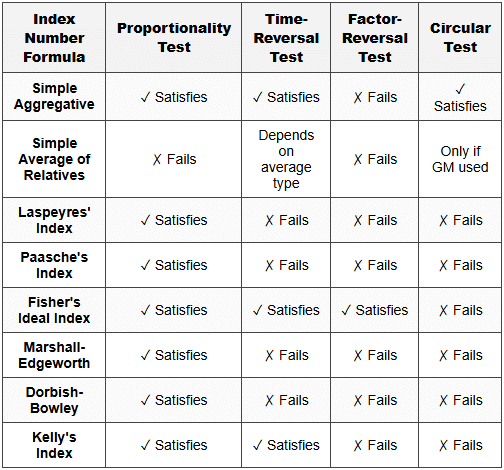
5.1 Comparison Table of Major Index Numbers
5.2 Key Observations from Comparison
- No Perfect Formula: No single index number formula satisfies all four tests simultaneously - this is a fundamental impossibility theorem
- Fisher's Strengths: Fisher's Ideal Index satisfies the two most economically important tests (time-reversal and factor-reversal)
- Simple vs. Weighted Trade-off: Simple indices satisfy more mathematical tests but lack economic relevance; weighted indices are more practical but fail circular test
- Practical Choice: Statistical agencies typically use Laspeyres (easier to compute) or Fisher's (more accurate) despite test failures
6. Interconnections Between Tests
6.1 Relationship Between Time-Reversal and Factor-Reversal
These two tests are conceptually linked through symmetry principles:
- Time-Reversal: Demands symmetry in treatment of time periods (base vs. current)
- Factor-Reversal: Demands symmetry in treatment of variables (price vs. quantity)
- Fisher's Achievement: Fisher's formula achieves both symmetries through geometric mean structure
- Irving Fisher's Contribution: He proved that these two tests together uniquely characterize the ideal index formula
6.2 Conflict Between Reversal Tests and Circular Test
There is an inherent mathematical conflict:
- Reversal Tests: Require weights to be symmetric (use both base and current weights)
- Circular Test: Requires weights to be fixed (constant across all comparisons)
- Impossibility Result: Cannot have both changing weights (for relevance) and fixed weights (for transitivity)
- Practical Resolution: Accept circular test failure for weighted indices; use chain indices with awareness of drift
6.3 Walsh's Modified Indices
Some special formulations attempt to satisfy multiple tests:
- Walsh's Price Index: Uses √(q0 × q1) as weights - satisfies time-reversal test
- Geometric Mean with Fixed Weights: Can satisfy circular test but loses current relevance
- Trade-off Recognition: Each modification gains one property but loses another
7. Practical Significance of Tests
7.1 Applications in Official Statistics
- Consumer Price Index (CPI): Uses Laspeyres formula despite test failures because of data availability and computational simplicity
- GDP Deflator: Conceptually a Paasche index; factor-reversal test failure accepted for practical reasons
- Producer Price Index: Fisher's Ideal sometimes preferred in practice despite circular test failure
- International Comparisons: Time-reversal test particularly important for bilateral price comparisons between countries
7.2 Choice of Index Formula in Practice
Selection criteria used by statistical agencies:
- Data Availability: Laspeyres requires only base period quantities; Paasche needs current quantities (harder to obtain)
- Computational Cost: Simple formulas preferred for frequent updates (monthly CPI)
- Economic Interpretation: Factor-reversal test valuable for decomposing value changes
- Revision Frequency: Circular test more important when base is frequently shifted
- Substitution Bias: Laspeyres has upward bias; Paasche has downward bias; Fisher's averages them
7.3 Chain Index Construction
When constructing chain indices (linking successive periods):
- Circular Test Relevance: Failure of this test leads to "chain drift" - cumulative error over many links
- Fixed-base vs. Chain-base: Fixed-base indices avoid chain drift but become outdated
- Splicing Techniques: Methods to link old and new series when base is revised
- Trade-off Decision: Accept chain drift to maintain relevance of weights, or accept outdated weights to maintain transitivity
8. Theoretical Foundations
8.1 Why Fisher's Index is Called "Ideal"
Irving Fisher designated his formula as "ideal" because:
- Satisfies Two Key Tests: Time-reversal and factor-reversal tests both satisfied
- Averages Two Biases: Geometric mean of Laspeyres (upward bias) and Paasche (downward bias)
- Symmetric Treatment: Treats both periods and both factors equally without preference
- Limitation: "Ideal" doesn't mean "perfect" - still fails circular test and is computationally intensive
8.2 Mathematical Proofs - Key Results
Time-Reversal Test for Fisher's Index:
P01(F) = √[(Σp1q0 / Σp0q0) × (Σp1q1 / Σp0q1)]
P10(F) = √[(Σp0q1 / Σp1q1) × (Σp0q0 / Σp1q0)]
Product: P01(F) × P10(F) = √[{(Σp1q0 × Σp1q1) / (Σp0q0 × Σp0q1)} × {(Σp0q0 × Σp0q1) / (Σp1q0 × Σp1q1)}] = 1
Factor-Reversal Test for Fisher's Index:
Price Index: P01(F) = √[P01(L) × P01(P)]
Quantity Index: Q01(F) = √[Q01(L) × Q01(P)]
After algebraic manipulation: P01(F) × Q01(F) = Σp1q1 / Σp0q0 (Value Ratio)
8.3 Axiomatic Approach to Index Numbers
Modern index number theory uses an axiomatic approach:
- Identity Test: If all prices are unchanged, index should equal 100
- Proportionality Test: As discussed above
- Monotonicity: If any price increases (others constant), index should increase
- Commensurability: Index should be independent of units of measurement
- Reversal Tests: Time and factor reversal as discussed
- Characterization Theorems: Certain axiom sets uniquely determine specific index formulas
9. Common Exam Questions and Application
9.1 Typical Question Formats
Format 1: Test Verification
- Show that Fisher's Ideal Index satisfies the factor-reversal test
- Prove that Laspeyres' Index fails time-reversal test
- Verify circular test for simple aggregative index with given data
Format 2: Comparison Questions
- Compare the performance of different index numbers with respect to all four tests
- Which test is more important for official price statistics and why?
- Explain why no single index satisfies all tests
Format 3: Numerical Problems
- Given price and quantity data for three periods, verify circular test for specified index
- Calculate forward and backward indices and check time-reversal test
- Compute price and quantity indices and verify factor-reversal test
9.2 Problem-Solving Strategy
For Time-Reversal Test:
- Calculate P01 using given data and formula
- Calculate P10 by interchanging subscripts 0 and 1 in the formula
- Compute product P01 × P10
- Check if product equals 1 (or 100 depending on index expression)
For Factor-Reversal Test:
- Calculate price index P01 using price formula
- Calculate quantity index Q01 by interchanging p and q in same formula
- Compute product P01 × Q01
- Separately calculate value ratio V01 = Σp1q1 / Σp0q0
- Check if product equals value ratio
For Circular Test:
- Calculate P01 (period 0 to 1) and P12 (period 1 to 2) separately
- Compute product P01 × P12
- Separately calculate direct index P02 (period 0 to 2)
- Check if product equals direct index
9.3 Important Points for Exam Answers
- Always State the Test Formally: Begin answers with mathematical expression of the test
- Show All Calculation Steps: Don't skip intermediate steps in numerical problems
- Interpret Results: After calculation, explicitly state whether test is satisfied or failed
- Give Economic Intuition: Explain why a test failure matters in practical contexts
- Mention Trade-offs: Discuss why practitioners use indices that fail certain tests
- Standard Formulas: Memorize exact expressions for Laspeyres, Paasche, and Fisher's indices
10. Summary Table of Test Characteristics
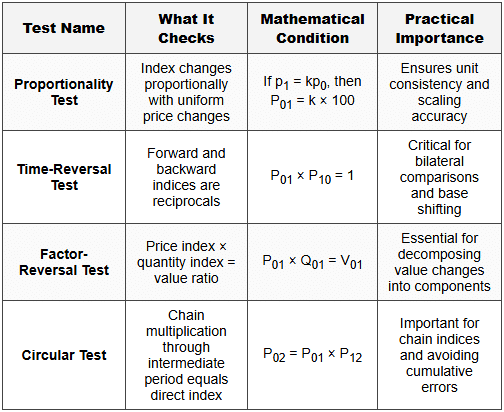
Understanding these four tests enables critical evaluation of different index number formulas. While Fisher's Ideal Index satisfies the economically important time-reversal and factor-reversal tests, the circular test failure highlights the fundamental trade-off in index number theory: no single formula can satisfy all desirable properties simultaneously. In practice, statistical agencies choose indices based on data availability, computational feasibility, and which test properties matter most for their specific application. The key exam skill is not just memorizing which index satisfies which test, but understanding why each test matters and what the consequences of test failure are in practical statistical work.




